← All women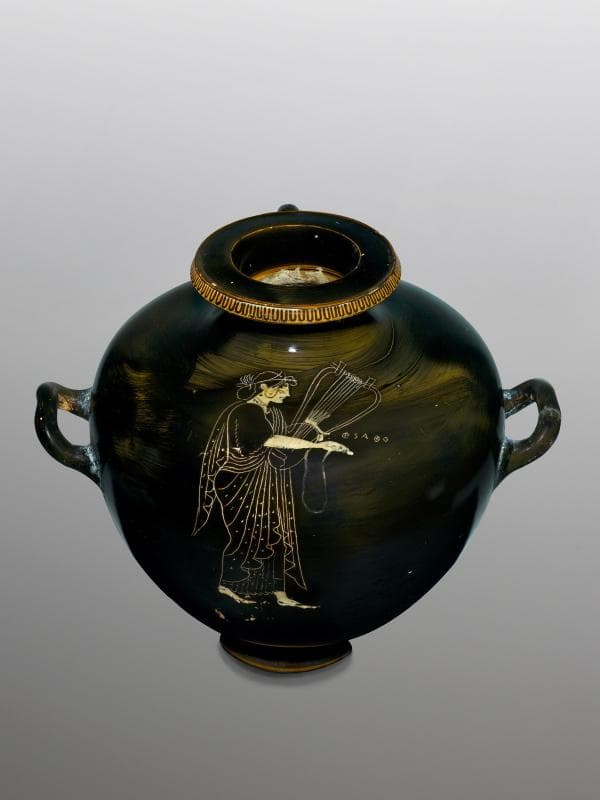
Greek · Literature · Arts
Sappho
610 – 570
Early Life and Background
Sappho was an Archaic Greek lyric poet from the island of Lesbos, active in the late seventh and early sixth centuries BCE.[3][14] Ancient sources and modern scholarship generally place her birth around 630–610 BCE and her death around 570 BCE, though precise dates are not known and remain debated.[3][7][14] She was born in the city of Mytilene or Eresus on Lesbos, a prosperous Aegean island known for its maritime trade and aristocratic clans.[3][7]
Little is securely known of Sappho’s family, and much of the biographical tradition stems from later, often unreliable ancient biographies and anecdotes.[3][14] Some sources name her father as Scamandronymus, while others give different names, and ancient writers often remarked that her mother was called Cleïs, a name Sappho also gives to her daughter in one poem.[3][14] These details, however, cannot be firmly verified. It is more broadly accepted that she belonged to the aristocratic elite of Lesbos, a class that played a central role in the island’s political struggles during her lifetime.[3][7]
Sappho grew up during a period of intense social and political change in the Greek world, marked by the rise of tyrants, colonization, and evolving forms of aristocratic culture.[3][7][11] Lesbos itself saw power contests among leading families and the emergence of figures such as Pittacus, later counted among the Seven Sages of Greece.[3] Sappho’s environment, with its mixture of aristocratic values, sympotic culture, and civic religion, formed the backdrop to the lyric poetry she would later compose. She wrote in the local Aeolic dialect of Greek, which would later be associated particularly with her work.[3][8][16]
Career Beginnings and Development
Sappho’s career as a poet unfolded within a cultural milieu in which lyric poetry was performed aloud, typically to the accompaniment of the lyre, in communal or semi-private settings such as symposia, religious gatherings, and weddings.[1][3][13] She is understood to have composed songs for performance by herself or by choruses of girls and women, and her poetry frequently refers to singing, dancing, and the ritualized world of female adolescence.[3][8][14]
Ancient testimonia suggest that Sappho led a circle or thiasos of young women devoted to the goddess Aphrodite and possibly the Muses, combining elements of religious devotion, education, and preparation for marriage.[3][14][8] While modern scholars debate the exact nature of this group—whether it was primarily religious, educational, or social—her poems clearly depict intense emotional and sometimes erotic bonds among women within a structured community.[3][11][16] This circle may have included women from aristocratic families across Lesbos and possibly other Greek cities.
There are references in later ancient tradition to Sappho’s temporary exile to Sicily, possibly to Syracuse, often linked to political upheavals on Lesbos.[3][7] One inscription from Sicily commemorates a statue to Sappho in Syracuse, suggesting that she was honored there in antiquity.[3] The historicity and exact circumstances of her exile remain uncertain, but the motif underscores her stature as a recognizable public figure in the wider Greek world.
Major Works and Poetic Innovation
Sappho’s oeuvre originally comprised a substantial body of lyric poetry. Hellenistic scholars in Alexandria arranged her works into nine books, indicating both their volume and the importance assigned to them.[3][14][16] Modern estimates suggest she may have composed around 10,000 lines of poetry, of which only about 650 lines survive in whole or in fragments, due largely to manuscript loss and selective transmission over the centuries.[8][16]
Her poetry was written to be sung with musical accompaniment, especially the lyre, and belongs to the genre of monodic and choral lyric rather than epic or dramatic verse.[1][3][13] She is credited with developing or refining a distinctive metrical form now called the Sapphic stanza, a quatrain consisting of three longer lines followed by a shorter Adonic line.[6][16] This metrical pattern became influential in later Greek and Latin poetry, notably in the work of Horace, and much later in European poetic traditions.
Sappho composed in various subgenres, including hymns to deities, epithalamia (wedding songs), love lyrics, and songs reflecting aging and loss.[3][8] Her surviving work exhibits a remarkable combination of brevity, emotional intensity, and vivid imagery. One of the best-known poems, often referred to as Fragment 31 or Sappho 31, describes the overpowering physical and psychological effects of desire as the speaker watches a beloved person speak with another, a poem so admired that Catullus later adapted it into Latin.[3][16]
Another major surviving piece is the so-called “Ode to Aphrodite” (Fragment 1), a nearly complete hymn in which the poet addresses the goddess of love, recounts past assistance in matters of the heart, and implores divine help once more.[3][14] This poem, preserved in a medieval manuscript, provides crucial evidence of Sappho’s religious language, her relationship to Aphrodite, and the sophisticated rhetorical structure of her songs.
Beyond individual poems, Sappho’s work collectively shifted the focus of Greek poetry from the heroic and public concerns of epic to the intimate realm of personal emotion and private experience.[1][6][9] She explored love, jealousy, longing, and separation with a directness that distinguished her from many of her male contemporaries, making her central to the definition and later understanding of the lyric genre itself.[1][9][16]
Transmission, Fragmentation, and Modern Discoveries
In antiquity, Sappho’s poems were widely known and admired across the Greek world and later the Roman Empire. She was included by Hellenistic scholars in the canonical list of Nine Lyric Poets, a select group of authors whose works were considered exemplary and worthy of careful study.[3][7] Her songs circulated in written form and through performance, and her image appeared on coins, statues, and painted pottery, testifying to her enduring renown.[1][7][12]
Despite this early fame, most of Sappho’s work was lost over the centuries. Shifts in literary taste, the fragility of papyrus, the limited copying of Aeolic dialect texts, and possible moral disapproval of her erotic themes contributed to the disappearance of her books from medieval manuscript traditions.[3][4][16] By the Middle Ages, only a handful of complete or nearly complete poems survived, along with quotations of lines and short fragments preserved by ancient grammarians and literary critics.
The modern understanding of Sappho’s poetry has been significantly shaped by papyrus discoveries in Egypt from the late nineteenth century onward. Excavations and the antiquities trade yielded numerous papyri containing previously unknown or partially known fragments of her poems, often in poor condition but still decipherable.[3][16] These finds allowed scholars to reconstruct additional lines, clarify earlier readings, and gain a better sense of her range and style.
In the twenty-first century, further papyrological discoveries have continued to add to the corpus, including longer fragments that have spurred renewed scholarly debates about her themes, voice, and historical context.[3] Each new piece of text underscores both the magnitude of the loss and the extraordinary quality of what remains.
Awards, Honors, and Ancient Reputation
Formal literary “awards” in the modern sense did not exist in Sappho’s era, but her stature in antiquity is attested by honorific epithets, inclusion in canonical lists, and civic commemorations. Ancient writers, including Plato, hailed her as the “tenth Muse”, placing her symbolically alongside the nine divine Muses who presided over the arts.[1][2][13][16] This epithet reflected both admiration for her poetic genius and recognition of her exceptional status as a woman poet.
Sappho was often referred to as “the Poetess”, in parallel with Homer’s title “the Poet,” suggesting that she occupied, for lyric poetry, a role comparable to Homer’s for epic.[1][3][11] Hellenistic scholars in Alexandria enshrined her in the canon of Nine Lyric Poets, an influential selection that guided education and literary criticism for centuries.[3][9] Her works were studied, edited, and commented upon by scholars who regarded her as a model of style, meter, and emotional expression.
Civic honors also attest to her fame. Statues of Sappho were erected in public spaces, and her likeness appeared on coins minted in Mytilene and elsewhere, an unusual distinction that highlighted her importance not only as a local figure but as a cultural symbol for the entire Greek world.[1][7][12] Later authors, including Strabo and Longinus, praised her as an unparalleled poet of love and emotion, and Roman writers such as Catullus and Ovid paid literary homage by adapting or imitating her themes and forms.[3][9]
Personal Life and Relationships
Sappho’s personal life has been the subject of fascination and speculation since antiquity. Much of what later readers claimed to know about her biography derived from interpretations of her poems, often filtered through cultural assumptions about gender and sexuality.[3][4] Ancient biographical traditions associated her with political conflicts on Lesbos and an exile to Sicily, as noted earlier, but hard evidence is scarce.[3][7]
Some of her poems mention a daughter named Cleïs, whom she describes with tenderness, leading many scholars to accept that Sappho had at least one child.[3][14] References to brothers—including Charaxus, who was said to have had a romantic entanglement with a courtesan in Egypt—also appear in later sources and may have roots in her poetry.[3]
The most debated aspect of her personal life concerns her erotic attachments. Many surviving fragments clearly express desire and affection between women, and ancient and modern readers alike have viewed Sappho as an emblem of female same-sex love.[3][7][8][9] Her homeland, Lesbos, and her own name gave rise in modern European languages to the terms “lesbian” and “sapphic,” both referencing female same-sex desire.[3][7][9][15]
Ancient sources, however, offered multiple and sometimes conflicting portraits of her sexuality, with some later writers attempting to portray her as primarily heterosexual, perhaps reflecting changing moral attitudes.[3][4] Modern scholarship generally recognizes that her poetry documents intense relationships with women and acknowledges her central role in the history of same-sex desire, while cautioning against imposing contemporary identity categories too rigidly upon an archaic Greek context.[3][7][11][20]
Legacy and Historical Impact
Sappho’s legacy extends across more than two and a half millennia of literary, cultural, and intellectual history. In the ancient world, she set a standard for lyric excellence and emotional precision that later poets sought either to emulate or to surpass.[1][9][10] Her metrical innovations, especially the Sapphic stanza, influenced Greek lyric and were adapted into Latin by poets such as Horace, ensuring her formal impact on Western verse traditions.[6][10][16]
Her themes and imagery—particularly her exploration of love, longing, jealousy, and the bittersweet nature of desire—shaped the development of erotic and personal poetry. Roman authors such as Catullus and Ovid drew on her motifs and sometimes on specific poems, helping to transmit aspects of her work to later European literatures even as the Greek originals were being lost.[3][9]
From the Renaissance onward, Sappho’s fragments were rediscovered and gradually incorporated into learned and literary culture. Humanist scholars collected and edited the surviving texts, and early modern poets and critics debated her reputation, often oscillating between admiration for her artistry and anxiety about her sexuality.[4][9] In the eighteenth and nineteenth centuries, as philology advanced and more papyri were found, her status as a canonical figure in classical literature was solidified, even though the fragmentary nature of her corpus remained a source of scholarly frustration and romanticized longing.
In the nineteenth and twentieth centuries, Sappho became a crucial figure in the history of women’s writing and feminist literary criticism. As one of the earliest known women poets in the Western tradition, she provided a powerful model of female authorship and a counterpoint to male-dominated canons.[9][11][16] Writers and scholars have interpreted her as an emblem of a distinct feminine poetic voice that foregrounds personal experience, relational emotion, and the inner life.
At the same time, Sappho’s association with love between women made her an iconic figure in LGBTQ+ history and culture. From the late nineteenth century onward, queer writers, activists, and communities reclaimed her as a symbol of lesbian desire and identity, drawing on both her extant poems and the cultural resonances of her name and island.[7][8][15][20] Modern scholarship in queer studies and gender studies has examined how her textual survival, erasure, and reinterpretation reflect broader histories of sexuality and power.
Her influence extends beyond academic and literary realms. Sappho has inspired visual artists, musicians, and playwrights who have sought to imagine or reimagine her life and voice across diverse media. Anthologies of women’s writing, LGBTQ+ histories, and general poetry collections frequently place her at or near the beginning, emphasizing her role as a foundational figure in multiple overlapping traditions.[1][8][9][11]
Later Life and Death
Almost nothing is known with certainty about Sappho’s later years or the exact circumstances of her death. Ancient sources generally assume that she continued to live and work on Lesbos, likely in Mytilene, after any period of exile, but direct evidence is lacking.[3][7] Modern reference works typically give approximate dates, suggesting that she died around 570 BCE, based on internal and external chronological indicators rather than explicit ancient testimony.[3][7][14]
A famous but late and probably fictional story claims that Sappho leapt to her death from the Leucadian cliff out of unrequited love for a ferryman named Phaon.[3][7] Most scholars regard this tale as a later romantic or moralizing legend that became attached to her name, reflecting Hellenistic and Roman narrative conventions rather than historical fact. The persistence of the Phaon story illustrates how Sappho’s life was reshaped by later cultural imaginations, often to align her with heteronormative narratives or to moralize about passion.
Despite the lack of concrete information about her final years, the enduring reception of her poetry ensured that Sappho’s name and reputation did not fade. Through selective transmission, quotation, and rediscovery, she remained present in the classical tradition and, subsequently, in the broader history of world literature. The fragmentary survival of her work, combined with the scarcity of reliable biographical details, has made her a figure of enduring mystery as well as profound influence.[3][4][16]
Assessment
Sappho’s historical significance lies in several intersecting domains. She is one of the earliest and most accomplished practitioners of lyric poetry in the Greek world and a key figure in the evolution of poetic forms and genres.[1][9][10] As a woman whose work was preserved, studied, and celebrated in antiquity, she stands out in a patriarchal literary culture that seldom recorded women’s voices.[8][11][16]
Her poems offer rare insight into the emotional lives and social experiences of women in archaic Greece, particularly the processes of female adolescence, friendship, and desire.[3][8] They also record, in some of the earliest extant Western texts, the articulation of erotic love between women, making her central to the literary and cultural history of same-sex desire.[3][7][8][9]
Although the exact contours of her life and corpus remain elusive, Sappho’s surviving work continues to shape discussions of gender, sexuality, poetic voice, and the politics of literary canon formation. Her fragments, at once incomplete and intensely present, invite continual reinterpretation and ensure her lasting place as one of the most important poets in world literature.[1][3][9][16]
Dated achievements
2 indexed.
- Jan01570Literature
Sappho's Death Year
Death of Sappho, marking the end of an era in Greek lyric poetry.
View details Sappho (c. 612–c. 557 BCE) | Encyclopedia.com - Jan01610