← All women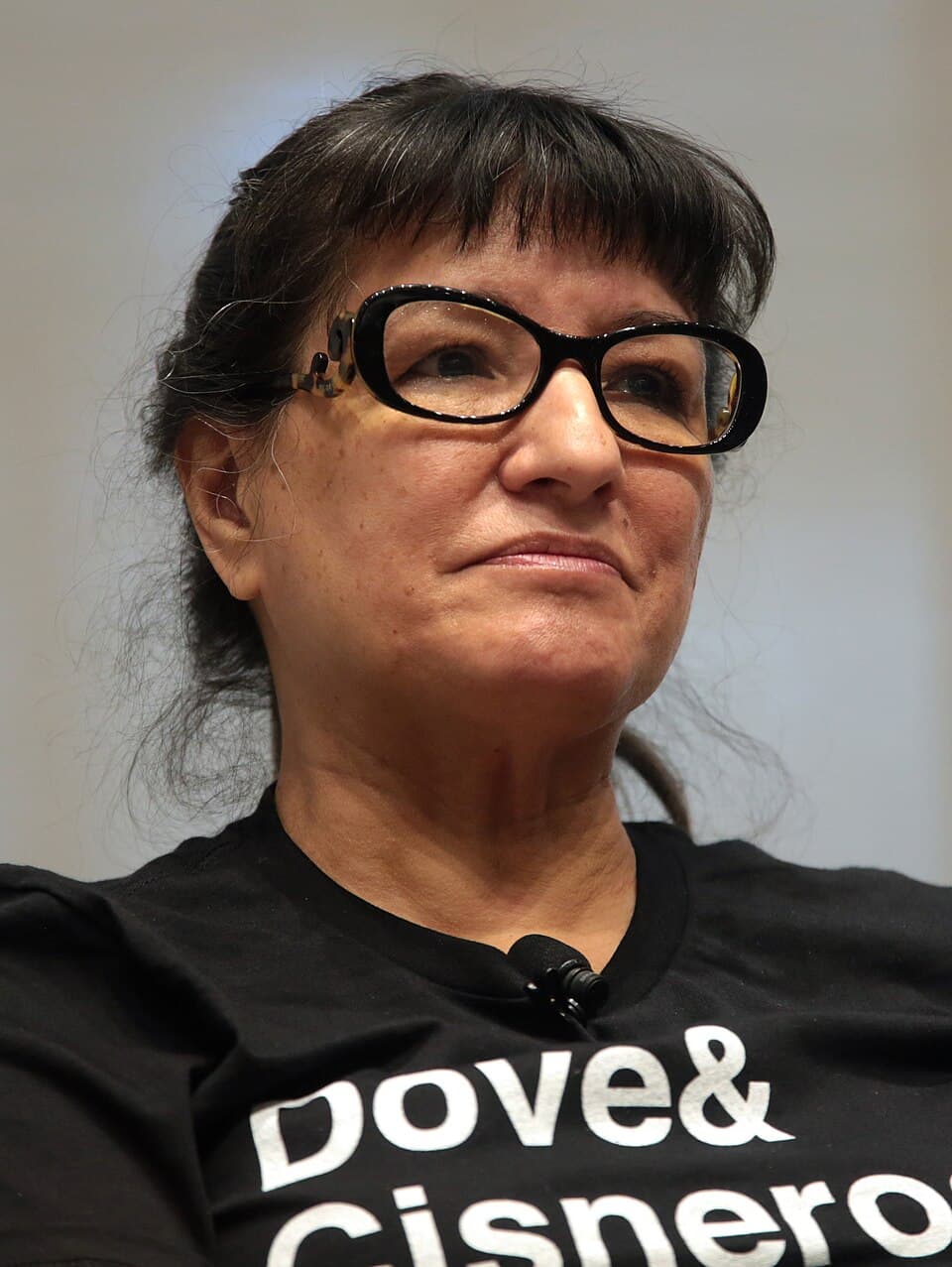
American · Literature · Arts
Sandra Cisneros
December 20, 1954 – present
Early life and education
Sandra Cisneros was born on December 20, 1954, in Chicago, Illinois, the only daughter in a family of seven children. Her father worked as an upholsterer and her mother was a homemaker, and the family’s working-class life, frequent movement, and Mexican American heritage later became central sources for her writing. Cisneros has repeatedly drawn on the experience of growing up between cultures, languages, and expectations, and those themes would define her literary identity.
She attended Catholic schools in Chicago and later studied at Loyola University Chicago, where she earned a bachelor’s degree in English in 1976. She then attended the University of Iowa, completing an M.F.A. in creative writing in 1978. During her time at Iowa, Cisneros became increasingly aware that the literature she loved did not adequately reflect the lives of working-class Mexican Americans like her own family. That realization became a major force in her artistic development and helped shape the mission of her later work.
Career beginnings
Cisneros’s early writing career began with poems, short prose pieces, and chapbooks. Her first chapbook, Bad Boys, appeared in 1980, marking the start of her book publication career. In these early years she worked in a variety of jobs, including teaching and arts-related positions, while continuing to write and build a literary identity outside the center of the publishing world. The early 1980s were not an easy time for a young Chicana writer trying to establish herself in mainstream American letters, and Cisneros’s early publications emerged against a background of limited representation for Latina voices.
Her writing from this period already showed the hallmarks that would later define her reputation: lyrical compression, sharp observation, and a close attention to the interior lives of girls and women. She was developing a style that combined poetry and prose, realism and memory, while insisting that the domestic, the local, and the everyday could be subjects of serious literature.
Breakthrough with The House on Mango Street
Cisneros achieved her breakthrough with The House on Mango Street, published in 1983. The novella is told through a series of interconnected vignettes and follows Esperanza Cordero, a young Latina girl in Chicago who dreams of a life beyond the constraints of poverty, gender expectation, and neighborhood boundaries. The book’s voice is intimate and immediate, and its form made it especially accessible to young readers while remaining rich enough to attract scholarly attention.
The work became one of the most influential books in contemporary American literature. It sold millions of copies, was translated into many languages, and became widely assigned in schools, colleges, and universities. Its significance lies not only in its popularity but also in its cultural intervention: it centered the experiences of a Mexican American girl in a literary landscape that had rarely treated such a perspective as universally important. Cisneros’s success challenged assumptions about whose stories could be commercially viable and critically respected.
The book was also important because it helped define a new space for Latina literary expression. Rather than presenting Mexican American life as a sociological problem or a side note to the American experience, Cisneros framed it as a source of beauty, conflict, imagination, and moral seriousness. That shift had a lasting effect on readers, educators, and writers.
Later major works
Cisneros continued to expand her body of work with Woman Hollering Creek and Other Stories in 1991. The collection deepened her engagement with the themes of desire, migration, family, violence, longing, and self-definition. The stories move across borders and generations while retaining the compressed lyricism that had become her signature. The book confirmed that her achievement was not limited to a single breakthrough title.
She also published poetry, essays, memoir, and later fiction, including Caramelo and children’s and young adult works. Across these genres, Cisneros remained focused on the experiences of women, the complexities of Mexican American identity, and the power of voice. Her writing often explores the tension between public and private selves, as well as the burdens and creativity that arise from multilingual, bicultural life.
In addition to her books, Cisneros became known for public readings, lectures, and advocacy. She has often spoken about the importance of artistic freedom and the need for literary spaces that welcome marginalized writers. Her career demonstrates the breadth of what a literary life can include: not only publication and awards, but teaching, mentorship, and cultural leadership.
Awards and honors
Over the course of her career, Cisneros received numerous honors. The provided sources note fellowships, including National Endowment for the Arts support, and major prizes such as the MacArthur Fellowship. Her honors also include the Texas Medal of the Arts, the PEN/Nabokov Award for Achievement in International Literature, and the Ruth Lilly Poetry Prize. These awards reflected the broad reach of her work across poetry, fiction, and essays.
A particularly significant recognition came on September 22, 2016, when President Barack Obama presented Cisneros with the National Medal of Arts. The award symbolized national acknowledgment of her artistic influence and the way her writing had helped reshape American literary culture. It also underscored the enduring relevance of her work to questions of representation and identity.
Her institutional honors are notable not merely as career milestones but as indicators of a broader shift in literary culture. Cisneros’s work moved from relative marginality to the center of academic and public recognition, helping open the field to later generations of Latina and Latinx writers.
Personal life
Cisneros has lived much of her adult life in Texas, and sources identify San Antonio as her home. She is known to keep a relatively private personal life, and public biographical sources emphasize her work more than family relationships. She has not centered marriage or motherhood in the public record in the way some writers do, and the major contours of her biography are instead shaped by family background, artistic development, and civic engagement.
Her personal identity has often been discussed in relation to her dual cultural inheritance. She is widely described as Mexican American and, in some sources, as a dual citizen of the United States and Mexico. That identity has been a source of both artistic inspiration and public importance, since her books have given literary form to experiences shared by many readers who live across linguistic, national, and cultural borders.
Advocacy and influence
Beyond her books, Cisneros has been active in supporting writers and communities, including immigrant and Latino/a cultural work. She has also been connected to the Macondo Foundation, an organization associated with social justice and literary community-building. Her career has thus extended beyond authorship into mentorship and advocacy.
Her influence is especially visible in education. The House on Mango Street became a staple of classroom reading, introducing generations of students to Latina perspectives and to a compact, accessible form of literary modernism. Teachers and scholars have used her work to discuss race, gender, class, language, and form. In that sense, Cisneros’s influence is both literary and pedagogical: she changed what many students read and how they think about American literature.
Legacy
Sandra Cisneros is now regarded as one of the most important Latina writers in the United States. She helped establish Mexican American women’s experiences as a central subject of literary art rather than a marginal topic. Her work bridged poetry and prose, popular readership and scholarly attention, and personal memory and public history.
Her legacy rests in part on the sheer reach of her best-known book, but also on the larger cultural change her career represents. Cisneros proved that a writer rooted in a specific working-class Chicana experience could speak to readers across backgrounds and become a canonical figure in American literature. For women’s history, her life is significant not only because of the books she wrote, but because of the barriers she helped break in publishing, education, and cultural representation.
Dated achievements
5 indexed.
- Dec201954Literature
Birth of Sandra Cisneros
Sandra Cisneros was born in Chicago, Illinois, on December 20, 1954.
View details Britannica biography of Sandra Cisneros - Jan011980Literature
Publication of Bad Boys
Cisneros’s first chapbook, Bad Boys, was published in 1980, launching her book career.
View details