← All women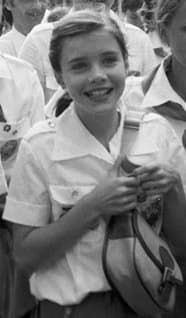
American · Activism
Samantha Smith
June 29, 1972 – August 25, 1985
Early Life and Background
Samantha Reed Smith was born on 29 June 1972 in Houlton, a small town in northern Maine near the Canadian border. Her parents, Jane Reed Smith and Arthur Smith, were respectively a social worker and a teacher, and they raised Samantha in the nearby community of Manchester, Maine. Her upbringing in a modest, politically aware household later proved crucial to her unusual role in international affairs.[1][2][14]
Samantha attended local public schools and lived what contemporaries described as an ordinary American childhood in the late 1970s and early 1980s. She enjoyed reading, time with friends, and family activities. Yet she also absorbed the pervasive nuclear anxieties of the era, as television news and classroom discussions routinely addressed tensions between the United States and the Soviet Union.[8][12][13]
Her mother encouraged curiosity about world events and did not shield Samantha from political news, believing that children could understand and discuss such issues. This environment meant that, by the age of ten, Samantha was aware of the dangers posed by nuclear weapons and the possibility of war between the superpowers—a level of engagement that would soon propel her into international prominence.[8][15]
Cold War Context
During Samantha’s childhood, the Cold War entered a particularly tense phase. The early 1980s saw the Soviet invasion of Afghanistan, the NATO decision to deploy Pershing II and cruise missiles in Europe, and intense rhetoric from leaders such as U.S. President Ronald Reagan, who referred to the Soviet Union as an "evil empire." Debates over nuclear arms and peace movements were widespread in both the United States and Western Europe.[13]
American and Soviet citizens lived under the shadow of potential nuclear confrontation. Civil defense discussions, peace marches, and nightly news coverage created a climate in which questions about war were common even among children. Samantha’s later decision to write directly to Soviet leader Yuri Andropov thus emerged from a broader public discourse but was remarkable for its simplicity and personal tone.[8][12][15]
Career Beginnings: The Letter to Yuri Andropov
In 1982, when Samantha was ten years old and in fifth grade, she saw Andropov’s photograph on the cover of Time magazine and asked her mother whether he was responsible for the tensions that frightened her.[12][13][15] Jane suggested that Samantha write to him. Samantha decided to do so, composing a letter that asked directly whether the Soviet Union intended to start a nuclear war and why relations with the United States were so hostile.[8][15]
The letter, written in plain, childlike language, expressed her fears and appealed to Andropov to work for peace so that children would not have to worry about nuclear destruction. It was mailed from Maine in November 1982
This act of writing to Andropov is widely regarded as the beginning of Samantha’s role as a peace activist and citizen diplomat. Commentators have emphasized that her initiative challenged conventional hierarchies in diplomacy—rather than relying solely on government officials, a fifth‑grader attempted to open dialogue about nuclear war directly with the head of a rival superpower.[8][12] On 26 April 1983, the Soviet newspaper Pravda published Yuri Andropov’s reply to Samantha’s letter.[1][2][15] In his response, Andropov assured her that the Soviet Union did "not want war" with the United States and that the Soviet people desired peace. He discussed the sacrifices of the USSR during World War II, portraying his country as fundamentally opposed to another devastating conflict. Most strikingly, Andropov extended a personal invitation for Samantha to visit the Soviet Union as his guest. Pravda’s publication of the exchange transformed a private correspondence into a public event, signaling that the Soviet leadership saw propaganda and diplomatic value in the story of an American child concerned about peace.[1][2] News of Andropov’s reply quickly reached Western media. American newspapers and television networks covered the story, emphasizing the unusual nature of a Soviet leader writing to a U.S. schoolgirl. Samantha became an overnight celebrity, depicted as "America’s youngest ambassador" and a symbol of hope in an otherwise confrontational international environment.[3][10][12] Samantha and her parents accepted Andropov’s invitation. On 7 July 1983, they arrived in the Soviet Union, beginning a two‑week goodwill tour.[1][2] The trip was heavily choreographed by Soviet authorities but also featured spontaneous interactions, particularly with children. Samantha visited Moscow and Leningrad (now St. Petersburg), toured the Artek Young Pioneer camp on the Black Sea, and met Soviet schoolchildren in formal and informal settings. During the visit, Samantha expressed her wish that Americans and Soviets could live in peace and that children would no longer fear nuclear war. Soviet media praised her, referring to her as a "goodwill ambassador" and highlighting her sincerity.[7][10][14] American media, meanwhile, followed the trip closely, often debating whether Samantha was being used for propaganda or genuinely contributing to mutual understanding. On 14 July 1983, while in Leningrad, Samantha participated in a telephone question‑and‑answer session with Soviet children. United Press International reported that, during this event, she unexpectedly received a call from Valentina Tereshkova, the first woman to orbit Earth.[6] Tereshkova congratulated Samantha on her courage and spoke about peace and space, creating a memorable moment that linked a pioneering female cosmonaut with a young American peace advocate. Samantha’s trip concluded on 22 July 1983, when she returned to the United States.[1][2] By then, she had become widely recognized in both countries. Photographs showed her embracing Soviet children, visiting monuments, and smiling in pioneer camp uniforms. The visit is often cited as one of the most visible examples of "citizen diplomacy"—informal, non‑governmental interactions aimed at improving relations between adversarial states—during the Cold War.[8][13] After her return, Samantha continued to speak publicly about peace. She appeared on American television programs, addressed school groups, and participated in peace‑related events. According to accounts of her life, she traveled to Japan as part of peace activities and met children and activists there to discuss nuclear disarmament and cross‑cultural understanding.[8][10] Samantha wrote a book recounting her experiences in the Soviet Union, usually described as a children’s account of her trip and the people she met.[5][10] In it, she described her impressions of Soviet life, emphasizing similarities between children in both countries and expressing hope that friendship could lessen the risk of war. The book reinforced her role as a voice for young people concerned about global politics. Her advocacy extended into media commentary. Samantha gave interviews in which she urged adults to remember that children everywhere wanted peace and to consider the human cost of nuclear conflict. Her sincerity and age lent moral weight to these appeals, even when critics questioned the extent to which her message aligned with Soviet public relations goals.[12][13] As a result of her public visibility, Samantha was offered opportunities in entertainment. In 1984, she appeared in the television series Charles in Charge, marking her debut as a child actress.[11] The role introduced her to a broader audience beyond news coverage of her activism. In 1985, Samantha was cast in the U.S. television series Lime Street, co‑starring with actor Robert Wagner.[1][10][11] The show featured her as a regular cast member, and she filmed episodes in London and other locations. While her acting career was brief, it underscored her dual public identity as both a peace activist and a child performer. Contemporary observers noted that Samantha balanced school with travel and filming. Reports indicate that her parents remained concerned about maintaining normalcy in her life, ensuring that her growing fame did not overwhelm her education or personal development.[8][12] Although Samantha did not hold formal diplomatic office, she received significant symbolic recognition. U.S. and international media frequently referred to her as "America’s Youngest Ambassador" or "America’s Littlest Diplomat", emphasizing the novelty of a child engaging directly with superpower leaders.[3][10][12] These titles were honorific rather than official governmental ranks. In both the United States and the Soviet Union, Samantha was portrayed as a goodwill figure. Soviet outlets described her as a "goodwill ambassador" and highlighted her ability to communicate across ideological divides.[7][10][14] After her death, various memorials, scholarships, and public commemorations were established in her name, reflecting continued recognition of her contributions to peace discourse. The portrait project "Americans Who Tell the Truth" includes Samantha among its subjects, depicting her as a model of citizen courage and moral clarity.[8] Articles and documentaries produced decades later—such as features in Smithsonian Magazine, programs by CBS, and retrospectives in international newspapers—testify to her enduring status as a historical figure in Cold War memory.[12][13][9] Samantha remained, in many respects, a typical child despite her unusual public role. She lived with her parents in Manchester, Maine, attended local school, and enjoyed friendships and extracurricular activities. There is no evidence that she married or had children; her life ended at age thirteen.[1][2][11] Her relationship with her parents was central to her activism. Jane and Arthur supported Samantha’s decision to write to Andropov and accompanied her on the Soviet trip. They also helped manage media requests and travel related to her speaking engagements and acting work, functioning as guardians navigating the complex intersection of childhood, politics, and celebrity.[8][12] In 1985, Samantha’s acting work on Lime Street required travel between Maine and filming locations. On 25 August 1985, she and her father boarded Bar Harbor Airlines Flight 1808, a commuter flight returning to Maine.[1][2][10][11] As the Beechcraft 99 approached the Lewiston–Auburn Regional Airport on a rainy night, it crashed, killing all eight people on board. Authoritative biographical sources, including encyclopedias and news archives, state that Samantha, born in June 1972, was thirteen years old at the time of her death, correcting occasional misstatements that she was ten or fifteen.[2][10][12] The crash occurred near Auburn, Maine, and investigations found no evidence of foul play.[2][9] News of her death spread quickly across the United States and the Soviet Union. Obituaries recalled her letter to Andropov, her Soviet visit, and her efforts to promote understanding. CBS’s "Mobituaries" and other later programs have described the event as the sudden end of a promising life that had already influenced international perceptions.[12][17] Samantha Smith’s historical significance lies in her role as a child peace activist who directly engaged with the leader of a rival superpower and became a public symbol of citizen diplomacy. Her 1982 letter to Yuri Andropov challenged the notion that nuclear policy and international relations were solely the domain of adults and officials.[8][15] The 1983 Soviet visit demonstrated that children could be central figures in high‑profile cultural exchanges. Samantha’s interactions with Soviet children, her televised appearances, and moments such as her phone call with Valentina Tereshkova offered alternative images of U.S.–Soviet relations—images focused on shared humanity rather than military rivalry.[1][2][6] Her story has continued to inspire scholarship and popular media. Articles in Smithsonian Magazine have framed her as "the American girl who broke through the Iron Curtain," emphasizing how her actions softened perceptions during a deeply polarized period.[13] International outlets such as El País have revisited her life, calling her "America’s youngest peace ambassador" and reflecting on the power and limits of symbolic gestures in geopolitics.[9] Educational and memorial initiatives, including websites dedicated to her memory and portraits in civic art projects, highlight Samantha as a model for young people who wish to speak out on global issues. Her example is frequently used in discussions of children’s rights, peace education, and the history of the Cold War, illustrating how youth voices can influence public debate even when they do not change official policy directly.[8][15] At the same time, historians and journalists caution against overstating her formal diplomatic role. She did not hold government office, and titles such as "ambassador" remained honorific. Nonetheless, Samantha Smith’s life and actions demonstrate the capacity of individual initiative—especially by women and girls—to reshape narratives in international politics and to highlight the moral dimensions of decisions about war and peace.[3][10][12]Andropov’s Reply and Invitation
Goodwill Visit to the Soviet Union
Continuing Peace Activism and Public Work
Acting Career
Awards, Honors, and Recognition
Personal Life
Later Life and Death
Legacy and Historical Impact
Dated achievements
7 indexed.
- Jun291972Activism
Birth of Samantha Smith
Samantha Reed Smith was born in Houlton, Maine, later becoming known internationally as a child peace activist during the Cold War.
View details Wikipedia - Nov011982Activism
Letter sent to Soviet leader Yuri Andropov
Ten-year-old Samantha Smith from Maine wrote to Soviet leader Yuri Andropov asking about the possibility of nuclear war.