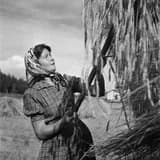
Sally Salminen was born on 19 March 1906 in Vårdö, in the Åland Islands, Finland, into a poor farming family.
Sally Salminen was born on 19 March 1906 in the village of Vårdö, part of the Åland Islands archipelago, then as now an autonomous, Swedish-speaking region of Finland. She was one of many children in a poor farming and fishing family, and her early life was shaped by hardship, rural labor, and limited access to formal schooling.
This modest origin is historically significant because it stands in stark contrast to her later international literary fame. Growing up in a peripheral, economically marginal community with a distinct Swedish-speaking identity, Salminen represented a demographic rarely given voice in mainstream Nordic or world literature: the rural working poor of a small island community.
Her upbringing on Åland, surrounded by the sea, agrarian labor, and the social dynamics of a tightly knit island community, would become the very subject matter of her breakthrough novel Katrina (1936), which drew heavily on the landscapes, dialect, and social textures of her childhood home. The isolation and economic precarity she experienced as a child directly informed the empathetic, realist depiction of poverty and endurance that later captivated an international readership.
Her birth in this remote setting, and her subsequent emigration and struggle, make her biography emblematic of early 20th-century Nordic emigrant experience and working-class women's paths into literature.