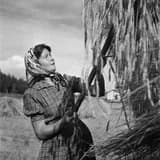
Sally Salminen died on 18 February 1976 in Höganäs, Sweden, having spent her later decades continuing to write and living in Scandinavia.
Sally Salminen died on 18 February 1976 in Höganäs, Sweden, where she had settled with her husband, the Danish-born artist Johannes Dührkop, after years of life spent between the United States, Denmark, and Sweden following her sudden literary fame in the 1930s.
Her death marked the end of a career that had spanned four decades and encompassed novels, memoirs, and social commentary, though none of her later works achieved the extraordinary international success of her 1936 debut Katrina. Nonetheless, she continued to be regarded as an important figure in Finnish-Swedish and broader Nordic literature, and her body of work remained a significant record of working-class and women's experience in the Nordic countries during the 20th century.
Salminen's legacy persisted after her death through continued editions and translations of Katrina, scholarly attention to her role as a pioneering working-class woman writer, and her symbolic importance to the Åland Islands, where she is remembered as one of the region's most celebrated cultural figures. Museums, literary societies, and Nordic women's literary histories have continued to document and celebrate her contributions, ensuring that her story, from an impoverished rural childhood to international literary acclaim, remains a touchstone for discussions of class, gender, and opportunity in twentieth-century literature.