← All women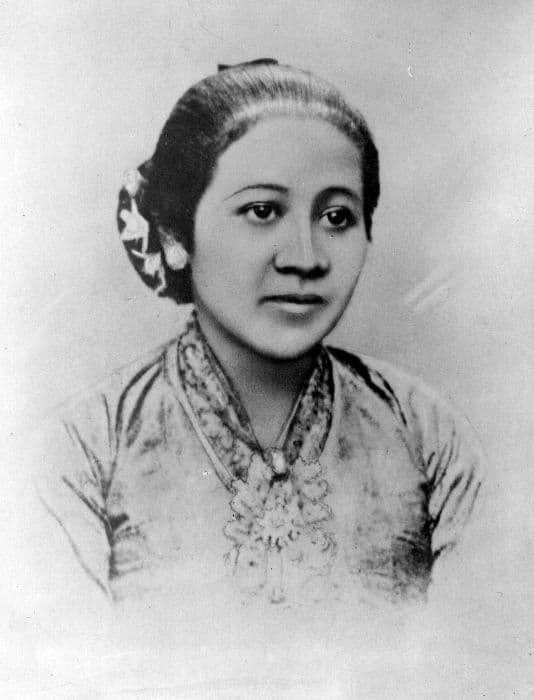
Indonesian · Activism · Literature
Raden Ajeng Kartini
April 21, 1879 – September 17, 1904
Early Life and Family Background
Raden Ajeng Kartini was born on 21 April 1879 in the coastal town of Jepara, in the Dutch East Indies (present-day Indonesia). She was born into the Javanese priyayi aristocracy, a hereditary administrative elite that served the Dutch colonial government. Her father, Raden Mas Adipati Ario Sosroningrat, was the Regent (Bupati) of Jepara, a position of considerable local authority within the colonial administrative hierarchy. Her mother, Mas Ajeng Ngasirah, was Sosroningrat's first wife but, as a commoner and daughter of a religious teacher rather than of aristocratic blood, held a lower status within the household than her father's second, aristocratic wife, Raden Ajeng Woerjan. This complex domestic arrangement, common among Javanese nobility of the era, exposed young Kartini early to the hierarchies and constraints placed on women, regardless of their birth status.
Kartini was the fifth of eleven children. Unusually for a girl of her time and place, she was permitted to attend the Europeesche Lagere School (European Lower School), a Dutch-language primary school, where she learned to speak and write fluent Dutch and was exposed to European ideas, literature, and notions of liberalism and women's emancipation. This education set her apart from the vast majority of Indonesian women, who had no access to formal schooling.
At the age of 12, in accordance with Javanese aristocratic custom, Kartini was placed into pingitan — a period of domestic seclusion for adolescent girls of high status, intended to prepare them for marriage and to protect their chastity and reputation. This confinement effectively ended her formal education and curtailed her freedom of movement, a rupture she would later describe with anguish in her letters as a kind of imprisonment that stole her youth and potential.
Intellectual Development and Correspondence
During her seclusion, Kartini continued her self-education through voracious reading. She subscribed to Dutch newspapers and magazines and corresponded extensively with several Dutch friends, most notably Rosa Abendanon-Mandri, the wife of Jacques Henry Abendanon, a high-ranking Dutch colonial official who served as Director of Education, Religion, and Industry. She also exchanged letters with other Dutch pen-friends, including Stella Zeehandelaar, a Dutch feminist and socialist, whose correspondence with Kartini beginning in 1899 became particularly significant.
In these letters, written primarily in Dutch between roughly 1899 and 1904, Kartini articulated a wide-ranging critique of the conditions facing Javanese women: forced and arranged marriages, polygamy, the practice of seclusion, and the systemic denial of education to girls. She expressed admiration for Western ideas of individual liberty, gender equality, and progress, while also grappling with complex feelings about Dutch colonialism itself — critiquing its injustices even as she engaged deeply with European Enlightenment thought. She wrote of her dream to become a teacher and to establish a school where Javanese girls could receive an education comparable to that of European children.
Kartini's letters reveal an intellectually restless and reform-minded young woman who read works of European literature and social criticism, including Dutch translations of foreign feminist and socialist writings. She was influenced by the broader currents of the Ethical Policy debates occurring within Dutch colonial administration at the time, which nominally sought to improve the welfare of native populations, though in practice colonial rule remained deeply exploitative and unequal.
Advocacy and the Founding of a School
Kartini's ambitions extended beyond private correspondence. She lobbied Dutch officials, including via her father's connections, for opportunities to study in the Netherlands or to train as a teacher, though societal and family constraints ultimately prevented her from studying abroad. Instead, she and her sisters, Roekmini and Kardinah, worked to establish informal educational activities for girls within their own household in Jepara, teaching reading, writing, and handicrafts.
In November 1903, Kartini married Raden Adipati Djojoadhiningrat, the Regent of Rembang, a widower considerably older than her who already had several wives and children. The marriage was arranged, and Kartini had long expressed resistance in her letters to the institution of polygamous, arranged marriage that she felt symbolized the broader subjugation of Javanese women. However, she ultimately negotiated an important condition with her husband: his support for her continued educational and reform work.
With this support, in September 1903 (and continuing after her marriage), Kartini formally opened a school for native girls within the regency compounds, first associated with Jepara and continued at Rembang. The school taught basic literacy, arithmetic, and practical domestic skills to girls of the local aristocracy and beyond, representing one of the earliest sustained efforts to provide formal education to indigenous Indonesian girls outside of colonial Dutch-language schools reserved mostly for European and mixed-race children.
Personal Life, Marriage, and Death
Kartini's marriage to Djojoadhiningrat in 1903 was a turning point that combined personal compromise with renewed opportunity. Though she had for years resisted the prospect of becoming one among several wives, she came to see the union as a pragmatic means of continuing her advocacy work with greater institutional support and resources than she could access as an unmarried woman confined to her father's household.
On 13 September 1904, Kartini gave birth to her only child, a son, Raden Mas Soesalit. Complications from the childbirth proved fatal, and she died just four days later, on 17 September 1904, at the age of 25. Her death was a profound loss that cut short a life of growing intellectual and social influence, just as her ideas were beginning to circulate more widely among sympathetic Dutch and Indonesian reformers.
Posthumous Publication and Legacy
Kartini's most enduring legacy began after her death, when Jacques Henry Abendanon collected and edited her letters for publication. In 1911, the collection was published in the Netherlands under the title Door Duisternis tot Licht ("Through Darkness into Light"), later translated into English as Letters of a Javanese Princess. The book was an immediate sensation both in the Netherlands and within the Dutch East Indies, presenting European audiences with an articulate, introspective, and critical native voice — a rarity in colonial literature of the period, which was overwhelmingly authored by Europeans about, rather than by, colonized peoples.
The proceeds and public interest generated by the book led to the establishment of the Kartini Fund, which financed the creation of several "Kartini Schools" (Kartini Scholen) in cities across Java and beyond, including Semarang, Surabaya, Cirebon, and Malang, significantly expanding formal educational opportunities for Indonesian girls in the following decades. These schools are widely regarded as important precursors to the broader expansion of native education in the Dutch East Indies during the early 20th century.
Kartini's writings and biography were later embraced by the Indonesian nationalist movement as a powerful symbol of both anti-colonial sentiment and women's emancipation. After Indonesian independence, President Sukarno declared Kartini a National Hero of Indonesia (Pahlawan Nasional Indonesia) in 1964, via Presidential Decree No. 108, and designated her birthday, 21 April, as Hari Kartini (Kartini Day), an annual national observance celebrating women's rights and achievements, particularly in education. On this day, Indonesian schools and institutions hold ceremonies, essay competitions, and cultural events, and women often dress in traditional Javanese attire (kebaya) in her honor.
Historical Assessment and Enduring Influence
Modern historians and scholars have offered nuanced assessments of Kartini's legacy. Some have noted that her writings reflect the complexities and contradictions of her position: a native aristocrat educated in the colonizer's language and intellectual traditions, whose critique of local patriarchal customs sometimes ran alongside admiration for aspects of the colonial "civilizing" project of the era. Feminist historians have debated the extent to which her ideas were shaped or filtered by her Dutch editor, Abendanon, and whether the published letters fully or accurately represent her authentic voice and priorities.
Nonetheless, Kartini remains one of the most celebrated figures in Indonesian history, revered as a pioneering advocate for female education, an early articulator of Indonesian national consciousness, and a symbol of resistance to both colonial and traditional patriarchal constraints. Her image appears on Indonesian currency, postage stamps, and countless statues and street names throughout the country. Her life has been the subject of numerous books, documentaries, and films, including the 2017 Indonesian biographical film Kartini, directed by Hanung Bramantyo, which brought renewed public attention to her story for contemporary audiences.
More than a century after her death, Kartini's brief life and passionate correspondence continue to resonate as an early and influential voice in the global history of women's rights, education reform, and anti-colonial thought.
Dated achievements
2 indexed.
- Apr211879Activism
Born in Jepara, Indonesia
Raden Ajeng Kartini was born on April 21, 1879, in Jepara, Central Java, Indonesia.
View details Encyclopedia Britannica - Sep171904Activism
Death of Kartini
Raden Ajeng Kartini died on September 17, 1904, at the age of 25.
View details