← All women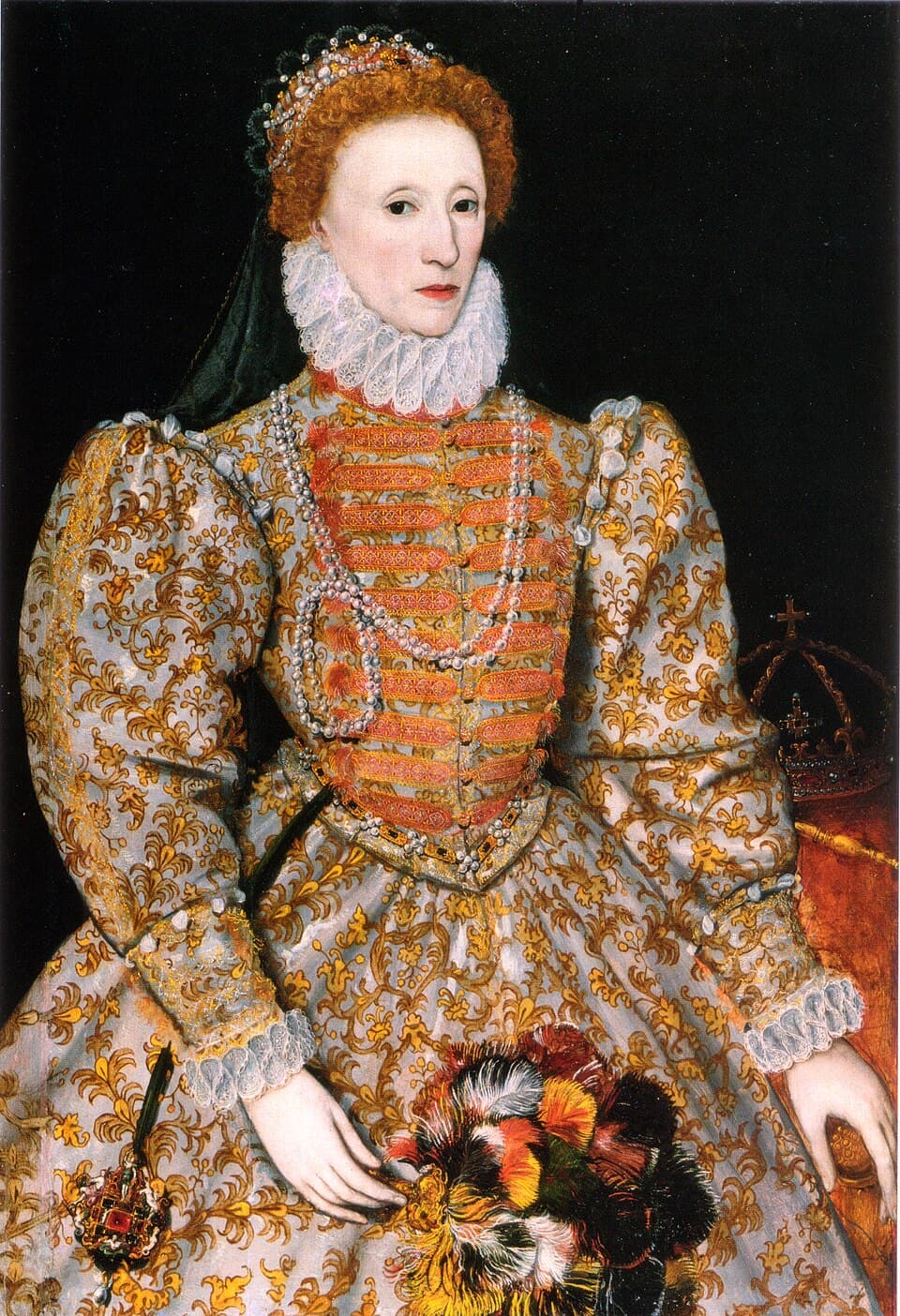
English · Politics
Queen Elizabeth I
September 7, 1533 – March 24, 1603
Early life and family background
Elizabeth I was born on 7 September 1533 at Greenwich Palace near London, the daughter of Henry VIII and Anne Boleyn. Her birth took place amid the dynastic upheavals of the Tudor court, where Henry’s search for a male heir and his break with Rome had already transformed English politics and religion. As the child of the king’s second marriage, Elizabeth’s position was politically charged from the beginning.
Her mother was executed in 1536, when Elizabeth was still a young child, and she was declared illegitimate. Although removed from the direct line of succession, she remained a royal daughter and was raised in an environment shaped by court intrigue, shifting religious policy, and the constant danger surrounding Tudor succession. Elizabeth’s early life was therefore defined by insecurity as much as privilege.
Despite these difficulties, she received one of the finest educations available to a princess. Tutors trained her in languages, classical learning, history, rhetoric, music, and theology. She became renowned for her intelligence, discipline, and ability with languages, qualities that later served her in diplomacy and in the management of her court. Her education reflected the expectations placed on royal children, but it also gave her intellectual tools that were unusually important for a reigning queen in a male-dominated political world.
From princess to monarch
Elizabeth’s status changed dramatically during the reigns of her half-siblings Edward VI and Mary I. Under Edward, she was politically cautious; under Mary, she was viewed with suspicion because of religious and dynastic tensions. She survived periods of danger and confinement, developing the caution and strategic self-control that later became hallmarks of her rule. By the time Mary died in 1558, Elizabeth had learned how to navigate a court where survival often depended on prudence, silence, and the careful use of information.
Elizabeth became queen on 17 November 1558. Her accession ended Marian policy and opened the way for a new settlement. She inherited a kingdom marked by confessional division, financial strain, and uncertainty over succession. Her first public acts were designed to stabilize the monarchy and reassure subjects who hoped for peace after years of religious conflict.
Her coronation at Westminster Abbey on 15 January 1559 was a crucial public affirmation of legitimacy. The ceremony placed her visibly at the center of English political life and helped establish the authority that would define the next forty-four years. As a woman ruler, Elizabeth had to convert ceremony, symbolism, and reputation into durable political power, a task she managed with exceptional skill.
The Elizabethan Religious Settlement
One of Elizabeth’s most important achievements was the creation of the Elizabethan Religious Settlement in 1559. Parliament passed the Act of Supremacy on 9 April 1559, restoring royal headship of the Church of England and making Elizabeth Supreme Governor. A few weeks later, the Act of Uniformity was passed on 29 April 1559, requiring use of the Book of Common Prayer and establishing common worship throughout the realm.
These measures did not end religious division, but they created a workable settlement that balanced Protestant doctrine, political conformity, and a degree of ceremonial continuity. Elizabeth and her ministers understood that England needed stability more than ideological triumph. The settlement also reflected the political realities of monarchy in the sixteenth century, when religious policy was inseparable from state security. The queen’s title of Supreme Governor was a carefully chosen compromise that allowed her to exercise authority over the church without adopting language that might alarm opponents.
In 1563, her second Parliament advanced the Thirty-Nine Articles of Religion, which gave the Church of England a more precise doctrinal identity. The process of defining Anglicanism extended across the reign, but these early legislative foundations were decisive. They helped create a national church that would endure long after Elizabeth’s death.
Government, advisers, and political style
Elizabeth ruled with the assistance of experienced advisers such as William Cecil and, later, Francis Walsingham. Yet she insisted on retaining final authority for herself. This balance of consultation and personal control became one of the defining characteristics of her monarchy. She was willing to listen, negotiate, and defer when useful, but she was not a passive sovereign. Her ability to shape policy while preserving a strong image of autonomy contributed greatly to the durability of her reign.
Her refusal to marry was a central feature of her politics. Later generations referred to her as the Virgin Queen, and she cultivated that image as part of her authority. Marriage would have created complex questions about dynastic power, foreign influence, and the subordination of her royal prerogative. By remaining unmarried, she preserved an unusual degree of sovereignty and used her marital status as a political instrument. For a female monarch in a patriarchal age, this was both a personal choice and a strategy of rule.
Elizabeth also had to manage succession anxieties throughout her reign. She never produced an heir, and the question of who would follow her remained a source of diplomatic and domestic tension. Her eventual successor was James VI of Scotland, who became James I of England after her death.
Religion, conflict, and national security
Elizabeth’s reign was shaped by international and domestic religious conflict. Her government confronted Catholic opposition at home and the threats posed by Catholic powers abroad, especially Spain. The political and religious stakes were sharpened by the presence of Mary, Queen of Scots, whose claim to the English throne made her a focal point for conspirators. Elizabeth signed Mary’s death warrant on 1 February 1587, after years of tension and repeated plots. The decision was severe, but it reflected the intense pressures facing the crown.
The confrontation with Spain reached its dramatic height in 1588. Before the crisis, Elizabeth delivered her famous Tilbury speech on 29 July 1588, addressing troops as England prepared to face the Spanish Armada. The speech became an enduring expression of martial resolve and royal solidarity. Soon afterward, on 8 August 1588, English forces defeated the Armada. The victory was celebrated across England and helped establish Elizabeth’s reputation as a strong and resilient monarch.
These events were not simply military milestones. They also shaped English identity, strengthened Protestant confidence, and encouraged a long tradition of national memory centered on resistance and providence. Elizabeth’s ability to survive these crises increased her authority and helped define the age named after her.
Patronage of the arts and the Elizabethan cultural flowering
Elizabethan England is remembered for its artistic and literary brilliance, and the queen played an important role in that development. Her court became a center of patronage for writers, musicians, and performers. In 1583, she ordered the formation of Queen Elizabeth’s Men, an early royal-sponsored acting company that reflected the growing sophistication and prestige of English theatre.
Her reign saw the rise of a vibrant dramatic culture that would include the works of Edmund Spenser, Christopher Marlowe, and William Shakespeare. While Elizabeth was not a playwright or artist herself, her patronage and the stability of her government created conditions in which literary culture could flourish. The arts became one of the defining features of the age and an enduring part of her legacy.
The cultural achievement of the period is one reason Elizabeth’s reign is often described as a “golden age.” That description should not obscure the era’s tensions, but it does capture the extraordinary concentration of literary, musical, and theatrical activity that flourished under her rule.
Expansion, exploration, and overseas ambition
Elizabeth’s reign also coincided with important developments in maritime expansion. Although her government did not create a full colonial empire, it supported voyages and ventures that expanded England’s reach. She encouraged figures such as Francis Drake, whose circumnavigation of the globe boosted England’s prestige, and Walter Raleigh, whose association with attempts at colonization helped link Elizabeth’s name to the New World.
In 1600, Elizabeth granted a charter to London merchants that founded the English East India Company, an institution that would become crucial to England’s commercial expansion. This was one of the most important late-reign developments in English trade. It reflected the growing importance of long-distance commerce and the emerging relationship between state power and global markets.
These ventures demonstrate that Elizabeth’s England was not inward-looking. It was increasingly connected to maritime strategy, commerce, and the wider world. Her reign laid foundations that later generations would develop into a larger imperial system.
Late reign, Essex, and the pressures of monarchy
The final years of Elizabeth’s reign were marked by exhaustion, factional tension, and growing concern over succession. One of the most dramatic crises came with the rebellion of Robert Devereux, Earl of Essex. After his failed uprising, Essex was executed on 25 February 1601. The episode revealed the instability of court politics and the emotional and political risks attached to royal favor.
Another landmark of the final years was the Elizabethan Poor Law, passed on 24 March 1601. This legislation established a parish-based system of poor relief and became one of the most durable social policy frameworks of early modern England. It showed that Elizabeth’s government was capable not only of defending the realm but also of responding to the social pressures created by poverty and population change.
By the end of her reign, Elizabeth had become a symbol of continuity and national identity. Although age and political strain weighed on her, she retained the authority and ritual presence that had sustained her monarchy for decades.
Death and legacy
Elizabeth died on 24 March 1603 at Richmond Palace, ending the Tudor dynasty after a reign of more than forty-four years. She left no direct heir, and the crown passed to James VI of Scotland, who became James I of England. Her death marked the end of an era, but it did not end her influence.
Her legacy is immense. She is remembered as one of England’s most successful monarchs, a ruler who secured the Church of England, strengthened the state, defended the realm against foreign threat, and presided over a remarkable cultural flowering. She also stands as a major example of female sovereignty in a period when women’s political authority was often questioned or constrained. Elizabeth turned those constraints into a source of strength, carefully constructing an image of queenship that combined virginity, majesty, intelligence, and command.
The Elizabethan age remains one of the most studied periods in English history because it fused political consolidation with artistic brilliance and maritime ambition. Elizabeth I’s reign helped define the modern monarchy and left a memory that continues to shape national and cultural identity.
Dated achievements
13 indexed.
- Sep071533Politics
Birth of Elizabeth at Greenwich
Birth of Elizabeth, daughter of King Henry VIII and Anne Boleyn, at Greenwich Palace near London, England.
View details Wikipedia: Elizabeth I - Nov171558Politics
Accession to the throne of England and Ireland
Elizabeth succeeds her half-sister Mary I and is proclaimed Queen of England and Ireland as the last Tudor monarch.