← All women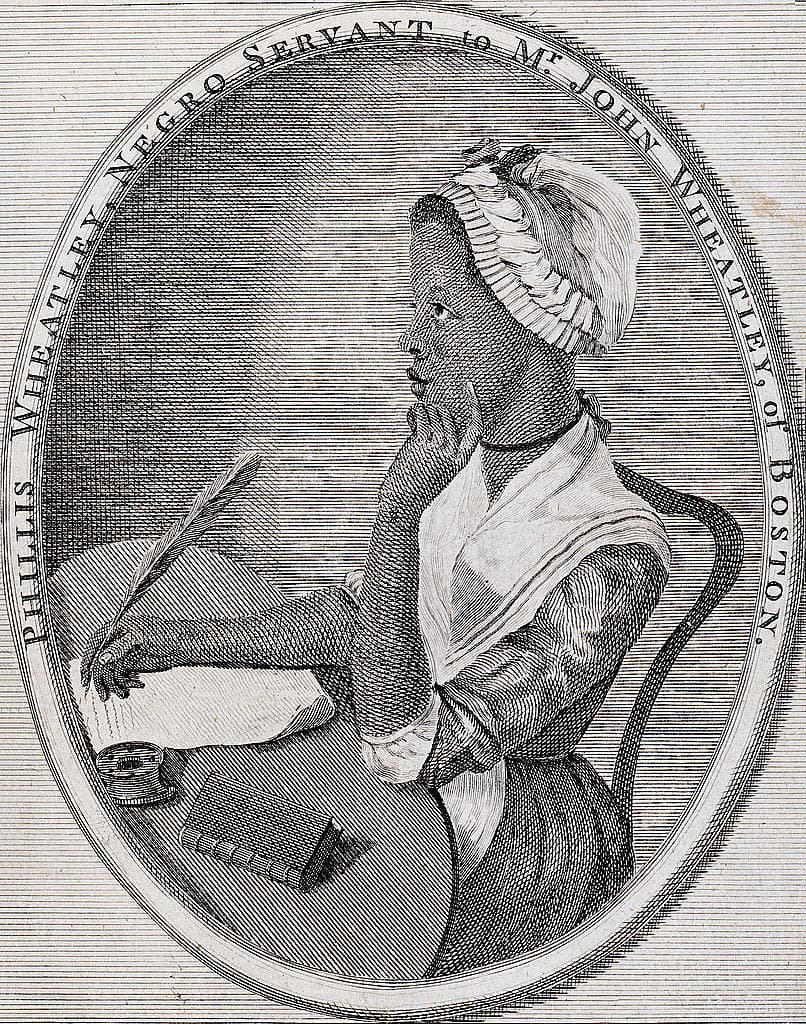
American · Literature
Phyllis Wheatley
1753 – December 5, 1784
Early Life and Background
Phillis Wheatley Peters (c. 1753–1784) was an enslaved African girl who became one of the most important poets in early American literature and the first African American woman to publish a book of poetry.[2][3][4] She was born around 1753 in West Africa, with many historians suggesting the region of present-day Gambia or Senegal based on shipping records and later testimony.[2][3]
At about seven or eight years old, Wheatley was captured by slave traders and forced onto a transatlantic voyage to North America.[2][3][4] In 1761 she arrived in Boston aboard a slave ship named the Phillis, from which she would derive her new first name.[3][12] Upon arrival, she was sold to John and Susanna Wheatley, a prosperous merchant family living in Boston, Massachusetts.[2][3][4]
The Wheatleys initially acquired Phillis as a domestic servant. She was physically small and frail, which likely influenced Susanna Wheatley’s decision to assign her lighter duties and allow her time indoors.[1][3] Within the household, Phillis quickly learned English and began to exhibit exceptional intelligence. Unlike most enslaved people in British North America, she was taught to read and write; she studied the Bible, classical literature, history, and geography.[2][3][6][7] She also encountered English poetic models, including Alexander Pope, John Milton, and Thomas Gray, whose influence would shape her own work.[6][7]
By the age of about twelve or thirteen, Wheatley was composing verse, a remarkable accomplishment given the legal and social restrictions on enslaved Black education.[3][6][7] Her learning took place informally under the guidance of the Wheatley family and their social circle, rather than through formal schooling. Nonetheless, she developed a level of literacy and classical knowledge that rivaled or exceeded that of many free white colonists.
Literary Beginnings and First Publications
Wheatley’s early poems circulated first in manuscript among Boston’s literate elite and then in local newspapers. According to literary historians, her first known published poem appeared on December 21, 1767, when the Newport, Rhode Island Mercury printed “On Messrs. Hussey and Coffin.”[2][3][6] The poem, written in heroic couplets and grounded in moral reflection, signaled that an enslaved African girl could participate with sophistication in the colonial literary public sphere.
In her mid-teens, Wheatley continued to compose occasional poems, elegies, and religious verse that responded to events in Boston and beyond. She gained particular attention for “An Elegiac Poem, on the Death of the Celebrated Divine George Whitefield,” published in 1770.[3][5] The elegy memorialized the famed itinerant preacher of the Great Awakening and circulated widely in both the colonies and Britain. Its success established Wheatley as a poet of religious feeling whose work resonated with the transatlantic Protestant community.[3]
During this period she also wrote notable poems such as “To the University of Cambridge, in New-England”, which addressed Harvard students and urged them to live up to their religious and moral responsibilities.[10] Another widely studied poem, “On Being Brought from Africa to America” (written around 1768), interpreted her own enslavement through a Christian lens, acknowledging the brutality of slavery while emphasizing the possibility of spiritual salvation.[2][6] These works reveal her complex negotiation of race, faith, and freedom in an era when Black humanity was widely denied.
Poems on Various Subjects and Transatlantic Recognition
By the early 1770s, Wheatley had produced enough poems to envision a collected volume. Because colonial publishers doubted that an enslaved African woman could attract subscribers or readers, she faced significant skepticism.[6][10] To counter this, the Wheatley family organized a panel of Boston gentlemen—ministers, scholars, and civic leaders—to examine her and confirm that she was indeed the author of the poems attributed to her.[4][6][10] Their signed testimonial, later printed as an “attestation” in her book, indicates the racial prejudice she confronted: her genius itself had to be proven.
With local support uncertain, Wheatley and her allies turned to Britain. Through correspondence and Boston merchant networks, she attracted the attention of Selina Hastings, the Countess of Huntingdon, a prominent evangelical patron.[3][6] The Countess agreed to support publication of Wheatley’s poems in London, on the condition that the poet travel there to oversee the process.[3]
In 1773 Wheatley sailed to London with Nathaniel Wheatley, the son of her enslavers.[3][6] In London she was presented to members of the British aristocracy and intellectual circles, including figures associated with evangelical reform movements.[1][6] She visited historic sites, met publishers, and received considerable acclaim as a literary curiosity and as evidence that Africans could master “polite” literature.[1][6]
Later in 1773, her collection Poems on Various Subjects, Religious and Moral was published in London.[2][3][4][6] The volume included religious meditations, elegies, odes, and poems on public events. Scholars widely recognize it as the first book written by an African American woman and one of the first published volumes of poetry by any woman in colonial America.[1][3][5][8][10] Many historians also regard Wheatley as the first person of African descent in the United States to publish a book of poetry, and likely the first enslaved person in the colonies to do so.[1][5][8]
Publication of Poems on Various Subjects transformed Wheatley into a transatlantic literary celebrity. The book’s subscribers included influential clergy and statesmen, and reviews noted both her mastery of neoclassical forms and the political implications of her race and status. For abolitionists in Britain and North America, Wheatley’s work became a powerful example used to argue that enslaved Africans possessed equal intellectual potential and deserved freedom.[1][6][8]
Emancipation and Revolutionary-Era Writings
Phillis’s journey to London coincided with a major shift in her legal status. While she was abroad, Susanna Wheatley’s health declined, and arrangements were made that led to Phillis’s manumission.[3][4][6] Sources differ on the exact timing, but Wheatley appears to have been freed around the time of the 1773 publication of her book, either shortly before or after her return to Boston.[3][4][6][10] Once emancipated, she adopted the surname Peters after her later marriage, though she continued to be widely known by her former enslavers’ surname.
Back in Boston, Wheatley used her poetry and prose to participate in debates surrounding the emerging American Revolution. She composed verses on events such as the Boston Massacre, though some of these poems remain known only through references or partial texts.[14] Most famously, she wrote a poem-letter to George Washington, then commander-in-chief of the Continental Army.[4][5][6]
In 1775 Wheatley sent Washington a poem titled “To His Excellency General Washington,” praising him as a leader of the American cause and invoking classical images of liberty.[4] Washington acknowledged the poem in a letter, and in early 1776 he invited Wheatley to visit him at his headquarters in Cambridge, Massachusetts.[4][6] The poem was published in 1776, further cementing her association with Revolutionary patriotism.[4][5] Her engagement with the Revolution was not uncritical; in letters and poems, she highlighted the contradiction between colonial demands for liberty and the continued enslavement of Africans.[3][6][12]
Wheatley also wrote letters to ministers and other figures addressing themes of slavery and spiritual equality. Her correspondence demonstrates that she saw her literary vocation as intertwined with moral reform. While her language often used Christian universalism, she implicitly condemned racial bondage and urged her readers to imagine a world in which Black and white people shared spiritual and civic freedom.[3][6]
Personal Life and Economic Hardship
After emancipation, Wheatley’s social and economic situation changed dramatically. Freed from the Wheatley household, she no longer had the material security or domestic protection that had allowed her to write. Around 1778 she married John Peters, a free Black man in Boston variously described as a shopkeeper, lawyer-in-training, or laborer.[3][4][5] Peters reportedly aspired to professional status and faced chronic economic instability.
The marriage placed Wheatley in the precarious world of free Black life in a city unsettled by war and shifting trade patterns. The couple struggled with debt, relocations, and limited employment opportunities due to pervasive racial discrimination.[3][4][10] Wheatley bore children, but most or all of them died in infancy or childhood; sources indicate that at least one child died on the same day she did.[5][10] These losses compounded the emotional and financial strain of her later years.
Despite hardship, Wheatley continued to write. She prepared a second volume of poetry and prose that she hoped to publish in the 1780s, including more explicitly antislavery pieces.[3][4][6] However, she was unable to secure sufficient subscriptions or patronage from American publishers, who were suspicious of both the market for poetry and the work of a Black woman author amidst postwar economic uncertainty.[3][6][10] As a result, many of the poems she composed after 1773 remained in manuscript and were only recovered piecemeal by later scholars.
Later Life and Death
In her final years, Wheatley lived in increasingly modest circumstances. Some accounts suggest that John Peters was imprisoned for debt or forced to leave Boston, leaving Wheatley to support herself.[3][4][10] She took up domestic work or other low-paid positions while continuing to write when possible. The dramatic contrast between her earlier celebrated status and her later poverty underscores the fragility of Black literary success in a society structured by racism and economic inequality.
In 1784 Wheatley became ill, likely with pneumonia.[10] On December 5, 1784, she died in Boston at about thirty-one years of age.[2][3][4][5][7][10] Contemporary reports indicate that she died in a boarding house, and that her last surviving child died the same day.[5][10] She was buried in an unmarked grave, a stark conclusion to the life of a woman whose published poetry had once drawn international acclaim.
Major Works and Themes
Wheatley’s only published book during her lifetime, Poems on Various Subjects, Religious and Moral, contains a wide range of compositions. Her poems often follow neoclassical conventions, employing heroic couplets, formal diction, and references to classical mythology and history.[2][6] Major themes include:
- Religion and Salvation: Wheatley frequently explored Christian concepts of grace, providence, and redemption, as in “On Being Brought from Africa to America,” where she acknowledges the trauma of enslavement but emphasizes spiritual equality.
- Mortality and Elegy: Many poems are elegiac, commemorating ministers, friends, and public figures such as George Whitefield, reflecting both personal grief and communal religious sensibilities.[2][3]
- Liberty and Politics: Her Revolutionary-era works praise figures like Washington while underscoring the irony of enslaved peoples excluded from the liberty that colonists sought.[4][6]
- Race and Identity: Wheatley’s poetry subtly confronts racism, insisting on Black intellectual and spiritual worth through her very mastery of English verse and occasional explicit references to racial prejudice.
Individual poems such as “To the University of Cambridge, in New-England,” “On Being Brought from Africa to America,” and “To His Excellency General Washington” have become staples of American literature curricula, studied for their rhetorical complexity and historical significance.[2][3][4][6][7]
Awards, Honors, and Contemporary Reception
In the eighteenth century, formal literary prizes were less common than today, but Wheatley received numerous forms of recognition. Her London publisher and subscribers treated her book as a remarkable event, and the Countess of Huntingdon’s patronage conferred elite endorsement.[3][6] In Boston, prominent men signed a testimonial vouching for her authorship, implicitly acknowledging her talent even as they upheld a racial hierarchy.[4][6][10]
Leading figures of the Revolutionary generation were aware of her work. George Washington praised her in personal correspondence, and there are reports that Benjamin Franklin admired her poetry.[12] Clergy quoted her lines in sermons, and abolitionists later cited her case as evidence for African intellectual equality.[1][6][8]
Although she did not receive formal titles such as “poet laureate” in her own time, later commentators have described her as a kind of unofficial poet laureate of the American Revolution, due to her prominent verses on Revolutionary events and leaders.[10] Her success was extraordinary given that she wrote from the position of enslavement and later precarious freedom.
Legacy and Historical Impact
Phillis Wheatley’s legacy extends far beyond the individual poems she produced. She is generally regarded as the first African American author of a published book of poetry and the first African American woman to publish a book in what became the United States.[1][3][4][5][8][10] She is also only the third woman in colonial America known to have published a volume of poetry.[1][3][8]
Her life and work have become central to the field of African American literary studies. Scholars see Wheatley as the foundational figure of a tradition that would later include Frederick Douglass, Frances E.W. Harper, Langston Hughes, and many others.[9] The fact that she produced sophisticated English verse while enslaved—and that she had to submit to an examination to prove her authorship—highlights both the oppressive structures of the eighteenth century and the resilience of Black creativity.
For abolitionists in the late eighteenth and nineteenth centuries, Wheatley’s book served as powerful evidence in debates over slavery. Her success contradicted racist arguments that Africans were inherently inferior or incapable of intellectual achievement. Writers and activists cited her as an example when demanding the end of slavery and the recognition of Black humanity.[1][6][8]
In the twentieth and twenty-first centuries, Wheatley has been the subject of renewed scholarly attention. Historians and literary critics have explored her negotiation of religious language, her subtle critiques of slavery, and the gendered dynamics of her authorship. Institutions such as the National Portrait Gallery, the National Park Service, and the National Women’s History Museum now feature Wheatley in exhibitions and educational materials, reflecting her status as a key figure in U.S. cultural history.[1][3][5]
Recent public history projects and media, including documentaries, biographies, and articles, emphasize her role in “shaping the US,” to borrow the phrasing of one contemporary analysis, by forcing readers—then and now—to confront the dissonance between ideals of liberty and the reality of slavery.[8] Modern poets and writers have engaged with Wheatley intertextually, reimagining her voice and situating her within broader narratives of Black women’s resistance.
Commemoration and Ongoing Reassessment
Today, Wheatley is commemorated in multiple ways. Schools, literary prizes, and community organizations bear her name. Public art and monuments, such as statues and portraits, depict her both as a historical person and as a symbol of early African American achievement.[1][5] Digital archives and library projects, including work by the Boston Public Library, seek to trace her life, recover lost manuscripts, and place her in the material context of eighteenth-century Boston.[13]
Scholars also reassess her work through contemporary lenses. Earlier critics sometimes viewed her strong Christian orthodoxy and formal neoclassical style as conservative. More recent interpretations highlight how she appropriated these dominant forms to express subtle critiques of slavery and racial prejudice, making strategic choices about what could be said in print by an enslaved Black woman.[6][8]
Her biography continues to raise challenging questions: How did race, gender, class, and religion shape the possibilities for Black authorship? What does it mean that an enslaved person’s genius was validated only through examination by white male authorities? How do we interpret religious language that both consoles and confronts? Wheatley’s life invites reflection on these issues, making her work not only historically important but philosophically and politically resonant.
More than two centuries after her death, Phillis Wheatley Peters remains a central figure in women’s history, African American history, and the history of literature. Her journey from a captured child on a slave ship to a celebrated author with transatlantic influence encapsulates both the brutality of slavery and the transformative power of education, faith, and artistic expression.[2][3][4][6][8]
Dated achievements
3 indexed.
- Dec211767Literature
First published poem: “On Messrs. Hussey and Coffin”
First published poem: “On Messrs. Hussey and Coffin” in Newport Mercury.
View details Phillis Wheatley - Poetry Foundation - Jan011773Literature
Publication of first book of poems
Publication of first book of poems: "Poems on Various Subjects, Religious and Moral."