← All women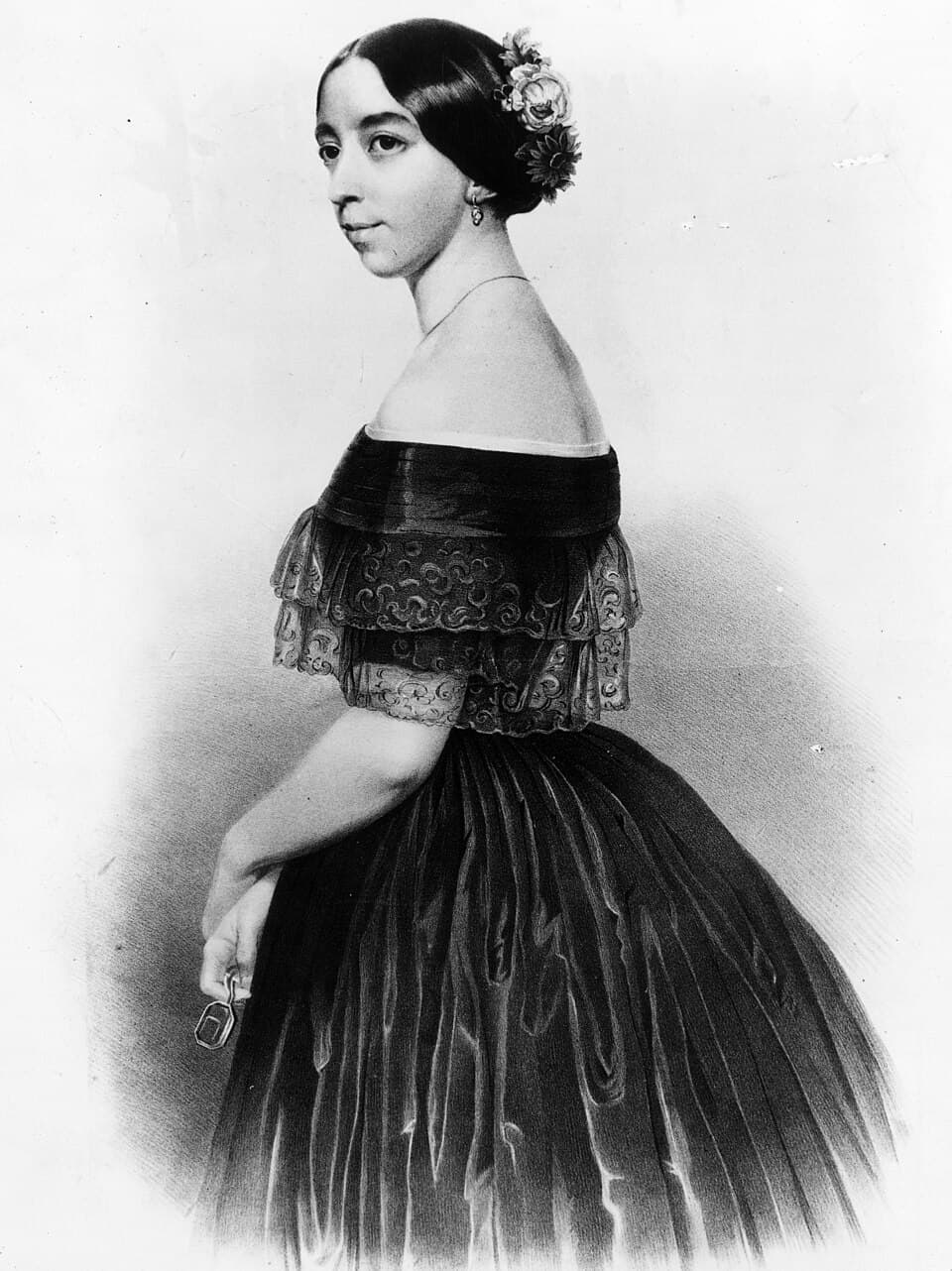
French, Spanish · Arts · Literature
Pauline Viardot
July 18, 1821 – May 18, 1910
Early Life and Family Background
Pauline Viardot, born Pauline Michelle Ferdinande García on July 18, 1821, in Paris, France, entered the world as the youngest child of one of the nineteenth century's most extraordinary musical dynasties. Her father, Manuel García, was a celebrated Spanish tenor, composer, and vocal pedagogue whose innovative teaching methods would influence generations of singers. Her mother, Joaquina Sitchez, was also a trained singer and actress. Pauline's elder sister, Maria Malibran, became one of the most legendary and beloved opera singers of the Romantic era before her tragic death at age 28 in 1836, while her brother, Manuel García Jr., became a renowned singing teacher credited with inventing the laryngoscope, a device that revolutionized the scientific understanding of the human voice.
Pauline's childhood was defined by constant travel and rigorous artistic training. Her father's opera company toured extensively, taking the family to London, Paris, New York, and Mexico City. Amid this itinerant existence, Pauline received an exceptionally broad education: she studied piano seriously, reportedly with lessons from or exposure to Franz Liszt, studied composition with theorists including Anton Reicha, and developed fluency in numerous languages—French, Spanish, Italian, English, German, and later Russian—that would serve her throughout her international career. Initially, her family envisioned a career for her as a concert pianist rather than a singer, but her father died in 1832 when Pauline was only eleven, and the death of her sister Maria Malibran in 1836 reoriented the family's ambitions toward Pauline's vocal gifts, which her mother and brother began cultivating intensively.
Career Beginnings and Rise to International Fame
Pauline García made her official operatic debut in London on May 9, 1839, performing the role of Desdemona in Rossini's Otello. She quickly followed this with a Paris debut later that year, and critics and audiences alike were struck by her dramatic power, unusual vocal range (she could sing both mezzo-soprano and soprano repertoire with remarkable flexibility), and sophisticated musical intelligence—qualities that distinguished her from singers who relied purely on natural vocal beauty. Unlike her sister Malibran, whose voice was often described as ravishing but somewhat untamed, Pauline's artistry was marked by intellectual rigor, precise musicianship, and an almost scholarly approach to interpretation, informed by her training in composition and piano.
On April 16, 1841, she married Louis Viardot, a French writer, art critic, and director of the Théâtre-Italien in Paris, who was twenty years her senior. The marriage, while partly arranged for practical and protective reasons common to the era, proved to be a genuine partnership: Louis managed much of Pauline's career, translated opera librettos and other texts for her, and supported her professional ambitions to an unusual degree. Adopting her married name, Pauline Viardot began to build one of the most illustrious singing careers of the century.
Major Performances, Compositions, and Artistic Collaborations
Throughout the 1840s, 1850s, and into the 1860s, Viardot performed on the great stages of London, Paris, Berlin, Vienna, and St. Petersburg, becoming one of the most sought-after mezzo-sopranos in Europe. Composers wrote roles specifically to showcase her extraordinary vocal and dramatic range. Giacomo Meyerbeer composed the demanding role of Fidès in Le prophète (1849) for her, a performance widely regarded as one of the operatic triumphs of the era. Hector Berlioz enlisted her for his celebrated 1859 revival of Gluck's Orphée et Eurydice, in which she sang the title role of Orphée—a landmark production that helped restore Gluck's reformist opera to the standard repertoire.
Viardot was also closely associated with many of the leading composers and musicians of her time. She maintained close friendships and professional relationships with Frédéric Chopin, Franz Liszt, Johannes Brahms, Charles Gounod, Camille Saint-Saëns, and Gabriel Fauré, among others; several dedicated works to her or sought her counsel. Beyond performance, Viardot was herself an accomplished composer, producing numerous songs (many setting texts by Turgenev, Pushkin, and other poets), several operettas performed in her private salon theater (including works such as Le dernier sorcier, with libretto by Turgenev), and chamber pieces. Her compositional output, though historically overshadowed by her performing fame, has undergone significant scholarly and performance revival in recent decades, recognized as a substantial achievement for a woman composer working within the constraints of nineteenth-century musical institutions that rarely welcomed women as creators rather than performers.
Viardot gave her farewell operatic performances in the early 1870s, after which she largely retired from the public stage but continued an active career as a highly sought-after singing teacher, running an influential vocal studio in Paris and, for a period, teaching at the Paris Conservatoire. Her pedagogical influence extended to numerous singers who carried her father's and her own vocal traditions into the next generation.
Personal Life and the Turgenev Relationship
Perhaps the most historically resonant aspect of Viardot's personal life was her extraordinary, decades-long relationship with the Russian novelist Ivan Turgenev, whom she met in 1843 when he attended her performances in St. Petersburg. Turgenev became devoted to Viardot for the rest of his life, following her and her family across Europe, living for extended periods in properties near the Viardot household in France and Germany, and forming what is widely regarded as one of the great platonic (or possibly romantic) literary-artistic partnerships of the century. The precise nature of their relationship has been the subject of extensive biographical speculation, but its intellectual and emotional intimacy is undisputed; Turgenev collaborated with Viardot on operetta libretti and remained a fixture of the extended Viardot family until his death in 1883, the same year as Louis Viardot's death.
Pauline and Louis Viardot had four children: Louise Héritte-Viardot, who became a composer and singer in her own right; Claudie; Marianne, who was briefly engaged to composer Gabriel Fauré; and Paul Viardot, who became a violinist. The Viardot household, wherever it was located—Paris, Baden-Baden, or Bougival near Turgenev's residence—functioned as a vibrant salon attracting writers, composers, and artists, cementing Pauline's role not merely as a performer but as a central cultural node of European Romanticism.
Legacy and Historical Significance
Pauline Viardot's legacy is multifaceted. As a performer, she was celebrated as one of the greatest dramatic mezzo-sopranos of the nineteenth century, admired for combining vocal virtuosity with genuine musical and dramatic intelligence. As a composer, she produced a substantial and increasingly recognized body of work that challenged the era's assumptions about women's creative capacities, composing songs, operettas, and chamber music that drew praise from major contemporaries. As a teacher, she shaped the technique of subsequent generations of singers. And as a cultural figure, she stood at the intersection of the great literary and musical currents of her time, personally connected to figures ranging from George Sand to Turgenev to Brahms.
Her family's legacy in the history of vocal science and performance—through her father's pedagogy and her brother's invention of the laryngoscope—further situates Pauline Viardot within a lineage that fundamentally shaped how the Western world understood and trained the singing voice. Modern scholarship, particularly feminist musicology of recent decades, has increasingly reclaimed Viardot as an important composer in her own right rather than merely a muse or performer, with revivals of her operettas and songs appearing in concert programs and recordings.
Later Life and Death
Following her retirement from the stage, Viardot spent her later decades in Paris, continuing to teach, compose, and host the artistic circles that had always surrounded her. She lived through the death of her husband Louis in 1883 and her devoted friend Turgenev the same year, outliving most of her great contemporaries. Pauline Viardot died in Paris on May 18, 1910, at the age of 88, having lived through nearly the entirety of the Romantic era's rise and transformation and into the dawn of musical modernism. She is remembered today as one of the towering musical personalities of the nineteenth century—a singer, composer, and teacher whose life bridged the worlds of Rossini and Fauré, and whose personal and artistic relationships left an indelible mark on the cultural history of Europe.
Dated achievements
4 indexed.
- Jul181821Arts
Born in Paris to a Family of Musicians
Pauline Michelle Ferdinande García was born in Paris on July 18, 1821, into one of the most celebrated musical families of the era.
View details Pauline Viardot - Wikipedia - May091839Arts
Operatic Debut in London as Desdemona
Pauline García made her professional operatic stage debut in London in Rossini's Otello, launching her international singing career at age 17.