← All women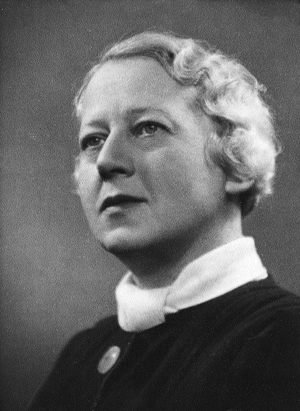
Norwegian · Arts · Activism
Pauline Hall
August 2, 1890 – January 24, 1969
Early Life and Background
Pauline Hall was born on August 2, 1890, in Hamar, Norway. Her family was well-educated, and their Icelandic-Norwegian heritage exposed Pauline to a rich cultural environment. She showed an early aptitude for music, attending piano and composition lessons in Oslo under the tutelage of teachers like Catharinus Elling. This foundation set her on a path toward becoming one of Norway’s respected composers.
Career Beginnings and Development
Hall's career began in earnest in the early 1910s. She moved to Paris to study further and was deeply influenced by the vibrant artistic scene, which included names like Erik Satie and Jean Cocteau. During this period, Hall began crafting her unique compositional voice characterized by a blend of Romanticism with modernist elements.
Major Works and Accomplishments
One of Hall's early works, the orchestral piece Violin Concerto (1924), gained acclaim for its innovative structure. Her 1931 Suite for Strings reinforced her reputation, showcasing her skill in exploiting string textures. Hall's most significant influence was perhaps as a founding member and leader of the Society of Contemporary Music which promoted the works of modern composers.
Awards, Honors, and Recognition
Hall received numerous accolades for her contributions to music and cultural life in Norway. Her efforts in advocating for contemporary music ensured a vibrant cultural scene, earning her a lasting place in Norwegian music history. Though her career faced challenges during World War II, Hall remained active in preserving and promoting new musical works.
Personal Life
Pauline Hall was known for her vivacious personality and strong intellect. Though she rarely discussed her personal life publicly, her letters and critiques reveal a woman deeply committed to her craft and the cultural growth of Norway.
Legacy and Historical Impact
Hall's advocacy for modern music bridged cultural divides and introduced Norwegian audiences to the avant-garde. Her work with the Society of Contemporary Music enabled composers to find platforms for their work, fostering a progressive artistic environment. Her efforts greatly influenced the acceptance and understanding of modernist music in Norway.
Later Life and Death
In her later years, Hall continued to compose and critique, influencing younger generations. She passed away on January 24, 1969, in Oslo, leaving behind a legacy as a pioneer in Norwegian music whose impact is still studied and celebrated today.
Dated achievements
2 indexed.
- Aug021890Arts
Born in Hamar, Norway
Pauline Hall was born on August 2, 1890, in Hamar, Norway.
View details Pauline Hall (composer) - Wikipedia - Dec251969Arts
Died in Oslo, Norway
Pauline Hall died on December 25, 1969, in Oslo, Norway, at age 79.
View details