← All women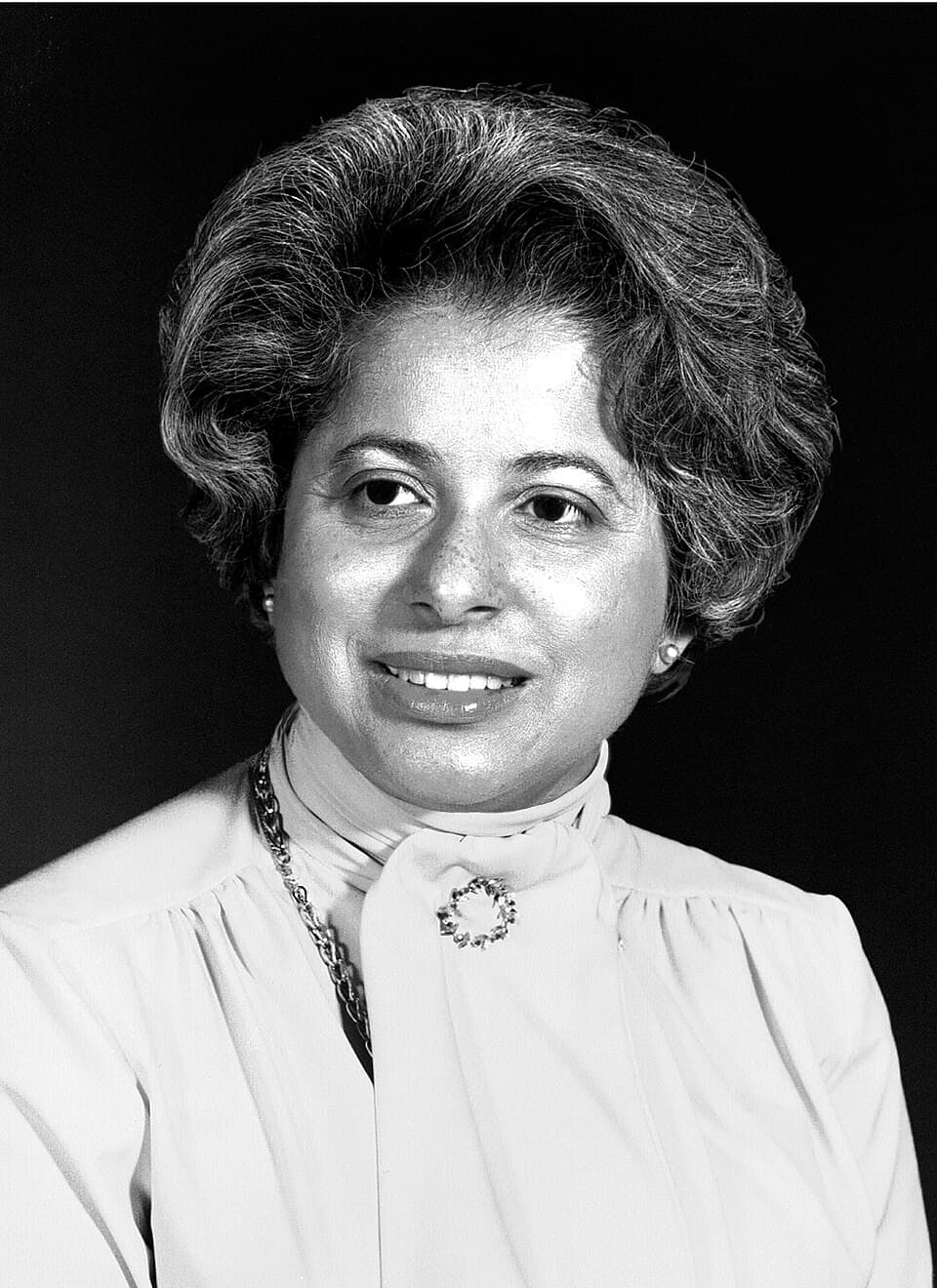
American · Politics · Law
Patricia Roberts Harris
May 31, 1924 – March 23, 1985
Early Life and Background
Patricia Roberts Harris was born on May 31, 1924, in Mattoon, Illinois, to Hildren and Bert Roberts, an African American working-class couple living in the segregated Midwest.[3][2] Her parents divorced when she was young, and she was raised primarily by her mother, who moved the family to Chicago in search of better economic opportunities.[4][8] Growing up during the Great Depression, Harris experienced both the economic precarity and racial discrimination that shaped Black communities in northern cities, experiences that would later inform her commitment to social justice and public service.
Harris attended Chicago’s Englewood High School, where she excelled academically, graduating with highest honors.[12] Her scholastic achievements earned her a scholarship to Howard University in Washington, D.C., one of the premier historically Black colleges and universities (HBCUs). At Howard, she studied political science and economics and quickly distinguished herself as a campus leader. She served as vice president of the campus NAACP chapter and took part in sit-ins and direct-action campaigns to desegregate restaurants and other public accommodations in the nation’s capital.[3][12] These early civil rights activities honed her organizational skills and deepened her belief in the capacity of law and politics to challenge entrenched inequality.
Harris graduated from Howard University in 1945, completing her degree in three years and earning summa cum laude honors; she was also elected to Phi Beta Kappa, an elite academic honor society.[3][5][8] After graduating, she pursued graduate studies in industrial relations at the University of Chicago, further broadening her understanding of labor issues and economic structures that affected working people, particularly African Americans.[12]
Career Beginnings and Development
Following her undergraduate education, Harris worked in the civic and social-service sectors. From 1946 to 1949, she served with the Chicago branch of the Young Women’s Christian Association (YWCA), working on programs that supported young women’s economic and social advancement.[8] She then moved into national civil rights advocacy, becoming assistant director of the American Council on Human Rights from 1949 to 1953, an organization affiliated with African American sororities that worked to combat segregation and discrimination through lobbying and public education.[8]
From 1953 to 1959, Harris served as executive director of Delta Sigma Theta Sorority, Inc., a major Black women’s service sorority known for its activism on civil rights, education, and community development.[8][5] In that role, she oversaw national programming, organizational management, and public-policy initiatives, gaining experience in administration and advocacy that would later prove critical in her governmental roles. During the early 1960s, President John F. Kennedy appointed her co-chair of the National Women’s Committee for Civil Rights, a coalition that coordinated efforts among women’s organizations to support civil-rights legislation.[5] This appointment placed her at the intersection of the civil rights and women’s movements.
Encouraged by her husband and driven by her growing interest in using the law as a tool for equality, Harris enrolled in law school in the 1950s. She attended George Washington University Law School, where she again excelled academically. She completed her law degree with high honors and graduated near the top of her class.[5][4] Harris was admitted to the District of Columbia Bar and qualified to practice before the Supreme Court of the United States, signaling both her legal competence and her ambitions within the profession.[5]
After law school, Harris worked in the criminal division of the U.S. Department of Justice, gaining experience in federal legal practice.[8][4] In 1961, she joined the faculty of Howard University School of Law as a lecturer and later as a full professor, teaching courses and mentoring a generation of students who would themselves enter civil rights and public-interest law.[5][8] At Howard she also served as associate dean of students, further sharpening her administrative capabilities.[5]
Rise in Diplomacy and National Politics
Harris’s national profile rose sharply in the mid-1960s. In 1965, President Lyndon B. Johnson appointed her U.S. Ambassador to Luxembourg, a position she held until 1967.[2][1][8] With this appointment, she became the first African American woman to serve as a U.S. ambassador and to hold ambassadorial rank in the American foreign service.[2][3] In Luxembourg, Harris represented U.S. interests in a strategically important Western European country during the Cold War, navigating diplomatic relations while also serving as a highly visible symbol of America’s evolving stance on race and gender.
Her ambassadorship broke significant ground in a State Department and diplomatic corps long dominated by white men. While in Luxembourg, she engaged with European leaders, advocated U.S. policy positions, and strengthened bilateral relations. Her performance countered racist and sexist assumptions that had historically excluded women and African Americans from such posts and helped broaden the perceived pool of qualified candidates for high-level diplomatic roles.[3][1]
With the end of the Johnson administration in 1967, Harris resigned her ambassadorship and returned to Howard University School of Law.[5][8] Back in Washington, she resumed teaching and deepened her involvement in legal education and civil rights advocacy. In 1969, she achieved another historic milestone when she was named dean of Howard University School of Law, becoming the first African American woman to serve as dean of a U.S. law school.[3][5] Although her tenure as dean was relatively brief, her appointment represented a transformative moment in legal academia, signaling that Black women could lead major law faculties at a time when they remained scarce in faculty ranks nationwide.
Harris also moved into the corporate sphere. In 1971, she joined the board of directors of IBM, making her the first African American woman to serve on the board of a Fortune 500 company.[5] Her presence on the IBM board was highly significant in the context of the early 1970s, when large corporate boards were overwhelmingly male and white. She brought to the boardroom a deep understanding of civil rights, public policy, and administrative law, contributing to discussions on corporate responsibility, employment practices, and community engagement.
During the early and mid-1970s, Harris also practiced law privately in Washington, D.C., while remaining engaged in public-policy debates and Democratic Party politics.[8][4] Her experience in government, academia, civil rights, and corporate governance made her an attractive candidate for national executive office when Democrat Jimmy Carter won the presidency in 1976.
Cabinet Service: Housing and Urban Development
In 1977, President Carter appointed Harris as Secretary of Housing and Urban Development (HUD).[1][2][4] With this appointment, she became the first African American woman to hold a U.S. Cabinet post and to head a Cabinet department.[2][3] Her service at HUD marked a turning point in the representation of women and African Americans in the highest levels of the U.S. executive branch.
As HUD secretary, Harris confronted complex challenges related to urban decline, housing discrimination, and federal support for low-income communities. The late 1970s were characterized by debates over the role of the federal government in urban policy, as cities grappled with deindustrialization, fiscal crises, and persistent racial segregation in housing. Harris oversaw programs pertaining to public housing, community development block grants, and fair housing enforcement.[1][4] She advocated for policies that expanded affordable housing and sought to strengthen enforcement of anti-discrimination provisions in the housing market.
Harris’s leadership style at HUD was often described as demanding and exacting; she expected high standards of performance from her staff and maintained a strong focus on program integrity.[3][4] Her presence in the Cabinet also had symbolic importance: as a Black woman overseeing federal urban policy, she embodied a level of representation that many civil rights activists had long sought but rarely seen in practice.
Her Cabinet appointment placed her in the presidential line of succession, making her the first African American woman included in that constitutional order.[3][7] By statute, Cabinet secretaries follow the vice president, congressional leaders, and earlier-listed secretaries in the order of succession, so Harris’s position underscored both the practical and symbolic significance of her role in national governance.
Cabinet Service: Health, Education, and Welfare / Health and Human Services
In 1979, Carter selected Harris to head the Department of Health, Education, and Welfare (HEW), one of the largest and most complex departments in the federal government.[1][4][8] With this appointment, she became the first African American woman to lead two different Cabinet departments.[3][4] Her portfolio now extended beyond housing to include federal health programs, social services, and education policy.
During Harris’s tenure, HEW underwent a major reorganization. In 1980, the department was split, and the Department of Health and Human Services (HHS) was created. Harris served as the last secretary of HEW and then as the first secretary of HHS, overseeing key programs such as Medicare, Medicaid, and various social-service initiatives.[1][7][8] She navigated debates over welfare policy, healthcare access, and the federal role in supporting vulnerable populations at a time of growing political pressure to reduce public spending.
Although specific policy details of her tenure are complex, Harris’s leadership at HEW and HHS positioned her at the center of national conversations about the social safety net and the federal government’s obligations to marginalized communities. Her work helped shape the institutional structure that continues to govern health and human services policy in the United States.
Major Accomplishments and Historical Firsts
Across her career, Harris accumulated a remarkable series of historic “firsts” that collectively reshaped expectations for African American women in law, diplomacy, and politics:
- In 1965, she became the first African American woman U.S. ambassador, serving in Luxembourg.[2][3]
- In 1969, she was named dean of Howard University School of Law, the first African American woman to serve as dean of a U.S. law school.[3][5]
- In 1971, she was appointed to the IBM board of directors, making her the first African American woman on a Fortune 500 corporate board.[5]
- In 1977, she became Secretary of Housing and Urban Development, the first African American woman Cabinet secretary and the first to head a Cabinet department.[2][3][4]
- With this Cabinet role, she also became the first African American woman in the U.S. presidential line of succession.[3][7]
- In 1979, her appointment as Secretary of Health, Education, and Welfare (later HHS) made her the first African American woman to lead two different Cabinet departments.[3][4][8]
These milestones were not merely symbolic. In each realm—diplomatic, academic, corporate, and governmental—Harris exercised real authority over policy, budgets, and institutional culture. Her achievements demonstrated that women of color could occupy and excel in leadership positions previously closed to them, thereby widening the pool of potential leaders and altering the expectations of institutions and the public.
Awards, Honors, and Recognition
Harris’s accomplishments earned her significant recognition during and after her lifetime. She was widely honored in legal, academic, and civil rights circles for her trailblazing career. Her academic performance at Howard—graduating summa cum laude and being elected to Phi Beta Kappa—stood as early markers of excellence that were frequently cited in later biographical accounts.[3][5]
After her death, Harris was inducted into the National Women’s Hall of Fame, which recognized her as a woman of many firsts and highlighted her dedication to public service, civil rights, and social justice.[5] Institutions such as the Smithsonian’s National Museum of African American History and Culture (NMAAHC) have featured her in exhibitions and digital stories, underscoring her role in the broader narrative of African American and women’s history.[3]
Her name has been commemorated in various ways, including scholarships, lectures, and institutional programs that honor her contributions to law, public administration, and civil rights. These honors collectively reflect a consensus among historians and public institutions that Harris was one of the most significant African American women in twentieth-century American government.
Personal Life
In her personal life, Patricia Roberts married William Beasely Harris, a prominent attorney and law professor, in the mid-1950s.[5][4] Her husband, who taught at Howard University School of Law, encouraged her to pursue legal education, a decision that profoundly shaped her career trajectory. Their partnership reflected a shared commitment to law, education, and public service.
The couple did not have children, and Harris often spoke of her work—teaching, public service, and advocacy—as central to her life’s purpose.[4][5] She was known to be intensely private about her personal affairs, focusing public attention instead on policy issues, institutional reform, and the advancement of civil rights.
Harris remained closely connected to the networks of Black professional and civic organizations that had supported her early career, including Delta Sigma Theta Sorority, Inc., and civil rights coalitions in Washington, D.C. Colleagues and students described her as demanding but deeply invested in mentoring aspiring lawyers and public servants, particularly women and African Americans.[3][5]
Later Life and Death
After the Carter administration ended in 1981, Harris returned full-time to Howard University School of Law, resuming her role on the faculty.[3][8] She continued to teach and write, sharing with students the insights she had gained from years in diplomacy and national policymaking. Her return to Howard symbolized a full-circle moment: from student activist to professor, dean, ambassador, Cabinet secretary, and finally senior mentor within the institution that had nurtured her early intellectual development.
During her final years, Harris remained engaged in civic and professional life, participating in conferences, serving on boards, and contributing to public discussions on law and policy. She also continued to be recognized as a role model for women and African Americans seeking careers in law, academia, and government.[3][6]
On March 23, 1985, Patricia Roberts Harris died in Washington, D.C., at the age of 60.[2][3][8] At the time of her death, she was still active on the Howard law faculty, underscoring her enduring commitment to legal education and mentorship. Her passing prompted tributes from political leaders, civil rights activists, academics, and former students, who emphasized both her personal rigor and the structural changes her career had helped to bring about.
Legacy and Historical Impact
Patricia Roberts Harris’s legacy lies in her transformative impact on multiple spheres—law, diplomacy, corporate governance, and federal public policy—and in the barriers she broke for African American women in public life. As the first African American woman ambassador, she altered the face of U.S. diplomacy and showed that women of color could credibly represent the nation abroad.[2][3] As the first African American woman dean of a U.S. law school, she challenged the overwhelmingly male leadership of legal education at a critical moment in the profession’s expansion.[3][5]
Her appointment as HUD secretary and later as head of HEW/HHS placed her at the center of federal policymaking on housing, health, and social welfare, areas profoundly shaped by racial and economic inequality.[1][4][8] These roles, combined with her historic presence in the presidential line of succession, broadened the public’s conception of who could govern at the highest levels.[3][7]
Harris’s service on the IBM board similarly helped open corporate boardrooms to women and minorities, signaling to major corporations that diverse leadership was both possible and valuable.[5] Her career demonstrated an integrated approach to change: working within institutions—universities, federal agencies, corporations—while also pushing those institutions toward greater equity and representation.
Historians and public institutions now situate Harris within the broader narrative of the civil rights movement and the rise of Black women’s leadership in the latter half of the twentieth century.[3][6] She is remembered not only for her “firsts” but also for the substantive contributions she made to public policy and legal education. Her life story continues to inspire students, lawyers, and public servants who seek to combine professional excellence with a commitment to justice.
Through her achievements, Patricia Roberts Harris helped redefine what was possible for African American women in American public life, leaving a legacy that endures in the institutions she transformed and the people she inspired.
Dated achievements
8 indexed.
- May311924Law
Birth of Patricia Roberts Harris
Patricia Roberts Harris was born in Mattoon, Illinois, the daughter of Hildren and Bert Roberts.
View details Higher Standard: Patricia Roberts Harris - Oct011965Politics
First African American woman U.S. ambassador (Luxembourg)
In 1965, Patricia Roberts Harris was appointed U.S. Ambassador to Luxembourg, becoming the first African American woman U.S. ambassador.