← All women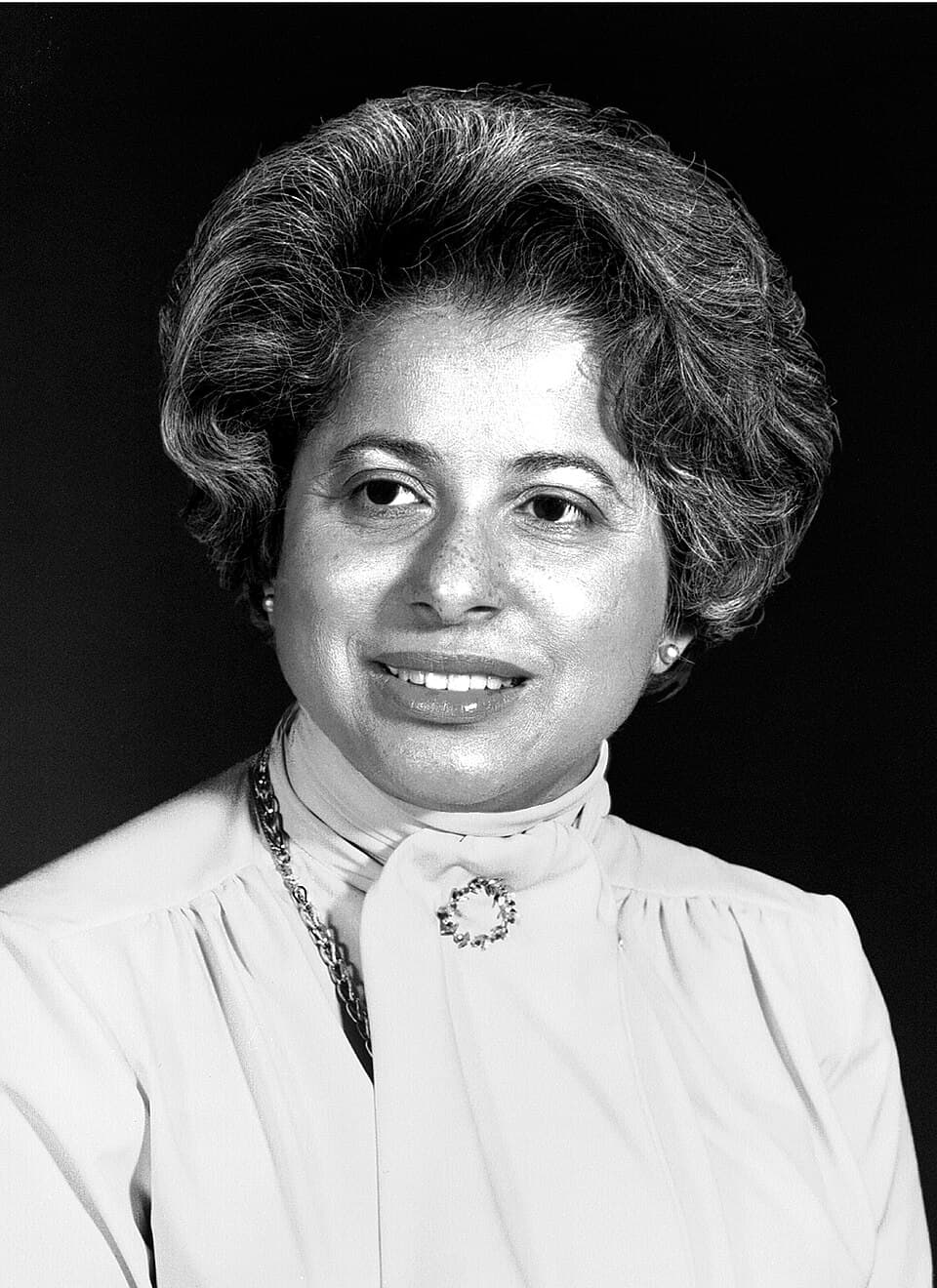
American · Politics · Law
Patricia Harris
May 31, 1924 – March 23, 1985
Early Life and Background
Patricia Roberts Harris was born on May 31, 1924, in Mattoon, Illinois, to Hildren, a seamstress, and Bert Roberts, a railroad dining‑car waiter.[2][6][7] Growing up Black in the Midwest during the Jim Crow era, she experienced the intersecting constraints of race, gender, and class that shaped the lives of many African Americans in the first half of the twentieth century.[2] Her parents’ working‑class occupations and the economic insecurity of the Great Depression framed her understanding of inequality and the importance of economic opportunity.
Harris attended public schools in Illinois and distinguished herself academically, earning a scholarship to Howard University in Washington, D.C., one of the leading historically Black universities.[2][3][6] At Howard she studied political science and economics, graduating summa cum laude in 1945.[2][3][4] Her undergraduate years coincided with a period of heightened Black student activism. She became involved in early sit‑ins aimed at desegregating Washington, D.C. restaurants, part of the broader struggle against racial discrimination in the nation’s capital.[2][9] These experiences fostered a lifelong commitment to civil rights and social justice.
In addition to her academic achievements, Harris was active in Delta Sigma Theta Sorority, Inc., a historically Black sorority with a strong tradition of public service and civic engagement.[4][11] Her later roles in the organization would deepen her national network among Black women professionals and activists, which in turn supported her ascent into leadership positions in law and government.
Career Beginnings and Development
Following her graduation from Howard in 1945, Harris embarked on a career in social service and advocacy that prefigured her later governmental work. From 1946 to 1949 she worked for the Chicago Young Women’s Christian Association (YWCA), focusing on programs for women and girls in an urban environment marked by racial segregation and economic inequality.[4] She then became assistant director of the American Council for Human Rights from 1949 to 1953, an organization that sought to advance civil rights and human rights through education and advocacy.[4][11]
In 1953, Harris assumed the position of executive director of Delta Sigma Theta, a role she held until 1959.[4] As head of the sorority, she coordinated national programs in education, civil rights, and community service, helping to place Black women’s leadership at the center of mid‑century social reform efforts. Her tenure reinforced her administrative skills and gave her extensive experience managing large, membership‑based organizations.
Harris’s trajectory shifted decisively toward law in the mid‑1950s. Encouraged by her husband, she enrolled in George Washington University Law School, where she excelled academically and graduated at or near the top of her class.[3][9][11] After receiving her law degree, she was admitted to the District of Columbia Bar and qualified to practice before the Supreme Court of the United States.[3] These credentials placed her among the relatively small cohort of Black women lawyers in the United States at the time.
After law school, Harris worked in the Criminal Division of the U.S. Department of Justice for approximately a year, gaining experience in federal law enforcement and criminal procedure.[4][6] In 1961, she joined the faculty of Howard University School of Law, initially as an assistant professor, marking the beginning of a long association with the institution that would include major administrative roles.[4] She later served as associate dean of students and lecturer at the law school and was promoted to full professor by 1963.[3]
Her growing influence in national policy circles was recognized in 1961, when President John F. Kennedy appointed her co‑chair of the National Women’s Committee for Civil Rights.[3][11] This role expanded her visibility in the federal government and connected her to broader efforts to mobilize women in support of civil‑rights legislation and enforcement.
Rise in Diplomacy and International Affairs
Harris’s transition into diplomacy came during the presidency of Lyndon B. Johnson. In 1965, Johnson selected her as U.S. ambassador to Luxembourg, making her the first African American woman appointed to a U.S. ambassadorship and the first to hold ambassadorial rank.[2][6][7][11] She served in Luxembourg until 1967, representing American interests in a small but strategically important European state and projecting a new image of U.S. leadership that included women and people of color.[5][6]
Her ambassadorship was widely noted as a major breakthrough. At a time when the U.S. foreign service was overwhelmingly white and male, Harris’s appointment sent a signal that diplomatic roles were beginning to open to a more diverse group of leaders.[2][7] She engaged with Luxembourg’s government on issues including finance and European integration, while also serving as a visible symbol of American civil‑rights progress.
Beginning in 1966, Harris also served as an alternate delegate to the United Nations General Assembly for the 1966–1968 sessions.[6] This role deepened her involvement in multilateral diplomacy and allowed her to participate in discussions on human rights, decolonization, and economic development at a global level. Her work at the UN connected her domestic civil‑rights experience with the emerging international human‑rights framework.
After completing her ambassadorial service, Harris returned to Howard University in 1967, resuming her position as a law professor and taking on greater administrative responsibilities.[4][6] Her combination of academic leadership and diplomatic experience placed her at the intersection of legal education and foreign policy, a vantage point that would inform her later Cabinet‑level work.
Leadership in Legal Education and Corporate Governance
In 1969, Harris became dean of Howard University School of Law, making history as the first African American woman to serve as dean of a U.S. law school.[2][3][6] Her appointment to lead one of the country’s most influential law schools underscored her stature as a legal scholar and administrator. Howard’s law school had played a central role in landmark civil‑rights litigation, and Harris’s deanship continued that tradition, shaping curricula and mentoring students who would go on to careers in public service, activism, and corporate law.
Harris’s influence expanded into the corporate sector in 1971, when she joined the board of directors of IBM. She thereby became the first Black American woman to sit on the board of a Fortune 500 company.[6] This appointment was significant not only for her personal career but also for the diversification of corporate governance in the United States. As a board member of a major technology firm, Harris participated in high‑level decisions about corporate strategy, employment policies, and global operations during a period of rapid technological change.
Between her academic and corporate roles, Harris also practiced corporate law after joining a Washington, D.C. law firm in 1970.[4] This period of private practice broadened her expertise in regulatory and business matters, enhancing her credentials for future positions in the federal executive branch.
Cabinet Service and Major Accomplishments
Harris reached the apex of federal executive power during the administration of President Jimmy Carter. In 1977, Carter appointed her Secretary of Housing and Urban Development (HUD), making her the first African American woman to serve in a U.S. presidential Cabinet and the first African American woman to head a Cabinet department.[2][6][7][11] With this appointment, she entered the presidential line of succession and assumed responsibility for national housing, urban development, and fair housing enforcement policies.
At HUD, Harris worked to reposition the department as an advocate for inner cities and low‑income communities. Contemporary accounts highlight her role in strengthening fair housing enforcement and supporting initiatives such as Urban Development Action Grants, which sought to stimulate economic development in distressed urban areas.[9] She brought a civil‑rights perspective to housing policy, emphasizing the need to address racial segregation and unequal access to quality housing.
In 1979, Harris was appointed Secretary of Health, Education, and Welfare (HEW), which during her tenure was reorganized and renamed the Department of Health and Human Services (HHS).[4][6] She thus became the first African American to lead HEW/HHS and, critically, the first woman and person of color to hold two different Cabinet posts.[6] Her portfolio now encompassed major social programs, including Medicare, Medicaid, public health initiatives, and welfare services.
At HEW/HHS, Harris oversaw one of the largest budgets in the federal government and confronted complex policy challenges involving health care costs, access to services, and the coordination of education and welfare programs.[6][11] Her leadership in this role highlighted the capacity of Black women to manage large, multifaceted bureaucracies and to shape national policy across multiple social sectors.
Harris resigned as Secretary of HHS in 1981, following Carter’s defeat in his bid for a second presidential term.[4][6] By that point, she had established a record as a two‑portfolio Cabinet leader whose work spanned housing, health, education, and welfare, making her one of the most consequential women in the history of the U.S. executive branch.
Awards, Honors, and Recognition
Throughout her career, Harris received numerous honors recognizing her trailblazing accomplishments and contributions to civil rights and public service. She was widely described as a "woman of many firsts"—a phrase used by institutions such as the National Women’s Hall of Fame to capture her role as the first Black woman U.S. ambassador, the first Black woman dean of a U.S. law school, and the first Black woman Cabinet secretary.[3]
The National Museum of African American History and Culture has profiled Harris as a "higher standard" in public service, emphasizing her influence in American politics and her significance during the Civil Rights Movement.[2] Biographical entries in Encyclopaedia Britannica, Encyclopedia.com, and the Social Security Administration’s historical materials further highlight her pioneering role and commemorate her impact on national policy.[4][7][11]
Harris’s achievements also garnered recognition within the legal and academic communities. Her leadership at Howard University School of Law, combined with her high‑level government service, made her a model for integrating legal scholarship with practical policymaking. While specific award dates are not always documented, the pattern of institutional recognition underscores her enduring reputation as a barrier‑breaking public official.
Personal Life
Patricia Roberts married William Beasley Harris, a lawyer, in 1955
Biographical sources focus primarily on Harris’s public roles and do not extensively document children or broader family life, reflecting the historical tendency to center professional achievements in narratives about pioneering women in politics and law.[6][7][11] Nevertheless, contemporaries noted her ability to balance personal relationships with a demanding public career that spanned academia, diplomacy, corporate governance, and Cabinet leadership. Patricia Roberts Harris’s legacy is defined by a series of groundbreaking "firsts" and by the substantive policy work she carried out in each role. She was the first African American woman U.S. ambassador, the first African American woman to hold ambassadorial rank, the first African American woman dean of a U.S. law school, the first Black woman on a Fortune 500 board, the first African American woman Cabinet secretary, and the first woman and person of color to head two different Cabinet departments.[2][3][6][7][11] Her career expanded the horizon of possibility for Black women in law, diplomacy, corporate governance, and high‑level government service. By occupying positions traditionally reserved for white men, Harris challenged entrenched assumptions about race and gender in leadership. She demonstrated that expertise grounded in civil‑rights advocacy and legal scholarship could drive national policy across multiple domains, from housing and urban development to health and social services. Institutions such as the National Women’s Hall of Fame and the National Museum of African American History and Culture highlight Harris as a key figure in both women’s and African American history, emphasizing her role as a "powerful influence in American politics" and a "major figure during the Civil Rights Movement."[2][3] Her story continues to be invoked in discussions about representation in the diplomatic corps, corporate boardrooms, and the federal Cabinet. Harris’s legacy also includes the pathways she helped open for subsequent generations. Later Black women ambassadors, Cabinet secretaries, and corporate directors operate in a landscape partly shaped by her precedent. Her life underscores the importance of institutional change—within universities, government agencies, and corporations—in achieving more equitable participation in decision‑making. After leaving the Carter administration in 1981, Harris remained an influential voice in public affairs, drawing on her experience in law, diplomacy, and executive leadership.[4][6] She continued to be consulted on issues related to urban policy, health and human services, and civil rights, though her formal governmental roles had concluded. Patricia Roberts Harris died of breast cancer on March 23, 1985, in Washington, D.C., at the age of 60.[2][5][6][7] Her death marked the end of a career that had spanned four decades of American social transformation, from the immediate post–World War II era through the Civil Rights Movement and into the reshaping of federal social policy in the late 1970s. In memorials and obituaries, Harris was remembered as a "woman of many firsts" and as a public servant whose work left a lasting imprint on the institutions she led.[2][3][11] Her burial and commemoration closed the chapter on a singular life in American politics, but her influence persists in the ongoing struggle to achieve full representation of women and people of color in positions of power.Legacy and Historical Impact
Later Life and Death
Dated achievements
8 indexed.
- May311924Politics
Birth of Patricia Roberts Harris
Patricia Roberts Harris was born in Mattoon, Illinois, United States.
View details Patricia Roberts Harris - Wikipedia - Oct011965Politics
Appointed first African American woman U.S. ambassador to Luxembourg
Patricia Roberts Harris was appointed as the first African American woman U.S. ambassador.