← All women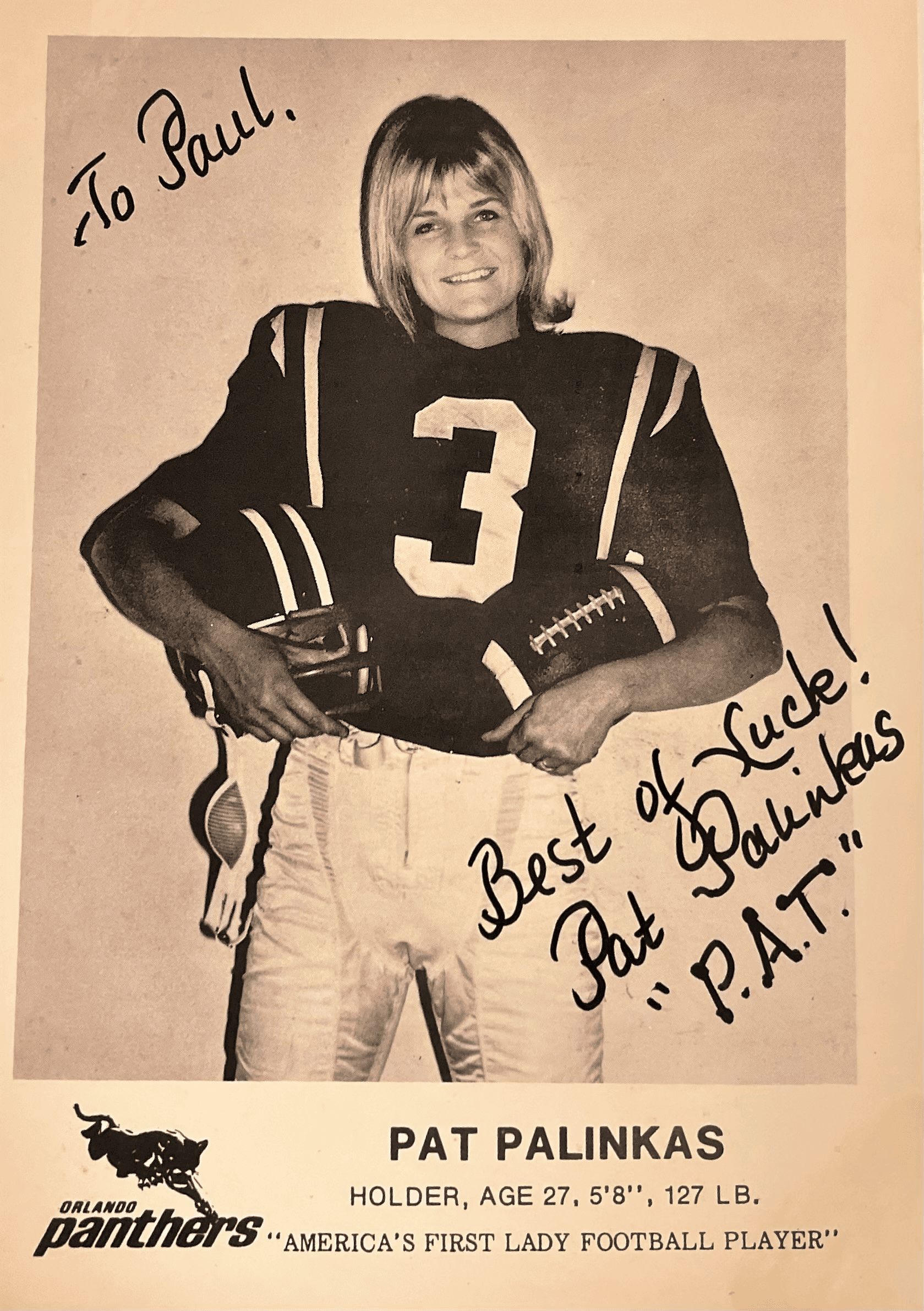
American · Sports
Patrica Palinkas
January 1, 1943 – June 21, 2025
Early Life and Background
Patricia "Pat" Palinkas, born Patric Barczi in 1943 in Chicago, Illinois, grew up in a Hungarian American family in the American Midwest.[1] Her parents were of Hungarian descent, and this immigrant heritage shaped her early environment, exposing her to the experience of ethnic minorities in mid-20th-century America. Chicago’s vibrant but often segregated neighborhoods provided the backdrop for her childhood at a time when women’s athletic opportunities were limited and largely informal.
Details of her early schooling are sparse in public records, but later accounts note that she pursued higher education at Northern Illinois University, a regional public institution that drew many first-generation college students.[2] It was there that she met Stephen (Steve) Palinkas, a fellow student and football placekicker, establishing a partnership that would become central both to her personal life and her brief but historic sports career.[2] Northern Illinois University, like many universities of the era, offered women only constrained roles in athletics, primarily in physical education and informal competitions, underscoring how unusual Palinkas’s later path into professional football would be.
Education and Early Career
While at Northern Illinois University, Palinkas studied education and trained to become a teacher.[2][5] After graduation, she worked as a first-grade teacher, a profession long associated with women’s labor within the traditional boundaries of care and instruction. Contemporary write-ups and later retrospective pieces describe her as a committed educator who returned to teaching after her short professional football stint.[5]
Her entry into teaching coincided with the expansion of suburban school districts and growing demand for elementary educators in the late 1960s. For many women of her generation, teaching offered a rare combination of professional identity and social acceptability. Palinkas’s classroom experience also contributed to the public fascination with her later football appearance, as journalists emphasized the contrast between her nurturing role with children and her willingness to face adult male athletes on the football field.
Path to Professional Football
The route that led Palinkas from teaching to the gridiron emerged through her relationship with Stephen Palinkas. Steve played as a placekicker and, by 1970, had joined the Orlando Panthers, a team in the Atlantic Coast Football League (ACFL), a minor professional league that functioned as a stepping-stone and adjunct to the National Football League.[1][3]
Accounts in newspapers and later historical treatments describe how the Panthers’ management, recognizing the publicity potential and Palinkas’s capability as a holder, invited her to join the team in the specialized role of placekick holder for her husband.[3][9] At that time, women were generally restricted to occasional "powder-puff" games or novelty appearances, not rostered positions in organized professional leagues. Her decision to accept the offer required not only physical courage but a willingness to endure public scrutiny.
Leading up to the 1970 preseason, she practiced holding for Steve’s kicks, learning the timing, ball placement, and composure required to absorb the rush of opposing linemen while ensuring a clean snap and kick.[9] Her competence in this precise role persuaded the Panthers that she could perform effectively and not simply serve as a publicity stunt, although promotional motives unquestionably shaped the media interest.
Historic Debut: First Woman in Professional American Football
On 15 August 1970, Palinkas made her historic debut in a preseason exhibition game against the Bridgeport Jets.[3][9] Wearing full pads and helmet, she took the field as the holder for Steve’s placekicks. Contemporary reporting from the Orlando Sentinel and later features in outlets such as Time magazine consistently identify this date as the first time a woman played professional American football in a predominantly male league.[3][9]
Approximately 12,000 spectators attended the game, joined by a significant press contingent intrigued by the presence of a woman on the roster.[3][5] The environment mixed curiosity and skepticism; some questioned whether she could withstand the physicality of the sport and the risk of being targeted by opposing players resistant to her presence. Nevertheless, she executed her duties over five kicking attempts, with reports indicating that three of the kicks were successful.[3][5][9]
Her role as a holder required remaining calm under pressure as defenders crashed the line, focusing on receiving the snap cleanly, positioning the ball correctly, and maintaining stability through the kick’s impact. In one widely recounted incident, an opposing player deliberately hit her late and hard, testing her resolve and highlighting the hostility she faced. Palinkas recovered and continued to play, demonstrating resilience that impressed supporters and critics alike.[3][9]
Journalists at the time underscored the novelty of her presence, with some framing it as a human-interest story and others as a challenge to entrenched gender norms. Retrospective analyses have noted that her appearance occurred just as second-wave feminism was gaining momentum, providing a visual symbol of women entering previously closed arenas, even if only briefly and under experimental conditions.
Professional Football Season and Departure from the Game
Following her preseason debut, Palinkas remained associated with the Orlando Panthers during the 1970 season.[1][5] Sources disagree slightly on the extent of her participation, with some emphasizing the preseason exhibition and others noting that she and Steve played together for one season before leaving professional football.[5] Regardless of the exact number of games, her presence on the team’s roster and field marked an unprecedented role for a woman in the professional game.
According to later summaries, the Palinkases’ tenure with the Panthers ended after one season, in part because of Steve’s leg injury and broader questions about the sustainability of the arrangement.[5] Following their departure, Patricia returned to her work as a first-grade teacher in Florida, resuming a more traditional career path that had been temporarily interrupted by her foray into professional sports.[5]
Her decision to step away from the gridiron also reflected personal priorities. Accounts describe her desire to start a family and build a more stable life beyond the uncertainties and physical demands of minor-league football.[5] In the broader landscape of women’s sports history, this transition illustrates the structural pressures that often limited women’s ability to sustain athletic careers, especially in disciplines without established pathways or institutional support for female participation.
Media Coverage, Recognition, and Later Portrayals
Although her playing career was brief, media outlets continued to revisit Palinkas’s story. A short documentary segment narrated by broadcaster Walter Cronkite highlighted her historic role, introducing television audiences to the image of a woman in full football gear telling her husband, "You ready, honey?" before a kick.[4] This clip helped cement her as a symbol of quiet defiance against gender expectations.
Decades after her game, publications such as Time ran retrospective articles presenting her as the "first woman to play pro football," summarizing the 1970 exhibition and contextualizing it within the evolution of women’s roles in athletics.[9] The Orlando Sentinel likewise revisited the story, describing her as the only woman to play professional football until the early twenty-first century.[3]
Online encyclopedic entries and sports-history sites, including English- and Spanish-language versions of Wikipedia and specialized American football wikis, consistently acknowledge Palinkas as a pioneering figure who played as a placekick holder for the Orlando Panthers of the ACFL.[1][2][6] These later accounts have contributed to the stabilization of her narrative within the historiography of American football, even as they differ on some minor details of spelling or context.
Her story has also been invoked in discussions of "powder-puff" football and efforts to move women’s football from novelty to competitive sport. Educational websites and blogs warn against treating her appearance as mere curiosity, arguing that her example underscores the potential for women to play meaningful roles in professional leagues.[5]
Personal Life
Palinkas’s personal life was deeply intertwined with her husband’s football career. She met Stephen at Northern Illinois University, where he was a kicker, and their shared interest in the sport later translated into their unique on-field partnership with the Orlando Panthers.[2][3] Off the field, she built a career in elementary education, focusing on first-grade teaching in Florida.[5]
Sources indicate that after leaving professional football, she and Steve settled in Florida, raising a family while she continued teaching.[5][7] Her identity as a mother and educator complicated simplistic narratives that framed her solely as a trailblazing athlete; instead, she embodied the multiplicity of roles many women navigated in the 1970s and beyond, balancing work, family, and, in her case, a brief foray into high-profile sport.
Later in life, after Steve’s death, Palinkas lived in Clearwater, Florida, with the family of one of her daughters.[1][7] Obituary notices and biographical notes emphasize her devotion to family and community, suggesting that, despite the national attention generated by her football appearance, she did not seek ongoing celebrity status.
Later Life and Death
As the decades passed, Palinkas remained a reference point in discussions about women’s participation in American football, even though she did not continue in the sport professionally. The long gap between her 1970 appearance and the next widely recognized instance of a woman playing pro football in a men’s league—Katie Hnida’s signing with the Fort Wayne Firehawks in 2010—highlighted the singular nature of her accomplishment.[1][2][9]
In her later years, she resided in Clearwater, Florida, where she lived with family and faced the ordinary challenges of aging.[1][7] On 21 June 2025, she died in Florida, marking the end of a life that had intersected briefly but significantly with national sports history.[1][7] Her obituary in the Tampa Bay Times and related notices drew attention to her pioneering role and her long career as an educator, presenting a rounded portrait rather than a single-event story.
Legacy and Historical Impact
Palinkas’s legacy rests not on a long statistical record but on the symbolic and practical significance of a single preseason game. By taking the field as a placekick holder in the ACFL on 15 August 1970, she became the first woman known to have played professional American football in a predominantly male league.[1][3][9] Her presence on the roster and her execution of a specialized role demonstrated that women could perform technical tasks under the same physical and psychological pressures as men.
For nearly forty years, she remained the only woman documented in such a capacity, until Katie Hnida’s involvement with the Fort Wayne Firehawks in 2010.[1][2][9] This long interval underscores how exceptional her opportunity was and how slowly institutions moved to open similar roles to women. In the broader context of sports history, her example has been used to critique the tokenism of some early breakthroughs, while also acknowledging that such token moments can alter perceptions and lay groundwork for future change.
Within women’s history, Palinkas’s story intersects with narratives about labor, media, and domestic life. She did not become a full-time professional athlete; instead, she returned to teaching and family responsibilities. Yet the memory of her appearance persisted in sports journalism and popular culture, periodically resurfacing in documentaries, anniversary pieces, and historical blogs.
Her legacy also challenges the boundary between "serious" sport and novelty events. While some contemporaries dismissed the Panthers’ decision to sign her as a stunt, her actual performance and the physical risks she endured argue for a more nuanced view. She trained, took hits, and contributed to scoring plays, and her willingness to confront skepticism helped expand the imagined horizon of women’s roles in football.
Today, as women increasingly participate in coaching, officiating, and playing roles in various levels of American football, Palinkas is remembered as an early pioneer. Her story continues to be cited in discussions about equity in sports, the history of women breaking into male-dominated professions, and the importance of recording women’s achievements even when they appear, at first glance, to be brief or singular episodes.
Dated achievements
4 indexed.
- Jan011943Sports
Birth of Patricia Palinkas
Patricia 'Pat' Palinkas was born in 1943.
View details Patricia Palinkas - Wikipedia - Aug151970Sports
First woman to play professional football
Patricia Palinkas became the first woman to play professional football on August 15, 1970.
View details