← All women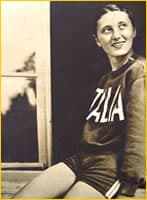
Italian · Sports
Ondina Valla
May 20, 1916 – October 16, 2006
Early Life and Background
Trebisonda Valla, universally known by her nickname Ondina, was born on May 20, 1916, in Bologna, Italy. Her father worked for the Italian railways, and family lore holds that he chose the unusual name "Trebisonda" after hearing a news report about the Turkish city of Trebizond around the time of her birth. As a small child, she reportedly displayed such graceful, fluid movement while swimming that she earned the affectionate nickname "Ondina," meaning "little wave," a name that would follow her for the rest of her life and become far better known than her given name.
Bologna in the years following the First World War was a city rebuilding amid considerable social and economic upheaval, and opportunities for girls to pursue athletics were extremely limited. Italian society, and the increasingly powerful Fascist regime that took power in 1922, held deeply ambivalent — often outright hostile — views about female participation in competitive sport, with many conservative voices, including elements within the Catholic Church, considering it unseemly or even dangerous for women's health and morality. Despite this cultural climate, Ondina's family supported her early athletic interests, and she began competing in swimming, gymnastics, and track and field as a young girl, showing prodigious natural talent across all three disciplines.
Career Beginnings and Development
Valla's speed and athleticism set her apart from her peers almost immediately. By her early teenage years she was already setting Italian national records in sprint and hurdling events. She trained under considerable social scrutiny; female athletes in 1920s and 1930s Italy were a rarity, and Valla had to contend not only with the physical demands of elite competition but also with public skepticism about whether women should compete at all, particularly in events considered "unfeminine" or physically strenuous, such as hurdling.
Her rise coincided with a period in which the Fascist government, despite its traditionalist rhetoric about women's roles as mothers and homemakers, began to recognize the propaganda value of successful Italian athletes — male or female — on the international stage. This created a paradoxical opening for Valla: while she faced resistance from conservative segments of Italian society, the regime's interest in international sporting prestige provided some institutional support for elite female athletes who could bring home international honors.
Valla represented Italy at the 1932 Los Angeles Olympics as a teenager, competing in the 100 meters, though without reaching the medal podium. This early Olympic experience, gained at just 16 years old, gave her invaluable international competitive exposure and set the stage for the far greater triumph to come four years later. Throughout the mid-1930s, she continued to break Italian and world records in the 80-metre hurdles, establishing herself as one of the fastest hurdlers in the world regardless of gender.
The 1936 Berlin Olympics: A Historic Gold
The 1936 Summer Olympics in Berlin were staged by Adolf Hitler's Nazi government as an elaborate propaganda spectacle intended to showcase the supposed superiority of the Third Reich. Amid this highly charged political atmosphere, Ondina Valla competed in the women's 80-metre hurdles, an event still relatively new to the Olympic program (women's track and field had only been permitted at the Olympics since 1928, and the 80m hurdles was contested for the first time at that same 1928 Games).
On August 6, 1936, Valla lined up in the final against a strong international field, including several German hurdlers competing before their home crowd. The race was extraordinarily tight: Valla and Germany's Anni Steuer crossed the line with identical times of 11.7 seconds, and officials were forced to consult a photograph of the finish to determine the winner. Valla was declared the victor by the narrowest of margins, becoming the first Italian woman in history to win an Olympic gold medal in any sport.
The victory was a sensation in Italy. Newspapers across the country celebrated Valla as a national heroine, and the Fascist regime, ever eager to capitalize on symbols of Italian excellence, embraced her triumph as evidence of the vitality of Mussolini's Italy — even though Fascist ideology had historically discouraged the very kind of female athletic achievement Valla now embodied. This tension between state propaganda and genuine personal accomplishment characterized much of how Valla's victory was received and remembered in the years immediately following the Games.
Beyond its immediate impact, Valla's gold medal carried lasting symbolic weight. It demonstrated, on the world's largest sporting stage, that Italian women could compete and win at the highest levels of international athletics, challenging prevailing assumptions about women's physical capabilities and their proper role in public life. Her achievement is frequently cited by historians of Italian sport and gender as a pivotal moment that helped, gradually, to shift attitudes toward women's athletics in Italy.
Later Competitive Career and Records
In addition to her Olympic triumph, Valla set multiple world records during her competitive career in the 80-metre hurdles and various sprint events, cementing her reputation as one of the outstanding female athletes of her generation. Her career, however, was significantly curtailed by the outbreak of the Second World War, which led to the cancellation of the 1940 and 1944 Olympic Games — Games in which Valla, still relatively young and at the peak of her athletic powers, might well have competed again. The war years thus robbed her, and an entire generation of European athletes, of further opportunities on the Olympic stage.
Personal Life
Following her competitive retirement, Ondina Valla largely withdrew from the public athletic spotlight, though she remained a celebrated and respected figure within Italian sporting circles for the rest of her life. She lived a comparatively private life in the decades after her Olympic triumph, though she was periodically invited to public commemorations, anniversaries, and tributes related to Italian Olympic history and the history of women's sport in Italy.
Awards, Honors, and Recognition
Valla's 1936 Olympic gold medal remains her most celebrated honor, and she has been repeatedly recognized in Italy as a pioneering figure in women's sport. Her name and achievement have been commemorated through various sporting tributes, historical retrospectives, and inclusion in histories of the Olympic movement and Italian athletics. She is regularly cited alongside other trailblazing women athletes of the interwar period as a symbol of the gradual, hard-won progress of women's participation in elite international sport.
Legacy and Historical Impact
Ondina Valla's legacy rests on her status as the first Italian woman to win Olympic gold — an achievement that occurred against significant social, cultural, and political headwinds. Her victory in Berlin came at a moment when women's very right to compete in demanding athletic events was still contested in much of Europe, and when the Italian Fascist state's attitude toward female athletes remained deeply ambivalent despite its eagerness to claim credit for her success.
In the decades since her competitive career, Valla has been increasingly recognized by historians and sports scholars as an important figure not just in Italian Olympic history, but in the broader history of women's emancipation through sport. Her story illustrates both the opportunities and the contradictions faced by pioneering female athletes competing under authoritarian regimes that sought to use their success for propaganda while simultaneously constraining women's broader social freedoms.
Today, Valla is commemorated in Italy through sporting facilities, historical exhibitions, and continued references in Italian media and Olympic retrospectives, particularly around anniversaries of the Berlin Games and International Women's Day observances related to sport.
Death
Ondina Valla died on October 16, 2006, in her native Bologna, at the age of 90. Her death was marked by tributes from Italian sporting institutions and international athletics bodies, which remembered her as a genuine pioneer whose courage and talent had opened doors for generations of Italian and international women athletes who followed in her path.
Dated achievements
3 indexed.
- May201916Sports
Birth of Ondina Valla
Birth of Trebisonda 'Ondina' Valla, pioneering Italian athlete.
View details Ondina Valla - Wikipedia - Aug061936Sports
Ondina Valla wins first Italian women's Olympic gold
Valla wins the 80-meter hurdles, the first Italian woman to win Olympic gold.
View details