← All women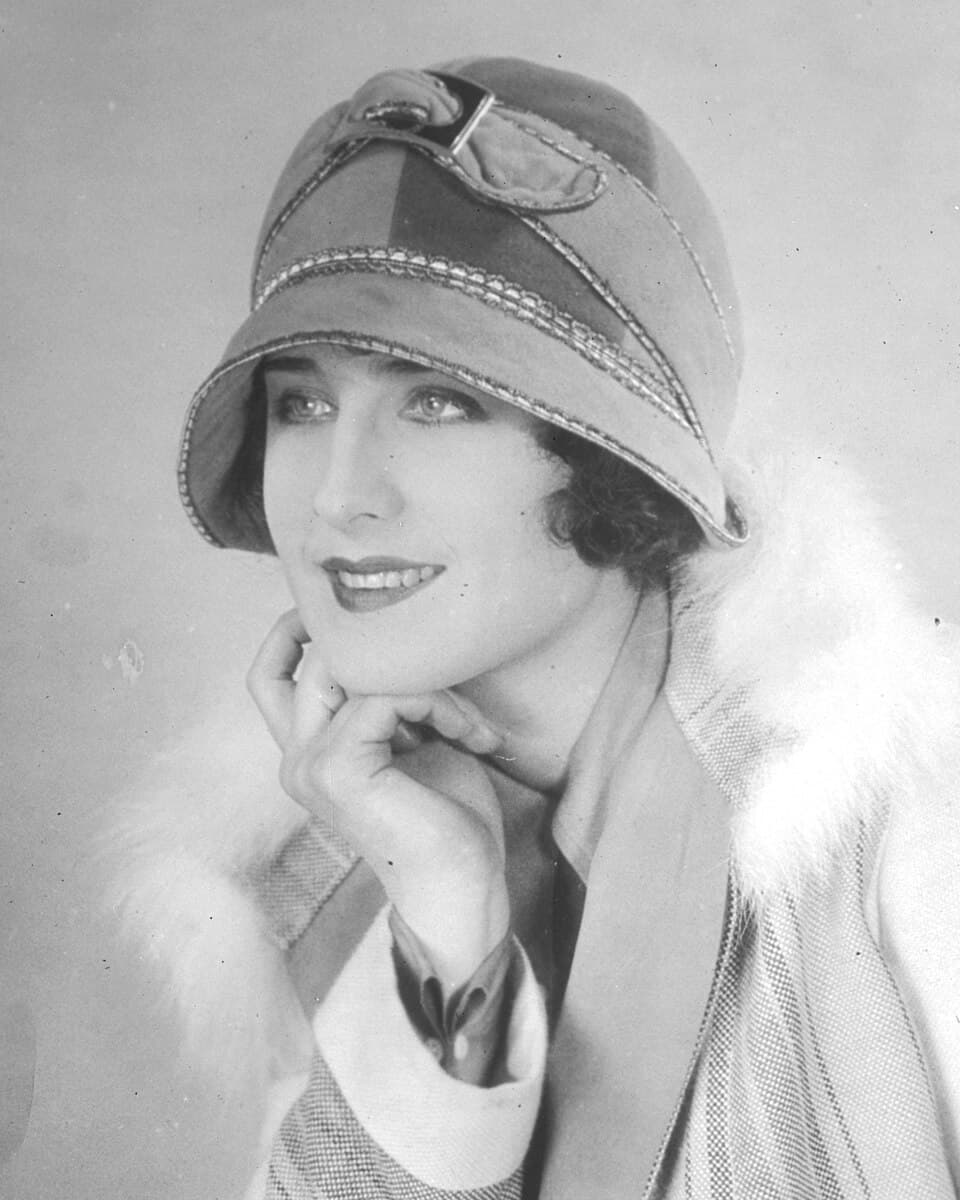
Canadian, American · Arts
Norma Shearer
August 11, 1902 – June 12, 1983
Early Life and Background
Edith Norma Shearer was born on August 11, 1902, in Montréal, Québec, Canada
Shearer’s childhood combined educational opportunity with personal and familial challenges. She attended schools in Montréal, including Westmount High School and the Montreal High School for Girls, institutions that reflected the relatively privileged educational paths available to middle-class anglophone girls at the time.[13] Yet she also grew up in a family marked by a history of mental illness and increasing economic strain.[7][8] Shearer herself was born with a noticeable cast in her right eye, a physical condition that caused her deep insecurity and led to frequent rejection when she began to audition for acting roles.[7][8] Despite these obstacles, Shearer developed a strong determination to become a performer from an early age. Biographical accounts suggest that she was inspired by vaudeville and stage performances she saw as a girl in Montreal, announcing her intention to be a star long before she had practical means to pursue that ambition.[7][13] As her father’s business declined, the family’s financial hardships forced difficult choices. Eventually, Edith Shearer left her husband and took Athole and Norma to the United States, seeking to restore their fortunes through the burgeoning film industry.[8] This decision to migrate would prove decisive in Norma’s future career. After moving to the United States, Shearer and her mother settled first in New York City, the hub of early American theatrical and film production.[8][13] The young Norma pursued acting training and auditioned relentlessly, despite the frequent rejections she faced because of her eye condition and because she did not fit high-fashion beauty ideals. Determined to overcome these barriers, she sought medical treatment and persuaded a doctor to correct the alignment of her eye, while she worked intensively on posture, expression, and grooming to present herself as camera-ready.[7][8] Shearer’s earliest documented screen work dates from 1919, when she appeared as a member of the "Beauties Squad" in the silent comedy short The Star Boarder.[2] Although this was a minor role, it served as her entry into professional film acting, placing her on screen at a time when small appearances could lead to further opportunities. In 1920, she secured her first feature-film role in The Stealers, a project that biographical and reference sources describe as officially launching her career in feature films.[2][6][10] Through this and other early roles, Shearer gradually built experience and visibility. Seeking greater prospects, Shearer moved west to Hollywood, where the film industry was rapidly consolidating around major studios. Her persistence paid off when she attracted the attention of producers and casting directors, leading to a contract and supporting parts in studio releases. In 1924, she appeared in He Who Gets Slapped, directed by Victor Sjöström, which is widely recognized as the first official production of the newly formed Metro-Goldwyn-Mayer (MGM).[6] This appearance embedded her in the emerging structure of MGM at a foundational moment. The mid-1920s marked Shearer’s ascent from supporting player to leading lady within MGM’s expanding roster. As the studio invested heavily in prestige productions, it nurtured a small group of stars whose images were carefully crafted through publicity and high-quality films. Shearer’s combination of determination, technical skill, and adaptable screen presence fit MGM’s needs perfectly.[1][6] Over the remainder of the silent era, Shearer appeared in a variety of dramas and romances that showcased her expressive face and ability to convey emotional complexity without dialogue. MGM’s publicity increasingly emphasized her sophistication, grooming, and "modern" femininity, positioning her as a glamorous yet relatable figure for urban audiences. She was often photographed in elegant gowns, with the studio’s costume and makeup departments collaborating to minimize the visible effects of her eye condition.[7][8] Her relationship with MGM deepened not only professionally but personally. During the 1920s, Shearer came to the attention of producer Irving G. Thalberg, the studio’s influential head of production. Their association, built on mutual respect and admiration, would later evolve into marriage and give Shearer unusual leverage over film choices and production decisions.[1][13] Even before that point, however, her growing popularity and box-office appeal secured her place as one of MGM’s principal female stars. The late 1920s brought the revolution of sound cinema, a transition that proved perilous for many silent film actors. For women, whose voices and diction were heavily scrutinized, the shift could end careers. Shearer confronted this new technological challenge with characteristic determination. In 1929, she starred in The Trial of Mary Dugan, her first talking picture, a courtroom drama adapted from a stage play that required sustained dialogue and emotional intensity.[5][7][14] Released as one of MGM’s early sound features, The Trial of Mary Dugan demonstrated that Shearer’s voice and delivery were well suited to the talkies. The film helped reestablish her as a leading player in the new medium and paved the way for a series of sophisticated dramas centered on women’s experiences. In 1929–1930, she starred in The Divorcee, a pre-Code film that would become her signature work.[1][6] The Divorcee follows Jerry, a woman who responds to her husband’s infidelity by refusing to accept the double standard that judges female sexuality more harshly than male. The story portrays Jerry’s choice to engage in her own affairs as an assertion of autonomy rather than a descent into moral ruin. Shearer’s nuanced performance captured the conflicted desires and frustrations of a modern woman confronting restrictive social norms.[1][6][21] The film was both commercially successful and critically acclaimed, and in 1930 Shearer received the Academy Award for Best Actress for her role, honored at the 3rd Academy Awards ceremony held on November 5, 1930.[5][6] In the same year, she also received a Best Actress nomination for Their Own Desire, marking the beginning of a series of nominations that would make her the first performer to be nominated for Academy acting awards five times and later six times in total.[1][12] Following The Divorcee, Shearer starred in A Free Soul (1931), another influential pre-Code film in which she plays Jan Ashe, a young woman who enters a destructive relationship with a gangster, testing both her independence and the boundaries of acceptable female behavior on screen.[1][6] The film is often noted for its portrayal of a woman drawn to sexual and social danger, and Shearer’s performance contributed to ongoing debates about women’s liberation and the limits of Hollywood’s tolerance for such themes before the Production Code was fully enforced. As the 1930s progressed, Shearer shifted toward prestige literary and historical adaptations that reinforced her image as a sophisticated, cultured actress. She starred in The Barretts of Wimpole Street (1934), playing poet Elizabeth Barrett in a role that earned her another Academy Award nomination.[1][12] In Romeo and Juliet (1936), she portrayed Shakespeare’s Juliet opposite Leslie Howard’s Romeo, and in Marie Antoinette (1938), she undertook the title role in a lavish historical drama about the French queen.[1][12] Both performances brought her further nominations, underscoring her reputation for tackling demanding, classical material. In addition to these prestige projects, Shearer contributed to ensemble works like The Women (1939), an all-female-cast satire of high-society relationships that has become a canonical text in women’s film history. She played the central character, Mary Haines, whose confrontation with infidelity and divorce again placed Shearer at the heart of narratives about marriage, autonomy, and female solidarity.[1] Norma Shearer’s career brought her sustained recognition from the film industry and the public. Her Academy Award for Best Actress for The Divorcee in 1930 stood as her most prominent formal honor.[5][6] Between 1930 and 1938, she accumulated six Academy Award nominations for Best Actress, for the films Their Own Desire (1929), A Free Soul (1930), The Barretts of Wimpole Street (1934), Romeo and Juliet (1936), and Marie Antoinette (1938), in addition to her winning role in The Divorcee.[1][12] These nominations made her the first performer to be nominated for Academy acting awards five times, and ultimately six times, underscoring her prominence in early Hollywood.[1][12] At the same time, her brother Douglas Shearer received multiple Academy Awards for sound engineering, making them one of the first sibling pairs both celebrated by the Academy; EBSCO’s research starter notes their status as an Academy Award–winning brother-sister duo.[13] Within MGM’s publicity, Shearer was frequently dubbed the “First Lady of the Screen” or “First Lady of MGM”, titles that recognized her combination of star power and her marriage to Irving Thalberg.[1][3][6][8] While these designations were promotional rather than official institutional titles, they reflected the studio’s reliance on her image to represent its brand. She was also repeatedly featured in fan magazines and international press as a symbol of refined glamour and modern womanhood. Posthumously, Shearer’s legacy continued to receive institutional recognition. On August 13, 1994, she was honored with a star on the Hollywood Walk of Fame, located at 6638 Hollywood Boulevard, acknowledging her lasting contribution to motion pictures.[5] Retrospective screenings, biographies, and scholarly analyses in subsequent decades further reinforced her status as a key figure in early American cinema. Shearer’s personal life was closely intertwined with her professional world. In 1927, she married Irving G. Thalberg, MGM’s head of production and one of Hollywood’s most influential creative executives.[1][13] Their marriage gave Shearer a unique position within the studio system: as both top star and spouse of the chief producer, she enjoyed significant input into the projects she chose and the roles she played. While some critics argued that Thalberg’s influence boosted her career, others noted that Shearer had already achieved popularity and possessed distinctive talent independent of her husband. The couple had two children, a son and a daughter, and maintained a household that balanced their intense professional schedules with family life.[1][13] Biographical sources also indicate that Shearer converted to Judaism in connection with her marriage to Thalberg, aligning herself with his cultural and religious background.[13] This decision occurred at a time when Jewish identity in Hollywood was complicated by both internal community dynamics and external prejudice, underscoring the personal significance of her choice. Thalberg’s fragile health, which had been a concern throughout his career, deteriorated in the mid-1930s. His death in 1936 deeply affected Shearer, both emotionally and professionally. Without his presence at MGM, she lost a key ally in negotiations over scripts and production, and the studio’s internal politics began to shift.[1][13] Although she continued working after his death, her enthusiasm for filmmaking waned, and her later roles reflected a more cautious approach to material. In her private life, Shearer was known for cultivating a refined social persona but also for episodes of emotional strain, driven in part by family history of mental illness and the pressures of stardom.[7][8] Accounts of her later years suggest struggles with depression and alcohol, though documentation varies and often comes from retrospective sources.[11] These aspects of her life highlight the psychological costs that Hollywood’s intense scrutiny and gendered expectations could impose on women. By the late 1930s, shifts in audience tastes and studio strategies, combined with personal factors, led Shearer gradually toward retirement. She remained a major star through films like Marie Antoinette (1938) and The Women (1939), but younger performers and changing narrative styles began to reshape MGM’s roster.[1][6] In 1942, Shearer appeared in Her Cardboard Lover, a romantic comedy that would effectively become her final film. After completing the project, she chose to withdraw from motion pictures, ending her active film career.[1][5][13] Commentary varies on the reasons for her retirement: some accounts emphasize her dissatisfaction with the roles offered to aging actresses, while others point to a desire for a more private life and her reluctance to adapt to post-war cinematic trends. Following her retirement, Shearer maintained a relatively low public profile. She managed her finances and estate, supported her children, and occasionally participated in social events, but she did not seek a return to the screen or substantial involvement in industry leadership.[1][13] Her four-decade absence from acting contributed to the gradual decline of her name recognition among mainstream audiences, even as film historians continued to acknowledge her importance. In her later years, Shearer experienced health challenges common to aging individuals, including memory loss associated with Alzheimer’s disease as noted in some biographical sources, and bouts of pneumonia.[2][11] In 1980, she moved to the Motion Picture Country Home in Woodland Hills, California, a retirement facility for film-industry veterans.[11][13] There, she lived among peers whose careers had also shaped Hollywood’s development, though much of her daily life was spent away from public attention. On June 12, 1983, Shearer died in Los Angeles, at age 80.[1][3][11] Sources identify Woodland Hills as the immediate location, reflecting her residence at the retirement home, while general references note Los Angeles more broadly as the place of death.[1][2][3] Her passing marked the end of a life that spanned the entire evolution of cinema from silent shorts to color sound features and witnessed profound transformations in women’s roles both on and off screen. Following her death, obituaries and retrospectives reexamined her career, highlighting her Academy recognition, her influence on MGM’s repertoire, and her pre-Code depictions of female sexual autonomy.[1][6][21] Over subsequent decades, scholars, critics, and fans contributed to a fuller understanding of her artistry and significance. Norma Shearer occupies a distinctive place in film and women’s history. As a Canadian-born actress who became a central star of the American studio system, she exemplifies the transnational nature of Hollywood’s talent pool. Her career arc—from small roles in shorts to leading parts in MGM prestige productions—illustrates how determination and strategic self-fashioning could enable women to navigate an industry structured by male executives and rigid beauty standards.[1][6][8] Shearer’s pre-Code films, especially The Divorcee and A Free Soul, have been widely discussed for their portrayals of women who openly question double standards around sexuality, marriage, and respectability.[1][6][21] In these roles, she brought emotional depth and moral complexity to characters who refused purely submissive positions, thereby expanding the range of female subjectivities visible on screen. Although the stricter enforcement of the Production Code later constrained such narratives, the survival and continued circulation of these films make them important sources for understanding gender politics in early 20th-century cinema. Her later work in literary and historical adaptations such as The Barretts of Wimpole Street, Romeo and Juliet, and Marie Antoinette helped legitimize film as a medium capable of engaging with classical and high-cultural material.[1][12] Shearer’s presence in these projects reinforced the idea that women could be central interpreters of canonical texts, not merely decorative figures, and that female stars could carry serious dramatic narratives. Institutionally, Shearer’s career reflects the complex dynamics of power and marriage in the studio era. Her relationship with Irving Thalberg undoubtedly afforded her access to scripts and production resources unavailable to many contemporaries, but her success also depended on her own skill and the audience’s sustained interest. Shearer’s negotiations over her roles, including her insistence on modern, challenging female characters in the early 1930s, demonstrate how some women stars leveraged personal influence to shape studio output.[1][6][13] In the years after her death, renewed attention from biographers such as Gavin Lambert and institutional tributes, including the Hollywood Walk of Fame star dedicated in 1994, have helped secure Shearer’s place in film history.[9][5][14] Contemporary analyses by organizations and writers interested in women’s history likewise highlight her as a figure who broke through physical and social constraints to achieve international visibility.[7][13] Today, Norma Shearer is remembered not only as an Academy Award–winning actress but also as a trailblazer whose roles complicated stereotypes of women in early cinema. Her body of work provides a rich archive for examining the intersections of gender, modernity, and media, and her story underscores both the possibilities and costs of female stardom in Hollywood’s formative decades.Migration to the United States and Career Beginnings
Rise at MGM and Silent-Era Stardom
Transition to Sound and Major Works
Awards, Honors, and Recognition
Personal Life
Later Career and Retirement
Later Life and Death
Legacy and Historical Impact
Dated achievements
8 indexed.
- Aug111902Arts
Birth of Edith Norma Shearer
Edith Norma Shearer was born in Montréal, Québec, Canada, later becoming a leading star of MGM.
View details Wikipedia - Norma Shearer - Jan011919Arts
Early screen appearance in 'The Star Boarder'
Shearer appeared in 'The Star Boarder', marking her early entry into films.
View details