← All women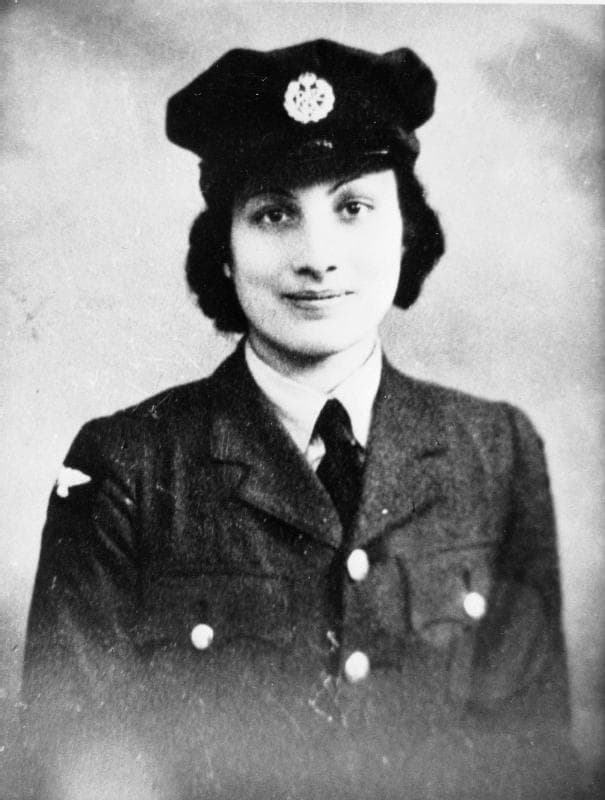
Indian, British · Activism · Exploration
Noor Inayat Khan
January 1, 1914 – September 13, 1944
Early life and family background
Noor-un-Nisa Inayat Khan (1 January 1914 – 13 September 1944), later known as Noor Inayat Khan and sometimes Nora Baker, was a British-Indian resistance agent in the Second World War, best known as the first female wireless operator sent by Britain into occupied France. She was born in Moscow to Hazrat Inayat Khan, an Indian Sufi teacher and musician, and Ora Ray Baker, an American woman. Her family background was cosmopolitan and intellectually rich: her father was a respected spiritual leader and her mother came from the United States, giving Noor an upbringing shaped by travel, cross-cultural identity, and artistic sensibility.
After her birth, the family moved repeatedly across Europe. Noor spent formative years in France and later in Britain, growing up in an environment marked by music, literature, and spirituality. She became fluent in French, a skill that later proved crucial in wartime intelligence work. Sources on her early life emphasize the unusual nature of her childhood: she was a descendant of Indian royalty through her father’s line, yet her upbringing was international rather than courtly, and she developed into a quiet, introspective, and creative young woman.
Noor’s father died when she was young, and the family’s life was shaped by her mother’s efforts to support and educate her children. Noor studied music and wrote stories from an early age. Her earliest ambitions were artistic rather than martial, and she later became known as a poet and author of children’s stories. That artistic training helped define her as a person of sensitivity and discipline, traits that would later be crucial in the exacting world of clandestine war work.
Education and artistic development
Noor studied at the École Normale de Musique de Paris and at the Sorbonne, reflecting the family’s deep ties to French cultural life. Her education was not only formal but also multilingual and artistic. She wrote for young readers and pursued music seriously, with a harpist’s sensitivity often noted in biographical accounts. Her literary and musical interests mattered because they show that her wartime service emerged not from a military career but from a life initially oriented toward culture and creativity.
When Europe moved toward war, Noor and her family left France and settled in London. The change marked a transition from artistic aspiration to wartime necessity. Her bilingual skills and technical aptitude made her a candidate for work supporting Britain’s war effort, and she joined the Women’s Auxiliary Air Force in 1940. There she trained as a wireless operator, acquiring the technical competence that would later bring her into the Special Operations Executive (SOE).
Entry into wartime service
Noor was recruited by the British Special Operations Executive in 1942. The SOE specialized in sabotage, subversion, and support for resistance movements in occupied Europe. Noor’s recruitment reflected her linguistic fluency in French and English, her technical training, and her willingness to undertake dangerous covert work. She received training as a wireless operator, one of the most demanding and dangerous roles in the SOE. Wireless operators were essential because they maintained contact between resistance networks in occupied territory and London, but they were also highly vulnerable to German direction-finding operations.
In this environment, Noor stood out as a woman operating in an overwhelmingly male and militarized field. The fact that she was chosen for clandestine deployment into occupied France was significant in itself. It showed that, despite the barriers of gender and the risks of enemy occupation, women could perform some of the most technically and operationally difficult tasks in resistance warfare. Noor’s code name was Madeleine, and she also used the identity Nora Baker while underground.
Mission in occupied France
On 16 June 1943, Noor was flown to France by Lysander aircraft, becoming the first female wireless operator sent by Britain into occupied France. She entered the field as part of the SOE’s efforts to sustain resistance communications after increasing German pressure on networks in Paris. For several months she served as a wireless link in the Prosper network, continuing transmissions even as arrests mounted and the situation deteriorated rapidly around her.
Her work was extraordinarily dangerous. Wireless operators had to remain in motion, use short bursts of transmission, and constantly evade detection. Noor did so under severe strain and with little margin for error. When other operators were arrested or forced out, she became the last remaining SOE wireless link in the Paris area for a period of time, a fact that has become central to her wartime legend. Her persistence allowed contact to continue between local resistance elements and London, helping preserve intelligence flow during a critical stage of the war.
Noor’s mission also illustrates the scale of the risks faced by women in intelligence. She operated under surveillance, used false identities, and worked in an atmosphere of betrayal and secrecy. Unlike combat soldiers, she could not rely on formal military protection; unlike many men in intelligence, she carried the added vulnerability of being a young woman alone in occupied territory. Her success in this role made her one of the most remarkable SOE agents of the war.
Arrest, imprisonment, and death
In 1943 Noor was betrayed and arrested by the Gestapo in Paris. Accounts indicate that she was interrogated and tortured, but she did not provide useful information to the Germans. Because she was considered a dangerous prisoner, she was transferred through several prisons before being taken to Germany. She remained imprisoned for roughly eleven months before her execution.
On 13 September 1944, Noor was executed at Dachau concentration camp. Reports of her final moments emphasize her courage and composure, including the famous reported last word “Liberté”. Her death at Dachau placed her among the many victims of Nazi repression, but it also gave her story a singular moral force because of the particular vulnerability and determination she had shown as an intelligence agent.
The circumstances of her death also reflect the brutal treatment endured by captured SOE agents, especially women, whose clandestine status often exposed them to prolonged interrogation and punishment. Noor’s execution became one of the most poignant examples of resistance sacrifice in occupied Europe. In later decades, historical accounts increasingly recognized not only her suffering but also the discipline and ingenuity that had allowed her to operate as one of Britain’s most important female wartime agents.
Honors and posthumous recognition
Noor received major posthumous recognition after the war. France awarded her the Croix de Guerre with gold star on 16 January 1946, acknowledging her courage and contribution to the French Resistance. The United Kingdom later awarded her the George Cross on 5 April 1949, its highest civilian decoration for gallantry. These honors confirmed that her wartime service had been exceptional and that her conduct under capture had met the highest standards of bravery.
Later remembrance also corrected the long period during which her contribution remained insufficiently known. Historians, archives, museums, and memorial organizations increasingly highlighted her as a woman of Indian Muslim heritage who served Britain in one of the war’s most dangerous roles. In 2012, a bronze bust of Noor was unveiled in Gordon Square Gardens in London, becoming the first memorial in Britain to a Muslim woman and to an Asian woman for service in the Second World War.
Personal life
Noor never married and had no children. Her personal life is most visible through her family, her education, and her artistic work. She was deeply shaped by her parents’ spiritual and cultural legacy, and she retained a creative identity even while serving in wartime intelligence. Before the war she wrote children’s stories and poetry, and she is sometimes remembered not only as a spy but also as a writer and musician.
Her life was defined by a tension between private artistic inclinations and public historical significance. That contrast is part of what makes her biography so compelling: she was not a career soldier or professional intelligence officer, but a woman whose multilingual upbringing, discipline, and moral seriousness led her into one of the most dangerous clandestine roles of the Second World War.
Legacy
Noor Inayat Khan’s legacy rests on several intersecting achievements. She is remembered as the first female wireless operator sent into occupied France, as a fearless SOE agent who continued transmitting under extreme threat, and as a posthumously honored heroine of both Britain and France. Her story also has significance for women’s history, Muslim history, South Asian history, and the history of intelligence, because she embodied multiple identities that were rarely represented in wartime commemorations.
In later decades, Noor became a symbol of the overlooked contributions of women and colonial subjects to the Allied war effort. Her memorials, biographies, educational resources, and public commemorations have helped restore her to historical visibility. She is now widely presented as a figure of courage, cross-cultural identity, and resistance against fascism, whose life demonstrates how private virtues such as artistic discipline, linguistic intelligence, and moral conviction can become historic under extraordinary circumstances.
Dated achievements
5 indexed.
- Jan011914Activism
Birth of Noor Inayat Khan.
Birth of Noor-un-Nisa Inayat Khan (later known as Noor Inayat Khan) in Moscow, Russia.
View details Britannica - Jun161943Activism
First female wireless operator sent into occupied France.
First female wireless/radio operator sent by Britain into occupied France in WWII.