← All women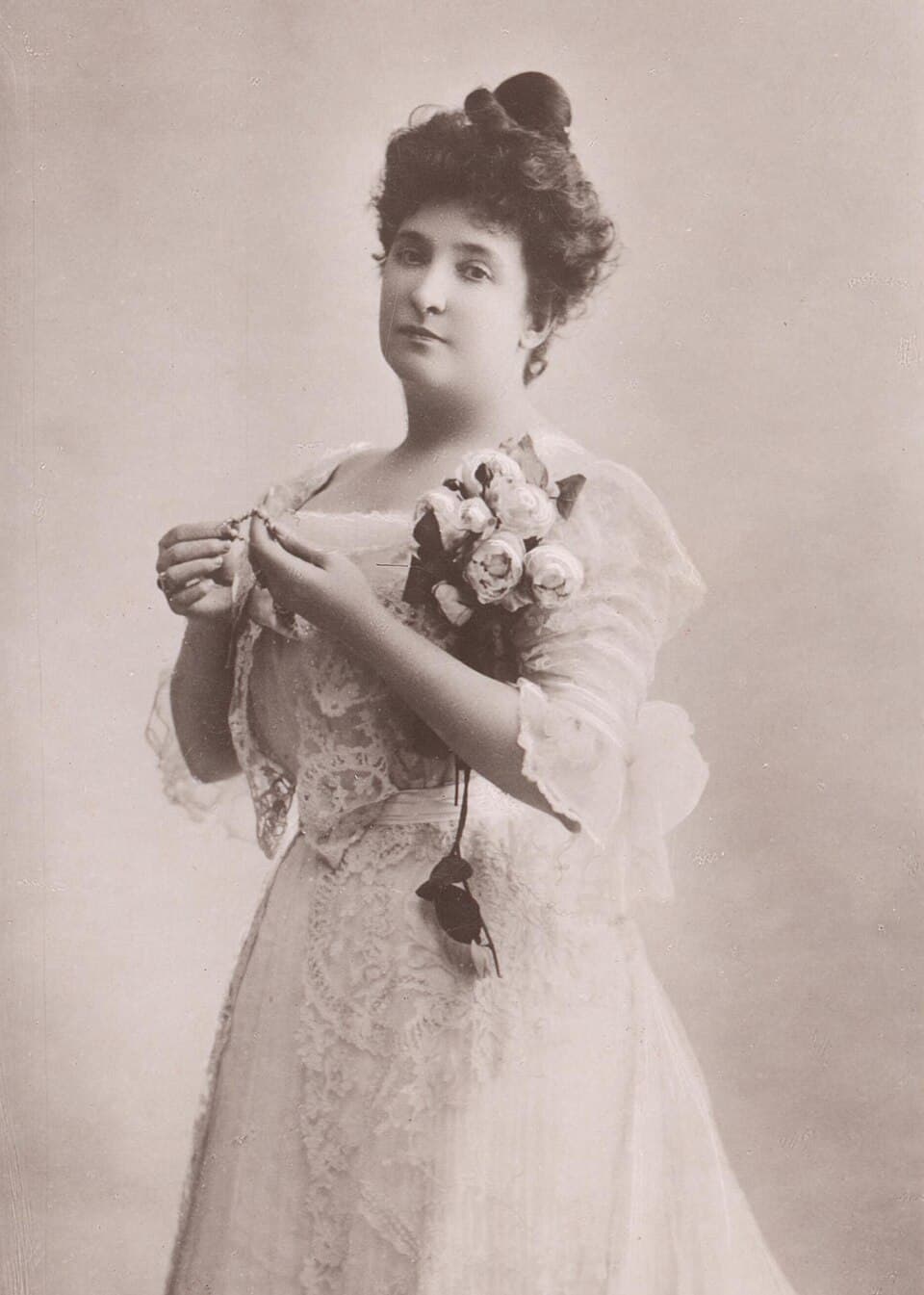
Australian, British · Arts
Nellie Melba
May 19, 1861 – February 23, 1931
Early Life and Background
Dame Nellie Melba, born Helen Porter Mitchell on 19 May 1861 in Richmond, a suburb of Melbourne, Victoria, was the eldest surviving child of David Mitchell, a Scottish-born builder and businessman, and his wife Isabella Ann Dow. Her father was a successful contractor whose work helped shape colonial Melbourne, and the family enjoyed relative prosperity, allowing young Helen access to music lessons from an early age. Her mother, herself an accomplished musician, gave her early instruction in piano, and Helen also studied violin, organ, and harp, displaying prodigious musical talent as a child.
Helen was educated at Presbyterian Ladies' College in Melbourne, where her singing voice was recognised as exceptional. She began performing in local concerts as a teenager and quickly built a reputation in Melbourne's musical circles. In 1882, she married Charles Armstrong, and the couple had one son, George, born in 1883. The marriage would prove troubled and the couple eventually separated permanently, though they were not formally divorced until many years later.
Career Beginnings and Development
Frustrated by the limited opportunities for serious operatic training in colonial Australia, Melba travelled to London in 1886 with her father, hoping to establish herself as a professional singer. After initial setbacks in London, she moved to Paris to study under the renowned vocal teacher Mathilde Marchesi, whose rigorous training refined her technique and helped shape her into a world-class coloratura soprano. It was Marchesi who suggested she adopt the stage name "Melba," an Italianised tribute to her home city of Melbourne, replacing her married name Mrs. Armstrong for professional purposes.
Melba's official operatic debut came in Brussels in 1887, performing the role of Gilda in Verdi's Rigoletto with the Théâtre Royal de la Monnaie. This was quickly followed by her historic Paris Opera debut on 13 October 1887 as Ophélie in Ambroise Thomas's Hamlet, a performance that catapulted her to fame across the European musical world. Critics were astonished by the purity, flexibility, and extraordinary upper register of her voice.
Major Works, Accomplishments, and International Stardom
Following her Paris triumph, Melba's career accelerated rapidly. She made her debut at London's Royal Opera House, Covent Garden, in 1888, again as Lucia in Donizetti's Lucia di Lammermoor, and would go on to become one of the most important and beloved artists associated with that institution for over three decades. Her repertoire encompassed the great bel canto and Romantic soprano roles: Violetta in Verdi's La Traviata, Marguerite in Gounod's Faust, Desdemona in Verdi's Otello, and Mimì in Puccini's La Bohème, a role she famously performed alongside a young Enrico Caruso.
She made her American debut with the Metropolitan Opera in New York in December 1893, further cementing her reputation as a truly international star. Melba toured extensively throughout Europe, the Americas, and returned frequently to Australia, where she undertook several highly publicised farewell and return tours that drew enormous crowds and were treated as major national events. Her final performances at Covent Garden included an emotional farewell in 1926, though she continued performing occasionally afterward, including a notable farewell concert tour of Australia in 1928.
Melba was also among the first great singers to embrace the phonograph and early recording technology, making numerous recordings for the Gramophone Company (later HMV) beginning in the early 1900s. These recordings helped immortalise her voice for future generations and contributed to the global spread of her fame beyond the physical reach of live opera houses. Her association with recorded sound places her among the pioneering figures who bridged the worlds of live nineteenth-century opera performance and the twentieth-century recording industry.
Awards, Honours, and Recognition
Melba's contributions to music and her charitable efforts, particularly extensive fundraising concerts during the First World War for the Red Cross and other war relief causes, were formally recognised in 1918 when she was created a Dame Commander of the Order of the British Empire (DBE). This was among the highest honours available to a woman in the British Empire at the time and cemented her status as "Dame Nellie Melba."
Beyond formal honours, Melba's cultural legacy found expression in more unusual tributes. The legendary French chef Auguste Escoffier created the dessert Peach Melba in her honour in the 1890s, reportedly inspired by a swan-shaped ice sculpture referencing her role in Wagner's Lohengrin. Escoffier and other bakers are also credited with naming "Melba toast," a thin, crisp toasted bread, after her. She was also closely associated with the establishment of the Melba Conservatorium of Music in Melbourne, reflecting her commitment to nurturing musical talent in her home country.
In recognition of her enduring significance to Australian cultural identity, Melba's portrait appeared on the Australian $100 note from 1996 until it was redesigned, and numerous streets, suburbs, and institutions across Australia bear her name, including the Melba Hall at the University of Melbourne.
Personal Life
Melba's personal life was, at times, turbulent and drew public scrutiny uncommon for the era. Her marriage to Charles Armstrong, contracted in 1882, produced one son, George Armstrong, but the couple separated permanently after some years amid personal difficulties, and Melba was later romantically linked to Prince Philippe, Duke of Orléans, a relationship that caused considerable scandal and estrangement from her family for a period. She never remarried after her separation from Armstrong. Despite the personal challenges, Melba maintained close ties with Australia throughout her life, regularly returning for concert tours and philanthropic engagements, and she maintained a home, "Coombe Cottage," in Coldstream, Victoria.
Legacy and Historical Impact
Nellie Melba holds a foundational place in the history of Australian and international opera. She was the first Australian-born performer to achieve major international stardom in the arts, paving the way for subsequent generations of Australian singers and performers to pursue careers on the world stage. Her success demonstrated that world-class artistic talent could emerge from what was, in the late nineteenth century, considered a remote outpost of the British Empire, challenging the presumption that only Europeans could achieve greatness in the highest echelons of classical music.
Her enduring cultural footprint is unusual among opera singers of her generation: beyond her recordings and the historical record of her performances, she is remembered daily through the dessert and toast that bear her name, ensuring her legacy persists well beyond typical operatic remembrance. The phrase "more farewells than Nellie Melba" entered Australian and British vernacular, referencing her numerous celebrated farewell performances and tours, a testament to both her enormous popularity and her reluctance to fully retire from the stage she loved.
Later Life and Death
In her later years, Melba continued to perform periodically even as her health began to decline, giving farewell performances at Covent Garden in 1926 and touring Australia in 1928. She underwent cosmetic facial surgery in the early 1930s, which led to a serious infection. Dame Nellie Melba died on 23 February 1931 in Sydney, Australia, at the age of 69. Her death prompted an outpouring of national grief, and she was honoured with a state funeral in Melbourne, reflecting her unparalleled status as Australia's first great international celebrity and one of the most significant operatic sopranos in history.
Dated achievements
4 indexed.
- May191861Arts
Birth of Nellie Melba in Richmond, Melbourne
Helen Porter Mitchell, later known as Dame Nellie Melba, was born in Richmond, Victoria, Australia.
View details Nellie Melba - Wikipedia - Oct131887Arts
Paris Opera Debut as Ophélie
Melba made her sensational debut at the Paris Opera in Ambroise Thomas's 'Hamlet', launching her international career.