← All women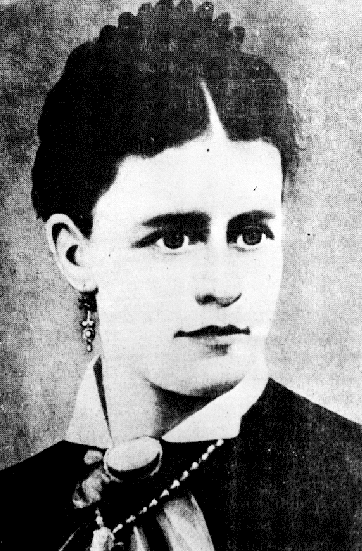
Irish, American · Exploration · Activism
Nellie Cashman
1844 – January 4, 1925
Early Life and Background
Ellen “Nellie” Cashman was an Irish-born prospector, boarding-house keeper, restaurateur, and philanthropist whose life spanned the mining frontiers of the western United States, British Columbia, the Yukon, and Alaska. Her exact birth date is uncertain: most scholarly and institutional sources place her birth in the mid‑1840s, with years such as 1844 or 1845 frequently cited, but none provide a verifiable day and month. She was born near Queenstown (now Cobh) or in Midleton, County Cork, Ireland, into a poor Catholic family during or just after the Great Famine.
Her parents were Patrick Cashman and Frances “Fanny” Cronin, and she had at least one sister, often identified as Charlotte or Maggie.[6][8][10] Her father is believed to have died when she was young, leaving her mother to support the family. Growing up in rural Cork amid famine and emigration, Nellie would have experienced both poverty and the tight-knit religious communities that shaped many Irish Catholic families. The hardship of these years later informed her empathy for struggling miners and migrants in North America.[6][10][13]
Like many Irish families, the Cashmans joined the tidal wave of emigration to North America in the mid‑nineteenth century. Sources generally state that Nellie, her widowed mother, and at least one sister emigrated in the 1860s, sometimes specifying 1865, first settling in Boston and later moving to San Francisco.[2][10][12][18] In Boston they would have encountered a large Irish community and pervasive anti‑Catholic prejudice, conditions that sharpened Nellie’s determination to be self‑reliant. The move to San Francisco exposed her to a bustling port city tied economically and culturally to western mining booms, giving her an early glimpse of the opportunities she later seized.
Career Beginnings in the American West
By the early 1870s, Nellie and her mother had relocated to the booming silver town of Pioche, Nevada, one of the roughest mining camps in the American West. A National Park Service account notes that her long business career "began in 1872" when Nellie and Fanny moved to Pioche to open a boarding house.[2] There she provided meals and lodging to miners and other transient workers, building a reputation for fairness and moral rectitude. Her work as a boarding-house keeper required financial acumen, logistical skill, and the ability to manage male customers in a violent environment; the camp was known for its lawlessness, and boarding houses could be both refuges and centers of gossip and informal politics.
During her time in Pioche, Nellie earned the nickname "Nellie of Pioche", reflecting both her local prominence and her Irish identity.[5] She reportedly refused to allow gambling and prostitution on her premises, positioning herself as a figure of ethical stability amid the camp’s vices. This role prefigured her later work in other mining communities, where she blended entrepreneurship with philanthropy and moral advocacy.
After Pioche, the Cashmans are recorded as returning for a time to San Francisco, which served as a staging point for journeys to British Columbia and other northern goldfields.[6][18] By then, Nellie had discovered that frontier mining booms offered a woman unusual opportunities for independence—especially if she could operate businesses that catered to male miners while maintaining a reputation for respectability.
Cassiar and the “Angel of the Cassiar”
Nellie’s most celebrated early frontier episode occurred during the Cassiar gold rush in northwestern British Columbia. By 1877, she had traveled north with a party of approximately 200 miners and became the first and only white woman known to enter the remote Cassiar mining district.[5] Cassiar was accessible primarily via the Stikine River and overland trails, and its camps faced severe winter conditions and isolation.
Her fame there rests largely on her role in organizing a rescue of stranded miners suffering from scurvy. Accounts vary in the exact year of the rescue, often placing it in the mid‑1870s, but they agree that Nellie became alarmed after hearing that dozens of men were trapped without adequate provisions. She reportedly gathered supplies—often cited as about 1,500 pounds of food and medicine—and led or helped organize a relief expedition into deep snow to reach the afflicted miners.[7][12][15] Once in the camps, she nursed patients and enforced dietary changes to combat scurvy, including insisting they eat fresh vegetables when available.
This episode earned her the enduring nickname "Angel of the Cassiar" or "Miner’s Angel".[9][12] The rescue illustrates her willingness to risk her own safety for others and her practical knowledge of health and logistics. It also underscores her unusual gender role: a woman leading men into dangerous conditions, operating with authority in male-dominated camps, and being publicly praised for her courage rather than criticized for stepping beyond conventional domestic boundaries.
Entrepreneurship and Philanthropy in Arizona
After her years in British Columbia, Cashman turned to the mining booms of the American Southwest. Around 1879, she relocated to Tucson, Arizona Territory, where she opened the Delmonico (or Del Monaco) Restaurant.[7][11][12] Several sources describe this establishment as the first woman‑owned business in Tucson, though precise documentation of "firsts" is limited and the exact opening date is not recorded.[12] Regardless of the formal ranking, her presence as a female restaurateur in a frontier town was notable. The restaurant served miners, travelers, and local residents, and her reputation for fair dealing and charity helped transform it into a social hub.
In 1880, Cashman sold the Tucson restaurant and moved to the newly formed silver boomtown of Tombstone, Arizona.[4][7][11] There she first operated a boot and shoe store before becoming best known for running the Russ House, a restaurant and boarding house.[15] Tombstone, notorious for gunfights and saloon culture, offered both opportunities and risks. Nellie capitalized on the influx of miners and speculators by providing reliable food and lodging, but she also devoted considerable energy to philanthropic activities.
In Tombstone she spearheaded fundraising campaigns for a Catholic church and is credited with helping raise money for a hospital and other social causes.[12][15] Contemporary reports highlight her habit of forgiving debts when miners fell on hard times and organizing benefits for families of those killed in accidents. Her religious faith remained central; she worked closely with priests and Catholic sisters, using her businesses as platforms for charitable drives.
These activities cemented her image as the "Angel of Tombstone" and demonstrated that women entrepreneurs could simultaneously build profitable enterprises and strengthen civic institutions. Her Tombstone years also connected her to well-known western figures and events, situating her at the intersection of mining, law enforcement, and popular mythology about the "Old West."
Klondike, Yukon, and Northern Alaska
By the late nineteenth century, Cashman’s restless pursuit of new opportunities led her north again. During the Klondike and Yukon gold rush era of the 1890s, she was active in northern mining camps, including around Dawson City and Nolan Creek.[9][10][18] She often arrived with or just ahead of the first wave of stampeders, establishing boarding houses or small restaurants that catered to miners.
Her northern work blended entrepreneurship with prospecting. She bought and sold mining claims, invested in small operations, and sometimes worked mines directly, earning enough to fund further ventures. Historian accounts emphasize that more than half of her mining career and roughly a third of her life were spent in northern Canada and Alaska, showing that her reputation as an "Arizona" figure captures only part of her story.[18]
In Alaska, Cashman participated in stampedes to districts such as Fairbanks and the Koyukuk‑Wiseman area.[9] She paid her way through businesses and mining, often leaving a camp before it played out and moving on to the next discovery. Her mobility, resilience, and repeated reinvention were unusual among women of her time, who were typically constrained to more settled roles. Yet she maintained her philanthropic ethos, continuing to assist sick or impoverished miners and support church and hospital projects when possible.
Political First: Voting in Alaska
One of Cashman’s most striking barrier‑breaking acts occurred in Alaska on 13 August 1912, when she cast a ballot in an Alaska‑wide territorial referendum. According to research highlighted by the Alaska Mining Hall of Fame and regional historians, she became the first woman known to vote in an Alaska‑wide election, participating in a vote on formally making Alaska a U.S. territory.[7][9]
At that time, women did not yet have legal suffrage in Alaska; the territory would not pass a women’s suffrage law until 1913.[1][9][18] Local officials at Nolan Creek allowed Cashman to vote, reflecting both her status in the mining community and the informal pragmatism of frontier politics. Her ballot did not have a direct legal impact, but its symbolism was powerful. She asserted a woman’s right to weigh in on territorial governance, effectively staging a modest but meaningful act of civil disobedience.
This episode situates Cashman within the broader context of the women’s suffrage movement, although she is not recorded as a formal suffrage activist. Her action demonstrates that frontier women could challenge exclusionary norms even without organized campaigns, and it provides an example of how suffrage history unfolded not only in state legislatures and urban protests but also in remote mining outposts.
Endurance and Dog Mushing Record
In her late sixties, Cashman undertook one of the most physically demanding feats of her life. In 1924, at about age 69, she drove a dog team on a journey of roughly 750 miles from the Koyukuk region of Interior Alaska to Seward, completing the trip in only 17 days.[9][14][18] Contemporary commentators and later historians have described this as a record‑setting performance for a woman musher, sometimes calling it a "world record" for women.
The run required navigating winter trails, river ice, and variable weather—conditions that posed serious risks even for experienced male freight drivers and mail carriers. Cashman’s successful completion of the journey at an advanced age underscores her remarkable stamina and her deep familiarity with northern travel. It also reveals how frontier women’s work could be intensely physical, contradicting stereotypes of female fragility.
Her 1924 mushing achievement belongs to the history of endurance sports and transportation in Alaska, foreshadowing later public fascination with dog mushing events such as the Iditarod. It extends her legacy beyond entrepreneurship and philanthropy into the realm of athletic accomplishment, demonstrating the breadth of her capabilities.
Awards, Honors, and Recognition
Despite her relative obscurity in mainstream histories for much of the twentieth century, Cashman’s contributions have been increasingly recognized by scholars and institutions. Her philanthropic work and frontier entrepreneurship have appeared in encyclopedias of women’s history and in exhibitions devoted to pioneering women.
In 1984, she was posthumously inducted into the Arizona Women’s Hall of Fame, which honors women who have significantly shaped Arizona’s development.[4][14] The Hall of Fame citation emphasizes her role as a pioneer, prospector, and businesswoman who spent nearly two decades in the territory, operating restaurants and boarding houses and providing aid to miners and community members.
In March 2006, the Alaska Mining Hall of Fame inducted Cashman, highlighting her extensive northern career and her dual identity as a "stampeder" and humanitarian.[9][18] The Hall’s biography notes that she died in the same hospital in Victoria that she had helped establish more than fifty years earlier, underscoring the long‑term impact of her fundraising efforts.
Beyond these formal honors, Cashman has been featured on a U.S. postal museum exhibition about "Women on Stamps" and in numerous popular histories, articles, and documentaries that celebrate her as an emblematic figure of the frontier West and North.[12][17] These recognitions collectively reframe her life as more than local lore, positioning her within national and transnational narratives of women’s history.
Personal Life
Cashman’s personal life was shaped by her decision to remain unmarried and childless, an unusual choice for a woman of her era, particularly in Catholic Irish communities. The Dictionary of Canadian Biography explicitly notes that she died "unmarried."[5] Her independence allowed her to move freely between camps and to invest her time and resources in business ventures and philanthropic projects without the domestic responsibilities that constrained many of her contemporaries.
Her closest long‑term relationships appear to have been with her mother and sister and with the Catholic clergy and religious sisters she worked alongside. She maintained strong ties to the Church, regularly raising funds for priests and orders such as the Sisters of St. Ann, and frequently seeking their partnership in building hospitals and churches.[5][6][12] These ties were as much practical as spiritual: they gave her a moral framework and institutional allies in her efforts to provide social services in rough frontier communities.
Cashman’s interactions with miners, local officials, and fellow entrepreneurs were characterized by a blend of toughness and compassion. Stories describe her confronting gamblers or saloon owners when she believed they exploited workers, refusing to serve customers who misbehaved, yet forgiving debts and organizing relief when disaster struck.[12][15] Her personal ethos combined strict standards with generous aid, earning respect across social boundaries.
Legacy and Historical Impact
Nellie Cashman’s legacy lies at the intersection of women’s history, frontier entrepreneurship, exploration, and philanthropy. She demonstrated that a woman could build independent economic power in mining camps, travel across dangerous frontiers, and exercise moral leadership in communities often dominated by male violence and vice.
Her repeated moves—from Pioche to British Columbia, from Arizona to the Klondike and Alaska—show a pattern of strategic mobility typical of male "stampeders" but rare among women. She used boarding houses and restaurants as bases of operation, but she also invested directly in mining, engaged in long-distance travel, and participated informally in politics. Scholars have noted that she spent more than half of her mining career and a third of her life in the North, challenging the tendency to treat her as primarily an "Arizona" figure.[18]
Cashman’s humanitarian work, including her role in the Cassiar scurvy rescue and her many fundraising campaigns, illustrates how women could shape health and welfare institutions even in remote camps. Her efforts to raise money for hospitals—most notably St. Joseph’s in Victoria—and to support churches and charitable organizations left infrastructural legacies that outlasted individual mining booms.[5][6][9]
In gender history, her life complicates stereotypes of frontier women as either passive dependents or exceptional outlaws. Cashman was neither a gunslinger nor a domestic angel confined to the home; she was a businesswoman, prospector, organizer, and endurance traveler whose authority rested on competence and moral credibility. Her 1912 vote in Alaska and 1924 mushing record further expand the range of women’s activities documented in frontier contexts.
Later Life and Death
In her later years, Cashman continued to divide her time between northern mining districts and urban centers such as Victoria, British Columbia. She persisted in prospecting and traveling well into her sixties and early seventies, even as the scale of new gold discoveries waned.[9][18] The 1924 dog‑team journey from Koyukuk to Seward illustrates that she remained physically active and committed to frontier life almost until the end.
By the early 1920s her health began to decline, and she returned more frequently to Victoria, where St. Joseph’s Hospital—whose founding she had helped support decades earlier—became both a medical refuge and a symbol of her philanthropic work. On 4 January 1925, under the care of the Sisters of St. Ann and her physician Dr. W. T. Barrett, she died of pneumonia, often described as "unresolved pneumonia."[5][6][10][14] She was about eighty years old, depending on the exact birth year accepted by different sources.
Newspapers across North America reported her death, recalling her rescues, her generosity, and her presence in colorful frontier episodes.[8][10][12] Obituaries emphasized that she died in the same hospital she had helped to build—an emblematic closure for a life devoted to supporting institutions that served others.
Today, Cashman is commemorated in halls of fame, museum exhibitions, local historical plaques, and scholarly work on mining and women’s history. Her story offers an important counterpoint to male-centered narratives of the gold rushes and underscores the central role that women could play in shaping frontier societies, not only as companions or dependents but as leaders, entrepreneurs, and angels of mercy.
Dated achievements
6 indexed.
- Jan011877Exploration
First white woman to enter Cassiar mining district
In 1877, Nellie Cashman audaciously became the first white woman to enter the Cassiar mining district.
View details Sharlot Hall Museum - Days Past Articles - Aug131912