← All women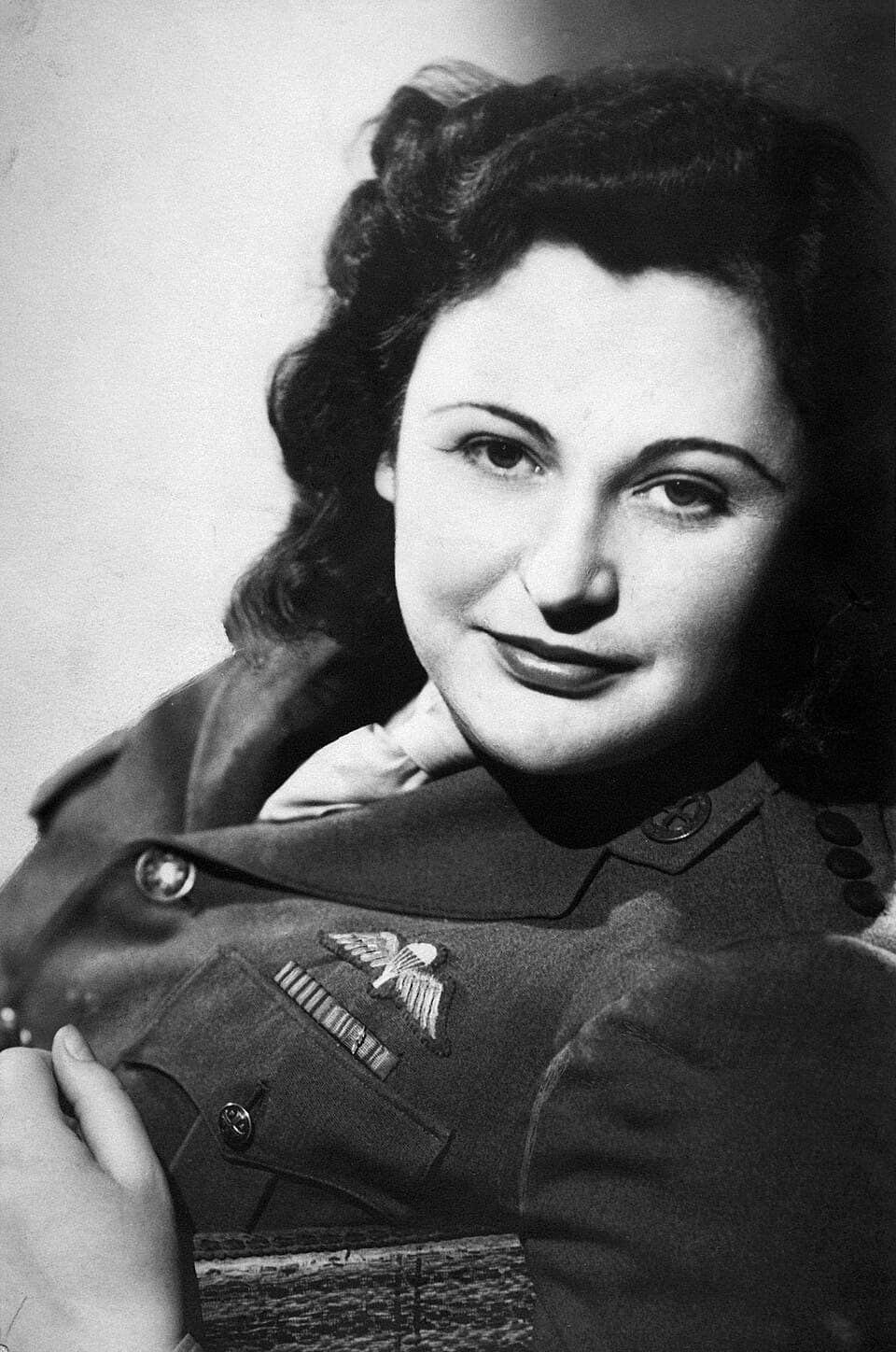
New Zealander, Australian · Activism
Nancy Wake
August 30, 1912 – August 7, 2011
Early Life and Background
Nancy Grace Augusta Wake, AC, GM, was born on 30 August 1912 in Roseneath, Wellington, New Zealand.[1][3][6] She was the youngest of several children of Charles Augustus Wake and Ella Rosieur, a family of modest means with English and possibly Maori heritage referenced in some accounts.[1][6] Around the age of two, her parents moved to Australia, and she grew up in North Sydney, New South Wales.[2][7][11]
Wake’s childhood was marked by financial hardship and family instability. Her father left the family when she was young, and she later described a deep resentment at his abandonment and the poverty that followed.[1][10] These experiences, combined with an independent temperament, pushed her to seek autonomy early. As a teenager she left home and trained as a nurse, taking work at a hospital in Sydney.[1][11] Nursing introduced her to disciplined care under pressure and the realities of physical suffering, skills that would prove valuable during wartime.
A turning point came when Wake received a small inheritance from an aunt. Determined to travel, she used the money to leave Australia, heading first to New York and then to London with the aim of becoming a journalist.[11] In London she enrolled in a journalism course and quickly secured work as a freelance reporter, developing skills in observation, interviewing and rapid writing that later aided her resistance work.[1][7]
Career Beginnings: Journalism and Witnessing Nazism
After her training in London, Wake moved to Paris and then to Marseille in the 1930s, working as a correspondent for various outlets.[1][7] As a journalist she travelled widely in Europe, including Germany and Austria, where she directly observed the rise of Nazism and the persecution of Jews and political opponents.[4][11] She later recalled witnessing scenes of brutality against Jewish people in Vienna, which profoundly influenced her hatred of the Nazi regime.[4][11]
Settling in the south of France, Wake entered the social world of Marseille and the French Riviera. In 1939 she married Henri Fiocca, a wealthy French industrialist and businessman.[1][7][11] The couple lived in Marseille, where their comfortable lifestyle gave Wake both social cover and resources that she would soon deploy in clandestine activities. Her marriage also gave her the courtesy title "Madame Fiocca," later used as one of her aliases.[1]
Entry into the French Resistance
The German invasion of France in May–June 1940 and the subsequent armistice transformed Wake’s life. Initially, she assisted the French Resistance informally, using her social position and vehicle to ferry messages, people and supplies.[4][11] Over time she became deeply involved in organised networks, including escape lines that helped downed Allied airmen and Jewish refugees move through occupied and Vichy France towards Spain and safety.[4][7]
Between roughly 1940 and 1942, Wake’s work intensified. She served as a courier, transporting money, forged documents and intelligence, and guiding fugitives through checkpoints.[4][7] Her natural boldness and ability to talk her way out of danger made her unusually effective. The Jewish Virtual Library notes that she became known as a "fantastic leader" and that she never accepted the idea that women should remain on the sidelines while men went to war.[9]
Her activities were extraordinarily risky. The Gestapo tracked her movements and, impressed by her ability to evade surveillance and arrest, gave her the nickname "the White Mouse" ("la Souris Blanche").[1][10] By 1943, she was reportedly high on the Gestapo’s most‑wanted list, and a large bounty was allegedly placed on her head.[9][10] Her network was eventually betrayed, forcing her to flee.
Escape from France and Training with the Special Operations Executive
Following increased Gestapo pressure and the arrest and torture of her husband—who refused to betray her—Wake attempted to escape France. After several failed attempts, she travelled through the Pyrenees into Spain and then on to Britain.[1][4] The National Archives notes that she left France and reached Britain in December 1943, where she was recruited into the British Special Operations Executive (SOE).[2][4]
SOE, created to support resistance movements and conduct sabotage in occupied Europe, was one of the most secretive wartime organisations. Wake was one of only about 39 women to serve as SOE field agents in France.[11] She underwent extensive training in Britain and, in some accounts, Scotland: learning parachuting, weapons handling, unarmed combat, wireless telegraphy, demolition and clandestine tradecraft.[2][7][11] The training was physically demanding and explicitly oriented towards operations behind enemy lines.
Return to France and Command in the Maquis
In 1944, as Allied planners prepared for the Normandy invasion, Wake parachuted back into France as an SOE agent.[2][4][7] Sources specify that she was dropped into the Auvergne region, tasked with working alongside French resistance forces known as the Maquis.[7][11][13] There she acted as liaison between London and local resistance groups, receiving and distributing arms and supplies delivered by air.
The National Portrait Gallery and other accounts describe Wake eventually becoming Chef du Parachutage, responsible for organising parachute drops and coordinating logistics for a resistance force of around 7,000 Maquisards.[7][12] She handled wireless communications with London, arranged drop zones, and supervised the distribution of weapons, explosives and food.
During the build‑up to D‑Day in June 1944, her group carried out sabotage attacks against German lines of communication, including railway and telephone infrastructure, to disrupt reinforcements heading to the Normandy front.[2][7] Wake’s leadership and ability to impose discipline on male fighters were noted by both British and French superiors; she was regarded as one of the most capable resistance operators in France.[11][12]
Accounts from comrades and later historians highlight her personal courage, including participation in combat operations and missions undertaken under aerial bombardment and ground attack. She was known to insist on equal risk, refusing to be shielded because of her gender.[9][11]
End of War and Recognition
By the end of the Second World War, Wake’s contributions were widely acknowledged by Allied governments. She was credited with playing a major role in sustaining escape routes for Allied airmen between 1940 and 1943 and in strengthening the Maquis capacity to support Allied operations in 1944–1945.[2][4][7]
In the immediate postwar years she received a series of decorations:
- From the United Kingdom, she was awarded the George Medal, one of the country’s highest civilian gallantry awards.[2][4][7]
- From the United States, she received the Medal of Freedom, recognising her assistance to Allied personnel and the liberation effort.[2]
- From France, she was made a Chevalier and later an Officer of the Légion d’Honneur, and awarded the Croix de Guerre multiple times (often cited as three awards, with star and palms), as well as the Médaille de la Résistance.[2][4][7]
- She also received British campaign decorations including the 1939–45 Star, the France and Germany Star, the Defence Medal, and the British War Medal 1939–45.[2][4][7]
These honours collectively made Wake one of the most decorated servicewomen of the Second World War.[2][4][11] However, sources indicate that recognition from her adopted home of Australia came slowly. For many years she expressed resentment that Australia had not adequately honoured her.[1][10][11]
Postwar Career and Political Activity
After the war, Wake briefly continued in intelligence work. She served in the Intelligence Department of the British Air Ministry, drawing on her SOE experience.[1][13] By the late 1940s she had returned to Australia and attempted to convert her wartime reputation into political influence.
Wake stood as a candidate for the Liberal Party of Australia in federal elections, contesting the Sydney seat of Barton in 1949 and Kings Cross in 1960, though she was not elected.[1] Her campaigns reflected a belief that her experiences in war gave her insight into international affairs and defence. They also demonstrated the difficulty women faced in translating wartime leadership into peacetime political authority in mid‑twentieth‑century Australia.
Her first husband, Henri Fiocca, had been arrested by the Gestapo and executed during the war for refusing to give information about her whereabouts.[1][11] Wake learned of his fate only after the war, and it remained a source of lasting grief. In 1960, she married John Forward, an Australian former RAF officer, and settled for a time in Australia.[1][11][13]
Writing, Media Portrayals and Public Persona
Wake’s extraordinary life attracted biographers, filmmakers and television producers. She collaborated with biographers and gave extensive interviews, though she sometimes expressed frustration at inaccuracies or sensationalism in portrayals. She authored an autobiography titled "The White Mouse", recounting her wartime experiences and emphasising the seriousness of resistance work.[9][14]
Her story was dramatized in the Australian television miniseries "Nancy Wake" (1987), which depicted her activities in France and England, and other documentaries and programs have revisited her life.[1][18] These portrayals contributed to making her a public figure in Australia and beyond, though she remained personally wary of hero worship, insisting that she had simply done what needed to be done.
In public interviews later in life, Wake maintained a forthright style, often using blunt humour and strong language. She was critical of any attempt to romanticise war and candid about her enjoyment of drinking and socialising. This persona contrasted with traditional expectations of female modesty and helped cement her image as an unconventional war heroine.[10][11]
Later Life and Honours
In her later decades, Wake divided her time between the United Kingdom and Australia.[11] She lived in London for many years, including at the Royal Star and Garter Home, a veterans’ residence. Despite age and declining health, she remained engaged with commemorative events and occasionally gave talks or interviews.
In 2004, the Australian government appointed her a Companion of the Order of Australia (AC), the country’s highest civilian honour, for "service to Australia in war and peace through contributions to international relations and to the welfare of veterans".[4][11] This award was widely noted as long‑overdue recognition of her wartime heroism from the nation she considered home.
New Zealand also acknowledged her, awarding her the RSA Badge in Gold, and institutions such as the Australian War Memorial, National Archives of Australia and National Portrait Gallery created exhibits and educational resources about her life.[2][4][7][11] Internationally, her legacy was further commemorated when the main‑belt asteroid 17038 Wake was discovered on 26 March 1999 and later named in her honour, symbolically inscribing her name in astronomical catalogues.[6]
Death
Nancy Wake died on 7 August 2011 in London, England, aged 98, following complications from a chest infection.[1][3][12][13] Obituaries in major outlets such as The Guardian, The New York Times and others reflected on her journey from a poor childhood in Australia to socialite life in Marseille and ultimately to her role as a daring resistance leader.[5][10]
Her ashes were later scattered in France, fulfilling her wish to be associated permanently with the country whose resistance she had served. Her death prompted renewed discussion of women’s roles in combat and clandestine operations, and highlighted the continuing importance of documenting women’s contributions to military history.[1][10][11]
Legacy and Historical Impact
Nancy Wake’s legacy lies in her extraordinary wartime service and the way her life challenges conventional narratives about gender and warfare. As one of the most decorated Allied servicewomen, she offers a counterpoint to the assumption that women’s wartime contributions were primarily auxiliary or domestic.[2][4][11]
Her work as a courier and escape‑line organiser from 1940 to 1943 demonstrates that women could play central operational roles in clandestine networks, handling logistics, intelligence and human movement under threat of torture and execution.[4][7][9] Her later position as commander and liaison for thousands of Maquis fighters illustrates how a woman could exercise direct military leadership, even within cultures often hostile to female authority.
Wake’s story has become a crucial case study in scholarship on resistance movements, espionage and gender. Historians use her experiences to explore themes such as the relationship between social class and clandestine work (her ability to move in elite circles), the transformation of journalists into activists, and the intersection of national identities in transnational resistance (New Zealander–Australian fighting for France under British command).[1][2][7]
Educational resources produced by institutions like the National Archives of Australia, the Australian War Memorial and the Anzac Portal present her as a model of courage and initiative, especially for young people learning about the Second World War.[2][4][11][12] They underline her refusal to accept the idea that women should stay at home while men fought, highlighting her insistence on taking front‑line risks.[9][11]
In popular culture, Nancy Wake embodies the archetype of the daring female spy and partisan fighter. Yet serious biographical work also stresses her human vulnerabilities—grief over her husband’s death, frustration with postwar bureaucracy, and the psychological weight of violence. This more nuanced legacy invites reflection on the costs of resistance, not just its heroics.
Overall, Wake’s life illustrates how individual determination can shape history, and how women’s contributions to military and resistance movements must be integrated into mainstream historical narratives. Her story continues to inspire new scholarship, artistic works and educational programs, ensuring that the "White Mouse" remains a central figure in the global memory of the fight against Nazism.
Dated achievements
3 indexed.
- Aug301912Activism
Birth of Nancy Wake in Wellington, New Zealand
Born on 30 August 1912 in Wellington, New Zealand; Nancy Grace Augusta Wake would become one of the most decorated women of the Second World War.
View details Nancy Wake – Wikipedia - Mar261999Science
Discovery of asteroid 17038 Wake named for Nancy Wake
On 26 March 1999, astronomers discovered main-belt asteroid 17038 Wake, later named in honour of French Resistance heroine Nancy Wake.