← All women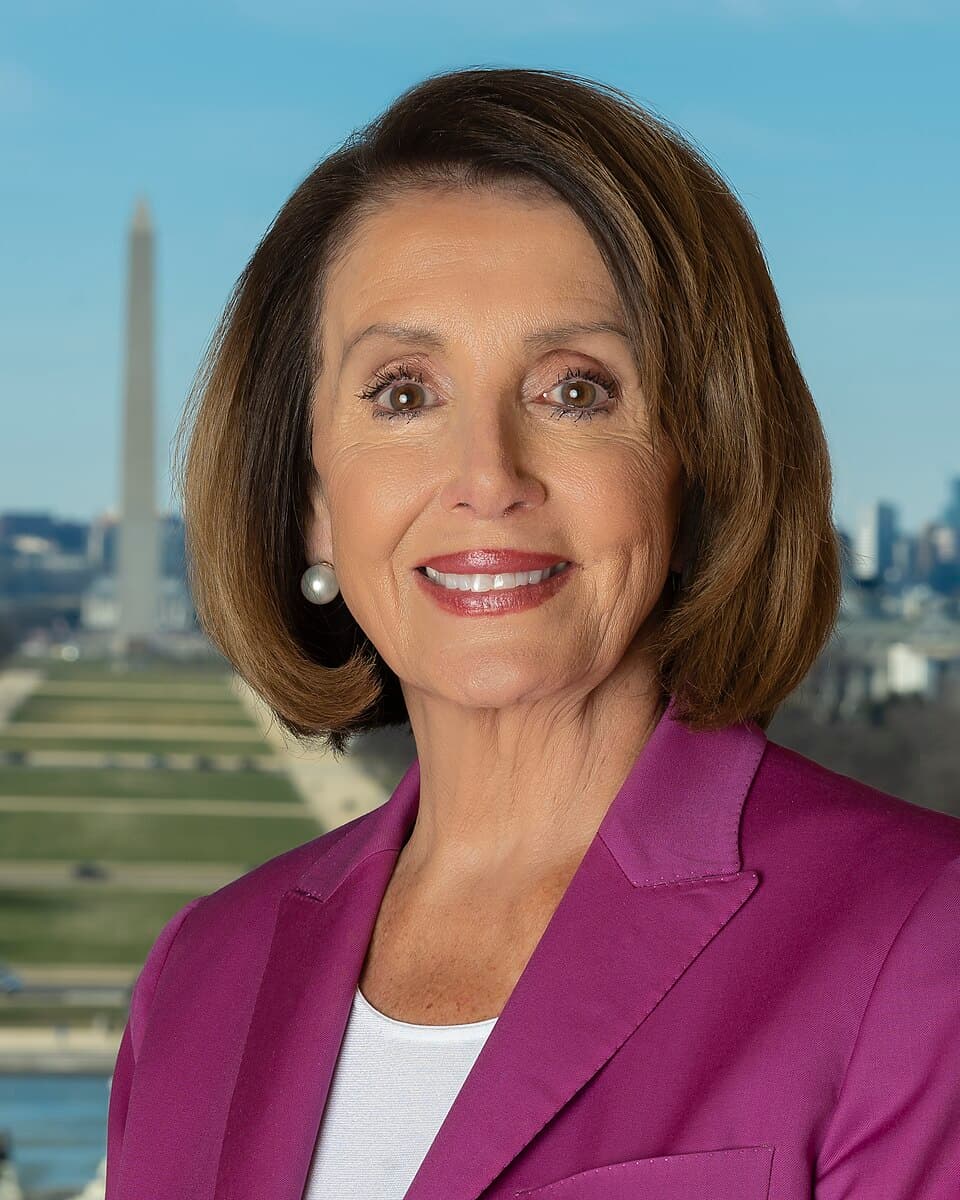
American · Politics
Nancy Pelosi
March 26, 1940 – present
Early life and family background
Nancy Patricia D’Alesandro Pelosi was born on March 26, 1940, in Baltimore, Maryland, into a tightly knit Italian American, Roman Catholic family steeped in Democratic machine politics.[2][5][13] She was the youngest of six children and the only daughter of Thomas D’Alesandro Jr. and Anunciata (Nancy) Lombardi D’Alesandro, both of whom were deeply involved in local political life.[2][5] Her father served as a New Deal Democrat in the U.S. House of Representatives from 1939 to 1947 before becoming mayor of Baltimore from 1947 to 1959, while her mother was known for neighborhood organizing and constituent casework.[2][5][9]
Growing up in what she later described as a "house of public service," Pelosi absorbed political skills from an early age. Family lore recounts that as a child she helped track constituent requests and favors in a notebook—an early exercise in the meticulous vote‑counting that would later define her congressional leadership.[5][9] Baltimore at mid‑century was a segregated, working‑class port city grappling with post‑Depression recovery and wartime mobilization, and the D’Alesandro household sat at the center of ward‑based, patronage‑driven Democratic politics. This environment taught Pelosi both the rough‑and‑tumble of campaigns and the importance of delivering tangible benefits to local communities.[5][9]
Pelosi attended Institute of Notre Dame, a Catholic girls’ high school in Baltimore, and remained active in church and community life.[2][5] Seeking higher education and a broader political horizon, she enrolled at Trinity College (now Trinity Washington University) in Washington, D.C., where she studied political science and was exposed to national politics and the workings of federal institutions.[2][5][6] She graduated with a Bachelor of Arts in political science in 1962, a period when women still faced substantial barriers in electoral politics and high office.[2][5][6]
Marriage, move west, and early political involvement
In 1963, Nancy D’Alesandro married Paul Pelosi, a businessman from San Francisco whom she had met while both were college students.[2][5][10] The couple eventually settled in San Francisco after time on the East Coast, and they had five children: Nancy Corinne, Christine, Jacqueline, Paul Jr., and Alexandra.[2][5][10] For much of the 1960s and 1970s, Nancy Pelosi primarily identified as a stay‑at‑home mother, but she remained politically engaged as a volunteer and organizer in Democratic Party circles.[5][9][10]
Pelosi’s formal political career began behind the scenes. She worked as a fund‑raiser and strategist for Democratic candidates and causes, gradually building a reputation as a formidable organizer. In 1976, she helped manage California Governor Jerry Brown’s presidential campaign in Maryland, demonstrating her ability to operate in national politics beyond her local base.[2] In 1977, the Pelosis moved permanently to San Francisco, a liberal, politically active city that would become the core of her electoral career.[2]
Within a few years, Pelosi rose through party ranks. She was elected a member of the Democratic National Committee (DNC) from California in 1981, giving her a national platform inside the party apparatus.[2] In 1983, she became chair of the California Democratic Party, overseeing organization and fundraising in one of the country’s largest and most influential states.[2] She played a key role as chair of the host committee for the 1984 Democratic National Convention in San Francisco, successfully managing a high‑profile event that showcased the city and the party.[2] In 1985, she became finance chair for the Democratic Senatorial Campaign Committee (DSCC), further cementing her status as a top‑tier fundraiser and strategist.[2]
Entry into Congress
Pelosi’s transition from party insider to elected official came in the late 1980s. When Representative Phillip Burton of San Francisco died in 1983, his widow Sala Burton won the seat and, over time, identified Pelosi as a potential successor.[2][5] After Sala Burton’s health declined, she encouraged Pelosi to run for the seat. Following Burton’s death in early 1987, a special election was called in California’s 5th District.
On June 2, 1987, Pelosi won the special election, defeating a crowded field with strong backing from local party organizations.[2][4] She was sworn into the U.S. House of Representatives on June 9, 1987, officially becoming the representative for a district encompassing much of San Francisco.[2][7] From the outset, she aligned herself with liberal positions on social issues, environmental protection, and foreign policy, reflecting her constituency’s priorities.
Representing a city at the epicenter of the HIV/AIDS crisis, Pelosi quickly made AIDS research, treatment, and housing funding central to her agenda. She later championed the Housing Opportunities for Persons with AIDS (HOPWA)1993 as a dedicated federal housing initiative for people living with HIV/AIDS.[9] She also became known for her advocacy of human rights abroad, particularly in China and Tibet, and for environmental protections, including efforts to preserve the Presidio of San Francisco as a national park, which Congress codified in legislation signed by President Bill Clinton in 1996.[9]
Emerging legislative profile and early foreign policy stands
During her early years in Congress, Pelosi built a record as a reliably liberal vote with a particular focus on health, human rights, and the environment.[5][14] One of her first nationally notable decisions came on January 12, 1991, when she voted against House Joint Resolution 77, authorizing the use of U.S. military force in Iraq during the Gulf War.[6] Though the resolution passed, Pelosi’s vote placed her in a minority sceptical of rushing into war, foreshadowing her later opposition to the 2003 Iraq War.
Pelosi also pursued policy innovations through legislative amendments. The so‑called "Pelosi Amendment", which took effect in 1993, required U.S. representatives at multilateral development banks to evaluate the environmental impacts of projects before approving loans.[9] This measure embedded environmental considerations into international finance, reflecting early attention to sustainability in global development policy.
Rise in the Democratic leadership
Pelosi’s organizational skills and fundraising capacity propelled her into the House Democratic leadership. On January 15, 2001, House Democrats elected her Minority Whip, making her the first woman to serve as House Democratic Whip and the first woman elected House Minority Whip.[2][5][7] In this role, she was chiefly responsible for counting votes and ensuring party discipline—a demanding position that showcases a member’s ability to unify a diverse caucus.
After the 2002 midterm elections, longtime Democratic leader Richard Gephardt stepped aside to prepare for a presidential run. On November 14, 2002, Democrats elected Pelosi as House Minority Leader, making her the first woman ever to lead a major party in Congress.[2][3][13] From this position, she led the Democratic opposition to President George W. Bush’s administration on issues including tax cuts, the Iraq War, and domestic surveillance.
At the start of the 108th Congress in 2003, she formally assumed the Minority Leader role.[3] Pelosi’s leadership style blended ideological liberalism with pragmatic vote‑counting. She strongly opposed the 2003 invasion of Iraq and rallied Democrats against parts of Bush’s domestic agenda, while also maintaining internal cohesion among moderates and progressives.[5][14]
First speakership and "marble ceiling" breakthrough
Democrats’ decisive victories in the 2006 midterm elections returned them to the House majority for the first time in twelve years. On January 3, 2007, the House elected Nancy Pelosi as Speaker for the 110th Congress, making her the first woman to hold the position and, at that time, the highest‑ranking woman in U.S. government.[2][4][5] She thus became second in line to the presidency, after the vice president.
The following day, January 4, 2007, Pelosi formally received and wielded the Speaker’s gavel in a highly publicized ceremony, surrounded by her children and grandchildren.[2] She framed the moment as shattering the "marble ceiling" that had long kept women from the highest leadership roles in Congress. Her initial legislative program, sometimes called the "First 100 Hours" agenda, focused on ethics reform, raising the federal minimum wage, expanding stem cell research funding, and cutting interest rates on student loans.[5][14]
During her first term as Speaker (2007–2011), Pelosi presided over major legislative battles. She helped steer through a substantial economic stimulus package following the 2007–2008 financial crisis and played a central role in the Emergency Economic Stabilization Act of 2008, which created the Troubled Asset Relief Program (TARP) to stabilize financial markets.[8] She also helped enact the Dodd–Frank Wall Street Reform and Consumer Protection Act in 2010, which tightened oversight of financial institutions in response to the crisis.[8]
Role in health care reform and social policy
Pelosi’s most consequential legislative achievement during her first speakership was her role in passing health care reform. After a prolonged and politically fraught process, she led the House to approve the Patient Protection and Affordable Care Act (ACA) on March 21, 2010.[2][14] This vote, coming after the unexpected loss of a Democratic Senate seat in Massachusetts, required Pelosi to persuade anxious members to accept the Senate bill and rely on a follow‑up reconciliation measure for changes. Her skill in mustering votes under intense pressure cemented her reputation as a master tactician.
The ACA, signed into law on March 23, 2010, expanded health insurance coverage through Medicaid expansion, insurance exchanges, and subsidies, while barring insurers from denying coverage due to preexisting conditions.[5][14] It became a defining achievement of the Obama administration and of Pelosi’s speakership, affecting millions of Americans and reshaping the health‑care system.
Pelosi also supported the repeal of the military’s "don’t ask, don’t tell" policy in 2010, which allowed LGBTQ service members to serve openly in the armed forces for the first time.[8] Her backing reflected longstanding advocacy for LGBTQ rights, including support for hate‑crimes legislation and anti‑discrimination measures.
Minority leadership and continued influence
In the 2010 midterm elections, Republicans gained a substantial majority in the House, ending Pelosi’s first tenure as Speaker. In 2011, she transitioned to the role of House Minority Leader once again, chosen by the Democratic caucus to continue leading them in opposition.[3][19] From this position, she confronted the Republican majority on budget negotiations, debt‑ceiling standoffs, and efforts to repeal or undermine the ACA.
During the Obama years and beyond, Pelosi remained a central figure in Democratic strategy. She helped protect key elements of the ACA from repeal efforts and supported major legislative packages such as the American Recovery and Reinvestment Act and later, under President Joe Biden, the American Rescue Plan Act and Inflation Reduction Act, though the latter two were enacted when she had returned to the speakership.[12][14] Her ability to maintain unity within a caucus that spanned conservative Democrats to democratic socialists was widely noted.[9][14]
Return to the speakership and leadership under Trump
Democrats regained control of the House in the 2018 midterm elections, propelled in part by opposition to President Donald Trump and concerns about health care and presidential conduct.[5][9] On January 3, 2019, Pelosi was once again elected Speaker of the House, becoming the first person in more than six decades to reclaim the speakership after losing it.[2][3][5] She thus resumed her role as the most powerful Democrat in Congress and the highest‑ranking woman in the federal government.
Pelosi’s second speakership was defined by confrontation with the Trump administration. For much of 2019, she resisted calls for impeachment from some members of her caucus, preferring to focus on legislative oversight and policy. However, revelations about Trump’s dealings with Ukraine—including a phone call in which he pressed the Ukrainian president to investigate political rival Joe Biden—led her to open a formal impeachment inquiry in the fall of 2019.[5][14]
On December 18, 2019, the House, under Pelosi’s leadership, voted to impeach President Trump on two articles: abuse of power and obstruction of Congress.[2][8] The Senate later acquitted Trump, but the impeachment established a historic precedent and showcased Pelosi’s willingness to use congressional powers against a sitting president she viewed as overstepping constitutional norms.
Pelosi and Trump’s antagonistic relationship was vividly displayed on February 4, 2020, when, at the conclusion of Trump’s State of the Union address, she tore up her copy of his prepared remarks in full view of the cameras.[2] She later characterized the speech as a "manifesto of mistruths." The gesture drew intense criticism from Republicans and praise from some Democrats and anti‑Trump commentators, symbolizing the depth of partisan conflict in the late Trump era.
Leadership during the COVID-19 pandemic and economic crisis
During 2020 and 2021, Pelosi played a central role in negotiating and passing multiple COVID‑19 relief packages designed to stabilize the economy, support public health efforts, and provide direct aid to households and businesses.[5][14] Working at times with the Trump administration and later with the Biden administration, she helped shape legislation including the CARES Act and subsequent measures.
Under President Joe Biden, Pelosi was instrumental in securing passage of the American Rescue Plan Act in 2021, a sweeping economic and public health relief bill that included stimulus payments, extended unemployment benefits, expanded child tax credits, and funding for vaccinations and schools.[12][14] In 2022, she was a key architect of the Inflation Reduction Act, legislation that combined climate and energy investments, health‑care subsidies, and tax reforms, widely described as the largest climate investment in U.S. history.[12][14]
Second impeachment of Donald Trump and defense of democratic institutions
The climax of Pelosi’s confrontations with Trump came in the wake of the January 6, 2021 attack on the U.S. Capitol, when a pro‑Trump mob stormed the building in an attempt to disrupt certification of the 2020 presidential election results.[14] In the days that followed, Pelosi described the attack as an insurrection and a direct assault on democracy, and she moved swiftly toward impeachment.
On January 13, 2021, the House, led by Pelosi, impeached Donald Trump for a second time, charging him with incitement of insurrection.[2][8] Ten House Republicans joined Democrats in the vote, making it the most bipartisan presidential impeachment in U.S. history. The Senate again acquitted Trump, but the proceedings underscored Congress’s willingness to respond to an unprecedented challenge to the peaceful transfer of power.
Pelosi’s role in the second impeachment cemented her place in constitutional history as the first Speaker to oversee two impeachments of the same president. It also highlighted her broader role in defending institutional norms amid rising political extremism and misinformation.[8][14]
Stepping back from leadership and later congressional service
After the 2022 midterm elections, Republicans narrowly regained control of the House. On November 17, 2022, Pelosi announced on the House floor that she would not seek re‑election as leader of the House Democratic caucus, ending her tenure as Speaker and party leader while continuing to serve in Congress.[2][5] In a reflective speech, she emphasized the need for a "new generation" of leadership and recounted her journey from Baltimore to the speakership.
House Democrats subsequently named her Speaker Emerita, an honorary title acknowledging her enduring influence and service.[1][14] She continued to represent California’s 11th District, focusing on issues including democracy protection, climate policy, and economic equity, while allowing new leaders such as Hakeem Jeffries to take formal charge of the caucus.[1][14]
Retirement planning and end of congressional career
As she advanced into her mid‑80s, Pelosi began to chart the formal end of her legislative career. On November 6, 2025, she publicly declared that she would not seek re‑election to the U.S. House of Representatives, signaling that the term ending in January 2027 would be her last.[6][15] The announcement came after she had already relinquished party leadership, reinforcing the sense of a managed, phased transition rather than a forced exit.
On November 7, 2025, national media coverage framed her decision as the closing of an extraordinary chapter in congressional history, highlighting her status as the first and, to date, only woman Speaker of the House and as a central architect of landmark legislation from financial rescue measures to health care reform.[6][15] Her retirement plans prompted assessments of her nearly four decades representing San Francisco in Congress and of the generational shift underway in Democratic politics.
Awards, honors, and public recognition
Pelosi’s barrier‑breaking leadership garnered numerous honors. On October 12, 2013, she was inducted into the National Women’s Hall of Fame in Seneca Falls, New York, in recognition of her historic role as the first woman Speaker and her leadership on issues including health care and human rights.[5] This placed her alongside major figures in the women’s rights movement and cemented her status as a key figure in the story of women’s political advancement in the United States.
On May 3, 2024, President Joe Biden awarded her the Presidential Medal of Freedom, the nation’s highest civilian honor.[2][10] The award recognized her decades of public service, including shepherding the Affordable Care Act, managing responses to economic and public health crises, and defending democratic institutions during an era of deep polarization. Other recognitions have included repeated listings among the world’s most powerful women by various media outlets and profiles in projects such as Britannica’s 100 Women series highlighting global trailblazers.[3]
Personal life and family
Throughout her career, Pelosi emphasized that she came to elected office relatively late in life after raising five children. She has frequently cited motherhood as a training ground for managing competing demands and personalities, skills she later applied to herding votes in Congress.[5][9] Her husband, Paul Pelosi, built a career in finance and real estate and largely remained out of the political spotlight, though he occasionally drew media attention due to business dealings and, later, a violent attack in the couple’s San Francisco home in 2022.[2]
Pelos’s children have pursued various professional paths, with some, such as Christine Pelosi and Alexandra Pelosi, maintaining public profiles. Christine has been active in Democratic politics and party governance, while Alexandra has worked as a documentary filmmaker, often focusing on political subjects.[2][10] Despite the family’s extensive public engagement, Nancy Pelosi has generally kept her private life distinct from her legislative work, emphasizing service and institutional responsibilities rather than personal narrative in her official communications.[1][14]
Legacy and historical impact
Nancy Pelosi is widely regarded as one of the most powerful and effective Speakers in modern U.S. history and as a transformative figure in women’s political leadership.[3][5][9] As the first woman to serve as Speaker and the first woman to lead a major party in Congress, she broke institutional barriers that had persisted since the founding of the republic.[3][5] For many years, she held the highest elected office attained by a woman in U.S. history, until the election of Vice President Kamala Harris in 2020.[7][14]
Substantively, her legacy is anchored in major legislation. The Affordable Care Act, financial regulatory reform after the 2008 crisis, large‑scale climate and health‑care investments in the Inflation Reduction Act, and expansive COVID‑19 relief measures all bear her imprint as a legislative architect and vote counter.[8][12][14] Her willingness to use congressional power against a sitting president—twice in the case of Donald Trump—underscored the centrality of the House in constitutional checks and balances.[8][14]
Pelosi’s career has also reshaped perceptions of what women can and do accomplish in high office. By navigating and mastering the internal politics of the House—often described as one of the most complex legislative bodies in the world—she demonstrated that women could not only participate in, but dominate, the highest echelons of legislative leadership. Her tenure inspired many women to pursue office at local, state, and federal levels, contributing to a broader surge in female political representation in the early twenty‑first century.[3][7][14]
At the same time, Pelosi remained a polarizing figure among opponents, who criticized her liberal positions, her leadership style, and her central role in expanding the federal government’s role in health care and economic management.[9][14] This polarization, however, also underscored her significance: she became a symbol of Democratic governance for both supporters and critics, much as earlier Speakers had come to personify their parties’ agendas.
As she prepared to leave Congress after nearly forty years of service, assessments of her career emphasized both the historic nature of her "firsts" and the durability of the institutional changes she helped bring about. Whether measured by policy impact, institutional influence, or symbolic importance in women’s history, Nancy Pelosi stands as one of the most consequential congressional leaders in American history.
Dated achievements
18 indexed.
- Mar261940Politics
Birth of Nancy Patricia D’Alesandro (Nancy Pelosi) in Baltimore
Nancy Patricia D’Alesandro (later Nancy Pelosi) is born in Baltimore, Maryland, into a prominent Democratic political family.
View details Nancy Pelosi - Wikipedia - Jun021987Politics
Elected to U.S. House of Representatives in special election
Nancy Pelosi wins a special election to the U.S. House from California’s 5th District, beginning her long congressional career.