← All women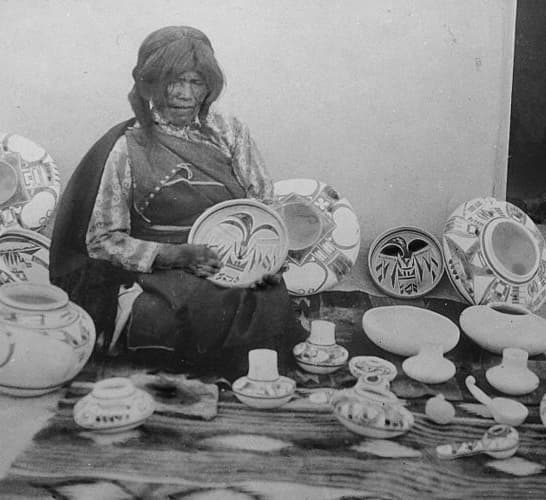
Native American, Hopi-Tewa · Arts
Nampeyo
1859 – July 20, 1942
Early Life and Background
Nampeyo (often dated c. 1858–1860–1942) was a Hopi‑Tewa potter from the village of Hano (also known as Tewa Village) on First Mesa in what is now northeastern Arizona.[4][12][14] Because Hopi‑Tewa people did not traditionally record births using the Euro‑American calendar, her exact birth date and even year are uncertain; major scholarly and museum sources place her birth around 1858–1860.[6][9][12][14]
She was born to a Tewa mother of the Corn Clan, named Kotsakao or White Corn, and a Hopi father of the Snake Clan, Kotsuema or Quootsva, from the nearby village of Walpi.[12][14] This dual Hopi‑Tewa heritage positioned her at a cultural crossroads between language communities and ceremonial traditions on First Mesa. Her Tewa name, recorded in several spellings—Num‑pa‑yu, Nampayu—is glossed as "snake that does not bite," reflecting the ceremonial importance of the Snake Clan.[7][12][19]
As was common in the late 19th century, Nampeyo also received an Anglo name: Iris Nampeyo, noted in museum records such as Philbrook Museum’s biography.[19] Nonetheless, she was widely known simply as "Nampeyo" in Native and non‑Native contexts, an unusual case of a Native woman artisan whose Indigenous name became standard in Western art history.
From childhood, Nampeyo lived in a subsistence agricultural community where women’s labor—farming, cooking, and particularly pottery—was central to domestic and ceremonial life. She is reported to have learned pottery from her paternal Hopi grandmother, who specialized in Polacca or "crackle ware," a white‑slipped pottery characterized by fine crazing and painted designs.[1][17] Other sources emphasize that she also learned utilitarian Tewa pottery from her mother.[14] In either case, she absorbed the techniques of clay preparation, coil building, burnishing, slip application, and outdoor firing at a young age.
Career Beginnings and Development
Nampeyo began making pottery in her late teens, in the 1870s, building upon the instruction she had received from elder women.[2][15] By the mid‑1870s to 1880s her work in the prevailing Polacca style had reached a high level of technical refinement, and she was regarded locally as one of the finest potters on First Mesa.[1][10] This period of her early career has been studied in detail in scholarship such as "In Search of Nampeyo: The Early Years, 1875–1892," which traces her development from traditional white‑slipped wares to the experimental forms that later defined her mature style.[13]
In the late 19th century, Hopi pottery traditions faced significant pressures. Missionaries, boarding schools, and changing economic conditions challenged subsistence lifeways, while the growing tourist trade and railroad traffic, especially through the Santa Fe and Fred Harvey systems, introduced new markets but also demanded standardized souvenir wares. Within this context, Nampeyo’s experimentation with ancient designs was both an aesthetic choice and a cultural strategy.
Her turning point came as she encountered excavated sherds and whole vessels from the ancient Hopi village of Sikyátki, a site occupied from roughly the 14th to 17th centuries on the flank of First Mesa.[6][17] Archaeological work and informal digging in the late 19th century exposed fragments of polychrome pottery with yellow slips and complex geometric and figurative motifs. Working with her second husband Lesou, Nampeyo studied these designs carefully, copying motifs and analyzing forms.[17]
Drawing on this research, she began to develop a new style, commonly called Hano Polychrome or the Sikyátki Revival style.[6][10] This ceramic tradition combined yellowish clay bodies fired to a warm buff tone, low wide‑shouldered jar forms, and designs featuring abstracted birds, animal faces, and interlocking geometric patterns, arranged with striking balance and rhythm.[17] By the late 19th century she had "almost single‑handedly" launched a renaissance of Hopi pottery based on these ancient precedents.[2][5][10][12][14]
Major Works, Style, and Accomplishments
Nampeyo’s major accomplishment was the creation and popularization of the Hano Polychrome style, which revived Sikyátki‑inspired pottery at a time when Hopi ceramics were shifting toward white‑slipped Polacca ware.[6][12] Her vessels often feature:
- Yellow‑orange clay bodies sourced from specific First Mesa deposits
- Low, wide‑shouldered jar forms with gently flaring rims
- Carefully burnished surfaces creating a soft sheen
- Intricately balanced geometric and zoomorphic designs painted in red, black, and brown
Museum collections such as the National Museum of the American Indian and the Denver Art Museum emphasize her mastery of form and composition and the way she integrated ancient motifs into new arrangements.[15][20] One widely cited polychrome jar, dated broadly to her mature period, illustrates her characteristic design of avian motifs broken into abstract elements distributed around the shoulder of the vessel.[20]
Throughout the late 19th and early 20th centuries, Nampeyo supplied pottery to the Fred Harvey Company, which operated hotels and trading posts along the Santa Fe Railway.[16] This commercial relationship expanded the distribution of her work far beyond First Mesa. Tourists and collectors purchased her jars and bowls at depots and hotels such as the Hopi House at the Grand Canyon, making her one of the earliest Native women artists whose work circulated widely in a modern mass‑tourist economy.
Despite working within a market that often favored novelty and volume, Nampeyo maintained high artistic standards. Her pieces are frequently distinguished from contemporaneous wares by their careful proportions, even wall thickness, and complex design layouts. While most of her pottery was not signed—since naming individual makers on vessels was not customary in her community—dealers and curators documented her work and style, and she became known by name through photographs, labels, and exhibition texts.[16]
By the early 20th century, art historians and curators recognized Nampeyo as arguably the first named Native American artist in Western art discourse, and specifically the first American Indian woman to make a name for herself as a potter outside her community.[6][13][15] This recognition reflected both the distinctiveness of her style and the growing practice of attributing works to individual Native creators rather than to anonymous "tribal" traditions.
Awards, Honors, and Recognition
During her lifetime, Nampeyo’s primary forms of recognition were:
- Widespread demand for her work among tourists, traders, and collectors supplied through Fred Harvey and other channels[16]
- Photographic documentation by figures such as W. H. Jackson, who noted her age and skill when he photographed her in 1875[16]
- Growing coverage in early 20th‑century ethnographic and popular publications that singled her out as a "master potter"[11]
In the decades after her death, institutional honors multiplied. Museums in the United States and abroad collected her vessels as exemplars of Hopi‑Tewa pottery. By the late 20th century, she was commonly described as one of the two most famous Indian potters, alongside San Ildefonso potter Maria Martinez of New Mexico.[3][5][6][16]
In 1986, Nampeyo was inducted into the Arizona Women’s Hall of Fame, which celebrated her as an innovator in form and design and credited her with reviving prehistoric Sikyátki‑style pottery.[4] This state‑level honor placed her within Arizona’s formal narrative of notable women, aligning a Hopi‑Tewa artist with political and civic leaders.
Art‑market recognition further amplified her legacy. On December 6, 2010, a decorated pot by Nampeyo sold for $350,000 at Bonhams, setting what was described as a world auction record for Southwest American Indian pottery.[2][11] Commentators such as Artnet and PBS used this event to highlight her stature as the "grande dame" or "master potter" of Hopi ceramics, underscoring the convergence of scholarly and market valuations.[3][11]
Personal Life
Biographical sources provide relatively rich detail about Nampeyo’s family life. Around 1879, she married Kwivioya; the marriage was later annulled.[12] In 1881, she married Lesou
Nampeyo and Lesou had five children: four daughters—Kwe‑tca‑we (later known as Annie), Ta‑wee, Po‑pong‑mana (Fannie), and Tu‑hi‑kya—and one son, Qoo‑ma‑lets‑tewa, who died in 1918.[12] Several of these children became important potters in their own right. Her daughter Fannie Nampeyo and granddaughter Elva Nampeyo are widely documented as central figures in continuing the family tradition, producing highly regarded vessels signed with variations of the family name.[2][18]
Family collaboration was integral to her later career. According to museum and encyclopedia accounts, after Nampeyo’s eyesight began to fail around 1920, she continued to shape vessels while Lesou, her daughters, and later grandchildren took on more of the painting.[12][15][17] This collective process allowed her to remain active despite near blindness and further reinforced the idea of a multi‑generational "Nampeyo style" that transcended any single individual.
Later Life and Death
By the 1920s, Nampeyo was nearly blind, yet her tactile memory of forms and her long practice enabled her to keep working.[12][15][17] She relied on family members to paint designs on the vessels she shaped, synthesizing her established aesthetic with the emerging styles of her descendants. Her home in Hano remained a center of pottery production, where visiting traders, anthropologists, and tourists encountered both her work and that of her extended family.
Nampeyo’s health declined gradually, but she continued to shape pottery until close to her death. She died on July 20, 1942, in her home in Hano on First Mesa.[6][9][12][17] Encyclopedia and museum sources estimate that she had been active as a potter for around 70 years, an extraordinary span even by the standards of long‑practicing Indigenous artists.[6]
At the time of her death, Nampeyo had already inspired hundreds of Pueblo potters, including at least 75 members of her own family, to support themselves through ceramics.[6][12][14] Her descendants and students carried forward the techniques of clay processing, hand‑building, and outdoor firing, as well as key elements of her design vocabulary, while also innovating in response to new markets and personal visions.
Legacy and Historical Impact
Nampeyo’s legacy rests on several intertwined achievements. First, she is credited with reviving the Sikyátki polychrome tradition and thereby transforming Hopi pottery from predominantly white‑slipped Polacca ware to the yellow‑bodied, richly decorated vessels that many now associate with First Mesa ceramics.[2][5][10][12][14] This revival reconnected contemporary Hopi‑Tewa communities with ancestral visual languages and made ancient designs part of living practice rather than static archaeological artifacts.
Second, she helped establish pottery as a sustainable economic resource for Hopi‑Tewa families. By teaching other women on First Mesa and integrating her work into tourist and collector markets, she contributed to a system in which ceramics provided cash income while also preserving cultural knowledge.[17][14] Her descendants, many of whom sign their work with the Nampeyo name, have continued to support themselves through pottery across multiple generations.
Third, Nampeyo occupies a distinctive place in women’s and Native art history. Institutions such as the Denver Art Museum describe her as the first American Indian woman to make a name for herself as a potter beyond her community, and art historians frequently cite her as the first named Native American artist to gain wide recognition in Western discourse.[15][6][13] In a period when Native arts were often anonymized or attributed only to tribal groups, the documentation of her personal name and biography represents a shift toward acknowledging individual Indigenous creators.
Her reputation as the "grande dame" or "master potter" of Hopi ceramics has grown over time.[3][11] Comparative studies position her alongside Maria Martinez and other Pueblo potters as a foundational figure in the canon of modern ceramics, not only within Native art but in global discussions of form, surface, and abstraction.[3][5][18] Museums worldwide—including state institutions in Arizona, major art museums, and specialized Native collections—feature her work as key examples of Southwest pottery.
Finally, the 2010 world auction record for a Nampeyo vessel has been interpreted as a milestone in the recognition of Native women’s art as fine art with substantial market value.[2][11][3] The record underscores the convergence of scholarly, institutional, and collector appreciation and highlights the ongoing relevance of her innovations more than half a century after her death.
In sum, Nampeyo transformed Hopi‑Tewa pottery through a creative synthesis of ancestral designs and contemporary practice; she forged economic pathways for her community; she became one of the earliest individually recognized Native women artists in the United States; and she left a dynastic legacy that continues to shape the art of the Southwest.
Dated achievements
3 indexed.
- Jul201942Arts
Death in Hano, First Mesa, Arizona
Nampeyo died in her home in Hano, ending a roughly 70-year pottery career that profoundly influenced Hopi-Tewa and broader Pueblo ceramics.
View details Nampeyo c. 1860-1942 - Jan011986Arts
Induction into Arizona Women’s Hall of Fame
Nampeyo was inducted into the Arizona Women’s Hall of Fame for her innovative impact on Hopi pottery and design revival.