← All women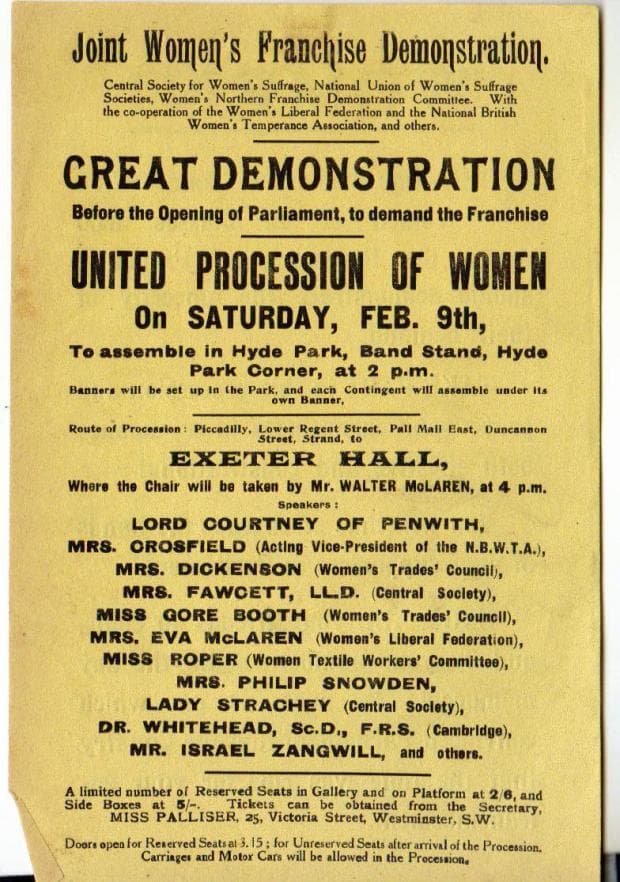
British · Activism · Politics
Mud March Suffragists
Unknown – present
Overview
The term “Mud March suffragists” refers to the thousands of women and their allies who participated in the United Procession of Women in London on 9 February 1907, soon universally known as the Mud March.[1][3][5] Organised by the National Union of Women’s Suffrage Societies (NUWSS), this peaceful demonstration was the first large procession mounted by the NUWSS and, by contemporary accounts, the largest public demonstration supporting women’s suffrage in Britain up to that date.[1][10][12] Marching in heavy rain from Hyde Park Corner to the Strand and Exeter Hall, more than 3,000 women—drawn from different regions, occupations, and social classes—publicly demanded the parliamentary vote for women.[1][3][5][10]
Because this dossier concerns the collective event rather than a single individual, the “Mud March suffragists” have no shared birth or death date; instead, their historical significance lies in a single, highly visible, coordinated act of political protest. The Mud March marked a turning point in British suffrage activism, demonstrating that constitutional suffragists could mobilise large, disciplined crowds and occupy public space in ways that had previously been associated mostly with male political campaigns.[1][5][12]
Background: Constitutional Suffrage and the NUWSS
By 1907, the campaign for women’s suffrage in the United Kingdom had already been underway for decades. Organisations such as the London National Society for Women’s Suffrage, the National Society for Women’s Suffrage, and various regional groups had lobbied Parliament, circulated petitions, and cultivated sympathetic MPs.[20][21][22] In 1897, these constitutional suffrage societies united under the umbrella of the National Union of Women’s Suffrage Societies (NUWSS), led for most of its history by the liberal feminist Millicent Garrett Fawcett.[1][17][23]
The NUWSS adopted a deliberate strategy of non-militant, constitutional campaigning. It rejected the violent or confrontational tactics that would later be associated with the Women’s Social and Political Union (WSPU), such as window-smashing or hunger strikes.[17][24] Instead, the NUWSS focused on petitions, letter-writing, deputations to ministers, public meetings, careful use of the press, and cooperation with sympathetic political parties—particularly the Liberal Party and, later, Labour.[17][23]
By the first decade of the twentieth century, however, many activists felt that traditional methods were not sufficient. Repeated defeat or neglect of suffrage bills in Parliament convinced leaders that they needed more vivid, public displays of support to show that women’s suffrage was a broad popular cause, not a narrow hobby of a few middle-class reformers.[5][12] At the same time, other movements—such as labour demonstrations and peace campaigns—had shown the effectiveness of processions and rallies in capturing public attention and press coverage.[5][12]
Conception and Organisation of the Mud March
The immediate political context for the Mud March was a private member’s bill for women’s suffrage due to come before the House of Commons early in the parliamentary session.[5][12] The NUWSS leadership decided to organise an impressive, orderly procession in London to coincide with the opening of Parliament, thereby signalling to MPs that support for women’s suffrage reached far beyond the committee rooms and drawing rooms of Westminster.[5]
Planning involved both national officers and local societies. According to institutional histories and later accounts, the march was closely associated with Millicent Fawcett’s leadership and with prominent suffragists such as Lady Frances Balfour, Lady Strachey, and other women from influential liberal and progressive families.[1][6][9] A blog based on family and movement sources notes that Philippa Strachey, daughter of suffragist Lady Strachey, played a key role in organising the logistics of the procession.[9] The NUWSS mobilised its affiliated societies—such as the Central Society for Women’s Suffrage and the London Society for Women’s Suffrage—to recruit marchers, prepare banners, and coordinate regional participation.[8][10]
The route was planned to maximise visibility. Marchers were to assemble at Hyde Park Corner, proceed along major thoroughfares, and end at Exeter Hall on the Strand, a large evangelical and reform venue already known for hosting public meetings on anti-slavery, missionary work, and other causes.[1][3][5][10] For the NUWSS, using such a symbolic space reinforced the idea that women’s suffrage was part of a broader tradition of moral and political reform.
The United Procession of Women, 9 February 1907
On the morning of 9 February 1907, London’s weather turned against the suffragists. Heavy rain and cold temperatures produced mud and slush in the streets, especially around Hyde Park and along the route to the Strand.[1][3][5] Despite these conditions, around 3,000 women and some male supporters gathered, many carrying banners bearing the names of their societies or their home towns.[1][3][5][10]
The procession included women from all social classes. Contemporary reports and later analyses emphasize the presence of aristocratic and middle-class women alongside teachers, doctors, typists, factory workers, and members of labour organisations.[1][3][10][12] Regional and occupational contingents highlighted the breadth of support—marchers came from northern industrial cities, university towns, and rural districts as well as London itself.[5][10] The Ethel Williams suffrage banner, now preserved in the University of Newcastle’s special collections, is known to have been carried in this march, representing the activism of a north-east England physician and suffragist.[10]
As the march proceeded from Hyde Park Corner to the Strand and Exeter Hall, the rain did not let up. Participants were soaked, their shoes and skirts caked with mud. This visual impression made a strong impact on witnesses and journalists. Newspapers later christened the event the “Mud March”, a nickname that quickly entered suffrage lore.[1][5][10][12] Despite discomfort, observers noted the disciplined and orderly character of the procession, which contrasted with stereotypes of suffragists as hysterical or disruptive.[1][5]
At Exeter Hall, a meeting followed the outdoor demonstration. Speakers—drawn from the NUWSS leadership and allied MPs—addressed the crowd about the pending suffrage bill and the need for continued pressure on Parliament.[5][12] While detailed verbatim records of the speeches are found mainly in contemporary newspapers and suffrage periodicals, institutional histories stress that the event successfully drew public attention to the bill and showcased the NUWSS’s organisational capacity.[5][12]
Strategic Significance and Immediate Outcomes
In legislative terms, the Mud March did not produce an immediate victory. The private member’s suffrage bill it sought to support encountered the usual obstacles in the House of Commons and was not passed into law.[5][11][12] However, scholars of the women’s movement emphasise that the march had important symbolic and strategic consequences.[1][5][9][12]
First, the Mud March demonstrated that constitutional suffragists—often portrayed as quiet lobbyists—could mobilise thousands of supporters in a public procession, matching or prefiguring the large marches soon associated with militant suffragettes.[1][5][12] It proved to critics, the press, and potential allies that there was a substantial, organised constituency for women’s suffrage that could not easily be dismissed as a fringe concern.
Second, the event established the large-scale procession as a key tactic for the NUWSS. English Heritage and other historians note that the Mud March is widely credited as the first large-scale women’s procession in London, and the first large procession organised by the NUWSS.[10][12] Subsequent constitutional suffrage campaigns drew on this example, organising further marches and rallies in London and other cities over the 1908–1913 period.[12][18]
Third, the march challenged prevailing gender norms. Respectably dressed women walking in organised ranks through city streets signalled a new vision of women as citizens rather than merely private domestic figures.[1][3][12] The inclusion of working-class and professional women alongside aristocrats undermined the idea that only privileged women desired political rights. As one later commentator summarised, the march showed that women were “unified and determined regardless of their social standing.”[13]
Class, Respectability, and Movement Identity
Histories of the Mud March often highlight its careful management of respectability. The NUWSS sought to present a dignified, non-confrontational image, with participants dressed soberly and the procession conducted under strict discipline.[1][5][9] This approach reflected the constitutional suffragists’ belief that they needed to reassure a sceptical public, and especially male MPs, that granting the vote to women would not destabilise society.
At the same time, the Mud March reflected ongoing debates within the movement about class and inclusivity. By inviting women from all backgrounds, the NUWSS signalled that suffrage was not only a middle-class cause. Banners identified teachers, doctors, factory workers, and regional groups, while some accounts mention the presence of trade unionists and socialist supporters.[1][3][10][12] Later historians interpret these elements as part of a broader effort to connect suffrage with democratic and labour questions rather than framing it solely as a matter of educated women’s rights.[19]
The organisational culture of the march laid groundwork for future cooperation between constitutional suffragists and labour organisations, even though tensions persisted—particularly over the NUWSS’s early preference for alliance with the Liberal Party.[17][23] Nonetheless, the visual image of women from varied backgrounds walking together became an enduring symbol of suffrage unity in movement memory.
The Mud March in Relation to Militancy
The Mud March took place at a moment when militant suffragette tactics were gaining notoriety. The Women’s Social and Political Union (WSPU), founded in 1903, had begun to adopt confrontational strategies, including heckling politicians and disrupting political meetings.[24] Though the Mud March itself was a constitutional NUWSS initiative, later commentators sometimes juxtapose it with WSPU activities to illustrate the range of suffrage tactics.
Some militant suffragettes participated in the Mud March, and the WSPU itself would later organise spectacular processions, such as the 1908 marches to Hyde Park. However, the NUWSS continued to insist on strict non-violence and legality.[17][24] The success of the Mud March gave constitutional activists greater confidence that they could claim public space without adopting militant methods, reinforcing their distinct identity within the wider movement.
Legacy and Historical Impact
In retrospect, historians treat the Mud March as a milestone in British women’s political history. English Heritage describes it as the first large-scale women’s procession in 1907, while the University of Newcastle’s commentary on the Ethel Williams banner underscores its importance in raising public awareness of the suffrage campaign.[10][12] Subsequent processions, including large pre-war marches and the celebrated Woman Suffrage Procession in Washington, D.C., in 1913, drew inspiration from such organised visual spectacles, though the latter occurred in a different national context.[25]
The Mud March also endures in archives and material culture. Banners, diaries, and photographs associated with the event are preserved in collections such as the LSE Women’s Library, the Newcastle University Special Collections, and national archives, where they serve as teaching tools for understanding the suffrage movement’s tactics and symbolism.[10][26][27] For example, Kate Frye’s suffrage diary offers a first-hand perspective on the experience of marching in cold, muddy conditions on that February day, reinforcing the human dimension behind the statistics of participation.[8]
Although women in the United Kingdom did not gain partial suffrage until the Representation of the People Act 1918, and equal voting terms with men only in 1928, the Mud March signalled that constitutional suffragists were willing to embrace mass mobilisation and public visibility at an early stage.[18][28] It helped move the suffrage question from legislative backrooms into mainstream public debate, making it increasingly difficult for politicians to ignore.
Later Memory and Commemoration
Because the Mud March was a collective event rather than an organisation that continued to exist, its “later life” is a matter of historical memory rather than institutional activity. Over time, the phrase “Mud March” has appeared in suffrage histories, museum exhibits, and anniversary articles, often emphasising the dramatic image of respectable women walking through rain and mud for their political rights.[5][6][9][11]
Writers on the history of women’s movements have used the Mud March to illustrate key themes: the shift from private lobbying to public protest; the interplay of class, respectability, and radicalism; and the importance of visual spectacle in political campaigns.[18][19] Modern blog posts, educational resources from heritage organisations, and academic articles continue to revisit the event, highlighting it as an early example of women defying expectations about staying out of politics and off the streets.[5][6][10][12]
In contemporary women’s-history teaching, the Mud March serves as an accessible case study. Its date, route, and participants are well documented, and surviving artefacts such as banners and diaries provide rich material for classroom analysis. The event is frequently cited in timelines of the British suffrage struggle as a major pre-war mobilisation, alongside later demonstrations and key legislative reforms.[10][12][18]
Assessment
The “Mud March suffragists” collectively represent a pivotal moment in the British women’s suffrage movement. On 9 February 1907, thousands of women chose to leave private spaces and take to the streets in disciplined solidarity, enduring bad weather and physical discomfort in order to make their demand for the vote visible.[1][3][5] Organised by the NUWSS, the march was the first large procession the union staged and the largest pro-suffrage demonstration in Britain up to that time.[1][10][12]
Though the immediate legislative goal was not achieved, the march’s long-term impact lay in its demonstration of women’s organising capacity, its challenge to gender norms about public space, and its role in establishing the mass procession as a powerful tactic in constitutional suffrage campaigning.[5][9][12] The Mud March suffragists, as a collective, thus occupy an important place in women’s-history almanacs: they exemplify the incremental, visible pressure that helped make the eventual extension of political rights to women both thinkable and, ultimately, unavoidable.
Dated achievements
1 indexed.
- Feb091907Activism
Mud March in London
The first large-scale women's suffrage procession in Britain, organized by the NUWSS.
View details Mud March (suffragists) - Wikipedia