← All women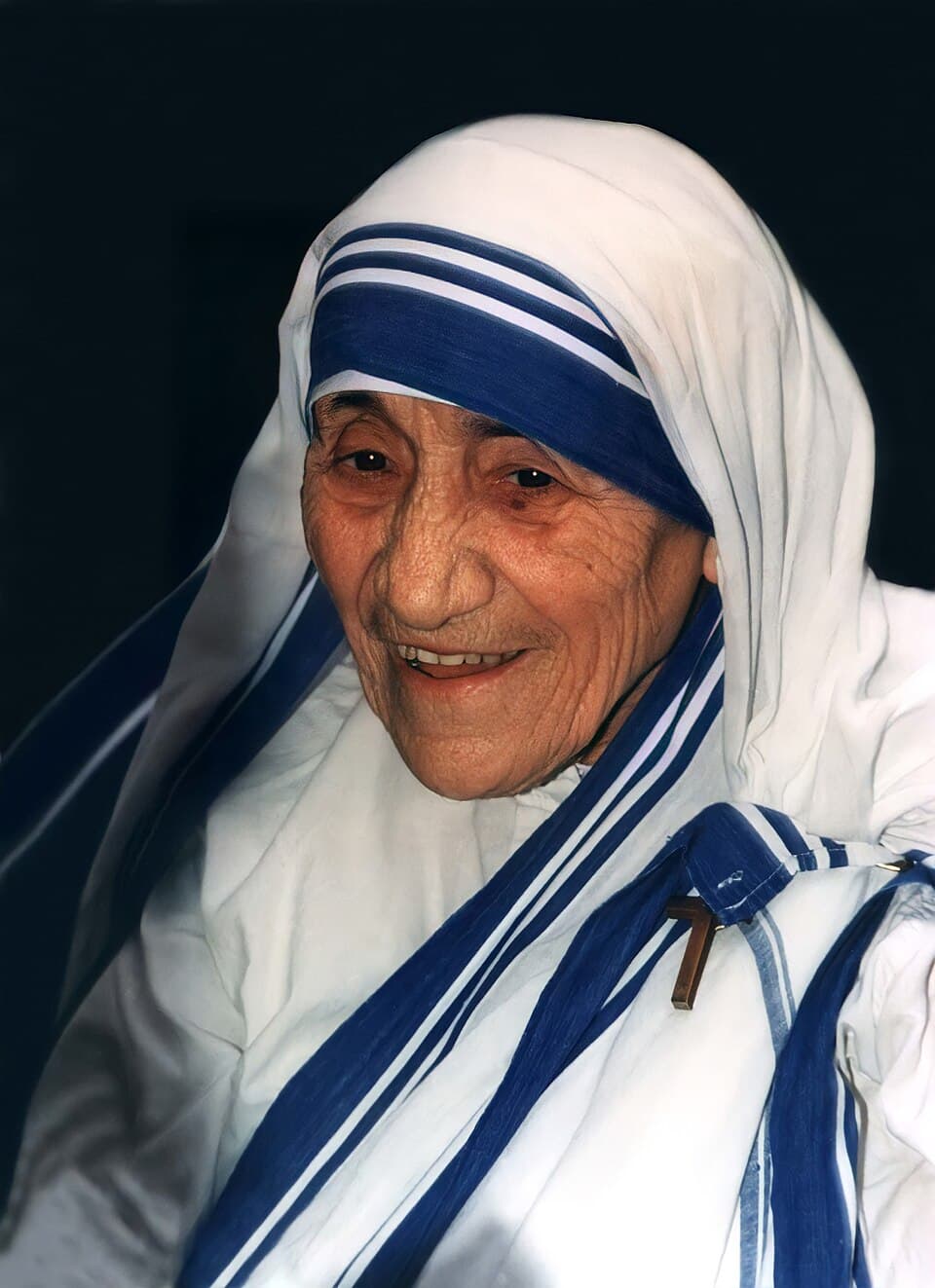
Albanian, Indian · Activism
Mother Teresa
August 26, 1910 – September 5, 1997
Early Life and Background
Mother Teresa was born Anjezë Gonxhe Bojaxhiu on 26 August 1910 in Skopje, then part of the Ottoman Empire and now the capital of North Macedonia. She was the youngest child of an Albanian Catholic family. Her father, Nikolle Bojaxhiu, was a businessman involved in local politics, while her mother, Dranafile, was known for her deep piety and charitable works.[11][18]
Mother Teresa grew up in a multiethnic, multireligious environment, with Albanian, Slavic, and Turkish influences shaping daily life. The family’s Catholic faith was central; they regularly attended Mass and were active in parish life.[11][17] When Anjezë was around eight, her father died suddenly, leaving the family in financial difficulty and intensifying her mother’s role as moral and spiritual guide.[11] Dranafile’s habit of sharing food and resources with the poor and elderly in their neighborhood profoundly influenced Anjezë’s developing sense of compassion.
From an early age, Anjezë showed an interest in missionary stories and religious life. At about twelve she first felt a vocation to serve God, and by eighteen she had decided to become a missionary nun.[17] She attended local state schools and was involved in parish activities, including a Catholic youth group, where she encountered accounts of Jesuit missions in India. These narratives of distant lands and suffering populations helped orient her imagination toward overseas service.
Religious Vocation and Career Beginnings
In 1928, at age eighteen, Anjezë left Skopje for Ireland, joining the Sisters of Loreto, a congregation focused on education and missionary work.[11][17] In Ireland she took the name Mary Teresa, after Thérèse of Lisieux, the patron saint of missionaries.[17] She spent several months at the Loreto Abbey in Rathfarnham learning English, the language of instruction in the congregation’s Indian schools.[11]
In early 1929, Sister Teresa was sent to India, arriving in Calcutta (now Kolkata), where she began her novitiate.[1][11] She soon moved to Darjeeling in the Himalayan foothills, completing her novitiate and making her first profession of vows.[2] In 1931 she took her final vows as a Loreto sister and was assigned to St. Mary’s High School in Calcutta, where she taught history and geography and later became headmistress.[2][17]
From 1931 to 1948, Sister Teresa lived a relatively conventional religious life within a teaching order.[2] However, the poverty she saw outside the convent walls deeply affected her. Calcutta in the 1930s and 1940s faced severe economic inequality, communal tensions, and later the devastations of World War II and the Bengal Famine of 1943. The suffering of families in the slums and the sight of people dying unattended in the streets left a lasting impression on her conscience.[11][17]
“Call Within a Call” and Founding the Missionaries of Charity
On 10 September 1946, while traveling by train from Calcutta to Darjeeling for her annual retreat, Sister Teresa experienced what she later described as a “call within a call.”[11][13] She believed Jesus was asking her to leave her teaching work and "go out into the slums" to serve the poorest and sickest people, particularly those who were "unwanted, unloved, and uncared for."[13]
Following this experience, she spent nearly two years discerning and seeking permission to change her vocation within the Church. In 1948, she received authorization from her superiors and the Holy See to leave the Loreto order and live among the poor while remaining a nun.[2][9][17] She exchanged her traditional habit for a simple white cotton sari with a blue border, similar to those worn by poor Bengali women but modified to become the distinctive habit of her future congregation.[11][7]
Mother Teresa began by establishing an open‑air school for children in the slums of Calcutta, teaching them basic literacy and hygiene.[10][9] She received training in basic nursing skills from the Medical Mission Sisters and started visiting families, caring for the sick, and offering rudimentary medical assistance. Her work attracted Indian women who wished to join her, forming the nucleus of a new community.
On 7 October 1950, Mother Teresa received formal permission from the Holy See to found a new congregation, the Missionaries of Charity, as a diocesan religious institute in the Archdiocese of Calcutta.[2][11] The order’s stated purpose was "to satiate the thirst of Jesus" for love and for souls through service to the "poorest of the poor."[7] Members took vows of poverty, chastity, and obedience, plus a distinctive fourth vow: to give "wholehearted free service" to the poorest.[13]
Expansion of the Missionaries of Charity and Major Works
In the early 1950s, Mother Teresa and her sisters established some of their most emblematic institutions. In 1952 she opened Nirmal Hriday (“Place for the Pure of Heart”), a hospice for people who were dying destitute in the streets of Calcutta.[17] Volunteers brought the dying to the home, where they received medical attention, food, and the opportunity to die with dignity according to their faith traditions.
In 1955, she founded a children’s home for orphans and abandoned children, later known as Shishu Bhavan (Children’s Home).[1][12] The Missionaries of Charity also developed mobile leprosy clinics and established a colony for people with leprosy, providing housing, work, and medical care.[1][4] Over time, the congregation opened homes for the elderly, people with disabilities, and those with diseases stigmatized in society.
The Missionaries of Charity grew rapidly. By the late 1960s and 1970s, houses had been founded across India and then internationally in Asia, Africa, Europe, and the Americas.[4][9][12] The sisters ran orphanages, hospices, schools, feeding centres, and family counseling programs in urban slums and impoverished rural areas.[12][17] Their work was deliberately small‑scale and personal, emphasizing presence and care over large institutional structures.
Mother Teresa became internationally known partly through media coverage. In 1969, British journalist Malcolm Muggeridge produced the television documentary “Something Beautiful for God”, followed by a book of the same title, which introduced her work to a wide Western audience.[12][17] The images of her tending to the dying in Kalighat and comforting children in crowded shelters became iconic representations of Christian charity.
Awards, Honors, and Recognition
Mother Teresa’s humanitarian work generated an extraordinary list of national and international honors. Among her early recognitions, she received the Padma Shri from the Government of India on 11 August 1962, acknowledging her service to the nation’s poor.[17] Later that month, on 31 August 1962, she was awarded the Ramon Magsaysay Award for Peace and International Understanding, often described as Asia’s Nobel Prize, for her work in South or East Asia.[11]
In 1971, she received multiple major honors. On 6 January 1971, Pope Paul VI presented her with the first Pope John XXIII Peace Prize, recognizing her efforts for peace through service to the poor.[2][13] On 16 October 1971, she was granted the John F. Kennedy International Award for contributions to human rights and international understanding.[9] These recognitions helped cement her position as a leading global humanitarian figure.
On 25 April 1973, Mother Teresa received the Templeton Prize, which honored her spiritual and humanitarian work, particularly with homeless and neglected children.[2] In 1975 she was awarded the inaugural Albert Schweitzer International Prize for humanitarianism, underscoring parallels between her work and Schweitzer’s medical missions.[9]
The most famous of her awards was the Nobel Peace Prize, formally conferred on 10 December 1979 in Oslo. The Nobel Committee cited her work "in the struggle to overcome poverty and distress, which also constitutes a threat to peace."[2][11] Mother Teresa used her acceptance speech to argue that the greatest destroyer of peace was abortion and to call for compassion toward the poor in all societies.
Recognition continued in the 1980s and 1990s. On 22 March 1980 she was conferred the Bharat Ratna, India’s highest civilian award.[17] Later that year, on 27 June 1980, her birthplace honored her with the Medal of Merits of the town of Skopje.[8] On 24 October 1983, Queen Elizabeth II appointed her to the Order of Merit, one of the United Kingdom’s most exclusive honors.[8]
In 1985, U.S. President Ronald Reagan presented Mother Teresa with the Presidential Medal of Freedom, the highest civilian award in the United States.[17] On 16 November 1996, the U.S. Congress granted her honorary United States citizenship, a distinction accorded to very few individuals.[8] On 5 June 1997, shortly before her death, she received the Congressional Gold Medal from the U.S. Congress.[8]
In addition to these dated honors, she received numerous year‑documented awards, including the Jawaharlal Nehru Award for International Understanding (1969), the Pacem in Terris Award (1976), an honorary doctorate in theology from the University of Cambridge (1977), the Balzan Prize for promoting humanity, peace, and brotherhood among peoples (1978), and the Légion d’Honneur from Haiti (1981).[8][17] These honors illustrate the breadth of institutional recognition across secular and religious bodies.
Personal Life and Spirituality
Mother Teresa did not marry or have children; her personal life was defined by her vows as a Catholic religious sister. She took perpetual vows of poverty, chastity, and obedience, later adding the Missionaries of Charity’s special fourth vow to serve the poorest of the poor.[13] Her closest relationships were with her fellow sisters, spiritual advisors, and collaborators in charitable work.
Her spirituality combined traditional Catholic devotion with a radical emphasis on Christ’s presence in the suffering poor. She frequently spoke of seeing Jesus "in the distressing disguise" of the poorest.[7] Daily practices included Eucharistic adoration, meditation on the crucifixion, and recitation of the Rosary. She promoted small acts of kindness and "doing small things with great love" as the core of Christian discipleship.[4]
After her death, publication of some of her letters, notably in the book “Mother Teresa: Come Be My Light”, revealed that she experienced long periods of spiritual dryness and a sense of the absence of God, even while maintaining her external commitment to service.[11] These revelations have been interpreted by many theologians as evidence of a "dark night of the soul" and have become part of her complex spiritual legacy.
Legacy and Historical Impact
Mother Teresa’s legacy is multidimensional and often contested. On one hand, she is widely regarded as a symbol of compassion and self‑giving service to the poor. At the time of her death, the Missionaries of Charity operated over 600 missions in more than 120 countries, including hospices, orphanages, schools, and homes for people with HIV/AIDS, leprosy, and tuberculosis.[12] Her model of direct, personal care inspired countless volunteers and led to the founding of allied communities, such as the Missionaries of Charity Fathers and lay associations.
Her influence on women’s history is significant. Mother Teresa demonstrated that a woman, operating largely outside formal political structures, could become a major global moral authority. Her leadership of a congregation of women religious and the visibility of their work challenged traditional boundaries around women’s roles in public life, especially in contexts like India where women’s labor in caregiving is often undervalued.
At the same time, her legacy has been the subject of critical scrutiny. Some secular critics, such as writer Christopher Hitchens, questioned the quality of medical care in some homes, arguing that pain relief and professional medicine were insufficient.[11] Others have critiqued her opposition to contraception and abortion, suggesting that her stance limited options for women and reflected conservative Catholic teaching rather than feminist perspectives on reproductive autonomy. Development scholars have debated whether her charity‑based approach addressed structural causes of poverty or primarily treated its symptoms.
Despite these controversies, few dispute that Mother Teresa helped to place extreme poverty and human dignity at the center of global consciousness. Her image, often in a simple sari embracing a sick child or comforting a dying person, became a powerful moral icon. Her canonization as Saint Teresa of Calcutta in 2016 further embedded her story in Catholic tradition, ensuring ongoing reflection on the relationship between sanctity, service, and justice.[11][17]
Later Life, Health, and Death
In her later years, Mother Teresa continued to travel extensively, opening new houses and visiting existing ones, even as her health deteriorated. She suffered from heart problems, including a heart attack in Rome in 1983 while visiting Pope John Paul II.[11] Subsequent years brought additional cardiac issues, including another heart attack in 1989, after which she received a pacemaker.
In the 1990s, her health struggles intensified, and she made several hospital visits for heart and lung conditions.[11] In 1990, she offered to resign as superior general of the Missionaries of Charity, but the sisters voted overwhelmingly for her to continue. She finally stepped down in March 1997; Sister Nirmala Joshi was elected as her successor as head of the congregation.[11]
On 5 September 1997, Mother Teresa died in Calcutta at age 87, following a heart attack.[11][18] India honored her with a state funeral, held with both Catholic and national ceremonies. Her body was interred in the motherhouse of the Missionaries of Charity in Calcutta, which has become a pilgrimage site for admirers and the faithful.
Beatification and Canonization
Shortly after her death, devotion to Mother Teresa intensified. In 1999, Pope John Paul II waived the usual five‑year waiting period and allowed the opening of her cause for canonization.[11] Following investigations into her life and virtues, and the recognition of a miracle attributed to her intercession, she was beatified on 19 October 2003 in Rome, receiving the title "Blessed Teresa of Calcutta".[11]
On 4 September 2016, during the Jubilee Year of Mercy, Pope Francis canonized her as Saint Teresa of Calcutta at the Vatican.[11][17] The canonization was based on a second approved miracle and reflected strong global devotion to her memory. Her liturgical feast day is celebrated on 5 September, the anniversary of her death.[16]
Today, the Missionaries of Charity continue to operate worldwide, guided by her charism and the Constitution she helped shape. Her life is commemorated in museums, biographies, films, and educational resources, and remains a touchstone for discussions about the ethics of care, the role of religion in humanitarian work, and the contributions of women religious to global history.
Dated achievements
17 indexed.
- Aug261910Activism
Birth in Skopje
Birth of Agnes Gonxha Bojaxhiu (Mother Teresa) in Skopje, then the Ottoman Empire.
View details Wikipedia: Mother Teresa - Aug311962Activism
Ramon Magsaysay Award for Peace and International Understanding
Mother Teresa receives the Ramon Magsaysay Award for her humanitarian efforts.
View details