← All women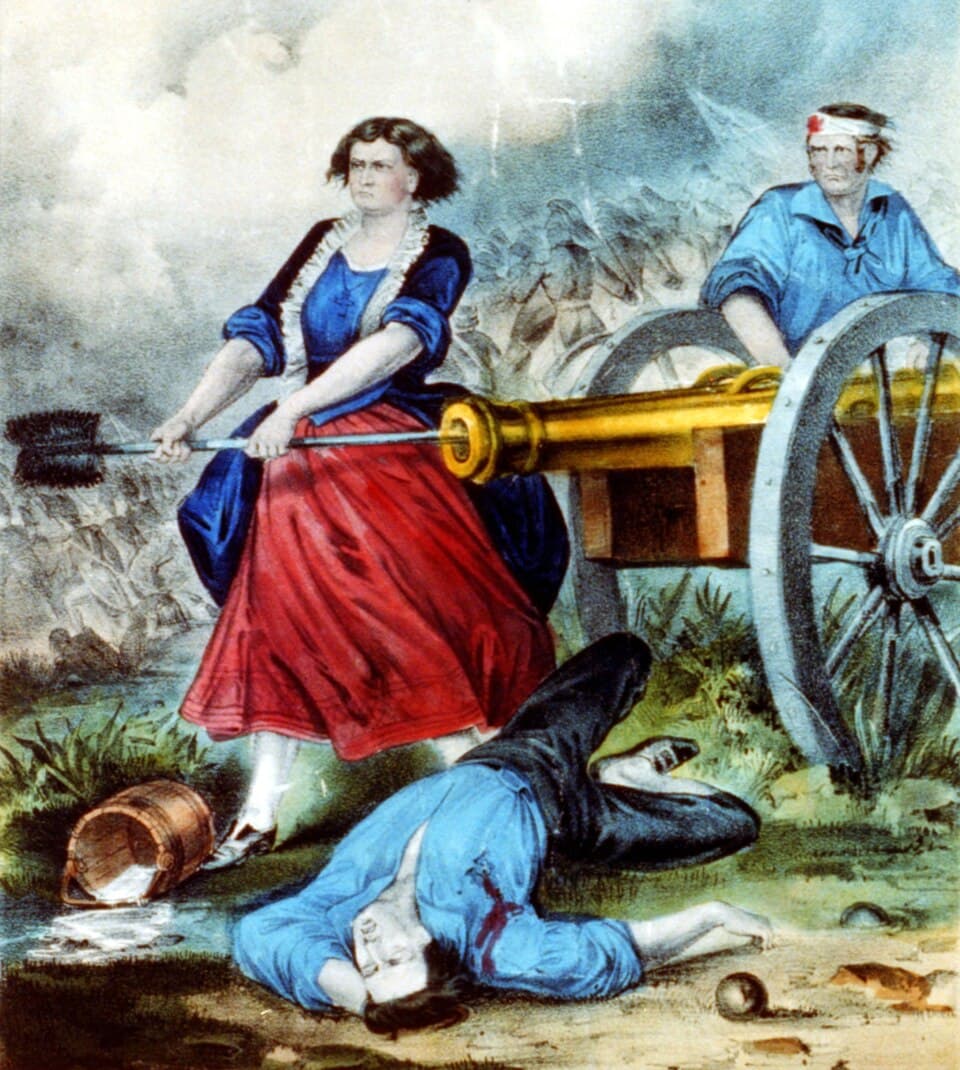
American · Activism
Molly Pitcher
October 13, 1754 – January 22, 1832
Overview
Molly Pitcher is the legendary nickname given to a woman who, according to popular accounts, carried water to soldiers and manned a cannon during the Battle of Monmouth on June 28, 1778, in the American Revolutionary War. Modern historians regard "Molly Pitcher" as a composite, folkloric figure rather than a single fully documented individual. The woman most commonly associated with the story is Mary Ludwig Hays McCauley, a camp follower and artilleryman’s wife whose traditional dates are October 13, 1754 – January 22, 1832.
Over time, stories about several women—especially Mary Ludwig Hays and Margaret Corbin, a documented artillery heroine at Fort Washington—were merged into the Molly Pitcher persona. The figure has become a powerful symbol of women’s labor, courage, and battlefield presence during the Revolution, illustrating how ordinary women’s experiences were transformed into national mythology.
Early Life and Background
The earliest biographical traditions identify "Molly Pitcher" with Mary Ludwig, said to have been born near Trenton, New Jersey, to dairyman John George Ludwig, likely of German or Irish‑German descent.[4][7][9] Later sources give her birth date as October 13, 1754, a detail repeated in modern encyclopedias and public‑history sites.[4][6][7][9] These dates and familial details rest on local tradition and nineteenth‑century accounts rather than surviving colonial vital records; historians therefore treat them as widely accepted but not incontrovertible.
Little is firmly documented about Mary’s childhood or education. As the daughter of a working farmer or dairyman in mid‑eighteenth‑century New Jersey, she would have grown up performing substantial domestic and agricultural labor, such as milking cows, tending kitchen gardens, and assisting with household tasks. Girls in her social position rarely received formal schooling, and there is no contemporaneous evidence for literacy or specific educational experiences.
At some point before or during the war, Mary married an artilleryman, usually identified as William (or John) Hays, though even her husband’s given name varies across later retellings.[4][8][13] This uncertainty underlines the broader problem of reconstructing a precise biography from fragmentary records and later patriotic narratives.
Camp Follower and Wartime Service
During the American Revolutionary War, Mary Ludwig Hays is said to have accompanied her husband as a camp follower, joining Continental Army encampments in the late 1770s.[1][6][9][15] Camp followers—often wives or female relatives of soldiers—provided critical support services: cooking, laundry, nursing, and hauling water and supplies. Despite their centrality to army life, they were not formally enlisted and appear only sporadically in official records.
Some accounts place Mary at Valley Forge, where she allegedly endured the harsh winter of 1777–1778 alongside Continental troops, sharing the privations of cold, hunger, and disease while supporting her husband’s artillery unit.[1] As with much of her story, direct documentation is sparse; the Valley Forge association emerges from later narratives emphasizing her endurance and solidarity with soldiers rather than from muster rolls or orderly books.
Women like Mary often carried water from nearby springs to cool cannons and provide relief for overheated soldiers, particularly during summer campaigns. Contemporary soldiers commonly shouted "Molly, pitcher!" as a generic call to women bringing water, a key linguistic detail that later fed into the creation of the nickname.[11][13] This usage suggests that "Molly Pitcher" was initially more a descriptive phrase than a personal name.
The Battle of Monmouth and the Birth of the Legend
The Battle of Monmouth took place on June 28, 1778, near present‑day Freehold, New Jersey, as part of the Philadelphia campaign.[9][10] The day was oppressively hot, and artillery positions required constant attention: cannons overheated, gun crews faced intense enemy fire, and water was desperately needed both to swab barrels and sustain soldiers.
According to the most famous version of the story, Mary Ludwig Hays spent the battle carrying pitchers of water to her husband’s artillery battery, earning the battlefield nickname "Molly Pitcher" from grateful soldiers.[1][9][10] During the fighting, her husband allegedly collapsed—either wounded or overcome by heat. Mary, the account continues, stepped into his place at the cannon, swabbing, loading, and firing the gun for the remainder of the engagement under enemy fire.[1][9][10]
These actions became the core of the Molly Pitcher legend, portraying a woman who performed a quintessentially male military task with skill and bravery. Some later traditions further claim that George Washington personally witnessed her courage and issued a warrant making her a noncommissioned officer, leading to the honorific "Sergeant Molly."[1][3][12] However, historians note that such specific details arise from nineteenth‑ and twentieth‑century embellishments rather than contemporaneous documentation.
Importantly, while the Battle of Monmouth and its date are well documented in military records, there is no known contemporaneous account naming a woman "Molly Pitcher" or describing this precise sequence of events.[5][11][13] The earliest detailed stories appear decades later, as Revolutionary memory was shaped by veterans’ recollections, local lore, and patriotic literature. This chronological gap has led modern scholars to treat the narrative with caution.
Composite Identities: Mary Ludwig Hays, Margaret Corbin, and Others
As interest in Revolutionary heroes grew in the nineteenth century, multiple women’s wartime experiences were gradually synthesized into the single persona "Molly Pitcher." Heritage organizations and historians consistently highlight Mary Ludwig Hays McCauley and Margaret Corbin as the two principal historical figures behind the legend.[2][11][12][15]
Corbin’s story is better documented: she fought alongside her husband at Fort Washington in 1776, taking his place at a cannon after he was killed and continuing to fire until she herself was seriously wounded. On July 6, 1779, the Continental Congress granted her a lifelong pension, the first formal recognition of a woman’s military service in United States history.[11][15] While Corbin was never called "Molly Pitcher" in official records, her experience of artillery combat and injury closely parallels the Monmouth tale and was later associated with the nickname.
Other women, such as Deborah Sampson, who disguised herself as a man to join the Continental Army, also entered the orbit of Molly Pitcher folklore.[15] Linda Grant De Pauw and other scholars emphasize that "Molly Pitcher" functions as a "collective generic term" comparable to "G.I. Joe," encompassing "hundreds, perhaps thousands" of women who served as ammunition wives, camp followers, and even combatants.[4][11]
Modern scholarship, including work by the National Archives, the Smithsonian’s Women’s History Initiative, and the Library of Congress Folklife Center, stresses that Molly Pitcher was almost certainly not a single person but a mythic figure stitched together from multiple real women’s stories.[2][5][11][12][13] This composite nature explains why biographical details vary widely across sources and why key episodes lack contemporaneous corroboration.
Later Life of Mary Ludwig Hays McCauley
Despite the legendary overlay, certain elements of Mary Ludwig Hays McCauley’s later life have been preserved in local records and tradition. After the war, she is said to have settled in Carlisle, Pennsylvania, where she lived out her remaining years.[4][9] Some accounts indicate that she worked as a domestic servant or laundress, occupations consistent with the limited economic options available to widowed or working‑class women in the early republic.
Mary reportedly remarried a man named John McCauley, though documentation of this marriage is limited and sometimes inconsistent.[4] Her life in Carlisle does not appear to have been one of public fame; instead, she seems to have lived in relative obscurity, even if neighbors preserved memories of her wartime service.
Mary Ludwig Hays McCauley died in Carlisle on January 22, 1832, according to widely cited secondary sources.[4][6][9] She was buried in the city’s Old Graveyard, where a cannon and flagstaff now mark the site.[1] These later commemorative additions reflect nineteenth‑ and early twentieth‑century efforts to concretize the Molly Pitcher narrative and tie it to a specific grave, reinforcing the idea that Mary was the "real" heroine behind the legend.
Artistic Depictions and the Growth of the Legend
During the nineteenth century, the figure of Molly Pitcher gained prominence in popular literature, prints, and patriotic artworks. An engraved image titled "Molly Pitcher at the 1778 Battle of Monmouth," produced in 1859, depicted a resolute woman firing a cannon, visually encoding the legend for a mass audience.[8][11] Such images circulated widely in books and periodicals, shaping public understanding of women’s roles in the Revolution.
As these depictions proliferated, the narrative hardened: Molly Pitcher was increasingly presented as a singular, identifiable heroine rather than a composite figure. Local histories in New Jersey and Pennsylvania claimed her as a regional icon, while women’s organizations and patriotic societies adopted her as a symbol of female valor.
In the twentieth century, the legend entered transportation and commemorative infrastructure. A stretch of U.S. Route 11 in Pennsylvania became known as the Molly Pitcher Highway, and a service area on the New Jersey Turnpike was named in her honor.[3][13][16] These namings, though not precisely dated in easily accessible primary sources, embedded the story in everyday geography, ensuring that travelers encountered the name and, often, simplified versions of the tale on informational plaques.
Awards, Honors, and Official Recognition
Although "Molly Pitcher" herself never received documented military honors during the Revolution, the figure has been extensively commemorated in later periods. The most notable federal recognition came on July 4, 1928, when the U.S. Post Office Department issued a 2‑cent Fourth of July stamp overprinted with "Molly Pitcher" to mark the 150th anniversary of the Battle of Monmouth.[3] The overprint elevated the legend into official national iconography, presenting her as a canonical Revolutionary heroine.
During World War II, the U.S. named a Liberty cargo vessel the SS Molly Pitcher, launched on March 18, 1943.[3] The ship’s name drew an explicit parallel between the women who labored and occasionally fought in the Revolutionary War and the millions of women contributing to wartime production, nursing, and auxiliary military service in the 1940s.
Multiple organizations, including the National Women’s History Museum, the American Battlefield Trust, the National Archives, New York’s Fraunces Tavern Museum, and others, have produced educational materials and exhibits that foreground Molly Pitcher as an emblem of women’s wartime service.[2][11][12][15] These recognitions, though symbolic rather than personal, testify to the legend’s enduring power and its utility for teaching women’s history.
Personal Life and Relationships
Biographical tradition portrays Mary Ludwig Hays as a married camp follower whose wartime presence was tied to her husband’s enlistment. The man in question is usually identified as William Hays, an artilleryman in the Continental Army, though some sources give his name as John.[1][4][13] After his death or incapacitation—whether at Monmouth or another point in the war—Mary’s continued association with artillery work fed into the later image of a woman gunner.
Mary’s reported second marriage to John McCauley and her domestic work in Carlisle fit the broader pattern of Revolutionary‑era women adapting to limited economic opportunities in the new republic.[4] There is little reliable information on children; most scholarly accounts refrain from specifying offspring due to the absence of firm records.
The emphasis on her marital status in historical narratives reveals how women’s battlefield presence was often interpreted through the lens of family roles—wives following husbands, rather than autonomous actors. Yet the very story of Molly Pitcher, with a woman stepping into a cannon crew, complicates that traditional framing by presenting her as an independent agent of military action.
Historiographical Debates and Reassessment
In the late twentieth and early twenty‑first centuries, historians and public‑history institutions have subjected the Molly Pitcher narrative to systematic scrutiny. Research by the National Archives, the Library of Congress, and the Smithsonian’s Women’s History Initiative concludes that Molly Pitcher is best understood as a mythic, composite figure rather than a single verifiable person.[2][5][11][12][13]
These scholars point out that there is no contemporaneous use of "Molly Pitcher" as a personal name in Revolutionary War records, and that detailed accounts linking the nickname to Mary Ludwig Hays or specific battlefield incidents appear only decades later.[5][11][13] The notion that George Washington personally commissioned her as a sergeant, for example, lacks documentary support and likely reflects later attempts to dramatize women’s contributions.
At the same time, historians emphasize that the legend emerged from real patterns of women’s wartime labor and courage. Hundreds of camp followers carried water, tended the wounded, laundered clothes, and sometimes helped operate artillery. Margaret Corbin’s pension and Deborah Sampson’s documented enlistment demonstrate that women did fight and suffer in battle, even if recognition was rare.[11][15]
Consequently, current scholarship often frames Molly Pitcher as analogous to "Rosie the Riveter" in World War II—a fictional or composite figure used to highlight widespread female participation in war work.[15] This perspective allows historians to honor women’s contributions without insisting on a biographical precision that the sources cannot support.
Legacy and Historical Impact
The legacy of Molly Pitcher lies less in the reconstruction of a precise life story than in her role as a symbol of women’s agency in the American Revolution. For generations of Americans, she has embodied the idea that women were present in battlefields, performing dangerous tasks and, at times, taking up arms.
Educational materials, children’s books, and school curricula have used the Monmouth narrative to introduce students to women’s history, emphasizing bravery, resourcefulness, and patriotism.[7][10][12] Even when historians stress the composite nature of the story, the figure remains a compelling entry point for discussions about gender and war.
Commemorations such as the 1928 stamp, the Liberty ship SS Molly Pitcher, highways, and rest areas named in her honor embed her in the visual and spatial fabric of American life.[3][13] Monuments in Carlisle and New Jersey, along with interpretive signs at battlefields, further reinforce her presence in public memory.
Importantly, recent scholarship and museum work have used Molly Pitcher to interrogate the processes of historical memory—how legends arise, how they are gendered, and how they can obscure as well as illuminate the lives of real women. By highlighting the gaps and ambiguities in the record, historians encourage critical engagement with patriotic stories while still recognizing their pedagogical and inspirational value.
Later Reception and Contemporary Interpretation
In the twenty‑first century, institutions such as the Smithsonian, the American Battlefield Trust, and the National Women’s History Museum present Molly Pitcher as both a popular heroine and a case study in the construction of myth.[2][10][12] Exhibits and blog essays explore her evolving image, from nineteenth‑century engravings to modern rest‑stop signage, alongside the documented biographies of Mary Ludwig Hays and Margaret Corbin.
Digital resources—including articles from the National Archives’ Prologue, the DAR’s analyses of "Molly Pitcher" folklore, and educational platforms—invite readers to distinguish between legend and evidence while still appreciating the ways in which composite figures can give voice to otherwise invisible experiences.[11][15][16]
In contemporary women’s‑history scholarship, Molly Pitcher thus occupies a dual role: she is simultaneously a cautionary example of how patriotic myth can distort the past and a powerful emblem of women’s wartime contributions. Her enduring presence in public culture ensures that the questions she raises—about gender, recognition, and the making of historical heroes—remain central to discussions of the Revolutionary era.
Summary
Although the precise details of her life remain elusive, the figure known as Molly Pitcher has had a profound impact on American historical imagination. Whether viewed as Mary Ludwig Hays McCauley, as a composite of several women including Margaret Corbin, or as a symbolic representation of countless unnamed camp followers, she stands for women’s labor, courage, and resilience in the struggle for independence.
Modern scholarship now emphasizes the importance of recognizing both the mythic and the real dimensions of her story: honoring the women whose experiences gave rise to the legend, while carefully distinguishing folklore from documentary fact. In doing so, historians and educators use Molly Pitcher to deepen our understanding of women’s roles in war and the complex ways in which nations remember their past.
Dated achievements
6 indexed.
- Oct131754Activism
Birth of Mary Ludwig (Mary Hays/McCauley)
Birth of Mary Ludwig (later Mary Ludwig Hays McCauley), traditionally identified as the woman behind the "Molly Pitcher" legend, near Trenton, New Jersey.
View details Encyclopedia Britannica: Molly Pitcher - Jun281778Activism
Battle of Monmouth actions later attributed to "Molly Pitcher"
Mary Ludwig Hays reportedly carried water and took over her husband's cannon at the Battle of Monmouth, actions pivotal to the "Molly Pitcher" legend.