← All women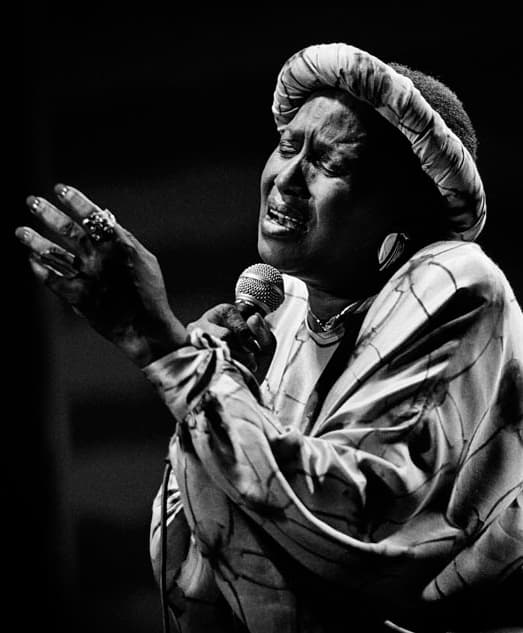
South African · Arts · Activism
Miriam Makeba
March 4, 1932 – November 10, 2008
Early Life and Background
Zenzile Miriam Makeba, later celebrated worldwide as "Mama Africa," was born on 4 March 1932 in Prospect Township, near Johannesburg in the Union of South Africa. Her parents were of mixed heritage: a Xhosa father and a Swazi mother, placing her at the crossroads of different southern African cultures.[2][4][5][13][15] Her father, often identified as Caswell, worked as a teacher, and her mother, Christina "Nene" Makeba, was a domestic worker and sang traditional songs.[4][13]
Makeba’s childhood unfolded in segregated Black townships such as Sophiatown, which would later be destroyed under apartheid’s forced removals.[2][5] Shortly after her birth, her mother was arrested for brewing homemade beer in violation of colonial regulations; as a result, infant Miriam spent six months in prison with her.[1][5] This early experience of state repression and economic precarity formed part of the backdrop to her later activism.
She grew up surrounded by music in church and community life, joining school and church choirs at an early age.[2][5] Although her formal schooling was limited—she left school in her mid-teens due to the constraints of racial segregation and poverty—she developed an exceptional ear and vocal range. In the late 1940s, she began singing in local groups and informal performances around Johannesburg, absorbing American jazz, local marabi and kwela styles, and traditional Xhosa and Zulu songs.[1][5][13]
Career Beginnings and Development
Makeba’s first notable step into the professional music world came when she joined the female vocal group the Sunbeams in 1952, a group that later became known as the Skylarks.[1] These ensembles were central to the urban Black music scene in Johannesburg, performing close-harmony songs that mixed African melodies with American swing and jazz influences. Her participation helped sharpen her skills in ensemble work and stage performance.
In 1953, Makeba made her official singing debut as a member of the prominent male vocal group the Manhattan Brothers, one of the most influential South African groups of the late 1940s and 1950s.[1][7] With them she recorded her first hit, "Laku Tshoni Ilanga" ("When the Sun Sets"), a song that brought her wide fame across South Africa.[9][13] She continued to perform and record with both the Manhattan Brothers and the Skylarks, becoming a leading figure in what has been described as African jazz or "Afro-jazz," a genre blending African folk idioms with jazz arrangements.[1][5]
By the mid-1950s, Makeba’s voice was recognized for its clarity, emotional depth, and distinctive timbre. In 1956, Gallotone Records released her single "Lovely Lies", her first solo success and her first recording in English.[1][9] The record became the first South African release to enter the U.S. Billboard Top 100, signaling her potential appeal to international audiences and marking a notable moment in the global circulation of African music.[1][9]
Her transition from national to international visibility was catalyzed by her appearance in the 1959 film "Come Back, Africa", directed by Lionel Rogosin.[1][3] The semi-documentary film, which exposed the harsh realities of apartheid, included Makeba’s performance in a shebeen scene. The film's screenings abroad, including at the Venice and New York film festivals, drew attention to her artistry and introduced her to audiences and networks beyond South Africa.[1][3]
Exile and International Breakthrough
Following the Sharpeville massacre and increasing international condemnation of apartheid, Makeba’s visibility drew the ire of South African authorities. In 1960, after she testified about apartheid before the United Nations, the South African government revoked her passport and denied her right of return.[1][2][3] Effectively forced into exile, she left South Africa that year and moved first to London and then to the United States.
In the U.S., Makeba’s career gained crucial support from American entertainer and activist Harry Belafonte, who became her mentor and producer.[1][3] She began recording for major labels and appeared on U.S. television shows, bringing African-language songs and rhythms to mainstream audiences. She released several albums in the early 1960s, including Miriam Makeba (1960) and The World of Miriam Makeba (1963), which featured songs in Xhosa, Zulu, Sotho, and other languages.[1]
Makeba continued to use her growing platform to speak against apartheid. In 1963, she addressed the United Nations General Assembly again, denouncing racial discrimination and calling for international sanctions against South Africa.[1][2] These interventions cemented her role as a global civil rights figure and connected her to broader anti-colonial movements unfolding across Africa and the diaspora.
Her international breakthrough as a recording artist culminated in collaborations that fused artistry with political commentary. In 1965, she and Belafonte recorded "An Evening with Belafonte/Makeba", an album featuring songs about the struggles of Black South Africans, sung in various African languages with minimal, folk-oriented arrangements.[1] At the 8th Annual Grammy Awards on 15 March 1966, the album won the Grammy Award for Best Folk Recording, making Makeba the first African recording artist to win a Grammy.[1][10][11][12][14]
Major Works and Accomplishments
Among Makeba’s most emblematic works is the song "Pata Pata". Originally developed in South African performances in the late 1950s, it was released internationally in 1967 on the album of the same name and quickly became a global hit.[1][8] The single reached No. 12 on the Billboard Hot 100 and achieved wide circulation in Europe and beyond.[1][8] Makeba is widely cited as the first Black woman to have a Top Ten worldwide hit, a distinction reflecting the song’s presence in international charts.[2][8]
"Pata Pata" combined a catchy rhythm with lyrics in Xhosa that described a dance, introducing many listeners to African languages and township sensibilities. While some critics saw it as lighter fare compared with her explicitly political songs, it served as a gateway for global audiences to engage with African culture and opened commercial space for other African artists.
Beyond "Pata Pata," Makeba’s repertoire included songs such as "Qongqothwane" (often known as "The Click Song"), which showcased the clicks of the Xhosa language; "Malaika", a Swahili love song; and various pieces drawn from folk traditions across the continent.[1][13] Her arrangements often balanced authenticity with accessibility, preserving linguistic and melodic integrity while delivering them through studio production suited to international markets.
Throughout the 1970s, after her marriage to Guinea’s Foreign Minister and her break with the U.S., Makeba was based largely in Guinea, where she served as a cultural ambassador and performed with state support.[1][3] She continued to record and tour in Africa, Europe, and other regions, maintaining her dual role as artist and activist.
In 1987, Makeba joined Paul Simon’s "Graceland" tour, which gathered South African and international musicians to perform songs from Simon’s controversial yet influential album recorded partially in South Africa.[1][3] Her participation helped reintroduce her to Western audiences and contributed to heightened attention to South African music in the final years of apartheid.
Awards, Honors, and Recognition
Makeba’s career was marked by numerous awards recognizing both her artistic achievements and her political engagement. The 1966 Grammy Award for An Evening with Belafonte/Makeba established her as a pioneer among African musicians in Western industry recognition.[1][10][11][12]
In 1986, she was awarded the Dag Hammarskjöld Peace Prize, honoring her contributions to peace and international understanding through her outspoken opposition to apartheid and her support for human rights struggles worldwide.[10][11][12] In 2001, the United Nations Association of Germany in Berlin bestowed on her the Otto Hahn Peace Medal in Gold, further acknowledging her role as a cultural diplomat and advocate for reconciliation.[10][11][12]
That same year, Makeba received a Grammy nomination in the category of Traditional World Music Album for her record "Homeland", a work that reflected on exile and return and blended styles from across the African continent.[14] She was later named a Polar Music Prize laureate, an honor often described as the "Nobel Prize of music," in recognition of her global influence and her pioneering status in world music, though the exact ceremony date is not consistently documented in accessible sources.[7]
Various states and institutions awarded her honors and citizenships: she was naturalized Guinean in the 1960s and later obtained Algerian nationality in 1972, reflecting her integration into broader African political networks.[11] Media and scholarly sources consistently refer to her as "Mama Africa", signaling a form of unofficial yet powerful recognition of her symbolic role.
Personal Life
Makeba’s personal life intersected closely with her political commitments and artistic career. She married several times, each relationship embedded in the currents of South African and diasporic politics. In 1959, she married Sonny Pilay, a fellow singer, though the marriage was brief and ended the same year.[13]
Later, while building her career in the United States, she married South African trumpeter and composer Hugh Masekela, a leading figure in African jazz. The union brought together two prominent exiled South African musicians, though it did not last and ended in divorce.[1][16] In the late 1960s, she married Stokely Carmichael (later known as Kwame Ture), a prominent African American activist and leader in the Black Power movement.[1][16] The marriage drew intense scrutiny from U.S. media and political institutions; combined with rising hostility toward radical Black activism, it contributed to difficulties in her U.S. career and eventual relocation.
Makeba had one daughter, Bongi Makeba, herself a singer and songwriter, who performed and recorded with her mother in later years. Bongi’s untimely death in the 1980s deeply affected Makeba and reinforced themes of loss and resilience in her later work.[13]
Throughout her life, Makeba’s personal relationships and family experiences were inseparable from her public identity. Her marriages linked her to key figures in music and social movements, while her motherhood and experiences of exile informed her passionate engagement with questions of home, belonging, and generational continuity.
Artistry, Activism, and Historical Impact
Makeba’s historical significance lies in the intertwining of her artistry and activism. She did not merely perform African songs to international audiences; she used them to articulate the dignity, sorrows, and aspirations of Black South Africans under apartheid. Her concerts often included explanatory commentary about the meaning of the songs and the political situation in South Africa, transforming musical events into educational and mobilizing occasions.[1][5][15]
She was among the first African musicians to achieve sustained global recognition, paving the way for later generations in Afropop, world music, and jazz.[1][3][4][9] Her use of multiple African languages in mainstream recordings expanded the sonic and linguistic horizons of popular music, normalizing clicks and tonal patterns that had previously been unfamiliar or exoticized for Western listeners.
Makeba’s activism extended beyond South African issues. Living in Guinea and traveling widely, she supported pan-Africanist visions and spoke about colonialism, racism, and women’s rights more generally. Her speeches at the United Nations and other international forums placed her alongside political leaders, yet she remained anchored in the role of artist, arguing that song could carry truths that speeches alone could not.[1][2][3][15]
In women’s history, her career challenged both racial and gender boundaries. As a Black African woman navigating male-dominated music industries and political spaces, she asserted authority over her repertoire, image, and message. Her successes—such as being the first African Grammy winner and the first Black woman with a worldwide Top Ten hit—demonstrated that women from colonized and marginalized communities could shape global cultural narratives.[1][2][8]
Later Life and Return to South Africa
After more than three decades in exile, Makeba returned to South Africa in 1990, following the unbanning of the African National Congress and the release of Nelson Mandela.[1][2][3] Her homecoming coincided with the country’s transition toward democracy, and she participated in public celebrations and continued to perform, now as a revered elder stateswoman of South African music.
In 2000, she announced her retirement from professional singing, though she remained musically active, accepting invitations to perform at selected events and for causes aligned with her values.[1] In 2005, she embarked on a "Goodbye Concert" farewell tour, appearing in multiple countries. Even after the tour concluded, she occasionally took to the stage, indicating the enduring demand for her presence and her own deep attachment to performance.[1]
Her later recordings, including the Grammy-nominated "Homeland" (2000), revisited themes of exile and return, blending sounds from different parts of Africa and reflecting on her life’s journey.[14] She continued to receive honors and invitations from governments, cultural institutions, and civil society organizations, reinforcing her status as a living symbol of resistance and reconciliation.
Death and Legacy
On 10 November 2008, after performing at a concert near Castel Volturno in southern Italy in support of writer Roberto Saviano, Makeba suffered a heart attack and died in hospital.[2][3][5][8][10][13] Some sources give 9 November as the date; however, multiple encyclopedic references, including Britannica and several European-language Wikipedias, record 10 November.[2][4][8][10][13]
Her death sparked tributes across the world from musicians, political leaders, and activists, many of whom emphasized her role in popularizing African music globally and her steadfast opposition to apartheid. Commentators noted the symbolism of her dying immediately after singing in defence of a writer targeted for his anti-mafia work, underscoring that she remained committed to causes of justice until the end.
Makeba’s legacy endures in several dimensions. Musically, she is remembered as a pioneer of Afropop and world music, whose recordings continue to inspire artists and audiences.[1][5][15] Politically, she is honored as a civil rights and anti-apartheid activist whose testimony and visibility contributed to international pressure on the South African regime.[1][2][3]
Her life story—imprisoned as an infant, forced into exile for speaking the truth, achieving global fame, and returning home after apartheid’s fall—embodies key themes in 20th-century African history: displacement, resistance, solidarity, and cultural renaissance. In the field of women’s history, Miriam Makeba stands as a central figure, demonstrating the power of a Black African woman to shape world opinion and artistic practice through courage, talent, and unyielding commitment to justice.
Dated achievements
8 indexed.
- Mar041932Arts
Birth of Miriam Makeba
Zenzile Miriam Makeba was born on 1932-03-04 in Prospect Township.
View details Wikipedia: Miriam Makeba - Jan011953Arts
Singing debut with the Manhattan Brothers
Makeba's official singing debut with the influential Manhattan Brothers.
View details