← All women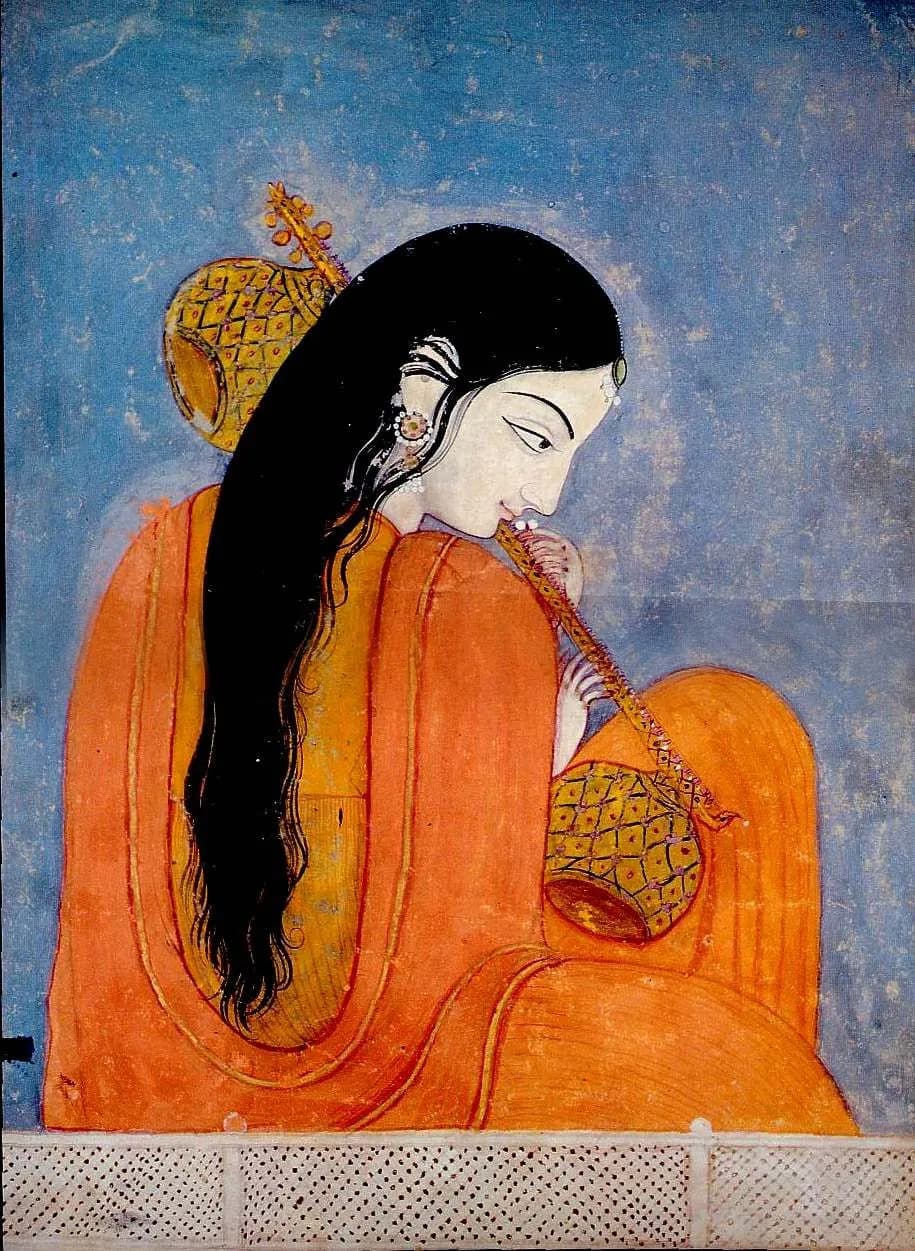
Indian · Arts · Literature
Mirabai
1498 – 1547
Overview
Mirabai (also spelled Mira Bai or Meera) was a sixteenth-century North Indian Hindu mystic poet and one of the most celebrated women saints of the Bhakti movement.[1][6][15][20] Revered for her intense devotion to the god Krishna and her emotionally charged devotional songs (bhajans), she has become an enduring symbol of spiritual love, resistance to patriarchal norms, and women’s religious agency in South Asia.[1][3][8][9][18] Although many details of her life are shrouded in legend and conflicting traditions, her historical and cultural impact is uncontested: hundreds of poems in Rajasthani, Braj Bhasha, and related dialects are attributed to her, and they remain central to North Indian devotional practice and literature.[1][3][6][18][20]
Early Life and Background
Most scholarly and traditional accounts place Mirabai’s birth around the late fifteenth century, often circa 1498–1500, in a Rajput family in present-day Rajasthan.[1][3][6][15] Britannica and several modern summaries describe her as born near Kudki (also spelled Kudaki) in the region of Merta, then part of the Rajput kingdom of Marwar.[6][7] The details of her parentage vary across sources, but the dominant tradition holds that she was the daughter of a Rajput noble of the Rathore lineage, connected to the ruling house of Marwar.[1][15] This aristocratic background is central to how later hagiographies frame her renunciation: as a princess who deliberately turned away from royal privilege for a life of devotion.
Accounts of her childhood emphasize an early and intense attraction to the figure of Krishna. Many narrative traditions recount that as a young girl she witnessed a wedding procession and asked her mother who her own husband would be; her mother pointed to an image of Krishna and replied that he was her true bridegroom.[3][12][17] Whether historically accurate or not, this story encapsulates the central orientation of her life as remembered in devotional communities: from an early age she regarded Krishna not only as her god but as her divine husband, a theme that pervades her poetry.
Mirabai likely received the education customary for high-born Rajput girls of her time: familiarity with devotional literature, some literacy in local languages or scripts, and training in music and dance suitable for courtly and domestic performance.[1][7][14] The strong musicality of her surviving poems—many of which are structured as songs easily adaptable to a variety of tunes—suggests that she was steeped in oral and musical traditions from childhood.[1][3][9] Her early environment also exposed her to the vibrant religious currents of late medieval North India, including Vaishnava bhakti focused on Krishna and Rama, as well as Shaivite and folk traditions that coexisted in Rajasthan and neighboring regions.[1][6][20]
Marriage and Early Adulthood
Mirabai is widely believed to have been married into the ruling clan of Mewar, in present-day Rajasthan.[1][6][15] According to traditional accounts, she became the wife of Bhoj Raj (also rendered Bhoja Raj), the crown prince of Mewar and son of Rana Sanga, a prominent Rajput ruler of the early sixteenth century.[1][6] The marriage, which likely took place when she was quite young, would have been politically significant, reinforcing alliances between Marwar and Mewar.
Sources agree that Mirabai’s married life was marked by tension between her expectations of devotion and the norms of a martial Rajput court.[1][3][8] Even while living within the palace, she dedicated herself to worship of Krishna, singing and dancing in public temples and in the company of sadhus and devotees of varied backgrounds.[1][3][17][20] Such behavior clashed with prevailing ideals of elite female seclusion, modesty, and strict observance of caste and clan boundaries.
Most hagiographic traditions narrate that her husband died relatively early, perhaps in battle, leaving her a young widow.[1][6][15] Widowhood in sixteenth-century Rajput society carried stringent expectations of austerity and withdrawal, and, in some cases, the now-outlawed practice of sati (widow self-immolation) was idealized.[5][8] In Mirabai’s story, her refusal to commit sati and her insistence on living as Krishna’s bride rather than as a mourning widow function as key moments of defiance against social norms.
Conflict with Family and Court
Across textual and oral sources, Mirabai’s life is characterized by escalating conflict with her marital family, particularly her in-laws at the Mewar court.[1][3][14][15] Palace elites and relatives are said to have objected to several aspects of her conduct: her refusal to worship the family’s tutelary deity in favor of Krishna, her open association with members of lower castes and wandering ascetics, and her practice of singing and dancing in public spaces without veiling.[1][3][8][9]
Legends narrate several attempts by family members to coerce or even eliminate her. Among the most famous stories are that relatives sent her a basket containing a snake which miraculously transformed into a garland, or a cup of poison that turned into nectar when she offered it to Krishna.[1][3][12][14] While historians treat these tales as hagiographic rather than strictly factual, they illustrate how later generations interpreted her life: as a continuous struggle between worldly authority and divine grace, in which miraculous interventions affirmed her spiritual legitimacy.
At a more historical level, scholars point to the rigidity of Rajput honor codes and gender norms as the likely source of Mirabai’s marginalization.[5][8][9] By openly rejecting expectations of female obedience, chastity as defined by patriarchal standards, and caste exclusivity in worship, she challenged the social order of her time. Her songs frequently lament the harshness of her in-laws and celebrate her willingness to suffer social disgrace for the sake of her beloved Krishna.[1][14][18]
Renunciation and Life as a Wandering Devotee
At some point after her husband’s death and years of tension with the royal household, Mirabai is said to have left the palace to pursue a life of itinerant devotion.[1][3][6][20] Different traditions locate her travels in various places of Vaishnava pilgrimage, especially Vrindavan, Mathura, and Dwarka, all major centers of Krishna worship in North and Western India.[1][6][15] In these narratives she abandons royal dress and status, adopting simple devotional clothing and spending her days in temple worship, singing, and composing bhajans.
Her life as a wandering saint placed her within the wider Bhakti movement, a diffuse religious phenomenon that, from about the fifteenth century onward, emphasized direct, emotional devotion to a personal deity over ritual formalism or caste-based restrictions.[1][6][11][20] Mirabai is frequently mentioned alongside other poet-saints such as Kabir, Tulsidas, and Surdas, who likewise wrote in vernacular languages and addressed social as well as spiritual concerns.[1][6][15]
One popular story recounts a meeting between Mirabai and the Mughal emperor Akbar, who, disguised and accompanied by the musician Tansen, came to hear her sing at a temple and was so moved that he offered her a gift despite political hostilities between the Mughals and the Rajputs.[13][14] Historians debate the plausibility of this particular episode, but its persistence in tradition speaks to Mirabai’s imagined reach beyond local politics to the highest levels of the subcontinent’s power structures.
Poetry, Language, and Themes
Hundreds of poetic compositions are attributed to Mirabai, though scholars caution that the exact corpus is difficult to establish, given centuries of oral transmission, regional variation, and later interpolations.[1][3][14][18] Her poems are primarily in Rajasthani and Braj Bhasha, with versions and variants appearing in Hindi and other North Indian vernaculars.[1][3][20] The Poetry Foundation and academic sources commonly describe her as “the most famous of the women bhakta poets of north India,” underscoring both her literary reputation and her gendered significance within the tradition.[3][20]
Mirabai’s verses express an intense, often ecstatic devotion to Krishna in the mood known as madhurya bhava, the sentiment of divine love akin to that between lovers.[1][3][6] Krishna appears in her songs as Giridhar Gopal or Shyam, a lover, husband, master, and lord whose presence both consoles and torments her.[1][17] Many poems depict separation (viraha) from Krishna, articulated as physical and emotional pain, while others celebrate union, divine grace, and joyous dance.
Her poetry also contains explicit social critique. She condemns the hypocrisy of those who prioritize caste, family honor, or ritual purity over sincere devotion, and she often speaks of abandoning conventional household duties to follow Krishna.[1][8][14][18] Through metaphors of chains, bonds, and the breaking of ornaments, she conveys the constraints placed on women and her own determination to transcend them. Scholars of gender and religion have thus read her songs as early articulations of female spiritual autonomy within a patriarchal society.[2][5][8][9]
Stylistically, Mirabai’s compositions are usually simple in structure, relying on repetitive refrains, vivid imagery drawn from Krishna lore and everyday rural life, and accessible language that facilitates communal singing.[1][3][9][11] This simplicity, however, often conceals sophisticated theological themes, including the tension between form and formlessness in conceptions of the divine, the paradox of devotion that renounces the world yet engages deeply with embodied experience, and the universality of the soul’s longing beyond social distinctions.[8][9][11]
Major Works and Transmission
Unlike some later poets who compiled their own works, Mirabai left no autograph manuscripts.[1][14][16] Her songs circulated orally for centuries, preserved by temple singers, itinerant devotees, and regional bhajan mandalis (singer groups). Collections of her poetry appear in various manuscript anthologies from the seventeenth century onward, though these differ considerably in selection and wording.[1][14][16]
Modern printed editions of “Mira bhajans” often gather several hundred poems, but scholars generally agree that only a portion of these can be confidently attributed to a historical Mirabai.[1][14][18] Nevertheless, the larger body of verse associated with her has itself become part of her cultural persona. The content of these poems—emphasizing personal devotion, critique of social norms, and feminine voice—has shaped how successive generations imagine who Mirabai was and what she represents.
Her songs have long been integrated into the repertoires of Hindustani classical music and various regional folk traditions.[1][3][9] They are regularly performed in temples, at religious festivals, and in domestic devotional settings across North India and the Indian diaspora. The adaptability of her verses to different musical styles—ranging from classical raag-based renderings to simple congregational chants—has contributed significantly to their endurance and spread.[1][9][11]
Personal Life and Spiritual Identity
Beyond the broad outlines of her aristocratic birth, marriage into Mewar, and eventual renunciation, many details of Mirabai’s personal life remain uncertain or legendary. There is no consensus on whether she had any children; most narrative traditions portray her as wholly devoted to Krishna and spiritually disinterested in conjugal or maternal roles as defined by society.[1][14][15] Her persistent self-identification as Krishna’s bride effectively reconfigures the conventional roles available to a Rajput woman of her rank.
Her relationship to other religious communities and figures also features in devotional stories. Some accounts describe her encounters with prominent Vaishnava teachers and saints, including debates with more orthodox practitioners who questioned her disregard for caste boundaries.[1][3][15] These stories often end with Mirabai demonstrating a superior understanding of devotion, sometimes leading her interlocutors to recognize the legitimacy of women’s spiritual experience.
Central to her spiritual identity is the notion of exclusive devotion: she repeatedly declares that she belongs only to Krishna, rejecting the claims of family, social role, or royal duty.[1][8][18] This exclusive allegiance is expressed not only as emotional intensity but also in concrete acts of renunciation, such as leaving the palace, singing publicly, and associating with people considered socially inferior, all of which challenged the established order.
Later Life and Death
The circumstances and date of Mirabai’s death are uncertain. Many sources, including Britannica and several Hindu devotional accounts, suggest that she died around 1547, probably at Dwarka in present-day Gujarat, an important center of Krishna worship.[1][3][6][15] Some traditions claim that she entered the temple of Krishna at Dwarka and miraculously merged with the deity’s image, leaving no physical body behind.[1][3][12] This motif of bodily dissolution into the divine is common in South Asian hagiographies and serves to underscore her complete union with Krishna.
From a historical perspective, scholars typically regard such accounts as symbolic representations of spiritual consummation rather than literal events.[1][6][14][16] However, the association of her final days with Dwarka and other Krishna pilgrimage centers is consistent with the broader narrative of her life as one of progressive detachment from worldly ties and increasing absorption in devotion.
Reception, Canonization, and Honors
By the early seventeenth century, Mirabai’s reputation as a saintly poet had become firmly established. She is mentioned in Bhaktamal, a seminal early-modern North Indian anthology of bhakti saints, which confirms that she was widely known and revered within a few decades of her presumed lifetime.[1][20] Subsequent hagiographical collections and regional chronicles further elaborated her story, aligning it with the devotional and social concerns of their own periods.
During the nineteenth and early twentieth centuries, as Indian intellectuals and nationalists sought indigenous models of spirituality and moral authority, Mirabai was rediscovered and reinterpreted as an icon of both religious devotion and women’s emancipation.[2][8][9] Figures such as Swami Vivekananda, Sri Aurobindo, and Mahatma Gandhi praised her steadfastness, her disregard for caste and gender boundaries, and her insistence on following conscience over social convention.[2][8] Her songs were translated into English and other languages, and she began to appear in printed anthologies and modern literary histories.
In the twentieth century, Mirabai’s life inspired films, plays, novels, and biographical studies in multiple Indian languages and in English.[1][12][14] Several Indian films titled “Meera” or “Mirabai” dramatized her story, often highlighting her resistance to patriarchal authority and her mystical union with Krishna. These representations have helped cement her status not only as a religious figure but also as a cultural heroine whose example is invoked in discussions of women’s autonomy and spiritual rights.
Legacy and Historical Impact
Mirabai occupies a prominent place in several overlapping domains: religion, literature, music, and gender history.
In the sphere of religion, she is revered as one of the greatest women bhakta saints of North India, and in many Vaishnava communities she is honored with titles such as Sant (saint) and Mira Mata (Mother Mira).[1][3][9][20] Her insistence that devotion to Krishna was open to all, regardless of caste or gender, contributed to the inclusive ethos of the bhakti movement and continues to inform popular Hindu devotional practice.[8][9][11]
Literarily, her poems have influenced generations of writers and poets, both religious and secular. Her use of colloquial language and her focus on personal experience helped to legitimize vernacular forms of expression in a cultural milieu that often privileged Sanskrit and courtly styles.[1][6][11][16] Modern poets and translators have engaged with her work to explore themes of longing, resistance, and spiritual eroticism, and she appears frequently in comparative studies of mystical literature worldwide.[11][16][19]
In music, Mirabai’s songs form a core component of the devotional repertoires of North Indian classical and semi-classical traditions, including bhajan, thumri, and regional folk genres.[1][3][9] Many renowned vocalists and instrumentalists have interpreted her verses, ensuring that her voice continues to resonate in contemporary performance. Her figure has also inspired choreographic works in Indian classical dance forms such as Bharatanatyam and Kathak, where her poems provide narrative and emotional frameworks.[1][9][11]
From the perspective of women’s history, Mirabai has long been recognized as a pioneering example of female spiritual autonomy. Scholars highlight how she asserted her right to define her own life in defiance of patriarchal expectations: refusing sati, rejecting enforced widowhood, challenging caste restrictions, and insisting on public visibility through song and dance.[2][5][8][9] During India’s struggle for independence and in later feminist movements, she has been invoked as a symbol of women’s courage to resist oppressive social structures while articulating alternative forms of selfhood rooted in spiritual commitment.[2][8][9][12]
Mirabai’s legacy also extends to contemporary popular culture and collective memory. Her name is commonly used for girls’ schools, cultural institutions, and devotional organizations in India, reflecting her status as a role model for piety and integrity.[9][10][17] Festivals, especially in Rajasthan and Gujarat, celebrate her life with performances of her songs, processions, and dramatic reenactments of episodes from her legend.[12][17] For many devotees, she represents the ideal of unwavering love for God that transcends worldly suffering and social constraint.
Historiographical Debates and Modern Scholarship
Modern scholarship on Mirabai grapples with the challenge of disentangling history from hagiography. There is no contemporaneous documentary record that provides a straightforward biography; instead, historians rely on later texts such as Bhaktamal, regional chronicles, oral traditions, and the internal evidence of her poems.[1][14][16][19] As a result, there is ongoing discussion about details such as her exact dates, the specifics of her marriage and family relationships, and the authenticity of particular poems.
Academic studies also examine how Mirabai’s image has been reinterpreted over time to serve different political and social agendas. In colonial and nationalist contexts, she was often portrayed as an Indian counterpart to Western romantic or mystical heroines, emphasizing her individualism and resistance to unjust authority.[2][8][16] In postcolonial and feminist scholarship, attention has shifted to how her story illuminates structures of gender, caste, and religious authority in early modern India, and how her ongoing veneration offers resources for contemporary struggles for social justice.[2][5][8][9][19]
Despite these debates, there is broad consensus that a historical woman named Mirabai or Mira lived in sixteenth-century Rajasthan, that she was associated with the courts of Marwar and Mewar, and that she became renowned within a few generations for her devotional songs to Krishna.[1][6][15][20] The layers of legend that surround her, far from obscuring her significance, testify to the profound impression she left on religious imagination and social thought in South Asia.
Enduring Significance
More than five centuries after her presumed lifetime, Mirabai remains a living presence in Indian spiritual and cultural life. Her songs are still sung in temples and homes; her story is retold in sermons, films, and literature; and her figure continues to inspire new interpretations across disciplines and traditions.[1][3][9][11][12][18] For many, she embodies a convergence of qualities rarely united in a single historical figure: intense personal devotion, poetic genius, social courage, and a capacity to speak across boundaries of time, caste, and gender.
As both a historical person and a legendary archetype, Mirabai offers scholars and devotees alike a rich site for exploring questions of religious experience, literary expression, and the possibilities of women’s agency within and against the constraints of their worlds.[2][5][8][9][16][19] Her legacy ensures that she continues to be counted among the most important women in the history of South Asian religion and literature.
Dated achievements
1 indexed.
- Jan011498Arts
Birth of Mirabai
Mirabai was born into a royal Rajput family in Merta, Rajasthan.
View details Mira Bai (1498–1547)