← All women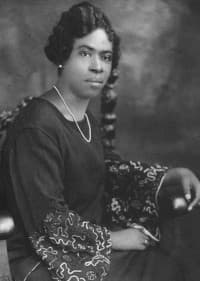
American · Politics · Activism
Minnie Cox
February 5, 1869 – January 1, 1933
Early Life and Background
Minnie M. Geddings (later Minnie Geddings Cox, and in some sources Minnie Cox Hamilton) was born in 1869 in Lexington, Holmes County, Mississippi, to formerly enslaved parents William and Mary (or Elizabeth) Geddings.[3][4][5][11] The precise date and even month of her birth are not entirely consistent across sources: the Mississippi Department of Archives and History notes that she was born in March 1869,[4] while other biographical treatments and educational materials simply give the year 1869 or specify February 5, 1869.[1][5] All agree, however, that she came of age in the Reconstruction-era South in a Black family that valued education as a path out of the constraints of slavery and Jim Crow.
Her parents’ experience as former slaves shaped both the opportunities and the obstacles that defined her childhood. Lexington, a small town in Holmes County, was part of a region where African Americans made up a substantial portion of the population but remained politically and economically subordinated.[3][11] Growing up in this context, Geddings learned early that advancement required both schooling and strategic engagement with the limited openings available to Black citizens. Her later achievements as a teacher, postmistress, and businesswoman echoed the aspirations nurtured in that household.
Evidence from later biographical accounts suggests that she had at least one sister and that her family encouraged intellectual development.[3][5] Though records of her early schooling are sparse, she likely attended local common schools for African American children in Lexington, where Black teachers and church-based institutions were critical to sustaining educational access. This foundation prepared her to seek higher education at a time when very few Black women from rural Mississippi entered college.
Education and Formative Influences
As a young woman, Minnie Geddings pursued higher education at Fisk University in Nashville, Tennessee, one of the most important historically Black colleges founded in the years immediately following the Civil War.[1][2][5] Fisk attracted students from across the South and became a center of Black intellectual and political life. According to multiple accounts, Geddings graduated from Fisk with a certificate in teaching around the age of nineteen, having studied pedagogy.[1][2][5]
Fisk’s environment would have exposed her to national debates about Reconstruction, Black suffrage, and women’s roles in public life. The university’s faculty and visiting lecturers emphasized the importance of education as a tool of racial uplift, and its alumni network connected students to emerging professional opportunities. For a Black woman from rural Mississippi, Fisk provided both credentials and a broader vision of what might be possible despite the growing backlash against Black rights in the South.
Her training in pedagogy prepared her for a career as an educator, which was one of the few respectable professional paths open to Black women at the time. Teaching also positioned her as a community leader, entrusted with shaping the next generation of Black youth. The combination of educational credentials and political awareness she gained at Fisk would later prove critical when she stepped into roles in federal service and business leadership.
Career Beginnings: Teaching and Local Leadership
After completing her studies, Minnie Geddings returned to Mississippi and began teaching in the common schools of Lexington.[2][5] In an era when Black education was chronically underfunded and often actively obstructed, her work as a teacher was itself a form of civic activism. She helped maintain educational access for African American children in the face of hostile policies and social attitudes.
Teaching also brought her into contact with local Black leaders and institutions, including churches and fraternal organizations that underpinned community life. These networks would become important in her later work. Soon after she began her teaching career, she married Wayne W. Cox, an educator and principal who led the Indianola Colored Public School.[1][3][5][9] The couple relocated to Indianola, in Sunflower County, where Minnie assisted Wayne in his work as principal and continued to teach.
The partnership between Minnie and Wayne Cox was both personal and professional. Both were active Republicans at a time when the party still claimed the legacy of emancipation and Black civil rights.[1] Their shared political commitments and reputations as educators placed them among the most prominent African American figures in their region. This standing made Minnie a plausible candidate for federal appointment when a postmaster vacancy arose.
Appointment as Postmistress and Barrier-Breaking Service
In 1891, Minnie Geddings Cox was appointed postmistress of Indianola, Mississippi, by President Benjamin Harrison, after local Republicans concluded that no qualified white Republican candidate was available.[1][4][5][9] She thus became the first Black woman to hold the postmistress position in Mississippi and is often described as possibly the first African American woman postmaster in the United States.[1][3][5][9] While national "first" status cannot be documented with absolute certainty, Mississippi-based and postal history sources consistently affirm her pioneering role in the state.
The appointment was unusual on several fronts. First, it placed a Black woman in charge of a federal facility in a small Southern town, making her one of the very few African American women in the South to hold a federal position during the Jim Crow era.[10][12] Second, the appointment occurred at a time when white Democrats were increasingly hostile to Black political participation and were working systematically to disenfranchise Black voters and officeholders.
Despite these obstacles, Cox quickly proved herself an efficient and conscientious administrator. She handled money, supervised staff, and oversaw the distribution of mail, which was critical infrastructure for communication and commerce. Her performance earned her respect among many patrons and positioned her as a symbol of Black competence and reliability in federal service.
In 1897, President William McKinley reappointed her to the post, confirming her continued tenure.[1][4][9] On January 25, 1900, McKinley raised the Indianola office from fourth class to third class and appointed Cox for a full four-year term, effectively upgrading her responsibilities and salary.[5] She continued in office under President Theodore Roosevelt after McKinley’s assassination, making her one of the few federal appointees to survive changes of administration.
The Indianola Affair, 1902–1904
By the early 1900s, the political climate in Mississippi had grown even more hostile to Black officeholders. Jim Crow laws, segregation, and disfranchisement were firmly entrenched.[4][5] In this context, Minnie Cox’s visible authority as postmistress became increasingly intolerable to many white residents of Indianola. In 1902, a concerted campaign began to force her from office.[4][5][10][12]
Local white citizens circulated petitions demanding her resignation and pressured the federal government to replace her with a white postmaster.[4][5][10] Their objections were not based on any allegation of misconduct or incompetence; sources emphasize that Cox’s service was exemplary. Instead, the hostility stemmed entirely from racist and sexist opposition to a Black woman holding a position of public authority. As tensions escalated, threats of violence and physical intimidation were reported against her.
Cox initially resisted efforts to remove her, but by late 1902 she submitted her resignation, to take effect on January 1, 1903, in an attempt to defuse the situation.[5] President Theodore Roosevelt, however, refused to accept the resignation. Viewing the campaign against Cox as an affront to federal authority and justice, he sought a way to prevent local racists from succeeding in ousting a duly appointed federal official.
On January 3, 1903, Roosevelt ordered the Indianola post office closed and rerouted the town’s mail to Greenville, about thirty miles away.[4][5][9][10] He further directed that Cox continue to receive her salary for the remainder of her term.[5][9] This decision was extraordinary: rather than allow a Black woman to be forced out, the president deprived the entire town of local postal service for more than a year.
The episode, soon dubbed the Indianola Affair, became a national political controversy. Southern politicians denounced Roosevelt’s action as federal overreach and a provocation on racial grounds, while many African Americans and Northern commentators applauded it as a rare stand against Jim Crow discrimination.[4][10] The incident revealed both the vulnerability of Black federal employees to local racial campaigns and the limited but significant ways in which the federal government could sometimes intervene.
The Indianola post office remained closed until February 1904, when, at the expiration of Cox’s term, it was reopened under new arrangements and demoted in rank from third class back to fourth class.[5][9] Cox did not return to the postmaster position. The reopening marked the end of the immediate crisis but cemented the Indianola Affair as a landmark in the history of race, federal power, and Black women’s public service.
Business Leadership: Banking and Insurance
After her departure from the post office, Minnie Cox shifted her energies toward Black economic institution-building. Drawing on her administrative experience and local networks, she and her husband Wayne co-founded the Delta Penny Savings Bank in Indianola in 1904.[9][11][12] The bank is widely regarded as the first African American–owned bank in Mississippi.[9] Its mission was to provide savings and credit services to Black residents who were largely excluded from white-controlled financial institutions.
The bank’s creation represented a significant expansion of Black economic agency. By offering secure places for deposits and access to loans, Delta Penny Savings Bank helped Black families and entrepreneurs build assets and weather economic downturns. Cox’s role in founding and managing the bank demonstrated her capacity to translate bureaucratic skills into private-sector leadership.
In 1909, Minnie and Wayne Cox were involved in organizing the Mississippi Beneficial Insurance Company, later known as the Mississippi Life Insurance Company.[9][11] This enterprise offered life insurance and other benefits to African Americans who were frequently denied policies or charged discriminatory rates by mainstream insurers. A scholarly article in Enterprise & Society highlights Cox’s role and the challenges she faced as a Black woman business leader in the early twentieth-century United States.[11]
Through these ventures, Cox contributed to the broader tradition of Black mutual aid and self-help institutions that sought to mitigate the effects of racial exclusion. Her business activities complemented her earlier public service, making her a key figure in the development of Black-owned financial infrastructure in the Mississippi Delta.
Political Engagement, Recognition, and Public Image
Throughout her career, Minnie Cox and her husband remained active in Republican Party politics.[1][3] Their support for Republican candidates reflected the party’s historical association with emancipation, despite growing ambivalence within the party toward Black civil rights by the turn of the twentieth century. Their political connections helped facilitate Minnie’s initial appointment as postmistress and may have contributed to Roosevelt’s willingness to defend her.
Although she did not receive formal national awards in the modern sense, Cox’s public image during her lifetime and afterward carried symbolic weight. Contemporary reports in newspapers and later historical accounts portrayed her as a respectable, educated woman unjustly targeted because of her race. The federal government’s refusal to accept her resignation and continued payment of her salary effectively functioned as an official endorsement of her competence and integrity.[4][5][9]
In the decades after her death, historians, museum curators, and educators increasingly recognized her significance. The Smithsonian National Postal Museum now features her story in its treatment of African Americans in the postal service.[1] The Mississippi Department of Archives and History and the Mississippi Encyclopedia include detailed entries on her life and the Indianola Affair, ensuring that her contributions are preserved in state and national memory.[3][4]
Personal Life
Minnie married Wayne W. Cox, an educator born in 1864 who served as principal of the Indianola Colored Public School and later joined her in founding financial institutions.[1][3][5][9] The couple’s partnership was central to both of their careers. Wayne initially suggested his wife for the Holmes County postmistress position, recognizing her administrative abilities and their shared political connections.[3]
Available sources do not provide extensive detail about whether the couple had children, and many biographical sketches focus primarily on their public roles in education, politics, and business. What is clear is that their marriage spanned work in schools, the postal service, and financial enterprises, and that they were regarded as leading members of the Black middle class in Indianola and, later, in the communities where they lived after leaving Mississippi.[3][9]
Wayne Cox died in 1916, while Minnie outlived him by nearly two decades.[3] After his death, she sometimes appears in records under the name Minnie Cox Hamilton, suggesting a subsequent marriage, though details of that relationship are less documented.[3] Despite these changes, she maintained ties to Indianola, where she would eventually be buried.
Later Life and Death
In her later years, Minnie Cox left Mississippi for Rockford, Illinois, where she spent at least part of her retirement.[3] This move reflected broader patterns of Black migration from the South to northern cities in the early twentieth century, driven by the search for greater safety, economic opportunity, and political rights. Her business and teaching experience would have made her a respected figure in Black communities beyond Mississippi as well.
Cox died in 1933, with the Mississippi Encyclopedia noting that she died in Rockford and was buried in the Little Rock Cemetery in Indianola next to Wayne Cox.[3][5] The exact day and month of her death are not consistently recorded across sources, but the year 1933 is widely agreed upon.[3][5] Her burial in Indianola symbolized her enduring connection to the town where she had taught, served as postmistress, and built financial institutions.
Legacy and Historical Impact
Minnie Geddings Cox’s legacy stretches across multiple domains: public service, Black women’s leadership, federal–local relations under Jim Crow, and Black economic institution-building. As Mississippi’s first Black woman postmistress, and possibly the first African American woman postmaster in the United States, she expanded the boundaries of who could hold federal office in the Deep South.[1][3][5][9] Her service demonstrated that Black women could manage complex administrative responsibilities and earn respect from many segments of their communities.
The Indianola Affair made her a national figure and forced public debate about racial discrimination within federal institutions. Roosevelt’s decision to close the post office and continue her salary is often cited as one of the clearest examples of early twentieth-century presidential intervention against local racist campaigns.[4][5][10][12] This episode highlighted the vulnerabilities of Black federal workers but also offered a rare instance in which the federal government sided with a Black woman under siege.
Her later work in founding the Delta Penny Savings Bank and helping to organize the Mississippi Beneficial Insurance Company/Mississippi Life Insurance Company placed her among the pioneers of Black-owned financial institutions in Mississippi.[9][11] These enterprises contributed to the development of Black economic autonomy and reflected broader movements toward mutual aid and cooperative economics in African American communities.
Scholars today study Cox not only for her role in the Indianola Affair but also as a case study in Black women’s business leadership. A detailed article in Enterprise & Society examines how her work in insurance confronted gender and racial constraints in the early twentieth-century United States and how she attempted, in her own words, "to do a work that would be very far reaching."[11] Her story intersects with themes of respectability politics, racial capitalism, and the contested terrain of public authority.
Public history projects, social media–based African American archives, and digital exhibits now regularly feature her as "the first Black postmistress they wanted you to forget" or "the postmaster they tried to silence."[6][8][10][12][13] These contemporary representations emphasize both her courage and the historical neglect of Black women’s contributions. Through such work, Minnie Geddings Cox has been restored to a more prominent place in U.S. women’s and African American history, serving as an enduring example of how Black women navigated and challenged the structures of Jim Crow to claim space in public office and economic life.
Dated achievements
5 indexed.
- Feb051869Politics
Birth of Minnie Geddings Cox
Minnie Geddings Cox was born in Mississippi, to become a significant figure in early 1900s U.S. politics.
View details Minnie Geddings Cox - YouTube - Jan011891Politics
First African American postmistress in Mississippi
Appointed by President Benjamin Harrison, she became the first African American postmistress in Mississippi.