← All women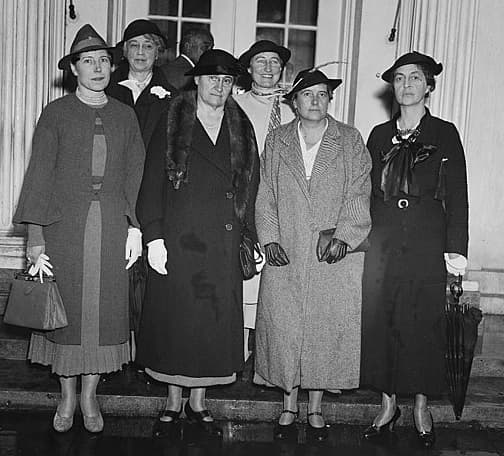
American · Activism · Politics
Mildred Scott Olmsted
December 5, 1890 – July 2, 1990
Early Life and Background
Mildred Scott Olmsted (born December 5, 1890) emerged from the small borough of Glenolden, Pennsylvania, into international prominence as a Quaker pacifist and women’s‑rights activist.[1][3][4][5] She was born Mildred Scott, the daughter of Henry J. Scott, a lawyer, and Adele Hamrick Scott, who was remembered as a socially prominent "high‑society beauty" in the Philadelphia area.[2][3] She was the second of three daughters, raised in a milieu that combined professional respectability with access to cultural and civic life.[2][3]
Olmsted’s upbringing in the greater Philadelphia region immersed her in the traditions of Quaker ethics, reformist Christianity, and Progressive Era activism.[3][5] She attended Friends’ Central School in Philadelphia, completing her secondary education there in 1908.[3][5] The school’s Quaker environment emphasized simplicity, social conscience, and the belief that individual moral responsibility extended to questions of war and peace. These formative influences would later shape her activism within the Religious Society of Friends and the Women’s International League for Peace and Freedom (WILPF).
Following Friends’ Central, Olmsted enrolled at Smith College, one of the preeminent women’s colleges in the United States.[1][3][4][5] She studied history and graduated in 1912, joining a growing cohort of college‑educated women prepared to enter professional and public life.[1][3][4] In 1913, she furthered her training by earning a certificate from the Pennsylvania School of Social and Health Work, positioning herself within the emerging field of professional social work.[3] Her early choice of social work signaled an orientation toward practical reform, integrating academic knowledge with direct engagement in communities affected by poverty, war, and inequality.
Career Beginnings and Development
Olmsted’s early career unfolded against the backdrop of World War I, a conflict that profoundly shaped her lifelong pacifism. In 1913, she traveled to France with the YMCA to organize recreation for soldiers at the Sorbonne.[3][4] This work exposed her to the realities of militarization and the human costs of war, deepening her commitment to peace. During and after the war, she also worked for Quaker and other relief organizations, including the American Friends Service Committee (AFSC).
In 1920, Olmsted joined the German Unit of the AFSC in Berlin, participating in postwar relief efforts aimed at addressing hunger and social dislocation in defeated Germany.[3][4] These experiences in France and Germany were crucial to her political formation. They brought her into contact with leading pacifists, including Jane Addams, the first president of WILPF and a Nobel Peace Prize laureate, whose example strongly influenced Olmsted’s decision to devote her life to peace work.[7][9]
Returning to the Philadelphia region, Olmsted accepted early positions in social work and community organization. She became the first social worker at Bryn Mawr Hospital, where she is credited with organizing the hospital’s first formal social service department.[2][5][10] She also worked with the Main Line Federation of Churches and became active in the Main Line Birth Control League, an advocacy group promoting women’s access to contraception.[2][5][10] Through these roles, she linked social work with emerging feminist concerns, arguing that women needed control over reproduction to secure health and economic stability.
Rise in Peace and Feminist Activism
By the early 1920s, Olmsted was deeply involved in both women’s suffrage and peace advocacy. She participated in suffrage campaigns in Pennsylvania and nationally, working to secure voting rights for women before and after the ratification of the Nineteenth Amendment in 1920.[1][2][3] Her suffrage work reflected a belief that women must have political power in order to effectively pursue peace and social justice.
In 1922, Olmsted’s trajectory shifted decisively toward organized peace work when she became Executive Secretary of the Pennsylvania Branch of the Women’s International League for Peace and Freedom.[1][3][4][6] In this position she coordinated educational programs on disarmament, organized meetings and campaigns, and helped recruit women across Pennsylvania into an international movement born from the antiwar women’s congress held at The Hague in 1915.[1][3][4] Her work as executive secretary gave her practical experience in organizing and administration, laying the foundations for later national leadership.
Olmsted’s effectiveness at the state level led to her assumption of national responsibilities in WILPF. From 1934 onward, she held positions in the U.S. section’s national office, eventually titled National Organization Secretary.[1][3][4][13] In this role she coordinated campaigns across the country, focusing particularly on opposition to militarism and promotion of disarmament in the tense political climate of the 1930s.[1][3][4] She participated in major peace coalitions of that decade, striving to influence U.S. policy on neutrality, collective security, and responses to fascist regimes.[9]
Olmsted’s influence quickly transcended national boundaries. From 1937 to 1953, she served on WILPF’s International Executive Committee, placing her in the organization’s core global leadership.[3][4][6] In this capacity, she contributed to WILPF’s responses to the rise of fascism, World War II, postwar reconstruction, and the onset of the Cold War. Her work included attending international conferences and collaborating with activists from Europe, Asia, and Latin America, helping to shape WILPF’s positions on international law, human rights, and disarmament.[3][4][6]
Major Roles and Accomplishments
Olmsted’s most sustained institutional impact came through her long tenure as the principal U.S. leader of WILPF. In 1946, she became National Administrative Secretary of the U.S. section, effectively directing the organization until her retirement two decades later.[1][3][4][7][13] Between 1946 and 1966, she oversaw staff, finances, program development, and national campaigns, guiding WILPF through key issues such as the formation of the United Nations, nuclear weapons testing, and domestic debates about McCarthyism and civil liberties.
During the 1950s and 1960s, Olmsted was a crucial figure in peace coalitions that opposed nuclear proliferation and challenged Cold War militarism.[9] Under her leadership, WILPF advocated for global disarmament, supported the United Nations as a forum for peaceful conflict resolution, and raised early concerns about the dangers of nuclear fallout. She helped craft WILPF’s strategy of combining feminist analysis with structural critiques of militarism, arguing that peace required not only the absence of war but also social justice and respect for human rights.
Olmsted also played a notable role in citizen diplomacy during the Cold War. In 1961, she initiated a series of exchange seminars linking WILPF’s U.S. section with the Women’s Committee of the USSR, a Soviet‑supported organization.[1][7] These seminars brought American and Soviet women together to discuss peace, social conditions, and their respective political systems. Olmsted believed that such exchanges could humanize opposing sides, reduce fear, and open new channels for dialogue beyond official government contacts.[1][7][9]
Beyond peace and disarmament, Olmsted was an early advocate of birth control and women’s health in the Philadelphia area. Working with the Main Line Birth Control League, she helped establish some of the first clinics providing contraceptive services to women in the region.[2][3][5][10] These clinics offered information and care at a time when contraception was highly controversial and often restricted by law and custom. Her efforts contributed to the broader movement for reproductive autonomy and public health that gained momentum in the mid‑twentieth century.
Olmsted also engaged deeply with the civil rights movement. In Delaware County, she was involved in founding a local chapter of the NAACP, and she and her husband hosted African American visitors at their home when racism kept them out of nearby hotels.[4][6] Her peace work, therefore, was intertwined with challenges to racial segregation and discrimination. She viewed civil rights as integral to the pursuit of peace, arguing that social injustice and racism fueled conflict and undermined democratic ideals.[3][4][6]
Throughout her career, Olmsted continued to support civil liberties. Her marriage to Allen S. Olmsted II, an early founder of the American Civil Liberties Union in Pennsylvania, knitted her peace activism to the defense of free speech, freedom of conscience, and legal protections for dissent.[4][6][8] She vocally opposed measures such as reintroducing the draft in 1940 and later critiqued anti‑communist policies that curtailed civil liberties.[2][7][9] Her activism thus spanned multiple overlapping movements: peace, feminism, reproductive rights, civil rights, and civil liberties.
Awards, Honors, and Recognition
Olmsted’s work garnered both institutional and symbolic recognition. In 1974, Smith College honored her with an L.H.D. (Doctor of Humane Letters), acknowledging her decades of service in peace and social justice.[5] This academic award linked her alma mater’s tradition of training women leaders to her specific achievements in national and international activism.
In 1986, WILPF awarded Olmsted its prestigious Peace and Freedom Award, described as a recognition of her long service and leadership within the organization.[1][7][8] By then in her mid‑90s, she had been active in WILPF for more than sixty years. The award symbolized her status as a "grand elder" of the movement, someone whose life embodied the organization’s principles of nonviolence and justice.
Two years before her death, the Rose Valley community and local institutions continued to highlight her contributions, including museum exhibits and local histories focused on her years at Thunderbird Lodge.[6][8][14] In May 1990, the City of Philadelphia presented her with a lifetime achievement award, formally honoring her nearly century‑long activism in peace, women’s rights, birth control, and civil liberties.[7][8] The timing—just two months before her death—underscored the enduring impact of her work on the region’s civic culture.
Olmsted’s papers are preserved in the Bryn Mawr College Peace Collection, which describes her as a "peace activist and suffragist" whose records document WILPF’s history and related movements.[3] In 1993, historian Margaret Hope Bacon published a comprehensive biography, One Woman’s Passion for Peace and Freedom: The Life of Mildred Scott Olmsted, further cementing her place in the historiography of twentieth‑century women’s activism.[9][11]
Personal Life
Olmsted’s personal life was closely intertwined with her public activism. In 1921, she married Allen S. Olmsted II, whom she had met during postwar relief work in Europe.[3][4][6] Allen became a judge of the Court of Common Pleas and played an early role in founding the American Civil Liberties Union in Pennsylvania.[4][6][8] Their shared commitment to civil liberties and peace shaped the atmosphere of their home.
The couple settled at Thunderbird Lodge in Rose Valley, Pennsylvania, where they lived for nearly sixty years.[6] The house functioned not only as a family residence but also as a hub of political and social activity. It was known as a place where African American visitors could stay when local hotels refused them service, reflecting the Olmsteds’ practical opposition to racial discrimination.[4][6]
Mildred and Allen had one biological child and adopted two more, raising a family while maintaining demanding public roles.[3] Olmsted’s life thus exemplifies the dual responsibilities many activist women shouldered: caring for children and family while simultaneously leading organizations and campaigns. Her Quaker faith informed this integration of personal and public spheres, emphasizing the continuity between private morality and social action.
Allen S. Olmsted II died in 1976, leaving Mildred a widow during the last decade and a half of her life.[7][8] She continued to be recognized locally and nationally for her contributions, maintaining connections with peace organizations and serving as a living memory of earlier struggles.
Later Life and Death
In her later years, Olmsted remained active as Executive Director Emerita of WILPF and as a respected elder in peace and women’s‑rights circles.[3] She continued to speak, correspond, and mentor younger activists, drawing on her experiences from World War I through the Cold War.
On July 2, 1990, Mildred Scott Olmsted died of heart failure at her home in Rose Valley at the age of 99.[1][3][4][7] The New York Times obituary described her as a "leader of pacifists and a suffragist," noting her long service as national executive director of WILPF and her role in exchange seminars with Soviet women.[7] Her death came only two months after the City of Philadelphia presented her with a lifetime achievement award, underscoring the belated yet meaningful recognition of her contributions.[7][8]
Legacy and Historical Impact
Olmsted’s legacy is multifaceted. As a Quaker pacifist, she helped shape the direction of WILPF, the first and one of the most influential international peace organizations led by women.[1][3][9] Her leadership in the U.S. section from 1946 to 1966 ensured organizational continuity through the turbulent mid‑twentieth century, linking the interwar disarmament campaigns with later anti‑nuclear and Cold War activism.
Her work also demonstrates the central role of women in constructing and sustaining social movements. Olmsted’s administrative skill, fundraising capacity, and ability to build coalitions were crucial to WILPF’s survival and effectiveness, yet such "organizational labor" has often been overlooked in traditional political histories.[1][3][9] By foregrounding her story, historians highlight the importance of women’s behind‑the‑scenes work in peace and justice movements.
In addition, Olmsted’s life illustrates the intersections of peace activism, feminism, reproductive rights, civil rights, and civil liberties. She did not view these domains as separate. Instead, she understood them as interdependent dimensions of a broader struggle against violence and oppression. Her early advocacy for birth control, support for working women, work with the NAACP, and defense of conscientious objectors all reflected a holistic conception of justice.[2][3][4][5][6]
Olmsted’s archives at Bryn Mawr College and biographies such as Margaret Hope Bacon’s book ensure that her contributions are documented and accessible to researchers.[3][9][11] Exhibits by institutions like the Rose Valley Museum further embed her story in local public memory, emphasizing her role as an exemplar of "act locally, have an effect globally."[6][14]
For women’s history, Mildred Scott Olmsted stands as a key figure in twentieth‑century transnational activism. She represents a generation of women who used voluntary associations to gain political voice, who challenged the inevitability of war, and who insisted that peace must be linked to gender equality and racial justice. Her near‑century life offers a lens through which to view the evolution of modern social movements, reminding us that sustained, often quiet organizational work can profoundly shape the course of history.
Dated achievements
12 indexed.
- Dec051890Activism
Birth of Mildred Scott Olmsted
Born Mildred Scott in Glenolden, Pennsylvania, later became peace activist Mildred Scott Olmsted.
View details Wikipedia: Mildred Scott Olmsted - Jun011912Activism
Graduation from Smith College
Graduated from Smith College, completing formal higher education.