← All women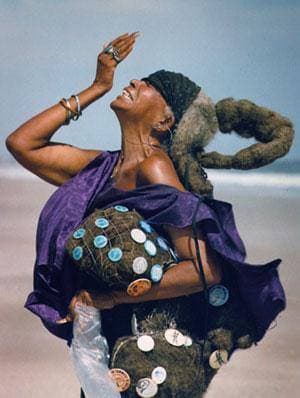
American · Activism · Arts
MaVynee Betsch
January 13, 1935 – September 5, 2005
Early Life and Family Background
MaVynee Oshun Betsch, widely known as the "Beach Lady," was born on January 13, 1935, in Jacksonville, Florida, into one of the South’s most prominent Black families.[1][2][4][13] Her parents, John Thomas Betsch Sr. and Mary Frances Lewis Betsch, were both involved in the insurance industry; John was an attorney and insurance executive, while Mary worked as a bookkeeper and insurance executive.[1][4][13] Through her mother’s side, MaVynee was the great‑granddaughter of Abraham Lincoln Lewis, Florida’s first Black millionaire and co‑founder of the Afro‑American Life Insurance Company, and of Anne Madgigine Jai Kingsley, the African woman who became the wife of plantation owner Zephaniah Kingsley.[1][10][12][13]
Lewis played a crucial role in MaVynee’s life story. In the mid‑1930s, at the height of Jim Crow segregation, he purchased waterfront land on Amelia Island north of Jacksonville to create American Beach, a resort where African Americans could enjoy the ocean free from the humiliations of segregated public facilities.[1][8][12][13] Notably, MaVynee’s birth year, 1935, is the same year American Beach became Florida’s first beach open to African Americans, symbolically linking her life to the site that would later define her activism.[4][8][13]
MaVynee spent much of her childhood at American Beach, absorbing both the joy of seaside recreation and the stories of why the place existed. Regular visits exposed her to the realities of segregation and the importance of Black‑owned land as a refuge from racial discrimination.[8][12][13] She attended public schools in Jacksonville and Washington, D.C., and later enrolled at Boylan‑Haven School, a private Methodist girls’ school in Jacksonville, which offered a disciplined, college‑preparatory education in a racially supportive environment.[13]
These experiences shaped a strong sense of cultural pride and social responsibility. Growing up surrounded by successful Black professionals, yet fully aware of the constraints imposed by segregation, MaVynee developed the conviction that Black spaces and histories deserved protection equal to that accorded to more widely recognized monuments and landscapes.
Musical Education and Opera Career
Demonstrating early musical talent, Betsch pursued formal training at the Oberlin Conservatory of Music in Ohio, one of the first American conservatories to admit Black students.[1][4][13] She graduated in 1955 with a degree in music, reportedly double‑majoring in voice and piano.[1][4][13] Oberlin, with its progressive traditions and integrated campus, exposed her to broader debates about civil rights and culture that would later inform the political dimensions of her environmental work.
After graduation, MaVynee moved to Europe to pursue a career as an opera singer. Sources describe her performing with the Frankfurt Opera and other German state opera companies, singing lead roles in the late 1950s and early 1960s.[1][4][10][13] She studied voice in Paris and London and sang in concert halls across Germany, where audiences and colleagues remembered her performances decades after she left the stage.[10] The Smithsonian profile on Betsch notes that she sang throughout Germany in the mid‑1950s and early 1960s before eventually feeling “called home” to Florida.[10]
During this period, Betsch enjoyed a glamorous lifestyle and accumulated a considerable fortune, assisted by her family’s wealth and inheritance as well as her professional earnings.[1][7][10] Her success as a Black woman opera singer in European houses during the era of de facto segregation in American classical music was itself a barrier‑breaking achievement, reflecting how many Black artists found more welcoming stages abroad than at home.[10]
By the early 1960s, MaVynee began to reassess her priorities. Some accounts indicate that she returned to Jacksonville around 1962, initially to study and promote conservation locally.[13] By the late 1960s and early 1970s, environmental concern had become central in her life, foreshadowing her eventual decision to leave formal performance altogether.
Turning Toward Environmentalism and American Beach
In the 1970s, Betsch underwent a profound transformation. Immersing herself in environmental literature and activism, she became deeply alarmed by threats to wildlife, coastal ecosystems, and historic Black landscapes.[1][7][10][12] During this period she made a radical personal choice: she donated her entire inheritance, reported as hundreds of thousands of dollars—some sources estimate about $750,000—to approximately 60 environmental organizations, including the World Wildlife Fund, the Sierra Club, and numerous wildlife and conservation groups.[1][10][12]
Betsch’s philanthropy was extraordinary not only in scale but in ethos. She wrote checks until the money ran out; as one account notes, a textbook on butterflies was dedicated to her and a whale tracked by New England Aquarium scientists was named MaVynee #1151, reflecting how her donations resonated within scientific communities.[10] She became a lifetime member of multiple organizations, particularly those involved with animal protection, trading financial security for the satisfaction of contributing to environmental causes.[1][10][12]
By the mid‑1970s, Betsch had effectively ended her formal opera career—sources often cite 1978 as the year she definitively left the stage—and relocated full‑time to American Beach on Amelia Island.[1][6][10][15] She lived in modest conditions, at times outdoors or in simple housing, dedicating herself entirely to the preservation of the beach her great‑grandfather had created. Her lifestyle choices, including wearing layers of colorful clothing and accumulating long, intricately styled hair, were not mere eccentricities; they became deliberate forms of protest and attention‑getting, used to draw visitors into conversations about history and conservation.
Becoming "The Beach Lady"
By the 1980s, MaVynee Betsch had become known locally—and eventually nationally—as "The Beach Lady."[1][6][10][12][14] She adopted a striking appearance: her hair grew to extraordinary length, sometimes measured in feet, and she adorned herself with butterfly jewelry, shells, and other natural motifs.[10][11] According to accounts, she grew her hair partly as a protest against Reagan‑era environmental policies, turning her own body into a symbol opposing governmental rollback of protections.[10][12]
On American Beach, Betsch acted as an informal park ranger, historian, and storyteller. She greeted visitors, reciting detailed histories of the beach’s founding, the role of Abraham Lincoln Lewis, and the experience of Black vacationers during Jim Crow.[8][10][12][13] She explained the ecological significance of dunes and coastal vegetation, warned against littering and destructive behavior, and advocated for sustainable development plans that would protect both the environment and the historic character of the community.
Her activism often involved direct confrontation with developers and planning officials. As real‑estate pressures mounted on Amelia Island, proposals emerged for high‑rise construction and intensive tourism development. Betsch participated in protests, lobbied officials, and mobilized residents to oppose projects that threatened to erase American Beach’s historic fabric and degrade its dune ecology.[7][9][12][14] She argued that the loss of the beach would not only harm wildlife but also erase a rare surviving coastal community built by and for African Americans.
NaNa Dune and Land‑Protection Campaigns
Central to Betsch’s activism was her advocacy for NaNa Dune, the tallest sand dune in Florida and a distinctive feature of American Beach.[2][6][15] She is credited with naming the dune "NaNa," reportedly in honor of her mother or grandmother, and with insisting that it be recognized as both an ecological treasure and a cultural landmark.[2][6]
Throughout the 1990s, Betsch led campaigns to secure permanent protection for NaNa Dune and the surrounding lands. She worked to build alliances with conservation groups, historians, and local officials, pressing for inclusion of the dune within the National Park Service’s Timucuan Ecological and Historic Preserve in Jacksonville.[1][2][6][15] Her efforts contributed significantly to federal recognition of the area’s value; in 2004, NaNa Dune was formally added to the preserve, an achievement widely attributed to her persistent advocacy.[2][6][15]
Betsch’s activism also supported the broader historic designation of American Beach. In 2002, the American Beach Historic District was listed on the National Register of Historic Places, a status that acknowledges the site’s significance as a Black leisure community during segregation and offers protections against destructive changes.[13][15] While designations involve many parties, local accounts consistently credit Betsch’s tireless work, documentation efforts, and public education as central to securing this recognition.[5][13][15]
Her campaigns exemplified an approach to environmentalism that integrated land conservation with the defense of Black history. She argued that preserving American Beach meant preserving the memory of generations of Black families who had used the site as a sanctuary from racism, and that the dunes, forests, and shoreline bore witness to this history.
Philanthropy, Activism Style, and Public Image
Beyond formal campaigns, Betsch’s daily life on American Beach served as continuous activism. She lived with minimal resources, often in deteriorating housing and with limited access to healthcare, having given away nearly all of her wealth.[1][7][10][12] Yet she maintained memberships in numerous environmental and animal‑protection organizations, considering these affiliations a core part of her identity. Her generosity extended not only to large groups like the World Wildlife Fund and Sierra Club but also to smaller, specialized organizations focused on birds, butterflies, and marine wildlife.[1][10][12]
Her storytelling style mixed humor, sharp critique, and spiritual reflection. Visitors recall her blending anecdotes about her opera career, her family’s history, and her environmental concerns into long, engaging conversations on the beach.[10][12][13] She cultivated an image that some contemporaries deemed eccentric, but which effectively drew attention, media coverage, and curiosity, creating opportunities to educate people about the intertwined issues of race, land, and conservation.
As environmental justice and heritage conservation gained traction nationally, Betsch’s work began to attract scholarly interest. Writers and journalists profiled her in magazines and books, noting how she embodied a holistic approach to activism that resisted compartmentalization of cultural and natural concerns.[10][11][12]
Illness, Later Life, and Death
Betsch was diagnosed with cancer around 2002, yet she continued her advocacy despite declining health.[3][6][7][12] Even as medical treatments and illness limited her physical strength, she remained on American Beach, speaking with visitors and participating in efforts to protect NaNa Dune and secure recognition for the community.
Her work bore major fruit shortly before her death. In 2004, NaNa Dune was officially incorporated into the Timucuan Ecological and Historic Preserve, fulfilling a long‑standing goal of Betsch’s activism.[2][6][15] The designation ensured federal protection for the dune and highlighted its ecological and historical importance. Two years earlier, the listing of American Beach as a historic district on the National Register had already strengthened the legal framework safeguarding the community’s built and natural environment.[13][15]
On September 5, 2005, MaVynee Oshun Betsch died of cancer at American Beach, Florida, at the age of 70.[1][2][3][6][7][12][15] She passed away in the place she had fought to preserve, surrounded by the landscape she had helped secure for future generations. Her death occasioned tributes from environmentalists, local residents, and national media, many of which emphasized how her unusual life trajectory—from opera star to penniless beach activist—illustrated a rare depth of commitment.
Awards, Honors, and Posthumous Recognition
Following her death, Betsch was posthumously honored as an Unsung Hero of Compassion by the Dalai Lama, a recognition bestowed on individuals whose lives exemplify selfless service.[12] This award highlighted the moral and spiritual dimensions of her work, acknowledging that her sacrifices were motivated by a deep sense of responsibility to both people and the natural world.
Environmental organizations and cultural institutions have continued to celebrate her legacy. The National Park Service maintains a biographical profile describing her significance as an environmentalist who fought to preserve a historic Black beach.[2] Conservation groups such as the Northern Virginia Conservation Trust and Virginia’s United Land Trusts present her story as part of "conservationists of color" educational materials, framing her life as exemplary for land‑trust professionals seeking equitable engagement with diverse communities.[14][3]
In 2014, the American Beach Museum opened, providing an institutional home for the interpretation of the beach’s history and for narratives about Betsch’s activism.[5][15] Exhibits and public programs frequently reference her as the informal historian and guardian of the site, using her life story to introduce visitors to the complexities of segregation, Black leisure, and coastal conservation.
Her life has also been recounted in children’s literature. The book "Saving American Beach: The Biography of African American Environmentalist MaVynee Betsch", written by Heidi Tyline King and illustrated by Ekua Holmes, presents her biography to younger audiences, emphasizing her love of American Beach, her opera career, and her activism that "ultimately saved" the place that felt most like home.[5][8] Museums and libraries have used the book in educational programming, further embedding her story in public memory.[9]
Personal Life
Accounts of Betsch’s life focus heavily on her public roles and activism, and relatively little is documented about marriage or children; major biographical sources do not report a spouse or offspring, suggesting that her principal familial bonds were with her extended Lewis–Betsch family and the community of American Beach.[1][2][4][12][13] Her brother, John Betsch, became a noted jazz drummer, and other relatives remained active in business and civic affairs, maintaining the family’s legacy in Jacksonville and beyond.[10][13]
Spiritually, Betsch’s worldview blended environmental ethics, African diasporic heritage, and compassion for animals. She frequently invoked butterflies, whales, and other creatures in her speech and appearance, and she understood conservation as protecting "all our relations" in the natural world.[10][12] This perspective resonated with the Dalai Lama’s recognition of her as an Unsung Hero of Compassion.
Legacy and Historical Impact
MaVynee Betsch’s legacy operates on multiple levels. Locally, her activism ensured that American Beach and NaNa Dune survived pressures that transformed much of Florida’s coastline into heavily developed tourist strips. The inclusion of NaNa Dune in the Timucuan Ecological and Historic Preserve and of American Beach on the National Register of Historic Places means that the landscape she loved is now preserved as both a natural and cultural resource.[2][5][6][13][15]
For environmental history, Betsch stands as an early example of environmental justice activism, decades before the term became mainstream. She insisted that conservation must include the defense of historically Black spaces, arguing that erasing those landscapes would erase stories of resilience and community building under segregation.[7][10][12][14] Her life challenges narratives that treat environmentalism as separate from civil rights, demonstrating how Black women have long mobilized around land and water as domains of freedom and dignity.
Her influence extends to contemporary conservation organizations that now recognize the importance of "conservationists of color" in shaping land‑protection outcomes. Profiles by Virginia’s United Land Trusts, Northern Virginia Conservation Trust, and Timucuan Parks Foundation use her story to inspire new generations of advocates who see environmental work as inseparable from social equity.[3][6][14]
As a Black woman opera singer who relinquished worldly success to live as a beach activist, Betsch also contributes to broader discussions about vocation, sacrifice, and the meaning of a life’s work. Her decision to give away her fortune, endure hardship, and prioritize a single landscape complicates conventional measures of achievement, inviting historians and the public to consider the value of lived, place‑based commitment.
Continuing Commemoration
In the decades since her death, commemoration of Betsch has intensified. The Timucuan Parks Foundation has repeatedly featured her in Women’s History Month and International Women’s Day campaigns, beginning in 2020 and again in 2024, highlighting her as a key woman in the region’s environmental history and emphasizing her role in naming and protecting NaNa Dune.[6] Environmental media such as Grist have described her as the "unsung hero who saved a Florida beach," while Audubon Florida has documented how her work lives on in protected coastline.[5][7]
Local journalism, notably the Fernandina Observer, continues to honor her on milestone anniversaries such as her 90th birthday in 2025, reiterating her symbolic status as the guardian of American Beach.[5] The American Beach Museum, humanities organizations, and educational publishers collectively ensure that her story reaches audiences from schoolchildren to scholars.
For women’s‑history scholarship, MaVynee Oshun Betsch exemplifies how Black women have shaped both cultural and physical landscapes through sustained, imaginative activism. Her life, rooted in a singular beach yet connected to global environmental and social movements, offers a rich case study in the power of individual agency, the importance of Black landownership, and the enduring impact of a woman who refused to separate art, history, and the natural world.
Dated achievements
9 indexed.
- Jan131935Activism
Birth of MaVynee Oshun Betsch in Jacksonville, Florida
Born January 13, 1935, in Jacksonville, Florida, into the Lewis–Betsch family linked to the founding of American Beach.
View details MaVynee "Beach Lady" Betsch Biography - Sep052005Activism
Death of MaVynee Betsch at American Beach
MaVynee Oshun Betsch died of cancer at American Beach, Florida, on September 5, 2005, after four decades of environmental and historic activism.