← All women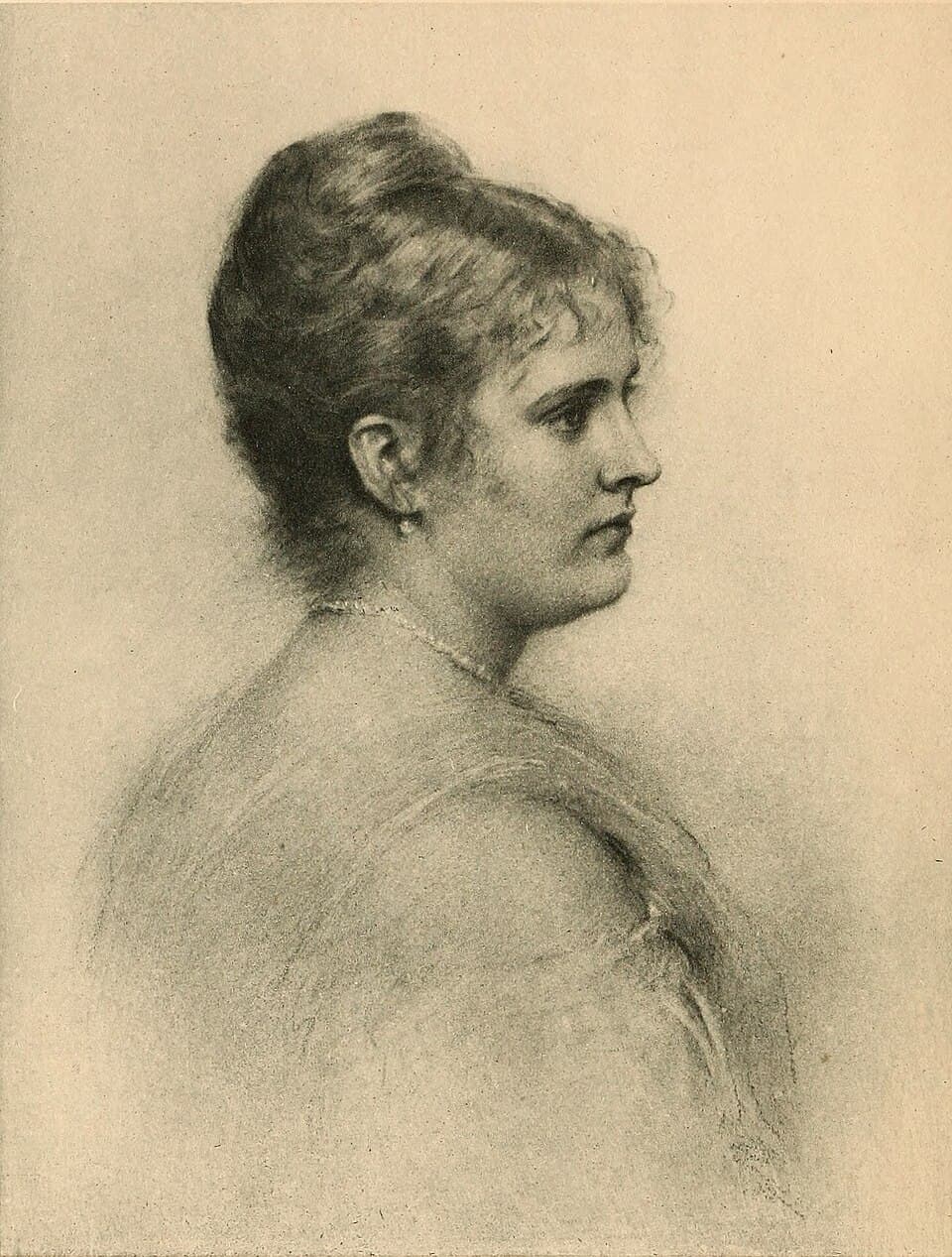
American · Literature · Activism
Maud Howe Elliot
November 9, 1854 – March 19, 1948
Early Life and Family Background
Maud Howe Elliott (born Maud Howe) was an American novelist, biographer, journalist, arts advocate, and suffragist, whose life closely intertwined with the major reform movements of the late nineteenth and early twentieth centuries. She was born on 9 November 1854 at the Perkins Institute for the Blind in Boston, Massachusetts, where her father, Samuel Gridley Howe, was founder and director.[4][2] Her mother, Julia Ward Howe, was a celebrated abolitionist, suffragist, and poet, best known as the author of the "Battle Hymn of the Republic."[2][4]
Maud was one of six children in a family that cultivated reformist ideals and intellectual pursuits. Her father’s work on behalf of blind education and his antislavery activism, together with her mother’s advocacy for women’s rights and peace, created a household steeped in public service and literary expression.[3][4] She attended the pioneering American kindergarten established by educator Elizabeth Palmer Peabody, an early influence that reflected the Howe family’s commitment to progressive education.[4]
Unlike many women of her generation, Maud’s education was shaped by direct access to leading literary and philosophical figures. She was privately tutored by her mother and had mentors that included Ralph Waldo Emerson and Henry Wadsworth Longfellow, as later noted in biographical accounts.[2] This informal but rigorous intellectual training, in the United States and during periods spent in Europe, prepared her not only for authorship but also for a life of travel and cultural engagement.[3]
Career Beginnings and Literary Development
By the early 1880s, Maud Howe had begun to publish fiction and travel writing, quickly establishing herself within the American literary field. Encyclopedia entries credit her with early novels such as A Newport Aquarelle (often cited as published in the 1880s), The San Rosario Ranch, Atalanta in the South, and Mammon, works that explored regional life and social themes.[4] These books drew on her experiences in Newport and the American South, reflecting both her mobility and her interest in local color narratives.
Elliott also worked as a journalist and correspondent. She wrote art criticism for the Boston Transcript and later became a nationally syndicated newspaper correspondent, reporting on life in Rome and other locations abroad.[5] Her journalism further cemented her reputation as an interpreter of art and culture for American audiences, bringing European and Mediterranean experiences into conversation with U.S. readers.
In 1887, Maud Howe married the English artist John Elliott, whom she had met in Rome.[3][4] Their marriage marked the beginning of a peripatetic life that included residence in Newport, Boston, Chicago, Rome, and Santo Domingo, with visits to Algeria and Greece.[3][4] Her husband’s painting and her writing formed a shared artistic trajectory that influenced many of her later works, including biographical studies of artists.
Chicago Years and Theatrical Work
During the 1890s, Maud Howe Elliott spent significant time in Chicago, a period she later recollected with detail in her memoir Three Generations.[11][2] In Chicago she integrated into the city’s cultural and clubwomen’s circles, lecturing on American art and engaging with reform-minded residents. She also contributed to the cultural life of the World’s Columbian Exposition in 1893, editing the book on the Woman’s Building and thereby documenting women’s artistic and intellectual achievements showcased at the fair.[5]
Her Chicago engagement was not confined to print. On 5 April 1897, Elliott and writer Fred Warren Upham saw their play "Hödmir" performed for the first time at Central Music Hall in Chicago, an event she later recorded in Three Generations.[11] This venture into dramatic writing broadened her creative repertoire and demonstrated her ability to work collaboratively across literary and theatrical spheres.
Later that same year, on 19 November 1897, she delivered her first public talk in Chicago at the home of Mrs. Charles Schwartz, presenting her experiences and literary work to an audience of local elites and clubwomen.[2] These parlor lectures reflected the period’s modes of women’s public engagement, where domestic settings served as gateways to wider intellectual and civic influence.
Major Works and Biographical Writing
Across her long career, Maud Howe Elliott produced a diverse portfolio of novels, travel narratives, memoirs, and biographies. Among her notable travel works is Sun and Shadow in Spain (1908), which formed part of a broader interest in Mediterranean cultures and was later highlighted in scholarly studies of American women exploring Spain.[1][3] She also wrote Two in Italy, drawing on extended stays in Italy with her husband.[4][3]
Her most celebrated achievement came through biography. Together with her sisters Laura E. Richards and Florence Hall, Elliott co‑authored a life of her mother titled Julia Ward Howe 1819–1910, often referred to simply as The Life of Julia Ward Howe.[1][3] This biography, published in the mid‑1910s, offered an intimate yet historically significant portrayal of Julia’s work in abolition, women’s rights, and literature. In 1917, the book received the Pulitzer Prize for Biography, the first time that award was granted in that category.[1][3] The Pulitzer recognized not only the importance of its subject but also the literary craftsmanship of her daughters; however, available sources typically specify only the year of the award, not the exact presentation date.
Maud Howe Elliott continued to publish into later decades. Her memoir Three Generations appeared in the 1920s, chronicling the Howe family’s history and her own experiences across three generations of reformers and intellectuals.[11][2] She later produced John Elliott, A Record of His Life as Told in Letters and Deeds, documenting her husband’s career and their artistic milieu, and in the 1940s she published This Was My Newport, a reflection on the social and cultural evolution of the coastal community where she had long resided.[2]
Arts Advocacy and Institutional Leadership
Beyond her writing, Elliott became a prominent advocate for the arts. In Newport, Rhode Island, she organized an exhibition of local artists at the YMCA in 1912, an initiative that led directly to the formation of the Art Association of Newport, now the Newport Art Museum and Art Association.[5][13] As secretary of the new organization, she effectively served as curator, director of education, and development officer for decades, striving to make the Association inclusive and representative of varied artistic voices.[5]
Her leadership in this institution placed her at the heart of Newport’s cultural infrastructure. She used her social position and organizational skill to support artists, arrange exhibitions, and promote public appreciation of art. Later accounts describe her as an advocate for American art more broadly, lecturing widely on the subject and contributing essays that emphasized the importance of national artistic expression.[5][3]
Maud Howe Elliott’s arts advocacy extended to national networks. She was one of the founding members of the Society of the Four Arts in Palm Beach, Florida, a cultural organization that fostered art, music, literature, and drama. According to biographical sources, she served as honorary president of the Society until her death, underscoring the continuity of her commitments across regional contexts.[1]
Suffrage Work and Progressive Politics
Elliott’s political activism was deeply influenced by her parents’ reform legacy. In Rhode Island, she helped form the Women’s Suffrage Association of Newport County and later became president of the Newport County Woman Suffrage League.[6][9] Her work involved managing membership lists, accounting, and personnel selection, alongside public speaking and organizing campaigns for state legislation granting women the right to vote.[6]
Her address to the Newport County Women’s Suffrage Association on 7 February 1910 typified this activism, as she used her platform to connect local efforts with national suffrage goals.[4][6] Later, on 1 December 1917, she helped organize and lead a mass meeting for woman suffrage in Newport, a milestone documented in local suffrage histories.[13] Such events were vital in building momentum toward the eventual passage of the Nineteenth Amendment, even though Rhode Island’s own legislative path to women’s full voting rights remained gradual.
Elliott also engaged in Progressive‑era political organizing. Sources credit her with founding or helping to found the Rhode Island Women’s Progressive Party, and with participating in the formation and development of the Rhode Island Progressive Party more broadly.[3][6] She urged figures like Theodore Roosevelt to run for president and supported Progressive platforms that emphasized social reform, government accountability, and expanded democratic participation.[9]
In 1916, she joined a cross‑country campaign train, delivering speeches on behalf of Republican presidential candidate Charles Evans Hughes, illustrating her willingness to engage directly in electoral politics.[5] Her activism thus spanned nonpartisan suffrage work, Progressive Party organizing, and engagement with specific campaigns, demonstrating the multiplicity of women’s political roles in the era prior to full enfranchisement.
Citizenship Controversy and Legal Status
Maud Howe Elliott’s activism intersected dramatically with changing laws on nationality. When the Expatriation Act of 1907 took effect on 2 March 1907, it declared that American women who married foreign nationals would lose their U.S. citizenship.[8] Because Elliott had married John Elliott, a British subject, in 1887, she was deemed to have automatically become a British subject and ceased to be an American citizen.[4][8]
This change had concrete implications for her life. According to accounts from Portsmouth and suffrage historians, she discovered that she could not vote in the 1920 elections—despite the recent ratification of the Nineteenth Amendment—because the United States no longer recognized her as a citizen.[8] Her situation exemplified the ways in which marriage laws could undermine women’s political rights even when constitutional barriers began to fall.
Elliott’s case became part of the broader legal struggle that led to reforms in nationality law. On 9 July 1917, she completed the formal process to regain her U.S. citizenship, reversing the automatic loss imposed by the 1907 Act.[8] While later legislation such as the Cable Act of 1922 would more systematically address derivative citizenship, her reinstatement in 1917 highlighted both the injustices of existing statutes and the avenues women used to reclaim their legal identities.
Awards, Honors, and Recognition
Maud Howe Elliott received significant recognition for her literary and civic efforts. Her co‑authored biography of Julia Ward Howe earned the Pulitzer Prize for Biography in 1917, a distinction acknowledged in encyclopedia entries and literary histories.[1][3] The award signaled high national esteem for both the subject and the biographers, and it represented one of the earliest instances in which women writers were recognized with a Pulitzer.
She also received formal academic honors. On 20 May 1916, Brown University awarded her an honorary Doctor of Letters (Litt.D.) during its Commencement ceremonies, citing her achievements as an author and civic leader.[12][5] Other sources mention a later honorary degree from Brown in 1940, reflecting continued institutional recognition of her contributions.[4]
In addition, Elliott’s leadership roles in organizations such as the Newport Art Association and the Society of the Four Arts served as practical honors, granting her influence over programming and policy. Her status as honorary president of the Society of the Four Arts until her death further cemented her reputation in arts circles.[1]
Personal Life and Relationships
Maud Howe’s personal life was deeply entwined with her family and artistic networks. Her marriage to John Elliott on 7 February 1887, recorded in biographical sources, united the daughter of renowned reformers with a cosmopolitan painter who shared her transatlantic outlook.[4] Together they lived in various locales—Newport, Boston, Chicago, Rome, Santo Domingo—and traveled to Algeria and Greece.[3][4]
Her relationship with her mother and sisters was central to her identity and work. Co‑authoring her mother’s biography with Laura E. Richards and Florence Hall involved drawing on familial memories, correspondence, and documents, and the collaboration itself is an example of women’s collective literary production in the early twentieth century.[1][3] Elliott’s later memoirs about her family and husband further demonstrate how personal ties served as sources of literary inspiration.
Biographical accounts do not emphasize children, suggesting that her primary familial commitments were to her extended Howe–Elliott circle and to the institutional families she helped build—art associations, suffrage leagues, and progressive political organizations. Her social networks included prominent reformers, artists, and intellectuals, many of whom appear in her writings and correspondence preserved in archival collections.[12]
Later Life and Continuing Work
In her later decades, Elliott remained active in writing and public life. She continued to publish works into the 1930s and 1940s, including John Elliott, A Record of His Life as Told in Letters and Deeds and This Was My Newport, the latter appearing when she was ninety years old.[2] These texts demonstrate her sustained capacity for reflection and documentation, as she recorded the evolution of artistic communities and social life over a long span of years.
Even as age advanced, she maintained her roles in arts and civic organizations. As secretary of the Newport Art Association, she performed duties analogous to those of curator and director, shaping exhibitions and programs well into the twenty‑first century’s predecessor decades.[5] Her engagement with the Society of the Four Arts and other institutions likewise persisted.
Maud Howe Elliott died on 19 March 1948 at her summer home in Newport, Rhode Island.[4][1] She was ninety‑three years old, and her death was noted as the passing of one of New England’s notable literary and civic figures. She was interred at Mount Auburn Cemetery in Cambridge, Massachusetts, alongside her husband and parents, situating her final resting place within a historic cemetery known for its association with writers, reformers, and intellectuals.[2]
Legacy and Historical Impact
Maud Howe Elliott’s legacy spans literature, women’s history, and arts administration. As a novelist and travel writer, she contributed to the genre of regional and international narratives that introduced readers to diverse American and Mediterranean settings. Her Pulitzer‑recognized biography of Julia Ward Howe remains an important source for scholars of abolition and women’s rights, offering a detailed portrait shaped by familial proximity.[1][3]
Her suffrage and progressive activism illustrate the ways in which educated, socially connected women used association life to transform politics before they had formal political power. Through the Newport County Woman Suffrage League and related organizations, she helped build the infrastructure that made the Nineteenth Amendment meaningful at the local level, ensuring that women were organized and ready to participate in elections once legal barriers fell.[6][13]
In arts advocacy, Elliott played a critical role in founding and sustaining institutions that continue to shape cultural life in Rhode Island and Florida. The Newport Art Association, now the Newport Art Museum, owes much to her early efforts at organizing exhibitions and promoting inclusive artistic communities.[5][13] The Society of the Four Arts similarly reflects her belief in the interconnectedness of literature, music, art, and theater.
Her personal experience with the Expatriation Act of 1907 has drawn scholarly attention in legal and women’s history, illustrating how nationality laws affected women married to foreigners and highlighting the intersection of citizenship, gender, and marriage.[8] By regaining her citizenship in 1917, she helped dramatize the need for reforms that would later come with the Cable Act and similar measures.
Archival collections, notably the Maud Howe Elliott Papers at Brown University, preserve her correspondence, manuscripts, lectures, and scrapbooks.[12] These materials offer rich insight into transatlantic artistic networks, Progressive‑era politics, and the everyday practices of women’s organizing. As historians continue to reassess women’s contributions to public life, Elliott’s multifaceted career stands as a reminder that literary production, arts administration, and political activism were often intertwined endeavors for women of her era.
Dated achievements
9 indexed.
- Nov091854Literature
Birth of Maud Howe Elliott
Maud Howe (later Elliott) was born in South Boston, Massachusetts.
View details Encyclopedia.com - Elliott, Maude Howe - Apr051897Arts
First performance of play 'Hödmir' in Chicago
The play 'Hödmir' by Maud Howe Elliott premiered at the Central Music Hall in Chicago.