← All women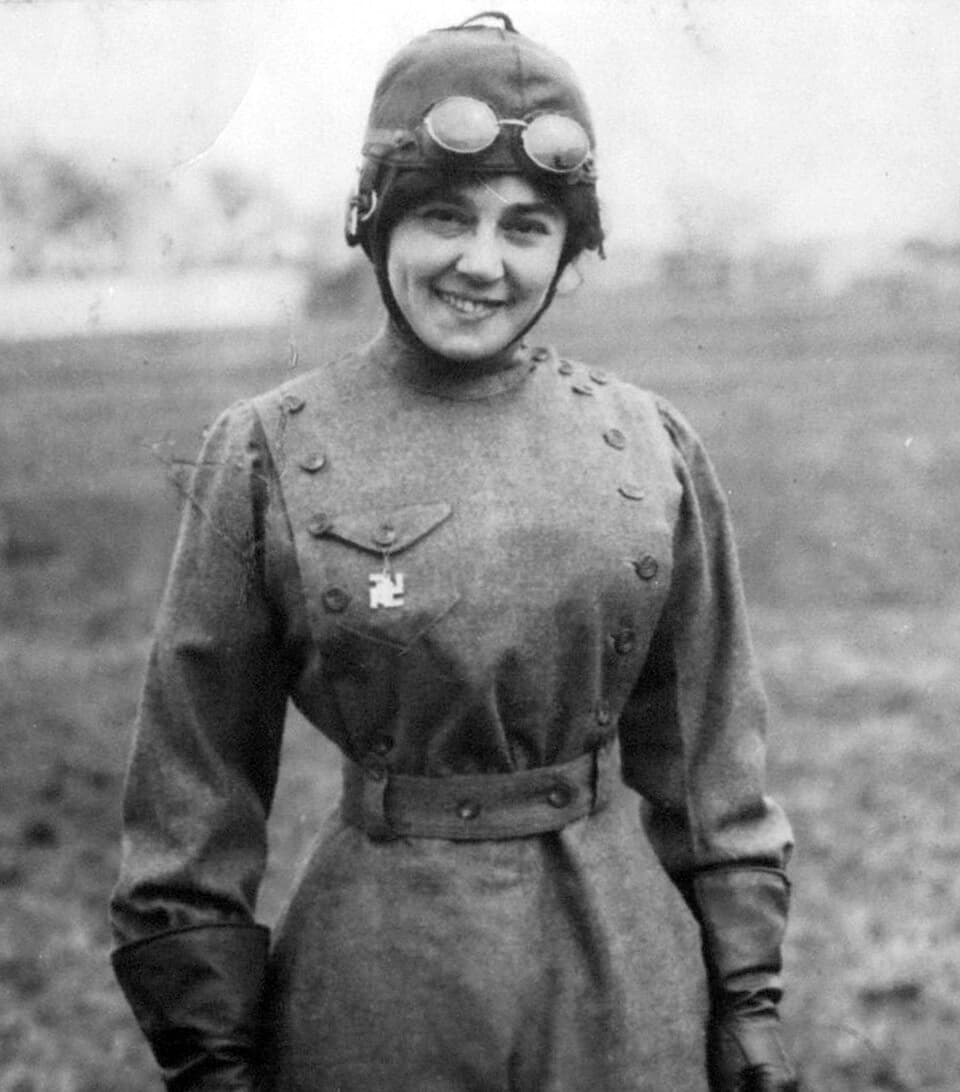
American · Aviation · Exploration
Matilde Moisant
September 13, 1878 – February 5, 1964
Early life and background
Matilde Josephine Moisant (often spelled Mathilde) was born on 13 September 1878 in Earl Park, Indiana, United States.[1][7][17] She was the daughter of French‑Canadian immigrants, part of a large family whose members would go on to play prominent roles in early aviation.[6][3][17] Aviation‑specific sources and major encyclopedic references, including English‑language and German‑language Wikipedia and the Early Birds of Aviation site, agree on the 1878 birth year and exact date, although one later encyclopedia entry gives an approximate birth year of about 1877.[1][3][7][17]
Her brothers John B. Moisant and Alfred (Albert) Moisant became known as pioneering aviators and aviation entrepreneurs. John learned to fly at the Blériot School of Aviation in Pau, France, and later founded the Moisant School of Aviation on Long Island.[17][14] The family’s international mobility and involvement in new technologies created an environment in which Matilde’s eventual interest in flying, while unusual for a woman, was embedded in family enterprise rather than isolated rebellion.
Details of her formal education are sparsely documented in available sources. However, biographical accounts emphasize that she worked closely with her brothers in their aviation ventures, suggesting practical exposure to mechanics, logistics, and business operations.[3] Contemporary descriptions note that she used nicknames such as "Tudy" and "Tillie," pointing to a family culture that treated her affectionately even as she entered a risky, male‑dominated field.[3]
Career beginnings in aviation
Moisant’s entry into aviation came through the Moisant School of Aviation, operated by her brother Albert at Mineola, Long Island, New York.[2][17] There she trained alongside Harriet Quimby, who would become the first woman in the United States to receive a pilot’s license.[1][2][4] Training at this school involved learning to fly Blériot‑type monoplanes powered by small engines, typically 50 horsepower, and coping with rudimentary instruments and minimal safety equipment.
According to both the Early Birds of Aviation site and Encyclopedia.com, Matilde’s practical training was exceptionally brief. After receiving verbal instruction from her brother John and basic familiarization with the aircraft, she undertook her first solo flight on 13 July 1911 at Mineola.[17][3] Flying an Anzani‑engined Blériot, she remained in the air for 32 minutes, an unusually long duration for a novice pilot. The Aero Club of America officially recorded this 32‑minute flight as part of her training time, and later accounts describe it as an all‑time record for the shortest composite training time to a pilot’s license.[3][17]
Her rapid progression challenged contemporary beliefs about women’s capabilities. Early‑20th‑century media and aviation commentators often argued that women lacked the strength, composure, and technical skill required for flying, yet Matilde advanced from verbal instruction to extended solo flight in a matter of days. This feat positioned her as an important figure in demonstrating women’s potential in aviation.
Pilot’s license and professional recognition
On 13 August 1911, Matilde Moisant earned her pilot’s license from the Aero Club of America, becoming the second woman in the United States to obtain an airplane pilot’s certificate.[1][4][2] This date is highlighted by the Smithsonian National Air and Space Museum, English‑language Wikipedia, and several aviation histories as the moment when she joined Harriet Quimby in breaking a major gender barrier.[1][4][2]
The Aero Club’s certification process followed standards of the Fédération Aéronautique Internationale (F.A.I.), which oversaw aviation records and licensing globally. Shortly after her licensing, her F.A.I. Airplane Pilot’s Certificate No. 44 was formally dated 17 August 1911 by the Aero Club of America.[17][7] Earlyaviators.com and German‑language Wikipedia underline this certificate date and note explicitly that she was the second woman to receive a pilot’s license in the United States.[7][17]
These two August dates reflect distinct aspects of her recognition: 13 August as the date she earned the license and was acknowledged as a pilot, and 17 August as the administrative date of her F.A.I. certificate. Together, they establish her as one of the very first women anywhere to receive professional, internationally recognized credentials to fly an airplane.[1][4][6][17]
Some secondary sources, including a web article on an aviatrix‑themed musical, casually refer to "August 1st" in connection with Moisant and Quimby’s licensing, but this appears to be a simplified or erroneous rendition; detailed aviation references favor 13 and 17 August.[8][4][17] Scholarship on early women pilots consistently treats Moisant as second in the U.S. and among the first ten women in the world to be licensed.[6]
Exhibition flying and international tours
After obtaining her license, Moisant pursued a short but dynamic career in exhibition flying. She joined the Moisant International Aviators, an air circus operated by her brothers that staged flying demonstrations and competitive events across the United States, Mexico, El Salvador, Cuba, and other locations.[4][17][14] The Smithsonian notes that she toured with Quimby and other pilots, performing in front of large crowds and participating in early aviation meets in both North and Central America.[4]
Later accounts, including the Early Birds of Aviation biography and Encyclopedia.com, state that she led an air circus in Mexico during the Mexican Revolution, likely in 1911.[3][17][14][10] As part of these activities, she flew before Mexican president Francisco I. Madero and other officials, and early sources claim that she became the first woman to fly in Mexico.[17][18][10] Although exact dates for these flights over Mexico City are not documented in readily accessible sources, the year 1912 is often mentioned for a women’s altitude record over the city.[17][10]
Exhibition flying in this period was perilous. Pilots flew low over spectators, navigated dusty and improvised fields, and contended with unreliable engines and unproven airframes. The spectacle of a woman pilot added to the promotional allure but also to the scrutiny and risk. Contemporary press coverage contrasted her calm professionalism with prevailing stereotypes that women were too nervous or fragile for aviation.[3][10]
Major accomplishments and records
Moisant’s most celebrated accomplishment occurred on 24 September 1911 at the Nassau Boulevard Aviation Meet in Garden City, Long Island. Flying a Blériot‑type monoplane powered by a 50‑horsepower Moisant engine, she reached an altitude of about 1,200 feet (366–370 m), breaking the women’s altitude world record and winning the Rodman‑Wanamaker Trophy.[4][17][3]
The Nassau meet was a major event in early American aviation, attracting top pilots and large audiences. The Rodman‑Wanamaker Trophy, sponsored by department‑store magnate Rodman Wanamaker, recognized altitude achievements and was notable as the first altitude trophy awarded to a woman flyer.[18][3] Moisant’s ascent exceeded the heights reached by many male competitors, underlining her technical skill and determination.
Several sources, including the New York Times obituary and the Smithsonian article, reiterate the significance of this record flight. The Times recalled that she made headlines with her 1,200‑foot ascent, while the Smithsonian emphasizes that she broke the women’s altitude record and flew higher than numerous male counterparts.[16][4] Some non‑primary sources and foreign‑language materials give slightly different dates or altitudes, but the consensus among aviation‑specific references points to 24 September 1911 and approximately 1,200 feet.[4][17][3]
Beyond this landmark record, Earlyaviators.com notes that she set a women’s altitude record over Mexico City in 1912 and was "royally feted" by President Madero and other officials, although no exact date is provided.[17][18] Such international performances reinforced her status as an emblem of modernity and technological daring and expanded the geographic reach of women’s aviation.
Awards, honors, and associations
For her Nassau Boulevard ascent, Moisant received the Rodman‑Wanamaker altitude trophy, widely described as the first trophy awarded for an altitude flight by a woman and, at the time, a world record for women.[3][18] This prize was not only a sporting accolade but also a symbolic endorsement of women’s capacity to excel in a domain associated with technical prowess and physical endurance.
Encyclopedia.com and other biographical references note that she was a member of the Early Birds of Aviation, an organization formed to recognize pilots who had flown solo before 1916.[3][17] Membership in the Early Birds signaled that her flights were not mere stunts but part of the foundational period of aviation history. Although the precise date of her admission to the association is not documented in readily available sources, her inclusion places her in the company of notable pioneers such as Glenn Curtiss and other early pilots.
Later institutional recognition includes biographical entries in reference works like Encyclopedia.com, coverage in the Smithsonian National Air and Space Museum’s "Because of Her Story" initiative, and a concise biography on sites dedicated to women in aviation and space history.[3][4][6] These attest to her enduring status as a figure of historical importance rather than a forgotten novelty.
Personal life and relationships
Available sources provide limited detail on Moisant’s personal life outside aviation. Encyclopedia.com notes that after her retirement from flying she lived in Los Angeles and La Crescenta, California.[3] No major reference work documents a marriage, children, or long‑term domestic partnerships, suggesting that either she did not marry or that such aspects of her life were not widely reported.
Her most documented personal relationship is her friendship and professional association with Harriet Quimby. The two trained together at the Moisant Aviation School, obtained licenses within weeks of each other, and toured with the Moisant International Aviators.[2][4] Their partnership has been described as a pioneering "gal pal" duo who collectively challenged gender norms by flying in public and setting records.[10]
Multiple sources indicate that she had close working ties with her brothers in operating the family’s airfield, flight school, plane factory, and air circus.[3][17] These relationships trace a familial network that sustained her aviation career and that shaped the broader development of early commercial and exhibition flying.
Accidents, retirement, and later life
Moisant’s career, like those of many early pilots, was marked by accidents. Encyclopedia.com reports that she experienced at least five crashes during her brief tenure as an aviator.[3] The most consequential occurred on 14 April 1912 at Wichita Falls, Texas, where she suffered a serious crash while flying in an exhibition.[3] The incident was severe enough that she chose to retire from flying afterward.
After this decision, she withdrew from public aviation and spent the remainder of her life largely in Southern California, residing in Los Angeles and La Crescenta.[3] She did not return to flying as a professional pilot, but her status as an "Early Bird" and one of the first licensed women aviators remained part of aviation lore. By contrast, her friend Harriet Quimby continued flying and died in an aviation accident in July 1912, highlighting the lethal risks Moisant narrowly avoided by leaving the field.
In later decades, Moisant lived quietly, but her accomplishments were periodically revisited in historical writings and museum exhibits. Earlyaviators.com records that she died in a Glendale, California sanitarium, underscoring that her final years were spent near the burgeoning aerospace centers of Southern California.[17]
Death
Matilde Moisant died on 5 February 1964 in Glendale, CaliforniaNew York Times, which described her as the "second woman in the country to get a pilot’s license" and recalled that on 24 September 1911 she made headlines by ascending to 1,200 feet in her monoplane.[16] The obituary underscored both her pioneering role and the brevity of her active career.
By the time of her passing, aviation had advanced to the jet age and early spaceflight. That she lived to see such transformations highlights the historical breadth of her lifetime, from the earliest experiments with powered flight to the dawn of human space travel. Her death marked the loss of a living witness to aviation’s formative years and prompted renewed interest in documenting the contributions of early women pilots.
Legacy and historical impact
Matilde Moisant’s legacy rests on several key contributions to women’s and aviation history:
- She was the second woman in the United States to earn a pilot’s license, following Harriet Quimby, and one of the first women in the world to hold professional aviation credentials.[1][4][6]
- Her 13 July 1911 solo flight and 32‑minute training record showcased women’s ability to master complex aircraft with minimal instruction, challenging contemporary gender stereotypes.[3][17]
- Her 24 September 1911 ascent to 1,200 feet at Nassau Boulevard broke the women’s altitude world record and secured the Rodman‑Wanamaker Trophy, the first altitude award given to a woman pilot.[4][3][18]
- Her participation in the Moisant International Aviators and flights in Mexico and Central America helped globalize public exposure to women pilots and associated them with technological modernity.[4][17][10]
Historians emphasize that while her flying career lasted less than a year at the highest level of prominence, its impact was disproportionate. She and Quimby provided early proof that women could be trained, certified, and celebrated as aviators within formal institutional frameworks. Subsequent female pilots, including those who served in wartime or broke commercial barriers, built on the precedent set by such early pioneers.
Today, Moisant is commemorated in museum exhibits, online biographies, and archival collections. The Smithsonian National Air and Space Museum has featured her in its "Because of Her Story" series, and women‑in‑aviation organizations include her in historical timelines of female accomplishments in flight.[4][6] Photographs and documents related to her life are preserved in public archives and digital repositories, including image collections on Commons and early aviator compilations.[17]
Her story also illuminates the intersection of gender, technology, and spectacle in the early 20th century. As a woman performing dangerous aerial feats in public, she was both a challenge to traditional norms and a participant in a culture that commodified risk and novelty. Her decision to retire after a serious crash underscores the human cost of pioneering in such environments.
In the broader context of women’s history, Matilde Moisant exemplifies how women entered high‑technology fields not only through formal education but also through family businesses and informal apprenticeships. Her achievements demonstrate that women were present at aviation’s inception, shaping its development and inspiring future generations long before women’s participation became routine.
Dated achievements
7 indexed.
- Sep131878Aviation
Birth in Earl Park, Indiana
Matilde Josephine Moisant was born in Earl Park, Indiana.
View details Matilde Moisant - Wikipedia - Jul131911Aviation
First solo flight and 32‑minute training record
Moisant made her first solo flight, lasting 32 minutes, at Mineola, Long Island.
View details