← All women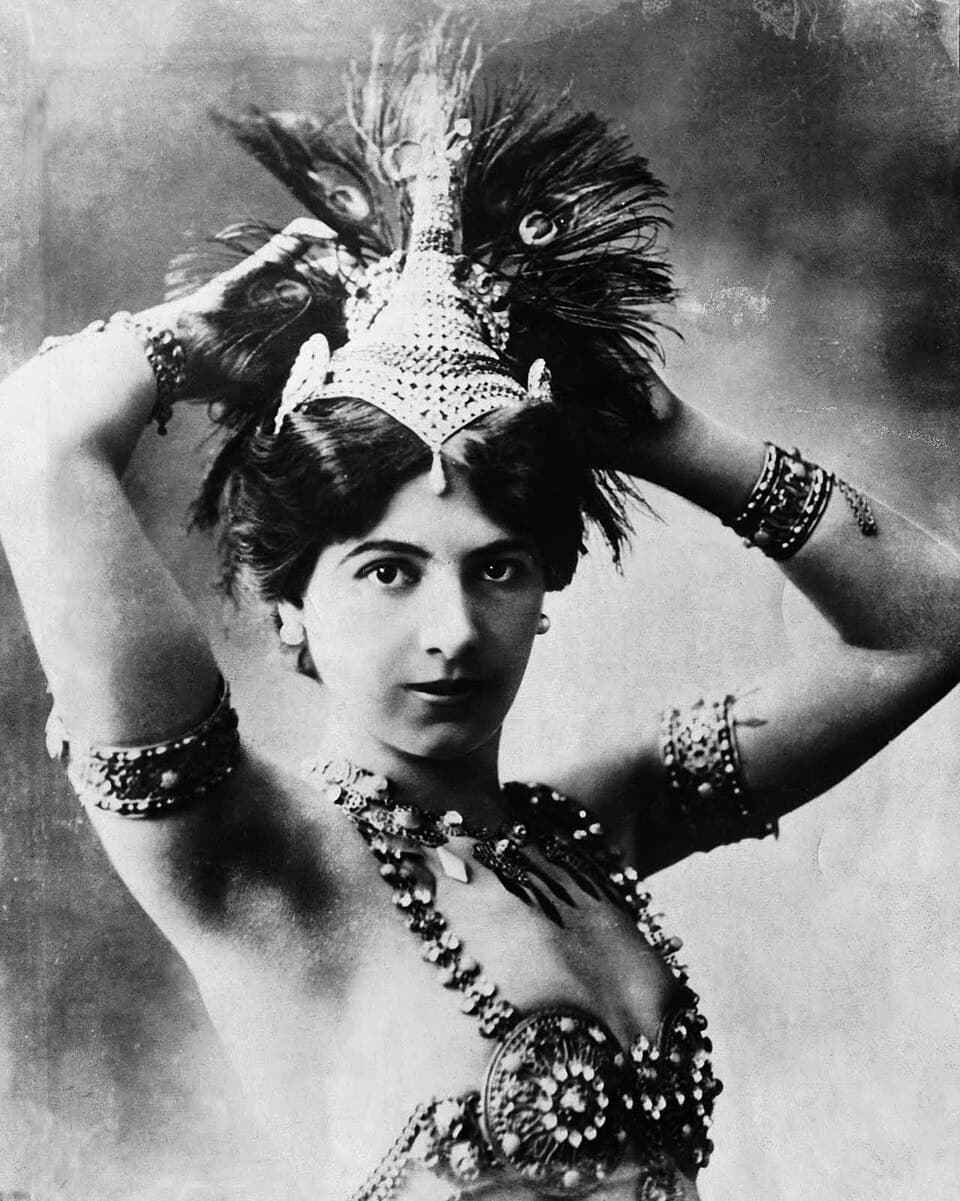
Dutch · Arts · Politics
Mata Hari
August 7, 1876 – October 15, 1917
Early Life and Background
Mata Hari was born Margaretha Geertruida Zelle on 7 August 1876 in Leeuwarden, in the northern Dutch province of Friesland.[2][3][4][6] She was the eldest of four children of Adam Zelle, a prosperous hat and textile merchant, and Antje van der Meulen
The family’s fortunes changed dramatically when Adam’s business failed and he went bankrupt, a downturn that fractured the household.[4][6] Her parents separated, and Antje died while Margaretha was still a teenager.[4][6] Biographical studies emphasize that this combination of sudden financial collapse and maternal loss left a lasting mark on her sense of security and belonging.[6][18] For a time she lived with relatives, including an uncle in The Hague, where she received teacher training and briefly worked in a kindergarten, an experience that she appears to have found stifling.[2][6] From an early age, Zelle demonstrated both a taste for glamour and a capacity for self‑reinvention. Later narratives she created about her own life—claiming sacred temple‑dancer origins in India, for example—were rooted not in childhood facts but in adult performances that would transform her from a provincial Dutch girl into a cosmopolitan figure.[12][17] In 1895, at around nineteen, Margaretha answered a newspaper advertisement placed by Rudolf (Rudolph) MacLeod, a Dutch colonial army officer much older than she.[2][9] They met, quickly became engaged, and married the same year.[2][9][19] Through MacLeod, she entered the world of the Dutch colonial military elite, and the couple soon moved to the Dutch East Indies (present‑day Indonesia).[2][8] In the Indies the couple lived mainly in Java and Sumatra, where colony life combined social privilege with harsh realities.[2][8] They had two children: a son, Norman, who died in early childhood under circumstances later debated by historians, and a daughter, Louise Jeanne, who survived into adulthood.[2][6] Their marriage proved deeply unhappy. Sources describe MacLeod as jealous, abusive, and alcoholic, while Margaretha herself engaged in extramarital affairs; mutual infidelity and violence marred the relationship.[2][4][6][18] During these years she encountered Javanese and other local performance traditions, experiences she later romanticized and exaggerated in crafting her identity as a temple dancer.[12][17] Her time in the colonies also exposed her to racial hierarchies and the gendered norms of imperial society, in which European women were expected to embody domestic respectability while navigating colonial constraints. By the early 1900s the marriage had disintegrated. The couple eventually separated, and in 1902 Margaretha returned to Europe, settling first in the Netherlands before moving to Paris to rebuild her life.[2][8][19] Custody disputes over her daughter and ongoing financial pressures further destabilized her position. These experiences of personal crisis, geographic displacement, and economic need helped set the stage for her transformation into Mata Hari. When Margaretha arrived in Paris in the early twentieth century, the city was a vibrant hub of artistic experimentation, cabaret culture, and interest in "Oriental" spectacle.[12][17] Initially she struggled, taking work as an artist’s model, minor performer, and courtesan associated with officers and businessmen.[2][6][18] Her beauty, poise, and knack for storytelling attracted lovers and patrons who could introduce her to theatrical circles. At the suggestion of a lover or impresario—accounts differ—she chose to reinvent herself as a professional dancer.[18] She adopted the stage name Mata Hari, a Malay or Indonesian term meaning "sun" or literally "eye of the day," which she claimed was bestowed on her in the East.[2][11][19] Drawing on fragments of her colonial experience, she crafted a persona of an Indian temple dancer trained from childhood in sacred rites, a story that historians now recognize as largely fabricated.[12][17] Her public career began decisively with her 13 March 1905 performance at the Musée Guimet in Paris, where she presented a series of "Oriental" dances framed as quasi‑religious rituals.[17] Contemporary reports and later biographies cite this as the first time she performed under the name Mata Hari and with the fully developed persona that would make her famous.[17] Her dances, characterized by slow, sculptural movements, layers of veils, and selective nudity, captivated audiences eager for exotic spectacle. Following her Musée Guimet debut, Mata Hari rapidly became a sensation in Paris and across Europe. She performed in private salons, theaters, and at high‑society events, often presenting her dances as authentically Eastern while incorporating motifs drawn loosely from Javanese, Indian, and other traditions.[12][17] Her success coincided with the height of European fascination with Orientalism—romanticized, often stereotyped images of Asian cultures filtered through colonial power relations. Critics and patrons praised her for bringing something "new" to the stage, even though her art owed more to European imaginings of the East than to particular indigenous forms.[12] By the late 1900s she was touring widely, appearing in cities such as Berlin, Vienna, and Madrid, and securing lucrative contracts.[17] She supplemented her income as a dancer with a parallel career as a high‑class courtesan, forming relationships with officers, diplomats, and financiers who provided gifts, travel opportunities, and access to elite networks.[2][6][18] Her lifestyle, marked by conspicuous consumption and public sensuality, challenged conventional expectations for European women. At a time when respectable femininity was closely tied to domestic roles and sexual discretion, Mata Hari openly commodified her allure and negotiated her own terms with powerful men. Yet this same visibility made her vulnerable: as later events showed, the qualities that fueled her stardom—sexual independence, cosmopolitan mobility, and self‑created exoticism—could be recast as evidence of duplicity and treason. With the outbreak of World War I in 1914, Europe’s social and political landscape changed dramatically.[1][2] International travel became heavily regulated, and suspicion of foreigners intensified. Mata Hari, a Dutch citizen from a neutral country, continued to move between nations, including France, Britain, and the Netherlands, under increasingly watchful eyes.[1][6] By 1915, she had come under investigation by French and Allied authorities for suspected espionage.[6][18] Her pattern of intimate relationships with officers from various armies, combined with her frequent cross‑border travel and substantial expenses, seemed suspicious in an atmosphere of pervasive fear about spies. Intelligence officers considered that her neutral status and access to military men might make her a useful agent—or a dangerous one. In 1916, French military intelligence, the Deuxième Bureau, approached her with an offer to work as a spy for France.[4][19] She allegedly agreed, motivated by promises of money, the prospect of travel, and perhaps a desire to restore her fading career. She was reportedly tasked with using her relationships with German officers to obtain information that could be passed to the French.[4][6] The exact extent and effectiveness of her espionage remain contested. Some scholars argue that she attempted to work for the French but was clumsy, naive about counterintelligence, and of limited value.[1][7] Others suggest that she may have simultaneously accepted money from German contacts—whether as a formal agent or an opportunistic informant is disputed.[1][4] This ambiguity, combined with fragmentary and sometimes contradictory intelligence records, is at the heart of later debates over whether she was truly a dangerous double agent or largely a scapegoat. French authorities intensified their scrutiny of Mata Hari as the war dragged on and casualties mounted. She was eventually arrested in Paris on espionage charges in early 1917, following surveillance and interception of communications that allegedly implicated her in passing information to Germany.[1][2][6] She was imprisoned at Saint‑Lazare women’s prison, a facility that housed a mix of common criminals and political detainees.[9] Her trial took place before a French military court, the Conseil de guerre, in a closed session that prevented public oversight and limited her ability to mount a robust defense.[1][6] Prosecutors portrayed her as a uniquely dangerous figure: a woman who used sexuality and exotic performance to seduce officers and trade in secrets. They relied heavily on coded telegrams, interrogations, and testimony from intelligence officers, though historians later noted that much of this evidence was circumstantial and open to alternative interpretations.[1][7] On 24 July 1917, the court found Mata Hari guilty on eight counts of espionage and sentenced her to death.[1] Her lawyers’ arguments—that she had worked for France, that the intelligence documents were misread, and that she lacked the capacity to cause major military harm—were rejected. In the wider public sphere, sensational newspaper coverage amplified the image of a lethal seductress whose treachery allegedly led thousands of soldiers to their death, claims that modern research finds greatly exaggerated.[13][15] Gender played a central role in both the prosecution and reception of the case. Scholars have argued that her visibility as an exotic dancer and courtesan made her an easier target for demonization, and that anxieties about women’s sexuality, foreignness, and independence were projected onto her.[1][6][18] The trial has since become a key example of how gendered stereotypes can shape outcomes in high‑stakes legal proceedings. Following her conviction, Mata Hari’s legal avenues narrowed. Appeals for clemency from various supporters, including some former lovers, were submitted but ultimately rejected.[5][8] She remained imprisoned at Saint‑Lazare while officials prepared for the execution. On the morning of 15 October 1917, she was taken to the military barracks at Vincennes, outside Paris.[2][3][6] Witnesses later recounted that she stood facing the firing squad without a blindfold and that she reportedly blew a kiss or looked steadily at her executioners—details that have contributed to her legend, even if their exact accuracy is hard to verify.[2][7][8] She was shot shortly after dawn, at age forty‑one.[3][6] Her body was not claimed by relatives and was turned over to medical faculty, reportedly for anatomical study.[2] Contemporary press accounts cast the execution as a necessary act of wartime justice, depicting her as a glamorous traitor whose death symbolized France’s determination to root out spies. These narratives reinforced the image of Mata Hari as the era’s most notorious female spy, merging fact and fiction into a compelling, if distorted, story.[13][15] Mata Hari did not receive formal awards or honors for her work; instead, her "recognition" took the form of notoriety. During her lifetime she achieved substantial fame as a dancer, on the strength of critical praise and high fees rather than official cultural prizes.[12][17] After her death, the public memory of her life was shaped less by archival records than by novels, films, and journalistic accounts that dramatized her as the archetypal femme fatale. Over time, historians and cultural critics have increasingly sought to disentangle these myths. Scholarly articles, biographies, and archival studies have re‑examined intelligence records and trial documents preserved in French military archives and other repositories, including the Service historique de la Défense in France.[1][16] Research in these sources has revealed gaps in the prosecution’s case, inconsistencies in surveillance reports, and indications that her actual role in wartime intelligence was limited. In 2017, the centenary of her execution sparked renewed interest and public programming. The UK National Archives published a major blog essay on 13 October 2017, reassessing her case and emphasizing the need to view her both as an individual woman and as part of broader patterns of wartime scapegoating.[17] Museums such as the Fries Museum in Leeuwarden developed exhibitions presenting "the real story" of Mata Hari, stressing archival evidence over sensational tales.[1] This evolving historiography functions as a form of posthumous recognition, highlighting not heroism in the conventional sense but the importance of critical, gender‑aware historical inquiry into celebrated and vilified women. Mata Hari’s personal life intertwined closely with her professional persona. Her marriage to Rudolf MacLeod introduced her to colonial society but also to domestic violence, infidelity, and custody struggles over her surviving daughter.[2][4][6] After leaving MacLeod and returning to Europe, she lived primarily as an independent woman, relying on her performances and relationships to sustain herself. As a courtesan, she formed relationships with officers, diplomats, and financiers from various countries, including France, Germany, and Russia.[2][6][18] These relationships provided her with material support and social access but also made her vulnerable to accusations of betrayal when wartime loyalties hardened. Her ability to move between national and social boundaries—Dutch by birth, shaped by colonial experience, resident in Paris, lover to men of different armies—complicated attempts to situate her within simple categories of allegiance. Identity was central to her self‑presentation. She changed her name from Margaretha Zelle to Margaretha MacLeod through marriage, and then to Mata Hari as a stage persona. She crafted narratives of Eastern origin, sometimes claiming to be half‑Indian or to have been raised in a temple, stories that blurred personal autobiography with theatrical invention.[12][17] For historians of gender and performance, these shifting identities illustrate how women in restrictive societies could use fiction to carve out space for autonomy, while also showing how such fiction could later be turned against them. Mata Hari’s legacy is multifaceted. In popular culture, she remains one of history’s most famous female spies, her name a shorthand for seductive treachery.[3][13][15] Films, novels, plays, and artworks have retold her story repeatedly, often emphasizing glamour and erotic danger more than archival fact. She has become, in this sense, a mythic figure rather than a simple historical subject. From the perspective of women’s history, her life underscores the constrained options available to many women of her era and the risks attached to crossing social boundaries. Her careers as dancer and courtesan represented strategies for economic survival and personal independence, yet they also exposed her to moral judgment and legal peril. The ways in which prosecutors, journalists, and later storytellers framed her sexuality and foreignness reveal enduring patterns in how powerful institutions and cultural narratives handle women perceived as transgressive.[1][6][18] Legal and intelligence historians see her case as a cautionary tale about espionage prosecutions. Her trial illustrates the difficulties of assessing secret‑world evidence, the dangers of conflating rumor with proof, and the tendency of states under pressure to seek symbolic convictions. The continuing debate over her actual guilt—whether she was an effective double agent, a minor informant, or largely a scapegoat—signals broader concerns about due process in national security cases.[1][7] Culturally, her story has prompted deeper reflection on Orientalism. Her success as an "Oriental" dancer depended on European fantasies of the East; her downfall, in part, reflected the readiness of those same societies to view a woman who embodied exotic otherness as inherently suspect. She thus occupies a critical place in discussions of race, gender, and empire in the early twentieth century. Today, institutions such as the Fries Museum and national archives continue to present new research and exhibitions on Mata Hari, encouraging audiences to move beyond legends toward a nuanced understanding of her life.[1][17] Her enduring fame ensures that these efforts have broad reach, making her case a gateway through which many encounter the complexities of women’s roles in war, performance, and modern culture. In the decades since her death, access to intelligence files and trial records has improved, allowing scholars to conduct more rigorous analyses. Some researchers, drawing on French, German, and British archives, argue that she did pass some information to German contacts and accepted payments, but that the intelligence value of her contributions was minimal and her role exaggerated by French authorities.[1][7] Others contend that she was primarily a would‑be asset for France who was compromised by sloppy tradecraft and hostile bureaucratic politics.[4][6] Historiographical essays emphasize several themes: the role of misogyny in her demonization, the use of spectacle in wartime justice, and the intersection of colonial fantasy with European fears.[1][10][18] While consensus has not fully crystallized, it is increasingly common in academic literature to treat Mata Hari as both a participant in espionage networks and as a casualty of a system inclined to make examples of conspicuous outsiders. In public memory, the figure of Mata Hari continues to evolve. New works often depict her less as a one‑dimensional villain and more as a complex woman navigating limited choices, surrounded by more powerful men in military and intelligence hierarchies. This reframing aligns with broader trends in women’s history that seek to recover women’s agency while also acknowledging structural constraints. Her story thus remains active rather than settled—a case in which each new archival discovery or interpretive lens can shift our understanding, reinforcing the value of critical historical research and the importance of examining how narratives about women are constructed and contested over time.Marriage, Colonial Experience, and Personal Upheaval
Reinvention in Paris and Career Beginnings
Rise to Fame: Exotic Dancer and Courtesan
Approach of War and Espionage Context
Arrest, Trial, and Conviction
Execution and Immediate Aftermath
Historiography, Awards, and Recognition
Personal Life, Relationships, and Identity
Legacy and Historical Impact
Later Assessments and Ongoing Debates
Dated achievements
5 indexed.
- Aug071876Arts
Birth in Leeuwarden, Netherlands
Birth of Margaretha Geertruida Zelle (later known as Mata Hari) in Leeuwarden, Netherlands.
View details Mata Hari (Encyclopedia 1914-1918 Online) - Mar131905Arts
Debut as Mata Hari at the Musée Guimet, Paris
Premiere of Mata Hari’s first public "Oriental" dance performance at the Musée Guimet in Paris.