← All women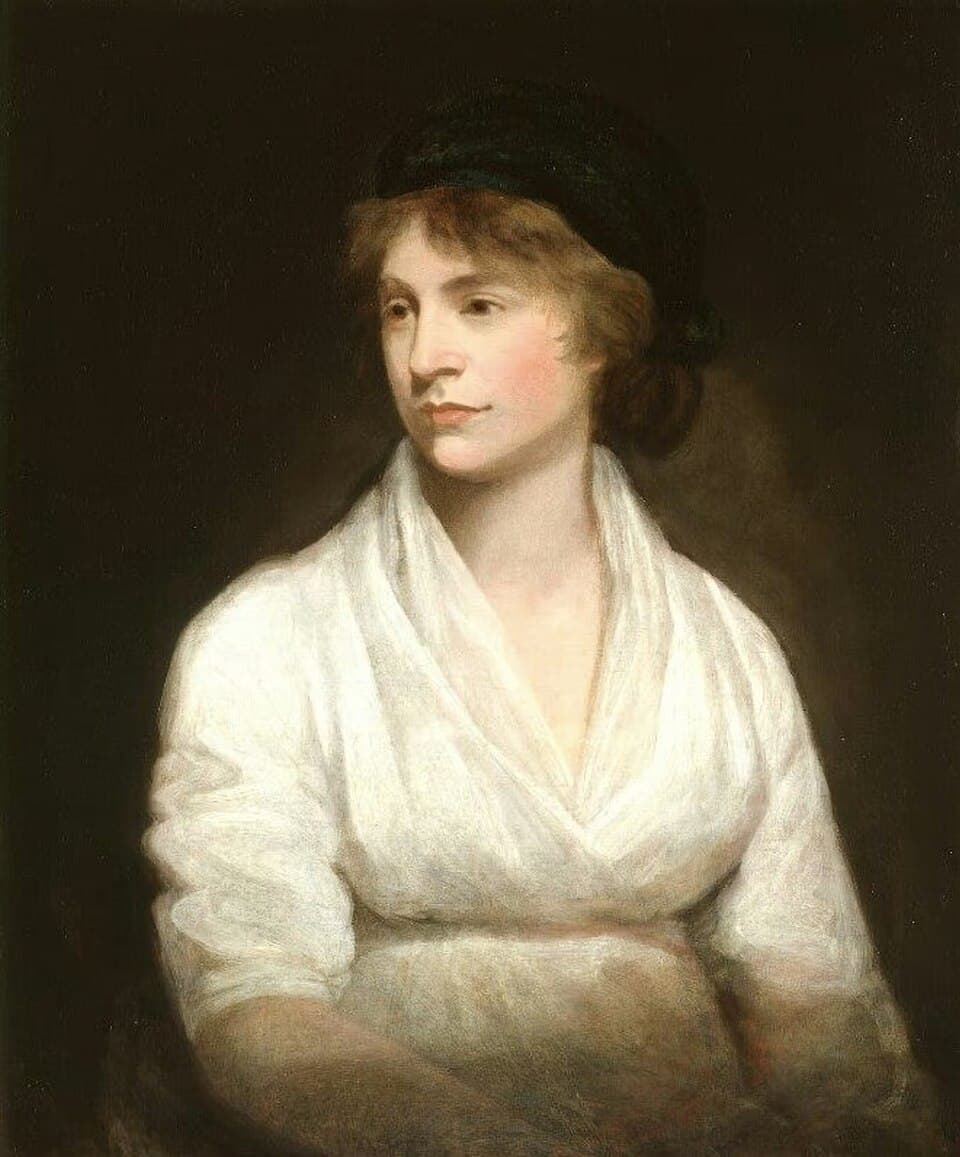
British · Literature · Activism
Mary Wollstonecraft Mother Feminist
April 27, 1759 – September 10, 1797
Early life and family background
Mary Wollstonecraft was born on 27 April 1759 in Spitalfields, London, England, the second of seven children. Biographical accounts describe a family whose circumstances declined over time, and whose domestic life was marked by instability and conflict. These early conditions mattered deeply for Wollstonecraft’s later thought: she did not write as a detached observer of women’s dependence, but as someone who had seen how economic insecurity and family disorder could limit a girl’s prospects.
Wollstonecraft received little formal schooling. Like many girls of her social rank, she was not given the sustained education that would have prepared her for intellectual independence. Instead, she educated herself through reading and through close attention to the problems of women’s lives around her. Later accounts emphasize that her early experiences included work in roles typically open to women, such as lady’s companion, schoolteacher, governess, and translator. Those positions exposed her to the realities of female labor: it was necessary, socially constrained, and often undervalued. The tension between women’s usefulness and women’s dependence would become one of the central themes of her writing.
Her early adulthood was shaped by a desire for self-support and autonomy. She moved within dissenting and reformist circles in London, especially those connected with the publisher Joseph Johnson, who would become an important supporter of her work. That intellectual environment introduced her to debates over education, politics, religion, and human reason. It also placed her at the center of a vibrant print culture in which women’s ideas could circulate, but only if they were strong enough to withstand ridicule.
Career beginnings and entry into print
Wollstonecraft’s first publication was Thoughts on the Education of Daughters: With Reflections on Female Conduct, in the More Important Duties of Life, published in 1787. The book signaled the start of a remarkable literary career and already revealed her core concern: education as the foundation of moral and intellectual life. Rather than treating women as naturally frivolous, she argued that women’s limitations were produced by the narrow training they received. That position would soon become the basis of her more radical work.
In 1788, she published her only complete novel, Mary: A Fiction. The novel widened her audience and showed that she could work within literary forms often associated with sentiment and fiction while still probing serious social issues. It is frequently read as a bridge between her educational writing and her later philosophical argument. Through fiction, she examined feeling, dependency, and the search for selfhood in a world that offered women few paths to independence.
During these years Wollstonecraft also worked as a governess and educator, experiences that sharpened her awareness of how girls were trained for submission rather than judgment. She came to believe that what society called feminine weakness was in fact a product of miseducation. This insight became the intellectual engine of her mature work.
Political writing and revolutionary context
Wollstonecraft moved decisively into political debate with A Vindication of the Rights of Men in 1790. Written in response to Edmund Burke’s attack on the French Revolution, the pamphlet defended reform, rational equality, and resistance to inherited privilege. It established her as a public thinker capable of engaging the major political controversies of the day. In the volatile atmosphere of the 1790s, that was a significant achievement for any writer, and a particularly bold one for a woman.
Her political writing did not separate the question of women from broader debates over justice. Instead, it treated inequality as a system with many forms: class privilege, aristocratic power, and gender hierarchy were all interwoven. This larger perspective is one reason Wollstonecraft remains important to historians of political thought as well as to historians of feminism. She understood that women’s oppression was sustained by institutions, custom, and ideology, not merely by individual prejudice.
In 1794, she published An Historical and Moral View of the French Revolution. The book reflected her sustained interest in revolutionary politics and in the moral costs of social upheaval. It showed that she was not only a polemicist but also a thoughtful analyst of history. Her work in this period demonstrates the breadth of her intellectual ambitions: she wrote across genres and kept returning to the question of how human beings might build a more just society.
A Vindication of the Rights of Woman and feminist philosophy
Wollstonecraft’s most famous work, A Vindication of the Rights of Woman, appeared in 1792 and is widely regarded as one of the foundational texts of modern feminism. In it, she argued that women were not naturally inferior to men; rather, they seemed inferior because they were denied the same opportunities for education and disciplined development. She insisted that reason, not ornament, should guide girls’ upbringing.
The book was radical because it challenged a deep cultural assumption: that women’s main purpose was to be pleasing, modest, and dependent. Wollstonecraft argued instead that women should be educated to become capable moral agents, workers, mothers, and citizens. She also connected women’s emancipation to the improvement of society as a whole. A nation that educated women badly, she suggested, weakened itself.
Her method was strikingly modern. She combined moral philosophy, social critique, and practical observation. The result was not just an argument for women’s better treatment, but a broad analysis of how power shapes character. That is why the Vindication is still described as a classic of feminist thought and a trailblazing work of political philosophy.
Personal life, motherhood, and later relationships
Wollstonecraft’s personal life was unconventional by the standards of her time. In 1794, she gave birth to her first child, Fanny Imlay, outside marriage. Such a birth carried severe social stigma in late 18th-century Britain, yet Wollstonecraft continued to live and work publicly. Her experience as an unmarried mother gives additional force to her arguments about women’s dependence and the costs of moral double standards.
During the 1790s, Wollstonecraft developed a relationship with the political philosopher William Godwin. They married in 1797. The marriage came late in her life and after she had already established her reputation as a writer, but it was part of her broader intellectual world. Godwin later wrote about her life and preserved key aspects of her legacy, even though some of the reaction to her posthumous reputation was hostile.
On 30 August 1797, Wollstonecraft gave birth to her second daughter, Mary, later known as Mary Shelley. The delivery was difficult, and complications soon followed. The birth linked two major literary figures across generations: the mother who wrote one of the first great feminist treatises and the daughter who would become a celebrated novelist.
Death, burial, and immediate aftermath
Mary Wollstonecraft died on 10 September 1797 in London, eleven days after her daughter’s birth. Accounts attribute her death to infection following childbirth complications, a reminder of the extreme dangers faced by women before modern obstetric medicine. She was buried at St Pancras Old Church in London.
Her death at only 38 meant that many of her ideas would be received, debated, and canonized posthumously. In life, she had been admired by some and attacked by others, especially because of her forceful views on politics and gender. After her death, her reputation passed through periods of neglect and hostility before being revived by later feminists, philosophers, and historians.
Legacy and historical impact
Wollstonecraft’s legacy rests above all on her insistence that women’s minds matter. She helped establish the idea that women should be educated as rational beings rather than shaped for decorative dependence. That argument influenced later feminist activism, educational reform, and political theory. Her work also helped define modern discussions of citizenship, autonomy, and moral equality.
She has since been recognized as a founding feminist philosopher and often described as the “Mother of Feminism” or Britain’s first feminist. Such labels are modern assessments rather than titles she held in her own lifetime, but they capture her historical place: she was among the earliest writers to present a sustained philosophical case for women’s rights in language of universal reason and justice.
Her influence extends beyond feminism. Scholars have also traced her impact on travel writing, Romantic literature, and the broader culture of political reform. Her work remains read because it combines moral seriousness with practical urgency. Wollstonecraft wrote at a time when women were expected to be silent, dependent, and agreeable; she chose instead to argue publicly that equality was both rational and necessary.
Awards and recognition
Wollstonecraft did not receive modern prizes or institutional honors during her lifetime, but her posthumous recognition has become substantial. She is routinely included in histories of women’s rights and feminist philosophy, and modern reference works consistently identify A Vindication of the Rights of Woman as her most important contribution. Her reputation has been especially strong in educational contexts, where she is now treated as a canonical figure in the history of political thought.
The continuing use of phrases such as “first feminist” and “Mother of Feminism” reflects a broader scholarly agreement that Wollstonecraft changed the terms on which women’s intellectual equality could be discussed. Her life, work, and early death together created one of the most enduring legacies in the history of women’s writing.
Dated achievements
12 indexed.
- Apr271759Literature
Birth of Mary Wollstonecraft
Mary Wollstonecraft was born in Spitalfields, London, England.
View details Encyclopædia Britannica - Jan011787Literature
Publication year of first book 'Thoughts on the Education of Daughters'
Joseph Johnson publishes Wollstonecraft’s first book, marking her debut as a feminist writer.