← All women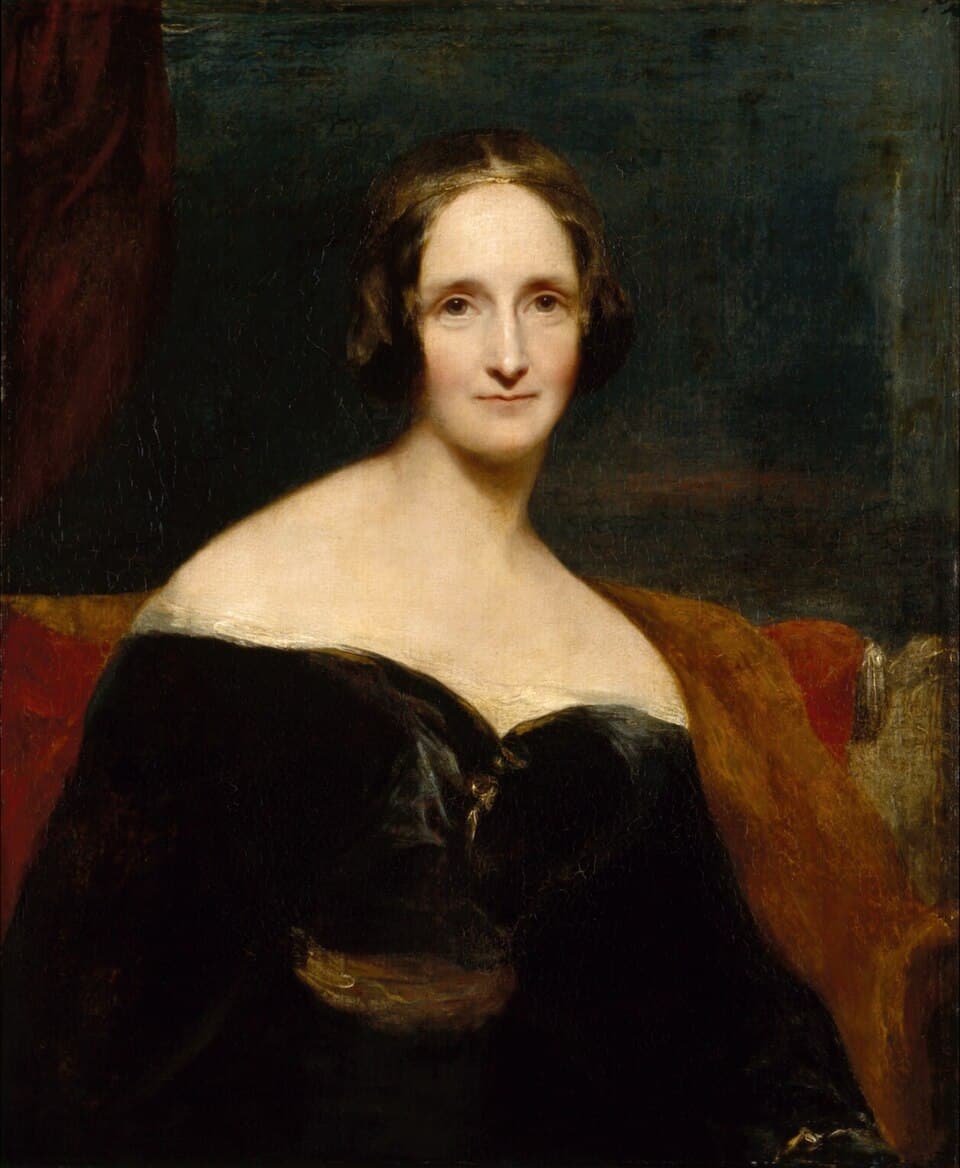
English · Literature
Mary Shelley
August 30, 1797 – February 1, 1851
Early Life and Background
Mary Wollstonecraft Shelley (née Godwin) was born on 30 August 1797 in Somers Town, London, into one of the most intellectually radical households of late eighteenth‑century Britain.[1][3][11] Her father, William Godwin, was a prominent political philosopher and novelist whose works, including Enquiry Concerning Political Justice, argued for rationalism, social equality, and critiques of inherited privilege.[1][11] Her mother, Mary Wollstonecraft, was a pioneering feminist thinker and the author of A Vindication of the Rights of Woman (1792), a foundational text in the history of women’s rights.[1][15]
Mary’s birth was immediately overshadowed by tragedy. Wollstonecraft died about ten days after Mary’s delivery due to complications, leaving the infant in the care of Godwin and household associates.[1][3][15] The loss of her mother, whose reputation as a radical writer was both celebrated and scandalized, profoundly shaped Mary’s sense of identity. Godwin fostered reverence for Wollstonecraft’s memory, preserving her manuscripts and publishing a candid memoir that exposed unconventional aspects of her life, thereby influencing how society viewed Mary’s maternal legacy.
Raised by Godwin, Mary grew up in a home that functioned as a salon for intellectuals, writers, and political radicals. Visitors included figures from British and continental literary circles, exposing her early to debates over philosophy, reform, and literature.[1][10] Although her formal schooling was irregular, she received an extensive informal education. Godwin encouraged her to read widely in history, philosophy, travel literature, and fiction, and he took her on walks to discuss books and ideas.[1][15] This environment nurtured a precocious imagination and gave her access to intellectual resources that were rare for girls of her time.
In 1801, Godwin married Mary Jane Clairmont, a neighbor with two children, Charles and Claire, adding step‑siblings to Mary’s household.[1][11] Relations between Mary and her stepmother were strained, but the blended family intensified the domestic dynamics that would later inform Mary’s fiction, often focused on complex kinship and surrogate familial bonds. Mary’s own emergence as a writer began early. In 1807, her verse tale Mounseer Nongtongpaw appeared in Godwin’s Juvenile Library and is frequently cited as her first published work, reflecting the intersection of her literary apprenticeship and her father’s educational publishing venture.[11]
Career Beginnings and Development
Mary’s transition from promising intellectual daughter to independent writer was closely tied to her relationship with Percy Bysshe Shelley. Percy first met Godwin in 1812 and became a frequent visitor to the household, attracted by Godwin’s political ideas.[1][3] Mary, by then a teenager, observed and participated in discussions that linked Romantic literary experimentation to radical politics. In June 1814, Mary and Percy declared their mutual love; despite Percy’s existing marriage to Harriet Westbrook, the pair embarked on a relationship that both families viewed as deeply transgressive.[1][14]
On 28 July 1814, Mary eloped with Percy, accompanied by her stepsister Claire Clairmont, leaving England for a six‑week tour through France, Switzerland, Germany, and Holland.[14][5] The journey involved financial hardship and social disapproval but also provided intense exposure to continental landscapes and revolutionary history. Their experiences later formed the basis of History of a Six Weeks’ Tour, published in 1817 and often regarded as Mary’s first book‑length work.[14][15] This travel narrative blended personal memoir, geographical description, and political reflection, signaling her distinct authorial voice.
Between 1814 and 1816, the couple lived in various locations in England and briefly in Switzerland, continually struggling with debt, ill health, and familial conflict. Mary and Percy had several children, most of whom died in infancy or early childhood—a series of bereavements that left Mary with deep emotional scars and informed her preoccupation with fragile life, loss, and parental responsibility in her fiction.[1][3] During this period, she continued to read widely, copy manuscripts, and experiment with writing, but she did not yet enjoy a secure reputation as an author.
The summer of 1816 marked a crucial turning point in her creative development. The Shelleys traveled to Lake Geneva, where they stayed near Lord Byron and his physician John Polidori at the Villa Diodati.[1][3] Unusually inclement weather—the “year without a summer” following the eruption of Mount Tambora—confined the group indoors, prompting Byron to propose a ghost‑story contest. Mary, initially struggling to find an idea, experienced a vivid waking nightmare about a “pale student of unhallowed arts” animating a manufactured creature, a vision that became the germ of Frankenstein.[1][3][15]
Over the following months, Mary expanded her idea into a complex narrative, with Percy providing encouragement, editorial assistance, and practical support such as negotiating with publishers.[1][3] By 1817 she had completed the manuscript of Frankenstein; or, The Modern Prometheus, demonstrating an ability to synthesize Gothic conventions, contemporary scientific discourse, and philosophical questions about creation, authority, and moral duty.
Major Works and Accomplishments
Mary Shelley’s most famous work, Frankenstein; or, The Modern Prometheus, first appeared anonymously in three volumes in London in 1818, published by Lackington, Hughes, Harding, Mavor & Jones.[1][3] The title page omitted her name, and a preface signed by Percy Shelley led many to assume he was the author.[1] The novel’s structure—framing Victor Frankenstein’s narration within the letters of explorer Robert Walton—allowed Mary to juxtapose the ambitions of scientific and geographical exploration, highlighting the ethical limits of human endeavor.
The novel draws on contemporary debates over galvanism, chemistry, and the boundaries between life and death, as well as on literary traditions including Miltonic epic and Gothic romance.[1][3] It explores themes of parental responsibility, social exclusion, and the consequences of abandoning one’s creations, casting the creature as an articulate, sympathetic figure whose suffering arises from societal rejection. Over time, critics have come to view Frankenstein as a foundational text of modern science fiction, though at the time it was often classified as a sensational Gothic tale.[1][3][15]
Later in 1818, Frankenstein appeared in France in translation, beginning its international reception and demonstrating the cross‑European appeal of its themes.[12] In 1823, a second English edition was issued in two volumes, this time naming Mary Shelley as the author on the title page.[12][1] This acknowledgement began to shift public understanding of the novel, situating its imaginative power explicitly in the work of a young woman writer.
Mary’s oeuvre extended far beyond Frankenstein. In 1817, she published History of a Six Weeks’ Tour, combining letters and travel narrative from her 1814 and 1816 journeys.[14][15] Around 1819, she completed the novella Matilda, a deeply introspective work exploring taboo themes of incestuous desire and alienation; it remained unpublished until the twentieth century due to its controversial subject matter.[1][15] This text exemplifies her willingness to probe psychological extremity and social boundaries.
Following Percy’s death in 1822, Mary increasingly relied on writing for financial support. She produced the novel Valperga (1823), a historical romance set in medieval Italy, and the ambitious speculative novel The Last Man (published in 1826), which portrays a future world devastated by plague, leaving a handful of survivors including a protagonist modeled partly on Percy Shelley and Lord Byron.[1][15] Often cited as an early example of post‑apocalyptic fiction, The Last Man reflects Mary’s experiences of loss, political disillusionment, and the fragility of human projects.
Mary continued to explore historical and social themes in later novels. The Fortunes of Perkin Warbeck (1830) centers on the pretender to the English throne in Henry VII’s reign, interrogating legitimacy and political intrigue.[1][15] Lodore (1835) examines the position of women and children within patriarchal legal structures, paying particular attention to inheritance, guardianship, and female education.[1][15] Her final full‑length novel, Falkner (1837), similarly focuses on moral reform, the power of female influence, and the possibility of redemption within oppressive social systems.[1][15]
In addition to novels, Mary wrote extensively in other genres. Her forty‑year career produced short stories, travel narratives, biographical sketches, essays, and literary criticism.[15][18] She contributed entries on Italian, French, Spanish, and Portuguese writers and scientists to biographical dictionaries and series, demonstrating a cosmopolitan intellectual reach.[15] Her travel book Rambles in Germany and Italy (1844) combined observational detail with political commentary on the 1840s European landscape.
Another crucial aspect of Mary’s literary contribution was her editorial work on Percy Bysshe Shelley’s writings. After his death, she compiled and edited collections of his poems and prose, wrote biographical notes, and corresponded with publishers to secure his reputation.[1][3][18] Her editions shaped how readers encountered Shelley and helped establish the canon of Romantic poetry. This editorial labor, rarely foregrounded in earlier criticism, is increasingly recognized as a major achievement in its own right.
Awards, Honors, and Reception
Mary Shelley wrote in an era before the modern system of literary prizes and formal awards, so she did not receive the kinds of honors later associated with canonical authors. However, her works enjoyed varying degrees of contemporary recognition and have since been accorded high status in literary history.
Contemporary reviews of Frankenstein were mixed, often emphasizing the novel’s perceived moral transgression and Gothic excess.[1][3] Some critics condemned its "disgusting" subject matter, while others acknowledged its imaginative power. Over the nineteenth century, the figure of Frankenstein’s creature entered popular culture through theatrical adaptations and, later, cinematic interpretations, sometimes distorting Mary’s original narrative but attesting to its cultural impact.[1]
Mary’s later novels generally received more modest attention and were often categorized as "ladies’ novels" or historical romances, labels that tended to marginalize their intellectual seriousness.[1][18] Nonetheless, they circulated in the growing market for fiction and found readership among middle‑class audiences.
From the twentieth century onward, feminist and historicist scholarship has re‑evaluated Mary’s work, recognizing her as a major Romantic writer and a crucial figure in the development of science fiction and speculative narrative.[1][15][18] Academic studies, critical editions, and conferences have placed her at the center of debates about gender, authorship, and the ethics of scientific progress. While these recognitions do not correspond to dated awards, they represent a significant transformation in her reputation.
Personal Life and Relationships
Mary’s personal life was marked by intense emotional bonds, ideological commitments, and profound loss. Her relationship with Percy Bysshe Shelley began when she was sixteen and he twenty‑one, against the wishes of her father and in defiance of social norms.[1][3] Their elopement in 1814 and subsequent years together embodied Romantic ideals of free love and intellectual companionship but also involved considerable hardship.
The couple’s domestic life was unsettled. They moved frequently between England, Switzerland, and Italy, pursued by creditors and haunted by familial conflicts and public scandal. Mary gave birth to four children with Percy: Clara (born and died in infancy), William, Clara Everina, and Percy Florence.[1][4] Only Percy Florence survived to adulthood; the deaths of William and Clara Everina during the Italian years were especially devastating. Mary’s grief and feelings of maternal failure left a lasting imprint on her psyche and her writing, where themes of orphanhood, failed nurture, and the consequences of abandonment recur.
Mary’s relationship with her father deteriorated after her elopement, though some contact resumed later. She remained close to her stepsister Claire Clairmont, whose involvement with Lord Byron and parenting of his daughter Allegra added further complexity to Mary’s social world.[1][3] These intertwined Romantic relationships, often outside conventional marriage, formed a network of companionship and creative exchange that both sustained and troubled her.
After Percy’s death on 8 July 1822, Mary returned to England and focused on raising Percy Florence.[1][3] She never remarried, despite opportunities and rumors, preferring to maintain her independence and to preserve Percy’s memory. Her later correspondence reveals strong friendships with figures such as writer and critic Leigh Hunt and others in literary circles, though she lived more quietly than in her youth.
Mary’s health was fragile throughout her life, and in later years she suffered from recurring headaches and neurological symptoms, now thought likely to have been caused by a brain tumor.[8][11] She continued to write and to manage family affairs despite these challenges, embodying the precarious position of a widow who relied on literary labor in a society with limited economic opportunities for women.
Later Life, Editorial Work, and Death
In the decades following Percy’s death, Mary Shelley balanced her own literary production with the task of safeguarding his reputation. She prepared editions such as Posthumous Poems of Percy Bysshe Shelley (1824) and later collections, providing biographical notes and textual organization that significantly influenced how readers approached his work.[1][18] Her editorial choices—what to include, how to frame certain pieces, and which aspects of Percy’s life to emphasize or mute—reflected both personal loyalty and Victorian sensibilities.
Mary lived mainly in England from the mid‑1820s onward, establishing herself within a more conventional domestic setting while continuing to publish fiction and nonfiction. She resided for periods in London and later in the coastal town of Bournemouth, where the Shelley family maintained connections.[1][11] Her writing slowed somewhat in the 1840s, but she produced travel literature and biographical sketches that leveraged her cosmopolitan experience.
On 1 February 1851, Mary died at her home in Chester Square, London, aged fifty‑three.[1][3][11] Contemporary accounts suggest the cause was a brain tumor, inferred from her longstanding neurological symptoms.[8] Following her death, her son Percy Florence and his wife, Jane, arranged for her remains to be interred at St Peter’s Church, Bournemouth, in a family grave that also commemorates Mary Wollstonecraft, William Godwin, and Percy Bysshe Shelley.[1][8]
At the time of her death, Mary’s reputation rested primarily on Frankenstein and her role as Percy Shelley’s widow and editor. Many of her other works were out of print or little discussed. Yet she left a substantial archive of manuscripts, letters, and published texts that would later support extensive scholarly reevaluation.
Legacy and Historical Impact
Mary Shelley’s legacy spans multiple domains: Gothic and Romantic literature, the emergence of science fiction, women’s writing, and the history of editorial and biographical practice. Frankenstein has become one of the most recognizable narratives in global culture, generating countless adaptations, reinterpretations, and critical debates. Its exploration of the ethics of creation, the responsibilities of science, and the voice of the marginalized creature continues to resonate in discussions of biotechnology, artificial intelligence, and social exclusion.[1][3][15]
In literary history, Mary is frequently cited as a founding figure of modern science fiction, since Frankenstein combines speculative extrapolation from contemporary scientific knowledge with narrative attention to the moral consequences of experimentation.[3][4][15] Her later work, particularly The Last Man, extends this speculative impulse into visions of future catastrophe and survival, anticipating later dystopian and post‑apocalyptic traditions.[1][15]
For women’s history, Mary Shelley embodies the complexities of female authorship in the early nineteenth century. She wrote from a position shaped by her mother’s feminist philosophy yet constrained by the gendered expectations of her own time. The initial anonymity of Frankenstein, the marketing of her later novels as domestic or historical romances, and the long period during which she was known primarily as "Shelley’s widow" all illustrate the mechanisms by which women’s intellectual work could be obscured.[1][18]
Twentieth‑ and twenty‑first‑century scholarship has restored Mary Shelley to a central place in Romantic studies. Editors and critics have produced authoritative editions of her novels, letters, and journals, emphasizing her range across genres and her sustained engagement with political, scientific, and philosophical questions.[1][15][18] Digital archives and academic projects, such as those hosted by Romantic‑era research centers, have made her texts more accessible, further invigorating research.
Mary’s influence extends beyond academia. The figure of Frankenstein’s creature has become a symbol deployed in debates over scientific responsibility, environmental crisis, and the treatment of the "other". Adaptations have often simplified or distorted her nuanced portrayal, but contemporary criticism and creative re‑imaginings increasingly return to the complexity of her original text. Her life story—born to radical parents, orphaned early, eloping as a teenager, writing a groundbreaking novel by her early twenties, enduring repeated bereavements, and sustaining a long career—is frequently invoked as an example of female resilience and intellectual daring.
Mary Shelley’s position at the intersection of Romanticism, early feminism, and speculative fiction makes her a key figure in any almanac of women’s history. Her work challenges readers to confront the ethical dimensions of creation and responsibility, while her life illustrates both the possibilities and the constraints faced by women writers in the early nineteenth century. The continued study and celebration of her writings testify to their enduring power and to her lasting impact on world literature.
Dated achievements
7 indexed.
- Aug301797Literature
Birth of Mary Wollstonecraft Godwin
Mary Wollstonecraft Godwin (later Mary Shelley) is born in London, England.
View details Wikipedia: Mary Shelley - Jul281814Literature
Elopement with Percy Bysshe Shelley
Mary Godwin elopes with the married poet Percy Bysshe Shelley.
View details