← All women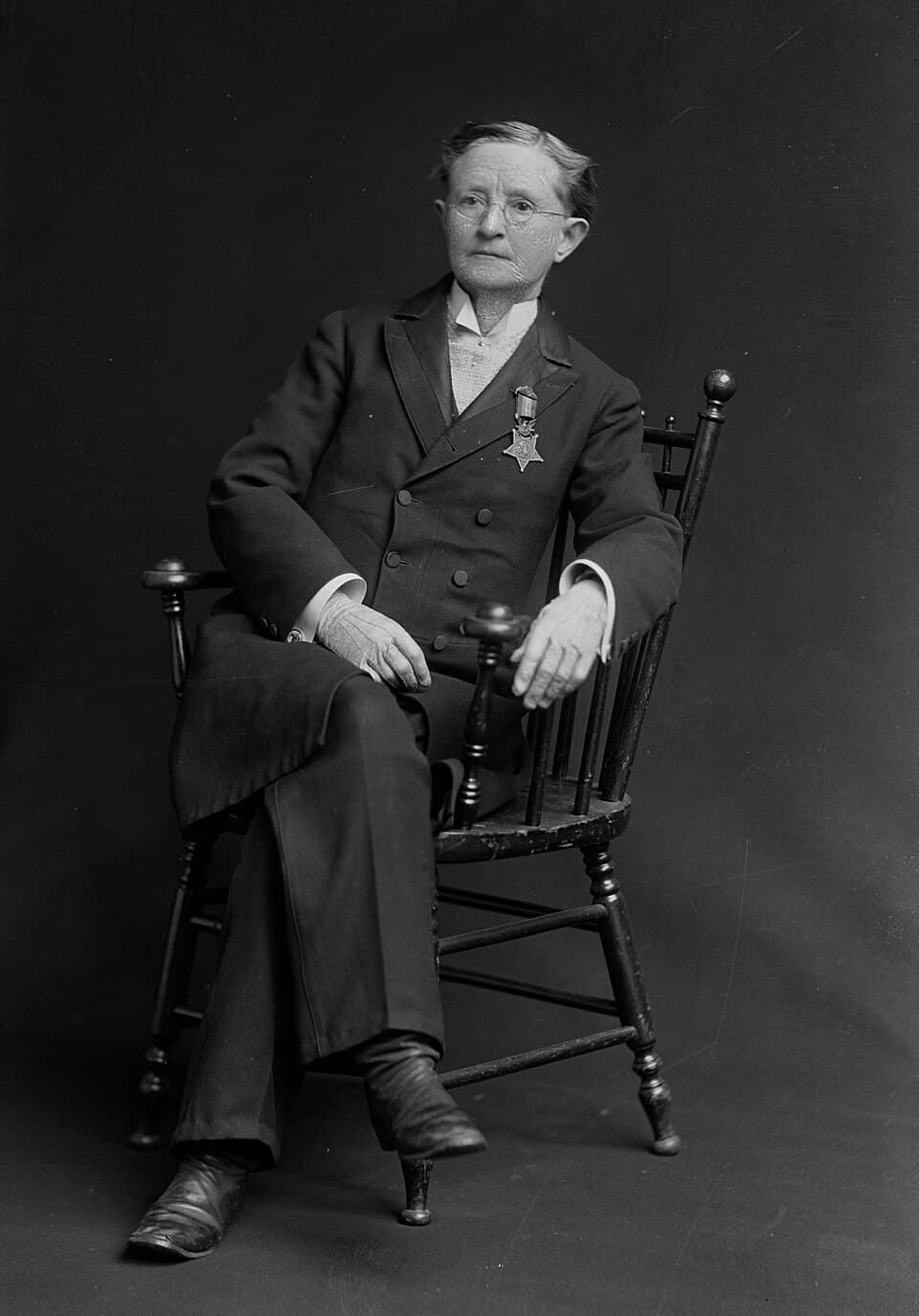
American · Medicine · Activism
Mary Edwards Walker
November 26, 1832 – February 21, 1919
Early Life and Background
Mary Edwards Walker was born on November 26, 1832, in the town of Oswego, New York.[1][4][9] She was the youngest of six children and the fifth daughter of Alvah Walker, a carpenter and farmer, and Vesta Whitcomb Walker, both committed abolitionists and reformers.[2][3][4][9] The Walker family farm operated within a culture of radical equality: Alvah and Vesta divided labor without regard to gender, encouraged all their children to wear practical clothing, and insisted that their daughters receive the same education as their son.[3][4][5][9]
The Walkers’ home participated in the Underground Railroad, sheltering freedom seekers fleeing slavery.[3][4] This antislavery activism immersed Mary from childhood in the politics of human rights and civil disobedience. Her parents also rejected restrictive women’s fashions, encouraging loose, comfortable dress that would later influence Mary’s own adoption of reform clothing.[3][5]
Walker attended local common schools until about 1850, then enrolled at Falley Seminary in Fulton, New York, for two terms, where she studied literature and science.[9] Exposure to seminary education strengthened her interest in intellectual work and prepared her for further study in medicine. She assisted with farm chores and briefly worked as a teacher, but she aspired to a profession that few women could then enter: surgery.[5][9]
Medical Education and Early Career
In the early 1850s, Walker decided to pursue a medical degree, inspired in part by reform literature and by the example of Elizabeth Blackwell, the first woman to earn an M.D. in the United States.[5][9] She enrolled at Syracuse Medical College, an eclectic institution that admitted a small number of women.[5][7][9] The curriculum included anatomy, physiology, surgery, and therapeutic approaches beyond orthodox medicine.[5]
Walker completed the full course of study and in 1855 received her Doctor of Medicine degree, becoming one of the earliest formally trained woman physicians in the country.[1][5][7][9] A contemporary college catalog confirms her graduation after a standard three‑term sequence.[5] On December 19, 1855, she was awarded her M.D., an achievement that placed her in the very small cohort of women with full professional medical credentials.[1][5]
Shortly after graduating, Walker married fellow physician Albert MillerRome, New York, where they hoped to attract patients interested in eclectic medicine.[1][5][9] Walker chose to retain her maiden name and to wear practical, relatively short skirts with trousers underneath, both unusual decisions for a married woman in the 1850s.[2][5][9] The practice struggled, in part because many patients refused to be treated by a woman doctor and because of suspicion toward eclectic therapies.[5][9]
The marriage was troubled. Walker later alleged Miller’s infidelity and objected to legal doctrines that gave husbands control over wives’ property and earnings.[1][2][9] The couple separated after a few years, and Walker eventually sought divorce or legal dissolution, becoming a critic of restrictive marriage laws. Her early experiences as a married female physician shaped her later advocacy for women’s property rights and more equitable divorce statutes.[2][8][9]
Entry into Civil War Service
When the American Civil War broke out in 1861, Walker saw an opportunity both to serve the Union cause and to practice surgery at a higher level.[1][2][3][5] She traveled to Washington, D.C. and applied to the U.S. Army for a position as a commissioned surgeon. Army officials rejected her application, insisting that women could serve only as nurses.[2][3][5]
Refusing to accept a nursing role, Walker volunteered her services instead. She worked without pay as a surgeon at makeshift hospitals in Washington, including a facility in the U.S. Patent Office converted to treat wounded soldiers.[1][2][3][6] She also helped organize a Women’s Relief Organization to assist families visiting sick and injured servicemen.[6]
In 1862, Walker moved closer to the front, providing care near Fredericksburg, Virginia, and later around Chattanooga, Tennessee, where battles produced heavy casualties.[1][3][6] Although unpaid and unofficial, she functioned essentially as a field surgeon, performing operations and treating trauma injuries. Her presence challenged both military hierarchy and gender norms, as surgeons were expected to be male, commissioned officers.[2][3]
First Female U.S. Army Surgeon
After nearly two years of lobbying the War Department and senior officers, Walker achieved a breakthrough in 1863. On September 21, 1863, she signed a contract with the U.S. Army as a "Contract Acting Assistant Surgeon (civilian)" and was attached to the 52nd Ohio Infantry in the Army of the Cumberland.[3][6][8] This appointment made her the first female surgeon in the U.S. Army.[1][3][6][8]
Walker served in and around Chattanooga, Tennessee, and other frontline areas, caring for wounded soldiers in field hospitals and makeshift facilities.[1][3][6] She often crossed lines to treat civilians and soldiers regardless of allegiance, driven by a belief that medical ethics transcended military boundaries.[6] Her colleagues’ reactions varied: some officers praised her dedication and skill, while others remained skeptical of a woman in a surgeon’s role.[2][3]
Capture and Prisoner of War Experience
Walker’s willingness to work in contested territory led to her capture. On April 10, 1864, while operating near the front in northern Georgia, she was seized by Confederate troops.[1][2] Accused of being a spy because she crossed enemy lines and wore unconventional clothing, she was taken to Richmond, Virginia and confined in the notorious Castle Thunder prison.[1][2][6]
Conditions in Castle Thunder were harsh, with overcrowding, poor sanitation, and limited medical care. Walker, herself a physician, endured these circumstances for about four months. She maintained her Union loyalty, refused to admit espionage, and continued to identify herself as a doctor.[2][6] Her incarceration highlighted the vulnerability of civilian medical personnel and the particular suspicion directed at women who transgressed expected roles.
On August 12, 1864, Walker was released in a prisoner exchange at Richmond, traded for a Confederate surgeon.[2][6][8] The exchange recognized her status as a medical officer of equivalent value to a male counterpart, despite her civilian contract. After her release, she returned to service, eventually becoming medical director of a women’s prison hospital in Louisville, Kentucky, and working with an orphan asylum in Clarksville, Tennessee.[6]
Medal of Honor and Recognition
Walker’s wartime service—volunteer work in Washington, field surgery near the front, cross‑line treatment of civilians, and imprisonment—drew the attention of military and political leaders. On November 11, 1865, President Andrew Johnson approved a Medal of Honor citation for her "meritorious service" during the war.[3][8] The citation emphasized her courage in remaining near the front, treating the wounded under dangerous conditions, and enduring captivity.
On January 25, 1866, Johnson formally presented the Medal of Honor to Walker at the White House.[3][4] With this presentation, she became the first and only woman ever to receive the United States Medal of Honor.[1][3][4][5][8] At the time, the award could be given for a broad range of distinguished service, and Walker’s recognition expanded the concept of valor to include non‑combat medical work.
The medal signaled an extraordinary, if singular, acknowledgment of women’s capacity for military heroism. Many other women served bravely as nurses, spies, or scouts during the Civil War, but none received comparable decorations.[2][3] Walker’s Medal of Honor thus stood as an exception to prevailing patterns of gendered recognition.
Postwar Career and Activism
After the war, Walker largely withdrew from regular medical practice and focused on writing, lecturing, and activism. She devoted herself to causes that included women’s suffrage, equal pay, improved medical care, and dress reform.[3][5][8] Drawing on her medical expertise, she argued that corsets and heavy, long skirts were unhealthy, restricting women’s movement and impairing circulation.[5][9]
In 1871, Walker published Hit: Essays on Women’s Rights in New York, a collection of her lectures and writings.[5][8] The book advocated women’s political rights, reform of marriage and divorce laws, and practical clothing. She argued that women should have equal control over property, custody of children, and the ability to leave abusive marriages, linking legal reform to broader social health.[5][8][9]
Walker became a familiar figure on the lecture circuit, traveling across the United States and abroad to speak about her war experiences and women’s rights.[3][8] She frequently wore what she termed "rational dress": knee‑length skirt or later trousers, a frock coat, and sometimes a top hat, clothing that many observers viewed as masculine.[5][9] Her attire challenged not only fashion norms but also legal and social rules about gender presentation.
Authorities in several cities arrested her for "impersonating a man" or for violating local dress ordinances, but she defended herself in court and often attracted press attention that amplified her message.[5][9] She framed dress reform as a health issue, arguing that women’s clothing should allow for exercise and professional work, and as a civil liberties issue, insisting on women’s right to choose their appearance.
Women’s Rights, Law, and Politics
Walker’s activism extended into legal and political debates. She supported universal suffrage, arguing that voting rights should not be restricted by sex, race, or property.[3][5][8] She was associated at times with both major suffrage organizations, though her emphasis on dress and marriage reform and her independent style sometimes placed her at the margins of mainstream leadership.[9]
She claimed the right to vote under existing constitutional provisions, interpreting the Fourteenth Amendment as already granting women citizenship sufficiently robust to include suffrage, an argument shared by some "New Departure" suffragists.[9] Although she was repeatedly turned away from the polls, her efforts contributed to legal debates over the interpretation of citizenship and voting rights.
Walker also advocated for women’s property rights and for reform of divorce laws, arguing that married women should be able to own and manage property, retain earnings, and escape harmful marriages without social stigma.[2][8][9] These positions reflected her own experience in an unhappy marriage and the broader realities faced by women who lacked legal autonomy.
Her activism intersected with other reform movements, including temperance and prohibition, and she supported efforts to restrict alcohol as part of a public health agenda.[1][9] She saw all these issues—suffrage, dress, marriage, temperance—as connected aspects of a larger struggle for women’s bodily, economic, and political freedom.
Later Life, Controversy, and Medal Rescission
In her later decades, Walker divided her time between Oswego and extensive travel for lectures and publicity. Despite age and declining health, she continued to appear in public in her characteristic clothing and with her Medal of Honor pinned prominently to her chest.[3][4][10] She followed developments in medicine and remained engaged with local and national suffrage campaigns.
In 1917, the U.S. Army undertook a thorough review of Medal of Honor awards, seeking to standardize criteria and reduce what officials saw as overly broad or improperly granted decorations.[1][6][10] A review board recommended rescinding 911 medals, including Walker’s, on the grounds that she had served as a civilian contract surgeon rather than as a member of the armed forces.[6][10]
On February 5, 1917, her medal was officially rescinded.[1][6] Walker refused to return the decoration and continued to wear it daily, declaring that her service and sacrifice justified the honor regardless of later bureaucratic reinterpretation.[6][10] The rescission provoked debate about the treatment of medical personnel and about whether civilian status should negate recognition of wartime valor.
Walker lived to see the early stages of renewed suffrage momentum. She did not witness the ratification of the Nineteenth Amendment in 1920, but her writings and public appearances contributed to the climate that made that victory possible.[2][3][9]
Death
On February 21, 1919, Mary Edwards Walker died of illness at her home in Oswego, New York, at the age of eighty‑six.[1][2][3][4] She was buried in the Oswego Rural Cemetery, reportedly wearing her Medal of Honor, which she had never surrendered despite its rescission.[4][10] Her death came two years before national women’s suffrage was realized, a reform she had championed for decades.
Local communities in upstate New York remembered her as a colorful and sometimes controversial figure: the "lady doctor" who had served in the war, dressed like a man, and continued to argue for women’s rights long after many of her contemporaries had retired from public life.[3][4][9]
Posthumous Restoration and Evolving Legacy
After Walker’s death, her family and supporters continued to press for restoration of her Medal of Honor. They argued that her civilian contract surgeon status did not diminish the dangers she faced or the importance of her service.[6][10] The case drew attention as women increasingly entered medical and military professions in the twentieth century.
In 1977, more than half a century after the rescission, the Army Board for Correction of Military Records reviewed Walker’s case and recommended that her medal be reinstated.[1][6][10] On June 10, 1977, President Jimmy Carter approved the recommendation and formally restored her Medal of Honor posthumously.[1][6][10] This decision confirmed her as a legitimate Medal of Honor recipient and the only woman ever to receive the decoration.[1][3][4]
Since the restoration, Walker has been commemorated in museums, historical markers, and educational materials. The National Park Service features her in Civil War and women’s history interpretation.[3][4][8] Military and women’s history organizations, such as the National Women’s History Museum and the Association of the U.S. Army, highlight her story as emblematic of women’s struggle for recognition in uniform.[2][6][11]
Major Works and Intellectual Contributions
Walker’s principal published work, Hit: Essays on Women’s Rights (1871), gathered lectures and essays on suffrage, property rights, marriage, and dress reform.[5][8] The book articulated a comprehensive feminist vision that combined legal, economic, and health perspectives. She later published another volume, sometimes referred to as Unmasked, although detailed bibliographic information is limited.[3][9]
In her writing, Walker linked women’s physical health to social and legal constraints, arguing that restrictive clothing and lack of economic independence damaged both individual bodies and the body politic.[5][9] She used medical reasoning to critique corsetry, long skirts, and fashion designed primarily for display rather than function, anticipating later feminist concerns with bodily autonomy.
Her speeches and essays also engaged with broader questions about citizenship and constitutional interpretation. She contended that women, as citizens, should enjoy the same rights as men, including voting and holding office, and she criticized legal doctrines that treated married women as dependents.[9]
Personal Life and Identity
Walker’s personal life was closely intertwined with her public persona. Her brief marriage to Albert Miller and subsequent separation informed her critique of traditional marriage.[1][2][9] She reportedly had no children.[9] She cultivated an identity that resisted conventional femininity, choosing functional clothing, professional work, and public speaking roles more commonly associated with men.
Contemporaries alternately admired and mocked her. Some saw her as eccentric or "mannish"; others lauded her courage and conviction.[5][9] Walker herself insisted that dress and demeanor were matters of health and practicality, not imitations of men. She understood her style as an assertion that women could claim the full rights and responsibilities of citizenship, including participation in war, politics, and professional life.
Legacy and Historical Impact
Mary Edwards Walker’s legacy spans medicine, military history, and women’s rights. As one of the earliest formally trained woman physicians in the United States and the first female U.S. Army surgeon, she helped demonstrate that women could meet the demands of professional medicine and battlefield surgery.[1][3][5][8]
Her Medal of Honor remains unique; she is still the only woman to have received it.[1][3][4][6] The medal, its rescission, and its eventual restoration exemplify both recognition and erasure of women’s achievements within male‑dominated institutions. Walker’s refusal to surrender the medal and her descendants’ successful campaign for reinstatement have become central narratives in discussions of how historical injustices can be challenged.
In women’s history, Walker is remembered as an unyielding advocate of suffrage, dress reform, and legal equality. Her book Hit and her lectures contributed to early feminist thought, particularly in linking health and bodily autonomy to political rights.[5][8][9] She also provided a model of professional independence for later generations of women physicians.
In cultural memory, Walker occupies a complex position. She was at times marginalized by mainstream suffrage leaders and criticized for her unconventional style, yet she has been embraced by later historians as a figure who tested the boundaries of gender roles more aggressively than many of her contemporaries.[2][9] Modern biographies and institutional profiles highlight her as a symbol of persistence in the face of institutional sexism.
Today, her life is taught in courses on Civil War history, women in medicine, and gender and law. Museums and historical sites feature her image and story, and the Medal of Honor Museum and related organizations use her example to illustrate that women "in uniform"—and in associated roles—have played crucial parts in securing freedoms.[6][10]
Assessment
Walker’s career was marked by contradictions. She never received a commissioned officer’s rank, yet she served as a surgeon in war zones. She was honored with the Medal of Honor, then stripped of it, then restored. She advocated equality but sometimes clashed with other reformers. These tensions make her a particularly revealing subject for understanding the complexities of women’s progress in the nineteenth and twentieth centuries.
Her story underscores how individual lives intersect with institutional change. By insisting on being treated as a physician, by serving near the front despite official resistance, by wearing her Medal of Honor even after its rescission, and by refusing to conform to restrictive dress codes, Mary Edwards Walker forged a path that would influence later generations of women seeking entry into medicine, the military, and law.
Dated achievements
11 indexed.
- Nov261832Medicine
Birth of Mary Edwards Walker
Born near Oswego, New York, to abolitionist parents.
View details NPS Mary Walker Biography - Dec191855Medicine
Graduation from Syracuse Medical College
Graduated with a medical degree from Syracuse Medical College.
View details