← All women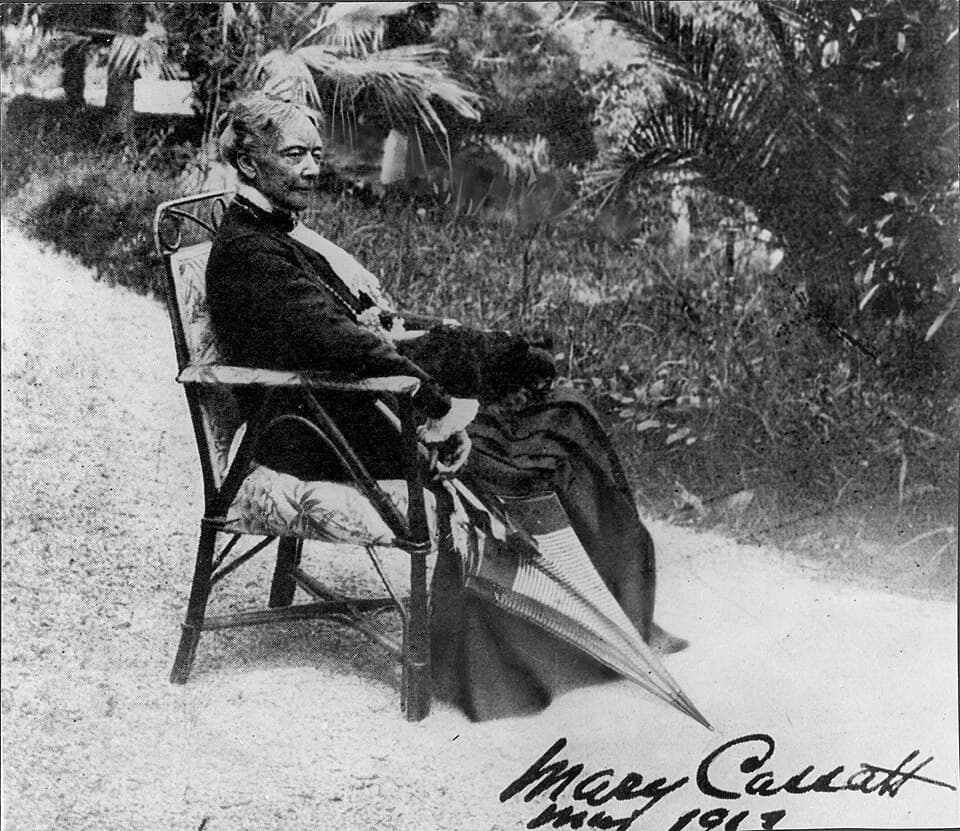
American · Arts
Mary Cassatt
May 22, 1844 – June 14, 1926
Early Life and Background
Mary Stevenson Cassatt was born on May 22, 1844, in Allegheny City, Pennsylvania, then a separate municipality and now part of Pittsburgh’s North Side.[2][3][7][17] She was the fourth of five children in a wealthy, socially prominent family. Her father, Robert Simpson Cassatt, was a successful stockbroker and banker, and her mother, Katherine Kelso Johnston Cassatt, came from a family with strong French heritage and cultural interests.[2][5][8][12] This comfortable, upper‑middle‑class background afforded Mary and her siblings the benefits of private education, travel, and exposure to the arts, but it also carried conservative expectations about a woman’s role.
In the 1850s, the Cassatt family spent extended periods in Europe, living in France and Germany so that the children could receive a cosmopolitan education and learn languages.[1][5][8] Mary visited museums such as the Louvre and absorbed European painting traditions at a young age. Her mother, who was well‑educated and valued culture, encouraged her interest in art.[5][8] These formative experiences convinced Cassatt that art was her vocation, despite prevailing social norms that regarded painting as a genteel hobby rather than a profession for women.
The family returned to the United States in the late 1850s, settling in Philadelphia.[5][8] Cassatt continued to draw and paint, showing considerable talent. At sixteen, she persuaded her parents to let her enroll at the Pennsylvania Academy of the Fine Arts, one of the few American institutions open to women students.[8][12][15] She began attending classes there in 1861
During the early 1860s, Cassatt became increasingly determined to pursue an independent professional path. The American art world was still relatively small, with limited opportunities for ambitious painters, and she felt that Europe offered more serious training and exposure.[2][5][8] In 1865, she traveled to Paris, embarking on what was initially a study trip but soon became the foundation of her career.[10] She remained in Europe for several years, studying in Paris, Rome, and Madrid.[10] Women were barred from enrolling in the prestigious École des Beaux‑Arts, so Cassatt sought instruction through private studios and master teachers. She studied with academic painters such as Jean‑Léon Gérôme, Charles Chaplin, and Thomas Couture, learning rigorous drawing techniques and the polished finish prized by the Salon.[3][15] She also copied Old Master paintings in the Louvre, a standard practice for aspiring artists.[3][7] This combination of academic training and museum study gave her a solid technical foundation. Cassatt’s first major professional breakthrough came in 1868, when her painting A Mandolin Player was accepted into the Paris Salon, the official exhibition of the Académie des Beaux‑Arts.[10] The Salon was the dominant arbiter of artistic success in France; acceptance conferred prestige and opened doors to patronage.[2] Cassatt, alongside fellow American Elizabeth Jane Gardner, became one of the first American women to exhibit there.[10] Her early Salon works were conventional in subject and style, reflecting the expectations of academic painting, but her Salon acceptance established her as a serious professional at a time when few women achieved such recognition. The outbreak of the Franco‑Prussian War in 1870 forced Cassatt to return to the United States.[2][5][7] Back in Pennsylvania, she faced difficulty selling her work and encountered limited support from local institutions.[5][7] At one point, she considered abandoning art altogether. However, a commission from the archbishop of Parma for a copy of a Correggio painting helped restore her confidence and finances.[5][7] Determined to succeed, she returned to Europe in the early 1870s, finally settling in Paris around 1874
Paris in the 1870s was a dynamic center of artistic experimentation, and Cassatt quickly engaged with progressive circles. She became friends with Edgar Degas, who reportedly first noticed her work in the Salon and was impressed by her skill.[3][10][17] Degas invited her to exhibit with the group of artists who would become known as the Impressionists, a groundbreaking movement that rejected academic conventions in favor of modern subjects, visible brushwork, and the study of light.[3][4] Cassatt formally joined the Impressionist circle in 1877, and she participated in their exhibitions, most notably the Fourth Impressionist Exhibition in 1879
Within the movement, Cassatt’s work distinguished itself through its focus on modern women and domestic life. While many Impressionists painted cafés, streets, and rural landscapes, Cassatt explored the intimate realms of middle‑class women—reading, sewing, bathing children, visiting theaters, and riding in carriages.[2][3][4] She rejected idealized or mythological subjects, instead depicting women as autonomous individuals engaged in everyday activities. Her compositions employed unusual viewpoints, cropped framing, and complex spatial structures, techniques influenced in part by Japanese woodblock prints, which she studied avidly after the landmark Japanese print exhibition in Paris in 1890.[3][7] Cassatt’s oeuvre includes numerous canonical works of Impressionism and modern printmaking. Among her best‑known paintings is The Child’s Bath (1893), which presents a mother and child viewed from above in a tender yet unsentimental moment of care.[2][3][7] The composition’s bold patterns, flattened space, and emphasis on touch exemplify Cassatt’s capacity to merge formal innovation with psychological depth. Another important work, Little Girl in a Blue Armchair (1878), depicts a child sprawled informally in a salon, challenging conventional, idealized portrayals of children.[3][7] Degas is believed to have advised on its composition, highlighting their artistic exchange. In the late 1880s and 1890s, Cassatt became a leading figure in color printmaking. Her series of color aquatints and etchings, such as The Fitting and The Bath, demonstrate a sophisticated fusion of Japanese aesthetics and Impressionist sensibility.[3][7] She experimented with aquatint, drypoint, and soft‑ground etching, achieving luminous tonal gradations and subtle textures. Scholars widely regard these prints as among the finest achievements in nineteenth‑century graphic art.[2][3] Cassatt’s subject matter consistently centered on women and children—not as sentimental emblems, but as complex individuals in modern domestic spaces. Works like Mother and Child variants, Young Mother Sewing, and Woman Holding a Fan portray quiet acts of care, concentration, and leisure.[2][3][4] She often emphasized the physical and emotional labor of motherhood, using intimate gestures and close framing to convey the bond between parent and child. Her art thus contributed to a redefinition of what constituted "serious" subject matter, elevating domestic life to the realm of high art. In addition to her paintings and prints, Cassatt created one notable large‑scale public commission: murals for the Women’s Building at the World’s Columbian Exposition in Chicago (1893).[2][5][7] Although the mural itself is now lost, contemporary accounts describe allegorical scenes celebrating the achievements of women, further evidence of Cassatt’s interest in women’s roles and aspirations. Her participation in this major international exposition underscored her stature as a leading woman artist. By the late nineteenth century, Cassatt enjoyed considerable success and recognition. She maintained a studio in Paris and exhibited regularly in French and international shows.[2][3] Her works were acquired by collectors in France, the United States, and elsewhere. Nonetheless, as a woman, she did not receive many of the formal honors routinely bestowed on male peers, such as official state commissions or positions in the École des Beaux‑Arts. One of Cassatt’s most significant contributions to art history came through her advisory work with American patrons. She cultivated relationships with wealthy collectors, including Louisine and Henry Havemeyer
Although formal awards for artists were less systematized than today, Cassatt’s contemporaries recognized her importance. Critics acknowledged her technical mastery, innovative compositions, and distinct approach to women’s subjects.[2][3][6] By the early twentieth century, she was widely regarded as one of the foremost Impressionist painters and "the most celebrated woman artist" of her time.[6] Retrospective exhibitions and scholarly studies in the decades after her death have further cemented her reputation. Cassatt’s personal life was marked by independence uncommon for women of her social class. She never married and had no children.[3][12][15] This choice allowed her to devote herself fully to her artistic career and to maintain control over her professional decisions. She lived primarily in Paris and later at her country estate, the Château de Beaufresne in Oise, France.[2][3][12] Her household often included members of her extended family, particularly her sister Lydia, who appeared frequently in Cassatt’s paintings before her death in 1882.[3][7] Cassatt’s social circle encompassed fellow artists, writers, and patrons. Her close relationship with Degas was both collegial and intellectually stimulating; they shared an interest in unconventional viewpoints, drawing, and printmaking.[3][10] However, Cassatt maintained her own artistic identity and did not simply adopt Degas’s style. She navigated the male‑dominated Parisian art world with determination, relying on her talent and professionalism rather than romance or scandal. Beyond her art, Cassatt supported women’s suffrage, particularly in the United States. In the early twentieth century, she lent her name and works to suffrage fundraising exhibitions and encouraged women to engage with public life.[4][7][14] Her advocacy was discreet compared with some activists, but it reflected her belief that women should have greater autonomy and political representation. In the first decade of the twentieth century, Cassatt continued to paint and exhibit, though she faced mounting health challenges. Around 1910–1915, her eyesight began to deterior severely, likely due to diabetes or related complications.[3][5][7][17] By 1915, she was effectively unable to paint, bringing an end to her active artistic production.[3][5][7] This loss was profoundly difficult for an artist whose identity and livelihood were bound to visual perception. Despite her declining vision, Cassatt remained engaged with the art world as much as possible. She continued to correspond with patrons and friends and to influence collecting, albeit less directly than before.[4][7] She spent most of her remaining years at Beaufresne, living quietly in the French countryside.[2][3][12] The upheavals of World War I, including shortages and political tensions, added strain to her final years. Cassatt died on June 14, 1926, at Château de Beaufresne, near Paris.[2][3][12][16] She was 82 years old. While some sources identify the nearby village of Mesnil‑Théribus as her place of death, others simply refer to Beaufresne in Oise; all agree on the date.[2][3][12][16] She was buried in France, the country that had become her home and the center of her artistic life. Mary Cassatt occupies a central place in the history of nineteenth‑century art. As an American woman who became a core member of the French Impressionist movement, she challenged national and gender boundaries in art.[2][3][4] Her work expanded the movement’s thematic range, focusing on women and children in domestic and semi‑public spaces rather than the cafés, boulevards, and landscapes favored by many of her male colleagues. Cassatt’s images of motherhood and childhood are notable for their balance of tenderness and realism. She avoided sentimentality, emphasizing the physicality of care and the individuality of both mother and child.[2][3][4] In doing so, she offered one of the most sustained explorations of women’s everyday experiences in modern painting. Her art has been interpreted by scholars as a visual counterpart to contemporaneous feminist thought, even though she rarely made explicit political statements in her work. From a formal standpoint, Cassatt was an innovator in composition and printmaking. Her adoption of Japanese print aesthetics—flattened space, bold patterns, and asymmetrical framing—helped introduce new visual strategies into Western art.[3][7] Her color aquatints are widely regarded as masterpieces of graphic art, influencing subsequent generations of printmakers. Institutionally, Cassatt played a decisive role in shaping American museum collections through her advice to patrons and collectors.[1][4][7] Without her guidance, many key Impressionist works might not have entered U.S. public collections as early or in such depth. The National Museum of Women in the Arts, the Smithsonian American Art Museum, the Metropolitan Museum of Art, and other institutions now hold significant examples of her work, underscoring her enduring presence in major art narratives.[1][4][8] Cassatt’s legacy also resonates within women’s history. She demonstrated that a woman could build an international career in fine art, achieve recognition among avant‑garde peers, and influence institutional structures. The National Museum of Women in the Arts and the Smithsonian’s women’s history initiatives highlight Cassatt as an artist who "gave women a place in the Impressionist movement" and advocated for their visibility in culture.[4][8] Her life and work continue to inspire artists, historians, and activists interested in gender, representation, and the arts. Modern scholarship and exhibitions have further illuminated Cassatt’s contributions, situating her as both a major Impressionist and a crucial figure in the broader story of women in art. Her paintings and prints remain widely reproduced and studied, and she is regularly featured in educational materials, documentaries, and children’s books that introduce audiences to women artists of the past.[6][11][14] Through this ongoing recognition, Mary Cassatt’s influence extends far beyond her own era, shaping how we understand both Impressionism and the possibilities of women’s creative work.Artistic Training and Early Career
Association with the Impressionists
Major Works and Artistic Innovations
Patronage, Advisory Work, and Recognition
Personal Life
Later Life and Declining Health
Legacy and Historical Impact
Dated achievements
3 indexed.
- May221844Arts
Birth of Mary Cassatt
Mary Stevenson Cassatt is born in Allegheny City, Pennsylvania, now part of Pittsburgh, U.S.
View details Mary Cassatt - Britannica - May011868Arts
First acceptance in the Paris Salon
First exhibition at Paris Salon in 1868, marking Cassatt as one of the first American women at the Salon.