← All women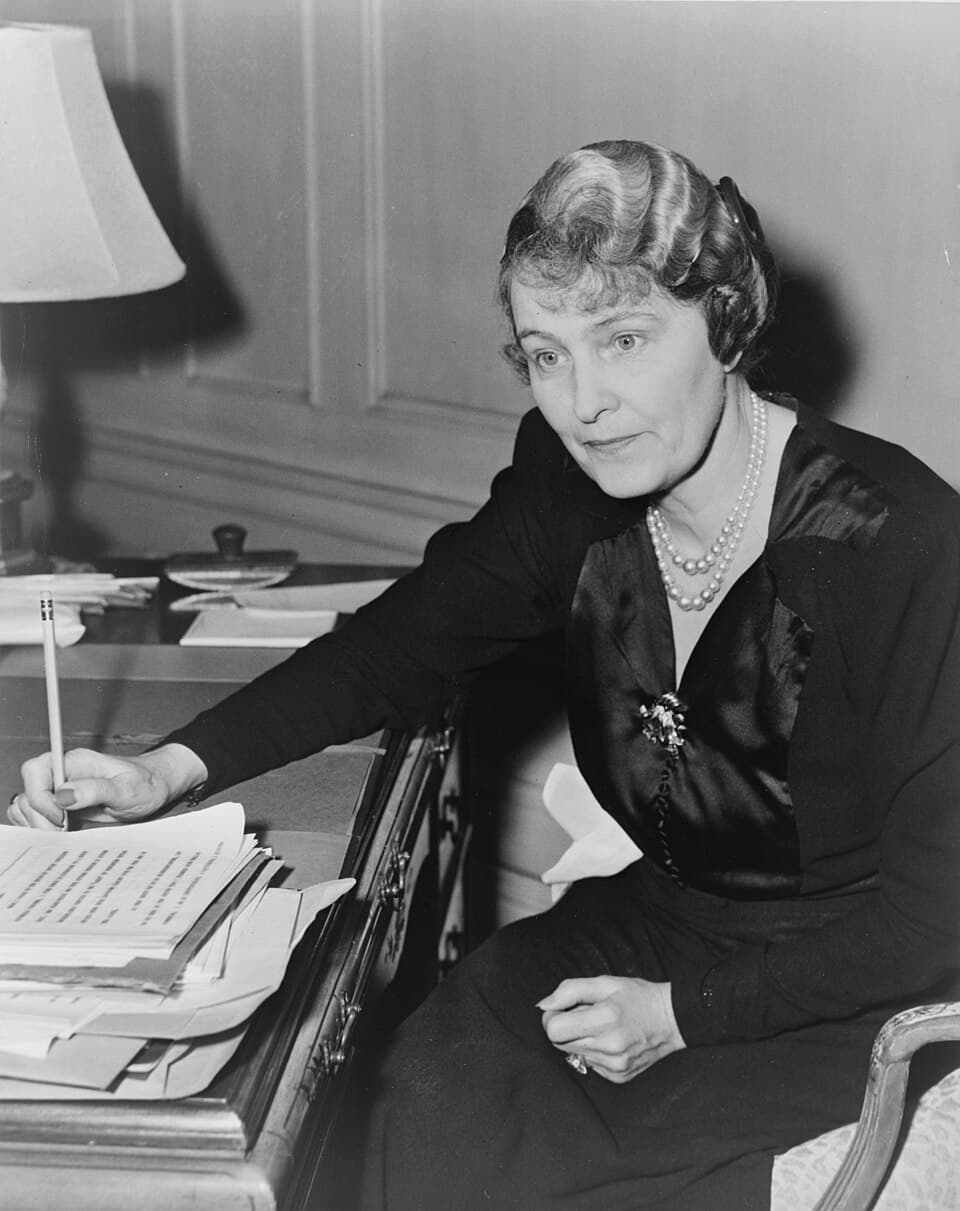
American · Politics
Marjorie Merriweather Post
March 15, 1887 – September 12, 1973
Early Life and Background
Marjorie Merriweather Post was born on March 15, 1887, in Springfield, Illinois, the only child of breakfast‑cereal entrepreneur Charles William (C. W.) Post and Ella Letitia Merriweather Post.[4][1][18] Her father, who struggled with ill health, became interested in dietary reform and founded the Postum Cereal Company in the 1890s, launching products such as Postum, Grape‑Nuts, and Post Toasties.[2][12][18] The family later moved to Battle Creek, Michigan, a center for health resorts and food experimentation, where C. W. Post’s business flourished.[2][18]
In 1891, the Post family relocated to Washington, D.C., where Marjorie grew up amid both the city’s political milieu and her father’s growing corporate ambitions.[2][20] She attended Mount Vernon Seminary, a prominent finishing school for young women, graduating in 1905.[2][20] Her education combined conventional training in social graces with exposure to modern languages and cultural studies, equipping her for a life that would span business management, international travel, and high‑profile entertaining.
From an early age, Marjorie observed her father’s methods: attention to marketing, brand loyalty, and the promise of healthful convenience. Biographers note that she would sit in on business discussions and absorb details of production and advertising, experiences that later informed her own approach to corporate expansion.[2][9][18] Her upbringing thus blended privileged social positioning with practical exposure to industrial enterprise, making her unusually prepared—though not formally trained—for corporate leadership in an era when women were rarely expected to work outside the home.
Career Beginnings and Assumption of Leadership
In 1905, the same year she graduated from Mount Vernon Seminary, Marjorie married Edward Bennett Close, a New York lawyer and real estate developer.[2][18] They had two daughters, Adelaide and Eleanor, but the marriage eventually ended in divorce.[4][18] Despite the conventional expectations of marriage and motherhood, Marjorie continued to follow developments in her father’s company, which was rapidly becoming a national brand.
Her life changed dramatically on May 9, 1914, when C. W. Post died, reportedly by suicide, after recurring health and financial concerns.[4][2][14] At age twenty‑seven, Marjorie inherited approximately $27 million and sole ownership and control of the Postum Cereal Company.[2][12][18] Contemporary accounts identified her as the wealthiest woman in the United States, and she became one of the country’s first highly visible female corporate leaders.[2][4][12] Rather than delegate authority, Post immersed herself in the firm’s affairs, working closely with managers, traveling to plants, and involving herself in decisions about product lines and advertising campaigns.[2][14][18]
In 1920, she married investment banker Edward Francis (E. F.) Hutton, whose financial expertise would significantly shape the company’s trajectory.[4][12][18] Through Hutton, Post gained greater familiarity with capital markets and large‑scale mergers, strengthening her conviction that the future of the food industry lay in diversified product offerings and nationwide distribution. Her personal partnership with Hutton was thus intertwined with a professional alliance that proved central to the creation of a modern food conglomerate.[4][12][18]
Expansion of Postum and Creation of General Foods
Under Marjorie Merriweather Post’s leadership, the Postum Cereal Company embarked on a program of aggressive expansion during the 1920s.[2][12][18] In 1922, the firm went public and reorganized its corporate structure, a step that gave it access to additional capital and facilitated major acquisitions.[2][12] On October 24, 1922, a shareholders’ meeting formalized the completed going‑public process, marking Postum’s transition to a widely held corporation and solidifying Post’s status as a woman actively steering a major public company.[2][12]
Throughout the decade, Postum acquired several prominent brands. These included Jell‑O, Maxwell House coffee, Sanka, and later the pioneering Birds Eye frozen foods business.[2][12][18] Post recognized that the American market was shifting toward convenience foods and was quick to embrace technologies and products that reduced time in the kitchen while standardizing quality. Her role was not merely ceremonial: she was widely reported to take a hands‑on interest in factory operations, packaging design, and advertising campaigns, often personally sampling products and critiquing marketing approaches.[2][9][18]
As the portfolio diversified, Post and her advisors concluded that the company’s identity needed to reflect more than cereal. On January 8, 1929, Postum filed corporate actions to change its name to General Foods Corporation, formalizing a new brand that conveyed the breadth of its offerings.[12][4] Under the General Foods banner, the firm became one of the largest food corporations in the United States, occupying a central place in mid‑twentieth‑century American kitchens through its packaged, branded, and increasingly frozen products.[4][18]
Post’s corporate leadership was particularly notable because she operated at a time when women were rarely present in executive suites, let alone at the helm of major industrial firms. She defied prevailing gender norms, using social acumen and business instinct to guide General Foods’ expansion. She remained a key figure in the company through the 1950s, eventually serving as director emerita and continuing to influence its philanthropic and cultural activities even after stepping back from day‑to‑day management.[15][18]
Major Properties, Collecting, and Cultural Patronage
Marjorie Merriweather Post’s wealth enabled her to construct and maintain several notable estates that functioned as sites of hospitality, diplomacy, and cultural display. Her most famous property, Mar‑a‑Lago, in Palm Beach, Florida, was completed by early 1927 and is often dated to January 1, 1927 as the point of practical completion.[4][7] Designed by architect Marion Sims Wyeth with interiors by Joseph Urban, the 118‑room mansion was conceived as both a luxurious winter residence and a potential winter presidential retreat.[4][7] Post filled Mar‑a‑Lago with decorative arts and used it to host elaborate gatherings that blended social spectacle with fundraising and informal diplomacy.
She also developed Camp Topridge in the Adirondack Mountains of New York, a rustic yet lavish compound of buildings that served as a retreat and venue for outdoor entertaining.[4][18] Later, in 1951, she purchased Hillwood, an estate in northwest Washington, D.C., which she extensively renovated with the explicit intention that it become a museum after her death.[18][20] Hillwood was designed to house her growing collections of Russian imperial art, including icons, gold and silver pieces, and objects associated with the Romanov court, as well as eighteenth‑century French decorative arts.[3][18]
Post’s passion for Russian art intensified in the 1930s, when she was married to Joseph E. Davies, who served as U.S. ambassador to the Soviet Union.[4][18] While living in Moscow and traveling throughout the country, she acquired numerous items from Soviet state sales of former imperial treasures. Her collecting during this period has drawn scrutiny because it was intertwined with the Soviet government’s liquidation of royal holdings; nonetheless, the resulting collection is now recognized as one of the most important assemblages of Russian decorative art outside Russia.[3][18]
Hillwood became the focal point of her cultural patronage. In 1968, Post finalized plans to bequeath the estate to the public, establishing Hillwood Estate, Museum & Gardens as a museum dedicated to her collections and to the study of Russian and French decorative arts.[18][20] Her foresight in planning for the institution’s future—through endowment, documentation, and professional curatorial practices—ensured that Hillwood would continue to serve scholars and visitors long after her death.
Humanitarian Work, Diplomacy, and Public Service
Alongside her corporate and cultural activities, Marjorie Merriweather Post was deeply involved in philanthropy and humanitarian work. She was a longtime supporter of the American Red Cross and the Salvation Army, contributing both funds and personal time to relief efforts.[4][2][18] Her philanthropy extended to youth organizations such as the Boy Scouts of America, as well as to cultural bodies including the National Symphony Orchestra and the institution that would become the John F. Kennedy Center for the Performing Arts.[7][18]
In the realm of international affairs, Post played a distinctive quasi‑diplomatic role connected to her experiences in the Soviet Union and her collection of Russian art. On December 27, 1935, she was appointed honorary vice president of Russian War Relief, a key American organization providing aid to the Soviet Union.[14] This position launched her most visible phase of humanitarian engagement with Russia. Working alongside diplomats and other philanthropists, she helped coordinate fundraising, material support, and public campaigns that underscored the shared sacrifices of Allied nations during World War II.[14]
Her social gatherings and art patronage also served diplomatic purposes. As the wife of Ambassador Joseph Davies, Post hosted events that brought together Soviet officials, foreign diplomats, and American visitors, using hospitality to soften tensions and promote cultural exchange.[14][18] The National Museum of American Diplomacy has since highlighted her as a figure whose unofficial diplomatic activities, conducted through relief organizations and cultural patronage, contributed to the broader tapestry of U.S.–Soviet relations.[14]
Awards, Honors, and Recognition
Although many of Marjorie Merriweather Post’s recognitions were informal—press coverage, social acclaim, and institutional gratitude—she also received formal honors. She was widely described in the mid‑twentieth century press as one of the wealthiest women in the United States, a status that, while not an official award, signified her unusual prominence in the economic sphere.[4][2][6] Her philanthropy brought her public acknowledgment from organizations such as the American Red Cross and the Salvation Army, which credited her with major contributions to relief and social welfare.[4][2]
A significant institutional honor came on March 14, 1969, when the National Portrait Gallery of the Smithsonian acquired a portrait of Post painted by Douglas Chandor.[19] Inclusion in the Portrait Gallery marked her as a figure of national historical significance, on par with political leaders, industrialists, and cultural icons. The portrait, created late in her life, emphasizes her poise and reflects how contemporaries viewed her—as a sophisticated, powerful woman whose influence extended across business, philanthropy, and the arts.
At General Foods, Post’s long service culminated in her status as director emerita, an honorary position recognizing her foundational role in the company’s growth and her ongoing advisory contributions.[15] This title symbolized the respect accorded to her by corporate peers and underscored the rarity of a woman holding such standing in a major U.S. corporation during the mid‑twentieth century.
Personal Life and Relationships
Marjorie Merriweather Post’s personal life involved four marriages, all to prominent men, reflecting the intersection of social, business, and political worlds in which she moved. Her first marriage, to Edward Bennett Close in 1905, produced two daughters, Adelaide and Eleanor.[4][18] After their divorce, she married E. F. Hutton in 1920, aligning herself with one of Wall Street’s most influential figures.[4][12] This union blended personal companionship with business collaboration, as Hutton’s financial expertise supported Post’s corporate strategies.
With Hutton, she had a third daughter, Nedenia Marjorie Hutton, later known professionally as Dina Merrill, an actress and socialite who maintained strong ties to Hillwood and the Post legacy.[4][18] Marjorie’s third marriage was to Joseph E. Davies, a lawyer and diplomat who served as U.S. ambassador to the Soviet Union in the late 1930s.[4][18] This relationship deepened her involvement in international affairs and facilitated her acquisition of Russian art.
Her fourth marriage was to Herbert A. May, a Pittsburgh businessman associated with the steel and utilities industries.[17][4] Each marriage eventually ended in divorce, a fact that drew public attention in an era when divorce among social elites was widely reported but still stigmatized. Despite these personal upheavals, Post maintained strong relationships with her daughters and used her homes to create a sense of continuity for family and friends.
Socially, she was renowned for her hospitality. At Mar‑a‑Lago, Camp Topridge, and Hillwood, she hosted guests ranging from political leaders to artists and military officers. Her entertaining was not merely ostentatious; it often served charitable purposes, with events doubling as fundraisers or opportunities to build support for causes she championed.[2][7][18]
Later Life, Retirement, and Death
By the 1950s, Marjorie Merriweather Post had spent decades at the forefront of American business and philanthropy. In 1958, she retired from active leadership at General Foods, though she continued to serve as a symbolic and advisory presence through her role as director emerita.[15][18] Her focus increasingly shifted to cultural patronage, estate planning, and the curation of her collections at Hillwood.
During these later years, Post carefully organized her assets to ensure that Hillwood would become a public institution. By 1968, she had finalized plans to bequeath the estate, establishing Hillwood Estate, Museum & Gardens as a museum dedicated to her Russian and French decorative arts, her memorabilia, and the preservation of her gardens.[18][20] She collaborated with curators and museum professionals to catalog objects, design displays, and guarantee that the property would be viable as a cultural institution.
On September 12, 1973, Post died at Hillwood in Washington, D.C., aged eighty‑six.[4][1][18] Obituaries noted her dual identity as a pioneering businesswoman and a major philanthropist whose fortune had supported charitable organizations, educational institutions, and the arts.[19] In death, as in life, she occupied a unique place in American consciousness: an heiress who had not merely enjoyed wealth but had actively shaped industries and cultural landscapes.
Legacy and Historical Impact
Marjorie Merriweather Post’s legacy spans multiple domains: business, philanthropy, art collecting, and women’s history. In business, she is remembered as a pioneer female executive who transformed her father’s cereal company into General Foods Corporation, a diversified food conglomerate that helped popularize convenience and frozen foods in the twentieth century.[2][4][12][18] Her embrace of national advertising, brand diversification, and industrial innovation influenced the way Americans eat and the structure of the modern packaged‑foods industry.
In philanthropy, Post used her fortune to support humanitarian organizations such as the Red Cross and Salvation Army, youth programs like the Boy Scouts, and major cultural institutions including the National Symphony Orchestra and the future Kennedy Center.[4][2][7][18] Her work with Russian War Relief and her diplomatic hospitality during the Davies ambassadorship illustrated how private citizens—especially wealthy women—could make meaningful contributions to international relations outside formal government roles.[14]
Her legacy as a collector and cultural patron is embodied most tangibly in Hillwood Estate, Museum & Gardens. The museum preserves her collections of Russian imperial and French decorative art, providing scholars with access to objects that illustrate the tastes and political realities of the nineteenth and early twentieth centuries.[3][18] Hillwood also preserves her domestic interiors and gardens, offering insights into elite American lifestyles and the role of women in shaping cultural consumption.
From the perspective of women’s history, Post’s life challenges simplistic narratives of heiresses as passive beneficiaries. She actively engaged in corporate management, navigated financial markets, and participated in decisions about mergers and branding at a time when women were largely excluded from such activities.[2][12][18] Her highly public role as a wealthy woman executive made visible the possibility of female leadership in industry, even though broader structural changes for women in the workforce would unfold more slowly.
Modern biographers and historians, including works such as American Empress: The Life and Times of Marjorie Merriweather Post, have emphasized the complexity of her character: ambitious yet philanthropic, devoted to luxury yet mindful of public benefit.[9][13][20] Her estates and collections continue to inspire discussion about the intersections of wealth, art, and responsibility. In the twenty‑first century, as Mar‑a‑Lago has taken on new political symbolism, renewed attention has turned to Post as its original creator—highlighting how her vision for that property differed from its later uses and underscoring her own role in imagining ways that private spaces might serve national purposes.[4][7]
Overall, Marjorie Merriweather Post stands as a key figure in the history of American business and philanthropy, and a central subject for scholars of women’s economic and cultural power in the twentieth century.
Dated achievements
8 indexed.
- Mar151887Politics
Birth in Springfield, Illinois
Marjorie Merriweather Post is born in Springfield, Illinois, to Ella Merriweather and Charles William Post.
View details Library of Congress - This Month in Business History - May091914Politics
Inherits Postum Cereal Company
Following her father's death, Marjorie assumes control of Postum Cereal Company, becoming a leading woman business executive.