← All women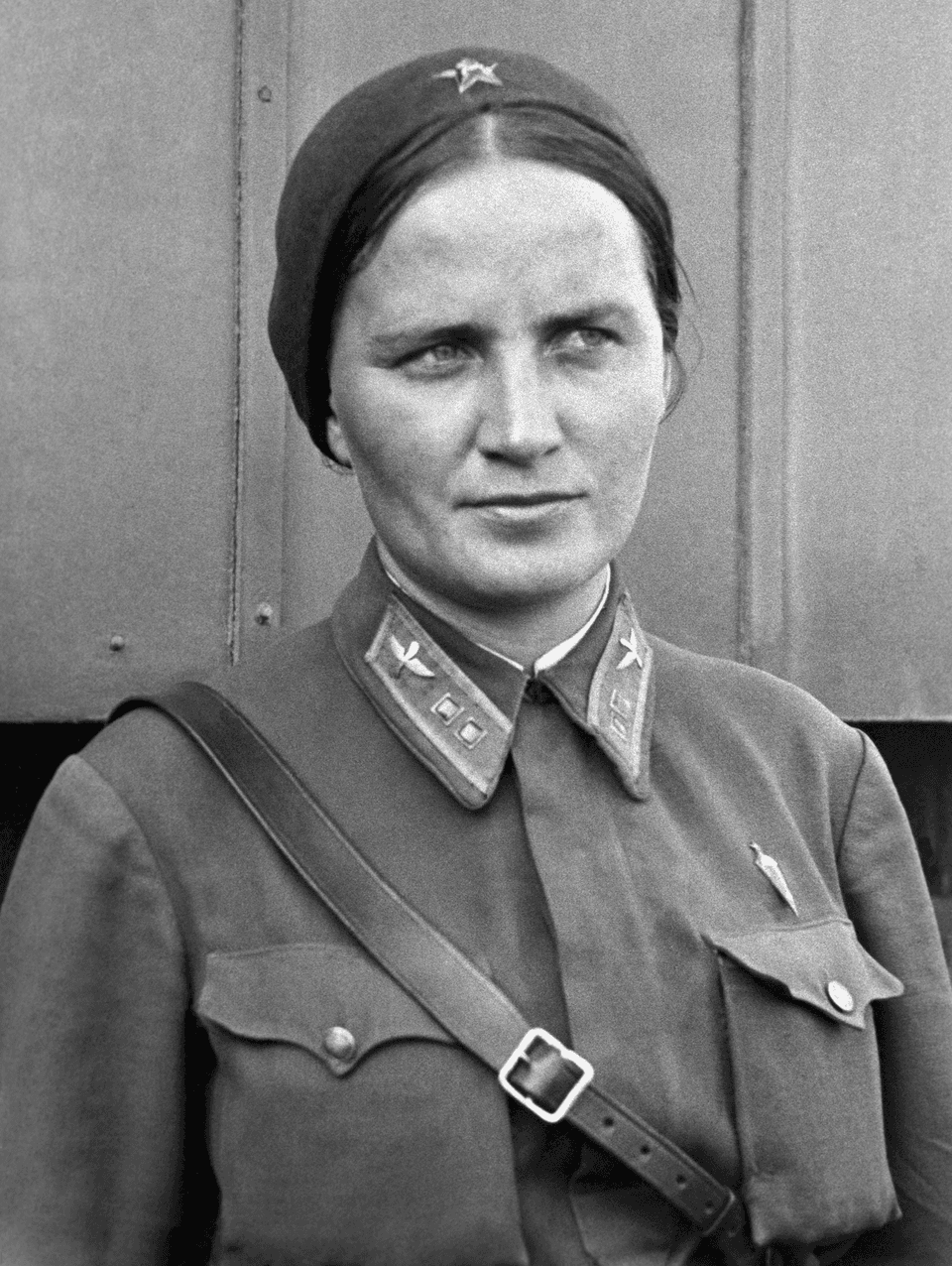
Soviet · Aviation · Exploration
Marina Raskova
March 28, 1912 – January 4, 1943
Early Life and Background
Marina Mikhaylovna Raskova (née Malinina) was born on 28 March 1912 in Moscow, then part of the Russian Empire.[1][5][6][12][18] She was the daughter of schoolteachers, growing up in a middle-class, educated household that valued learning.[18] Her childhood coincided with the upheavals of the Russian Revolution and Civil War, which reshaped the political and social context in which she would later build her career.
From an early age, Raskova showed artistic talent and initially pursued a musical path. She studied at the Moscow Conservatory with the ambition of becoming an opera singer.[6][10][18] However, ear problems—often described as chronic issues affecting her hearing—forced her to abandon this dream. This setback pushed her toward a different professional trajectory, ultimately bringing her into technical work and aviation.[6][18]
After leaving the Conservatory, she trained as a laboratory assistant and worked in a chemical factory in Moscow.[6][10][18] This experience introduced her to scientific and technical environments and helped prepare her for later work in aeronautical navigation, which demanded mathematical precision and familiarity with instruments and physical principles.
Transition to Aviation and Career Beginnings
Raskova’s entry into aviation came through education. In 1932 she enrolled at the Zhukovsky Air Force Academy, one of the Soviet Union’s leading institutions for military aviation training.[10][18] There she studied air navigation, a demanding discipline requiring mastery of meteorology, aerial cartography, and the use of navigational instruments. Her choice itself was notable: few women pursued such highly technical military specialties in the early 1930s.
By 1933, Raskova had completed her training and became the first woman in the Soviet Union to qualify as a professional air navigator and the first woman navigator in the Soviet Air Force.[1][6][9][10][18] This milestone placed her among the pioneers of women’s participation in Soviet military aviation. Sources emphasize that she achieved a formal navigator’s diploma, a credential that allowed her to serve in frontline aviation units rather than in auxiliary roles.[1][6]
Raskova quickly gained a reputation for technical skill and reliability. Beyond flight duties, she soon began teaching navigation, and in 1934 she became the first woman instructor at the Zhukovsky Air Academy.[6][10][18] Instructing male and female trainees in a high-status military institution further challenged prevailing gender norms and extended her influence over the next generation of Soviet aviators.
Record-Setting Flights and Professional Recognition
During the mid-1930s, long-distance and record-setting flights became a key arena for Soviet technological prestige. Raskova’s skill as a navigator brought her into this world. In 1938, she joined pilots Valentina Grizodubova and Polina Osipenko in a non-stop flight from Moscow to the Soviet Far East, near the Sea of Okhotsk.[1][5][12][18] The aircraft, a modified ANT-37 named Rodina ("Motherland"), flew 3,717 miles (approximately 5,947 kilometers) and set a women’s long-distance world record.[1][18]
During the flight, poor weather and fuel limitations forced a dramatic conclusion. To reduce weight and save the aircraft, Raskova parachuted out over the remote Siberian taiga before the pilots made an emergency landing.[1][12][18] She then survived for around ten days alone in the forest, subsisting with limited supplies until a search party found her.[12][18] The episode became part of Soviet heroic lore, emphasizing her courage, endurance, and navigational skill under extreme conditions.
The flight and its successful record brought Raskova national fame. In 1938 she, Grizodubova, and Osipenko were awarded the title Hero of the Soviet Union, the country’s highest honor.[1][5][6][11][12] They were among the first women to receive this distinction, and they were the only members of the Soviet armed forces to be granted the award before the outbreak of World War II.[11] Raskova also received two Orders of Lenin in recognition of her achievements.[18] These awards solidified her standing as a symbol of Soviet modernity and women’s capabilities in advanced technological fields.
Her professional presence extended beyond flight and military circles. In 1939 she authored Notes of a Navigator (Zapiski shturmana), reflecting her practical experience and offering insights into the art and science of air navigation.[18] This work contributed to her reputation as both a practitioner and a thinker in aviation, and its publication helped disseminate best practices in navigation to Soviet air crews.
World War II: Organizing Women’s Aviation Regiments
The German invasion of the Soviet Union in June 1941 radically transformed Raskova’s role. With her established fame and personal connections, she was well-placed to advocate for women’s involvement in combat aviation. According to multiple accounts, she used her influence and her rapport with Soviet leader Joseph Stalin to press for the creation of women’s air units.[1][5][8][11][18]
In 1941–1942, the Soviet high command authorized the formation of three women’s aviation regiments, and Raskova played a central role in organizing and training them.[1][5][8][10][11][16] These were:
- the 586th Fighter Aviation Regiment, equipped with Yakovlev fighters;
- the 587th Bomber Aviation Regiment, later redesignated the 125th Guards Bomber Regiment; and
- the 588th Night Bomber Regiment, later the 46th Guards Night Bomber Regiment, which became famous as the "Night Witches".
These units were initially staffed entirely by women pilots, navigators, ground crew, and support personnel, many of whom were young volunteers inspired by Raskova’s achievements.[1][5][7][8][10][13][16] She personally helped select candidates, drawing from civilian flying clubs and aviation schools, and oversaw intensive training programs to prepare them for front-line service.
The regiments went on to fly tens of thousands of combat sorties on the Eastern Front, conducting night harassment bombing, air defense, and ground-attack missions.[1][5][8][9][16] Their performance challenged deep-seated skepticism about women in combat roles and became a powerful example of wartime mobilization of women in the Soviet Union. Raskova herself served as a commander and staff officer, coordinating operations and continuing to advocate for her aviators’ recognition.
Awards, Honors, and Recognition
Raskova’s official honors reflected both her individual accomplishments and her symbolic significance. In addition to the Hero of the Soviet Union title awarded in 1938 for the Rodina flight, she received two Orders of Lenin, one of the highest orders of the Soviet state.[11][18] These decorations acknowledged her contributions to aviation technology, record-setting flights, and national prestige.
During the war, she was promoted to the rank of major in the Red Army Air Force.[1][5][12][18] After her death, she received the Order of the Patriotic War, 1st Class posthumously, recognizing her wartime leadership and sacrifice.[18] Her state funeral and interment in the Kremlin Wall Necropolis further underscored the regime’s view of her as a national heroine.
Beyond official Soviet honors, later historical and educational institutions have highlighted her legacy. She is frequently described as the "Russian Amelia Earhart" or a "Mother of Witches" in reference to the Night Witches regiment, framing her as a cultural icon of women’s aviation.[3][7][8][11][13] Modern museums and women’s history organizations feature her as a key figure in narratives about women in combat and in technical professions.[11][18]
Personal Life
While many accounts focus on Raskova’s professional achievements, sources also record elements of her personal life. She married engineer Pavel Raskov, from whom she took the surname by which she is historically known.[12][15][18] The couple eventually divorced, but her married name remained attached to her public and professional identity.[12][18]
Raskova had at least one child; Encyclopedia.com notes that she was "married with children," though detailed information on her family life is limited in standard biographical sources.[18] Her responsibilities as a mother coexisted with the demands of a high-profile aviation and military career, highlighting the often-overlooked domestic dimensions of women’s lives even when they occupy public and pioneering roles.
Accounts emphasize her charisma, pedagogical skill, and ability to inspire younger women. Trainees and fellow aviators later recalled her as a demanding but supportive leader who combined technical rigor with emotional encouragement, crucial in a context where women faced skepticism and increased scrutiny.[3][7][13][16]
Later Life, Death, and Funeral
By the early 1940s, Raskova was deeply involved in wartime aviation, both organizationally and operationally. She traveled frequently between front-line bases and rear-area training facilities, coordinating the deployment and support of the women’s regiments.[1][8][16] Her work placed her in dangerous conditions, including flights over contested territory and journeys in harsh weather.
On 4 January 1943, while on a mission near Saratov, the aircraft carrying Raskova crashed, killing her.[1][12][18] The circumstances are usually described simply as a crash during military operations rather than a combat dogfight. Her death shocked the regiments she had founded and the broader Soviet public, coming at a time when the Battle of Stalingrad and other critical operations underscored the war’s human cost.
The Soviet leadership accorded her a high honor in death. Raskova was buried in the Kremlin Wall in Red Square, Moscow, a resting place shared with leading political and military figures.[18] The funeral affirmed her status as a symbol of Soviet heroism, technological progress, and female participation in the war effort. Her early death at the age of thirty set a poignant tone for subsequent representations of her life.
Legacy and Historical Impact
Marina Raskova’s legacy operates on several levels: as a pioneering navigator, as a record-setting aviator, and as an organizer of women’s combat units. Her achievement in 1933 as the first woman professional air navigator in the Soviet Union opened a path for women into technical military specialties that had previously been closed.[1][6][9][10] This milestone is frequently cited in both Soviet-era and post-Soviet historiography as an example of women’s expanding roles in the professions.
The Rodina long-distance flight and the associated Hero of the Soviet Union award cemented her status as a national icon. The flight embodied Soviet claims to technological prowess and gender equality, showing that women could match or surpass famous Western aviators in endurance and skill.[1][5][12][18] Her survival ordeal in the taiga and her calm professional performance became part of a heroic narrative that inspired many young women to join aviation clubs and seek technical careers.
Her most enduring impact, however, lies in the creation of the 586th, 587th, and 588th women’s aviation regiments during World War II.[1][5][8][10][11][16] These units demonstrated that women could serve effectively in direct combat roles, flying fighters, bombers, and night harassment missions under extremely challenging conditions. The 588th Night Bomber Regiment, the "Night Witches," in particular became legendary for its daring night raids, minimalist equipment, and psychological impact on German forces.[7][8][13][16]
Historians and commentators often credit Raskova with using her prestige and connections to overcome institutional resistance and secure official sanction for these regiments.[1][5][8][11][18] Her leadership helped build networks of women aviators and made visible women’s capacity to perform in high-stress, high-skill combat roles. In the broader history of women in the military, her work is seen as a precursor to later expansions of women’s roles in air forces around the world.
Postwar and contemporary accounts, including biographies, museum exhibits, and popular histories, present Raskova as both a product of Soviet policy and an individual actor who pushed those policies further.[3][7][8][11][13][18] She remains a central figure in discussions of women’s aviation, often mentioned alongside—or in deliberate comparison to—figures such as Amelia Earhart. Her life illustrates the complex interplay between ideology, opportunity, and personal initiative in the history of women’s work.
Assessment in Women’s and Aviation History
Within women’s history, Raskova is significant not only for her firsts but for the institutional changes she helped bring about. By demonstrating competence as a navigator and instructor in a male-dominated sphere, she challenged gender stereotypes embedded in technical and military cultures.[1][6][10][18] Her role in creating all-female regiments moved women from symbolic participation to substantive combat engagement, influencing both contemporary perceptions and later scholarly understandings of gender in war.
In aviation history, Raskova stands as a key figure in the evolution of long-distance flight and air navigation. Her contributions to record flights showcased the importance of skilled navigators, who often received less public recognition than pilots. Her writings and teaching helped codify navigation techniques for Soviet air crews, contributing to the professionalization of the field.[18]
Modern analyses emphasize that her career depended on—and helped shape—the Soviet state’s willingness to use women’s labor in advanced sectors. At the same time, her exceptional status highlights that opportunities were uneven and often contingent on individual initiative, political context, and state needs. Her story continues to be used in educational materials and commemorations to illustrate both the possibilities and constraints women faced in the twentieth-century military and technological spheres.[11][18]
Dated achievements
3 indexed.
- Mar281912Aviation
Birth of Marina Raskova
Marina Mikhaylovna Raskova was born in Moscow.
View details Wikipedia: Marina Raskova - Jan011933Aviation
First woman navigator in the Soviet Air Force
Marina Raskova became the first woman in the Soviet Union to serve as a navigator in the Soviet Air Force.
View details