← All women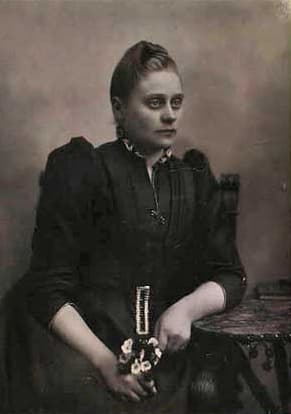
Danish · Literature
Marie Bregendahl
November 6, 1867 – July 22, 1940
Early life and background
Marie Bregendahl (born Marie Sørensen) was born on 6 November 1867 in Fly near Skive in Jutland, Denmark. She came from a farming family, and the rural world of her childhood remained the central imaginative landscape of her writing throughout her career. Biographical sources identify her father as a farmer in the Viborg district and describe her as the eldest of a large sibling group. Her early life was marked by responsibility within the household, particularly after her mother died in childbirth in 1879, a loss that left a strong impression on the young Marie and later echoed in the emotional depth of her fiction.[1][2][3]
Her upbringing in the Jutland countryside gave her close knowledge of the social structures, labor, and emotional codes of farm life. She was shaped by a world in which domestic work, agricultural labor, religious habits, and local custom structured everyday existence. That background became one of the defining strengths of her writing: she was able to represent rural life not as picturesque scenery, but as a complex social environment filled with affection, conflict, endurance, and inequality.[1][3][4]
At the age of nineteen, she attended a folk high school, an experience that broadened her horizons and linked her to the educational and cultural currents of late nineteenth-century Denmark. Folk high schools played an important role in Danish civic and cultural life, especially for young people from rural areas who had limited access to formal higher education. For a woman of Bregendahl’s generation, this was a meaningful opening into intellectual life and personal independence.[1]
Marriage, family, and separation
In 1893, Bregendahl married the poet Jeppe Aakjær, who had been her neighbor in Jutland and would later become one of Denmark’s best-known literary figures. Their relationship placed her within an exceptionally literary household, but the marriage did not last. The couple had a son in 1894, and by 1900 the marriage had ended in divorce. Sources differ slightly on the marriage year, but they agree on the marriage, the child, and the later divorce.[1][2][7][11][12]
After the separation, Bregendahl supported herself and her child through work as a housekeeper and later through writing. This period was decisive for her development as an author. As a single mother and a woman seeking literary recognition in a society with narrow expectations for women’s economic roles, she had to combine domestic responsibility with artistic ambition. Her eventual success is historically significant in this context because it reflects both personal determination and the broader expansion of women’s participation in modern Danish literary culture.[1][7]
Career beginnings
Bregendahl began publishing relatively late. Her first published text, Da katten løb med Frikadellerne, appeared in 1899 in the magazine Vagten. Several reference sources identify this as her debut publication and note that it introduced her to print culture before she became widely known as a novelist.[7][12][18]
Her first stories were published in 1902, marking the beginning of her recognition as a fiction writer. These early stories were important because they established the qualities that would characterize her mature work: realism, close observation, and an interest in the lives of ordinary people, especially women in rural households.[2][11]
Her book-length debut came in 1904 with the novel Hendrik i Bakken. This work is generally described as a marital novel and was followed by later prose that deepened her reputation as a writer of psychological and social realism. The book debut matters because it signaled her transition from occasional publication to sustained literary authorship.[4][12][14]
Major works and literary breakthrough
Bregendahl’s major breakthrough came with En Dødsnat in 1912, a work that established her as one of Denmark’s strongest prose stylists. The novel drew on the death of her mother and presents the experience through the perspective of children, making private grief into a literary meditation on family, mortality, and memory. Critics and reference works consistently identify it as her best-known title and as the work that brought her wider recognition.[1][2][4][7][11][14]
Her largest and most important achievement was the eight-volume sequence Billeder af Sødalsfolkenes liv, published between 1914 and 1923. This cycle depicts the daily lives of farmers and villagers in a West Jutland community and is widely regarded as her main contribution to Danish literature. Rather than idealizing the countryside, she examined the social and emotional realities of peasant life: labor, inheritance, marriage, sexuality, family conflict, and the burden of tradition.[1][2][7][11]
This body of work is especially notable for its perspective on women’s experience. Bregendahl often wrote from within female consciousness, paying close attention to the limits placed on women’s desires and choices in rural society. Her prose is described in reference sources as realistic and sometimes almost grotesque, yet it retains compassion for its subjects. That combination made her one of the most distinctive voices in Danish regional literature.[1][4][8]
Later in her career she continued to produce substantial fiction. Holger Hauge og hans Hustru, published in two parts in 1934 and 1935, explores marriage and the desire for an exclusively erotic relationship between man and woman. The novel shows that Bregendahl remained attentive to the emotional and bodily dimensions of human relationships well into the later period of her career.[7]
Style and themes
Bregendahl is usually classified as a writer of regional literature or rural realism. Her fiction is deeply rooted in the specific geography and social conditions of northern Jutland, particularly the village world of her childhood. Rather than writing broadly sentimental pastoral fiction, she portrayed the countryside as a structured social environment with its own harshness, moral codes, and forms of inequality.[1][2][4][8]
A hallmark of her style is her sympathy for ordinary people, especially women, while avoiding romantic simplification. Her writing combines realism with a distinctive oral quality and a subtle, sometimes severe sense of irony. The emotional force of her stories often emerges through restrained language and close attention to domestic detail. This approach helped her work stand apart from both highly polished urban literature and idealized depictions of peasant life.[4][8][13]
Her interest in women’s inner lives is especially important in women’s literary history. Bregendahl wrote about motherhood, marriage, sexuality, household labor, and grief at a time when such subjects were often treated as secondary or private. She transformed them into central literary material, thereby enlarging the scope of modern Danish fiction.[1][7][15]
Awards and recognition
Bregendahl received several honors in the later part of her life. In 1927 she was awarded the Tagea Brandt Travel Scholarship, which supported women’s intellectual and artistic work and enabled travel.[12] Sources also record an award from the Society for the Promotion of the Fine and Useful Sciences in 1937.[6] While the exact presentation dates are not supplied in the available references, the awards indicate that she had earned public recognition for her literary contributions.
Her reputation has continued well beyond her lifetime. Encyclopedias and literary histories describe her as one of Denmark’s most acclaimed rural writers and as a major contributor to the nation’s prose tradition.[1][2][4][11] Later criticism has also reassessed her importance, sometimes suggesting that her literary quality and thematic range were underestimated in earlier accounts of Danish modernism.[15]
Later life and death
Bregendahl lived much of her adult life in relative seclusion. Except for travel to Norway in 1901 and 1908, Germany in 1926, and Italy in 1928 on a scholarship, she remained largely within the Danish cultural sphere. This relative withdrawal did not mean artistic isolation; rather, it suggests a writer who drew continually from memory, local observation, and close engagement with the social world she knew best.[7]
She died in Copenhagen on 22 July 1940. By then she had produced a body of work that secured her place in Danish literary history. Her death marked the end of a career that had begun with modest publication and grown into a major contribution to prose fiction about rural life.[1][2][7]
Legacy
Marie Bregendahl’s legacy lies in her ability to make rural women’s lives central to serious literature. She helped define a form of Danish regional realism that was both local and broadly human in its appeal. Her work remains important for scholars interested in gender, domestic labor, peasant culture, and the literary representation of ordinary life.[1][4][7][15]
She is now remembered not simply as a writer of village settings, but as an author who brought emotional precision, social observation, and a strong female perspective to Danish prose. In doing so, she created literature that preserved a disappearing rural world while also exposing the constraints and inner lives of those who inhabited it. Her fiction continues to stand as a major record of Jutland life and as an enduring achievement in Nordic women’s writing.[1][4][7][13]
Dated achievements
2 indexed.
- Nov061867Literature
Birth of Marie Bregendahl in Fly, Denmark
Marie Bregendahl was born on 6 November 1867 in the village of Fly near Skive, in the Jutland region of Denmark.
View details Marie Bregendahl - Nordic Women's Literature - Jul221940Literature
Death of Marie Bregendahl in Copenhagen
Marie Bregendahl died on 22 July 1940 in Copenhagen, Denmark, closing a decades-long literary career chronicling rural Danish life.