← All women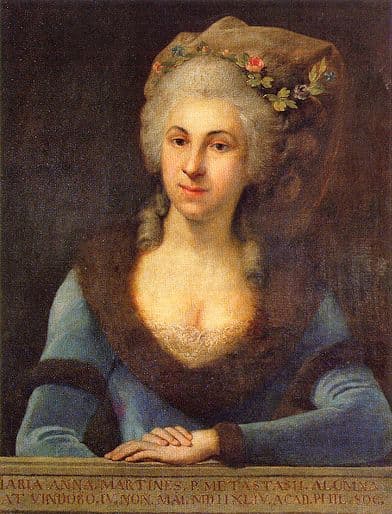
Austrian · Arts
Marianna Martines
May 4, 1744 – December 13, 1812
Early life and family background
Marianna Martines was born on 4 May 1744 in Vienna, then one of Europe’s most important musical capitals. She is identified in sources under several names, including Marianna von Martines, Marianne Martinez, and variants of her baptismal name, commonly given as Anna Katharina or Anna Catharina. She came from a family of mixed Italian and Spanish background and spent much of her life in the Michaelerhaus, a prominent building in the center of Vienna. Her father served in the household connected to the papal nuncio, placing the family in contact with court and diplomatic circles, while her household also included her sisters and a wider network of educated and influential acquaintances.
Martines’s upbringing was unusually favorable for a woman of her period. She grew up in a city where music was central to aristocratic and ecclesiastical life, and her home attracted important visitors. The most decisive of these was the poet and librettist Pietro Metastasio, who lived in the same building and became a lifelong mentor. He recognized her gifts while she was still a child and helped shape the extraordinary education that made her career possible. In an era when girls were generally expected to receive limited instruction and were rarely trained for public musical life, Martines benefited from personal patronage, household privilege, and uncommon intellectual encouragement.
Education and formative influences
Martines received an education far beyond the norm for eighteenth-century women. Metastasio supervised her studies and arranged instruction in languages and music. Sources describe her learning Italian, German, French, and English, along with singing, keyboard, composition, and counterpoint. Her teachers included Joseph Haydn, Niccolò Porpora, Giuseppe Bonno, and probably Johann Adolph Hasse. The exact details of some lessons vary by source, but there is broad agreement that she was connected to the central figures of Viennese music through Metastasio’s patronage.
Haydn’s early involvement is especially notable because he was then still a young musician. Later accounts describe him giving Martines keyboard lessons in exchange for meals at the Martines household, a vivid reminder of the informal and reciprocal networks through which musical training often took place. This combination of domestic salon culture, elite patronage, and professional instruction helped her develop into a singer, keyboard player, and composer with unusual command of multiple genres. Her training also placed her in a position to absorb the stylistic language of the Classical era from the inside, rather than as a distant amateur observer.
Career beginnings in Vienna
Martines was active in Vienna from a young age and quickly became known as a gifted performer. Sources report that one of her masses was performed publicly when she was sixteen and that her reputation reached the court. By the early 1760s, she had already drawn the attention of Empress Maria Theresa. Her public and semi-public musical life unfolded in a society where women could perform in aristocratic homes, salons, and churches more readily than they could claim formal positions in the church or theater. Martines navigated those limits with exceptional skill, building a career based on performance, composition, and teaching rather than on institutional employment.
Her home became a center of musical activity. Contemporary and modern accounts alike describe her private concerts as a gathering place for some of Vienna’s leading musicians and connoisseurs. These events were significant not only because they showcased her talents, but also because they placed a woman at the center of a sophisticated artistic network. In the cultural world of late eighteenth-century Vienna, where reputation depended heavily on patronage, conversation, and salon performance, Martines established herself as an artist of real consequence.
Composer, performer, and teacher
Martines composed in a wide range of genres. Her surviving works include masses, psalms, an oratorio, cantatas, arias, sonatas, and orchestral pieces. She also wrote keyboard music and other vocal works. Sources emphasize that she was one of the most prolific and respected women composers of her century, although much of her output has not survived. Some accounts suggest that she composed around two hundred works in total, with many later lost, including in a twentieth-century archive fire. The surviving pieces reveal an accomplished composer fluent in the idioms of the Classical style and capable of writing on a scale uncommon for women of her generation.
Her music was admired in her own lifetime for its craftsmanship and expressive clarity. It was also shaped by the conventions and opportunities available to a woman composer in Vienna. Sacred music, salon pieces, and works intended for private or semi-private performance were the genres most likely to be performed and preserved. That pattern reflects both the practical realities of the period and the gendered limits on publication, theater composition, and public institutional appointment. Martines nevertheless achieved a level of visibility that was exceptional, especially for a woman who did not marry and did not rely on a husband’s professional identity.
Relationship with Haydn, Metastasio, and Mozart
Martines’s life is deeply intertwined with the major male musical figures of her time, but she was not merely a student or curiosity in their orbit. Metastasio served as a patron and intellectual guide throughout her life. Haydn’s early instruction linked her to the emerging Classical style, while later descriptions show that she remained in contact with him as an adult. She also knew Wolfgang Amadeus Mozart, and accounts describe their playing keyboard duets together. That friendship is significant because it places Martines inside the mainstream of Viennese musical life, not at its margins.
The evidence of these relationships matters historically because women composers are often described only through their associations with famous men. In Martines’s case, those associations were real and important, but they should be read as evidence of her centrality to the city’s musical ecosystem. She was not an isolated amateur. She was a musician trusted by leading figures, heard by elite audiences, and engaged in the same artistic world that produced the canonical Classical repertoire.
Honor, recognition, and the Accademia Filarmonica
One of the clearest signs of Martines’s status came in 1773, when she became the first woman admitted as an honorary member of the Accademia Filarmonica of Bologna. The exact day of that election is not verifiable from the available sources, but the year is securely documented. This was a landmark achievement. The Accademia Filarmonica was a prestigious institution, and women were rarely admitted to such bodies in the eighteenth century. Martines’s inclusion signaled not only esteem for her work but also a slow widening of institutional recognition for women musicians.
This honor was important beyond its immediate ceremonial value. It demonstrated that a woman composer based in Vienna could be recognized in an international musical context. It also offered later generations a concrete example of a woman who crossed barriers of geography, gender, and institutional exclusion. Even so, the honor did not erase the structural limits of her era. Martines still worked within a world where women’s compositions were more likely to be heard in private than printed widely or performed on large public stages.
Personal life
Martines never married, a fact noted by several sources and often connected to her ability to devote herself to music. Remaining unmarried gave her unusual autonomy for a woman of her social position, though it did not free her from dependence on family and patronage networks. She lived in the Martines household for much of her life and appears to have built her career within the support structure of family and close friends rather than through a conventional domestic life of her own.
There is no reliable evidence that she had children. Instead, her documented relationships are primarily artistic and intellectual: Metastasio as mentor, Haydn as teacher and colleague, and Mozart as a musical friend. Her life illustrates a model of female achievement in which social respectability, household stability, and cultivated networks could substitute, at least partly, for the institutional pathways open to men.
Later years, death, and posthumous reputation
Martines continued to live and work in Vienna into old age. She died there on 13 December 1812. After her death, her reputation faded in the nineteenth century, as the musical canon increasingly privileged male composers and as the domestic and salon-based contexts in which she had flourished became less central to music history narratives. Many of her works were lost, which further contributed to her disappearance from standard repertory and scholarship.
Modern research has recovered Martines as a major figure in the history of women’s composition. Musicologists and performers now value her as a composer who wrote confidently in the Classical style while negotiating the gendered limitations of her time. Her surviving works are performed and recorded with increasing frequency, and institutions dedicated to women’s music history have helped restore her visibility. She is now recognized as one of the most accomplished women musicians of eighteenth-century Vienna and as an important example of the intellectual and artistic worlds women could create when given access to education and patronage.
Legacy
Marianna Martines’s legacy lies in both her music and her historical example. She was a singer, keyboardist, teacher, and composer who built a serious artistic career in a milieu dominated by men. Her admission to the Accademia Filarmonica of Bologna made her a pioneer, and her long presence in the Viennese musical scene showed that women could be central participants in eighteenth-century artistic life even when official structures excluded them. Her career also demonstrates the importance of mentorship, salon culture, and informal networks in the making of musical history.
For modern scholars, Martines is valuable not only because she was exceptional, but because she reveals the broader conditions under which women’s creativity could survive in the Classical era. Her life bridges domestic music-making and public recognition, private education and institutional honor, and later neglect and modern recovery. That combination makes her one of the essential figures in the history of women in music.
Dated achievements
3 indexed.
- May041744Science
Birth of Marianna Martines in Vienna
Marianna Martines was born in Vienna on 4 May 1744, into a family connected to the papal nuncio's household, setting the stage for her extraordinary musical education.
View details Marianna Martines - Wikipedia - Jan011773Science
First woman admitted to the Accademia Filarmonica of Bologna
In 1773 Martines became the first woman elected an honorary member of Bologna's prestigious Accademia Filarmonica, a landmark recognition for a female composer.