← All women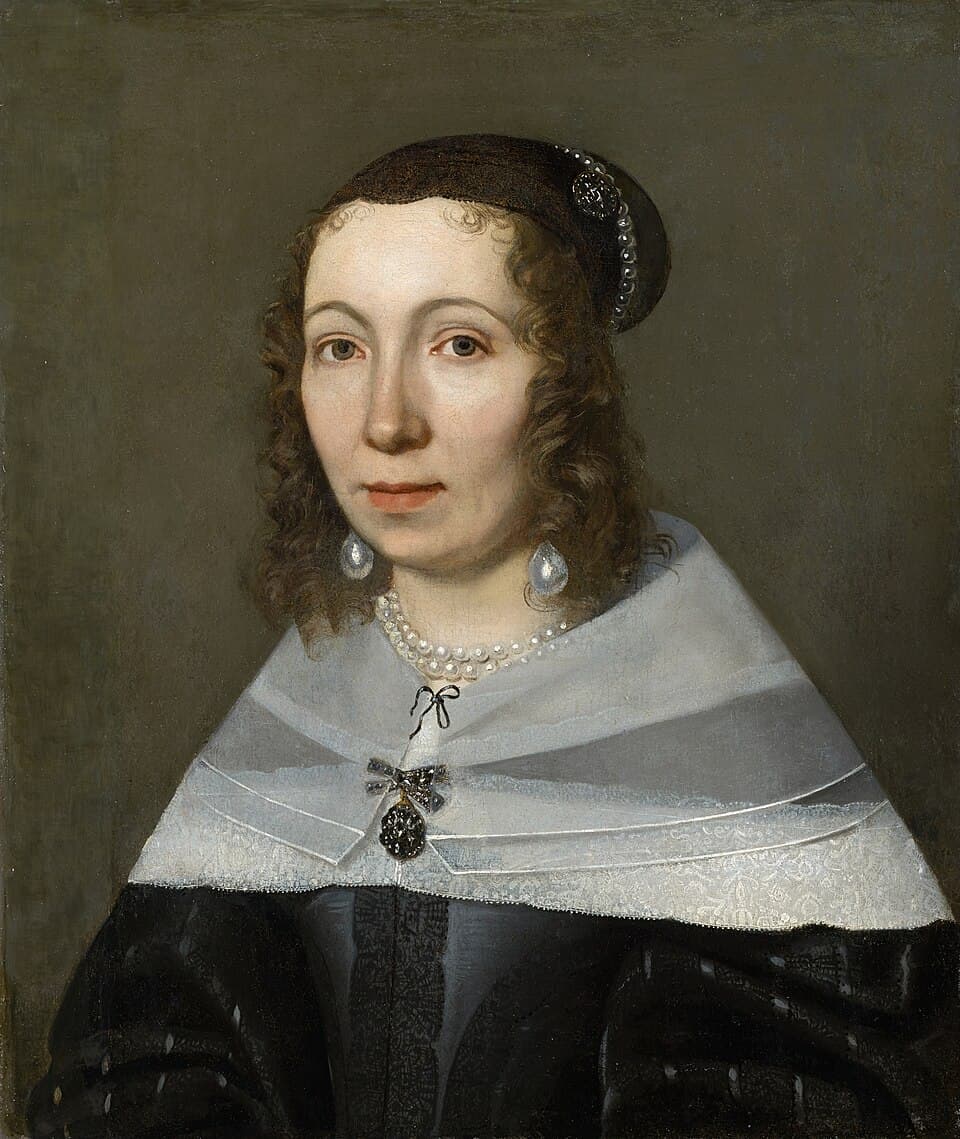
German, Dutch · Science · Arts
Maria Sibylla Merian
April 2, 1647 – January 13, 1717
Early Life and Background
Maria Sibylla Merian was born on 2 April 1647 in Frankfurt am Main, a Free Imperial City of the Holy Roman Empire, into a family deeply embedded in the world of printing and art.[2][4][12] Her father, Matthäus Merian the Elder, was a renowned Swiss‑born engraver and publisher whose maps and illustrated books were widely circulated across Europe.[7][17] He died when Maria was still a young child, and her mother, Johanna Sibylla Heim, subsequently married Jacob Marrel, a prominent still‑life painter associated with the Dutch flower‑painting tradition.[7][6]
Growing up in this artistic and commercial environment, Merian learned drawing, watercolor, engraving, and the practicalities of book production. Marrel’s studio exposed her to the meticulous representation of flowers and fruit in the Dutch still‑life style, which demanded close observation of natural forms.[7][17] It was in this context that she began to notice the insects that lived on and around the plants she painted. According to later biographical accounts, Merian started systematically collecting caterpillars around the age of thirteen, observing how they transformed into butterflies and moths and keeping notes and sketches of their life stages.[14][6]
Unlike many women of her time, Merian’s education was largely informal and craft‑based rather than academic; there is no evidence that she attended a university or received a formal scientific curriculum.[2][13] Instead, her scientific formation emerged organically from artisanal practice. Her apprenticeship in an artist’s workshop gave her both technical skills and a means of livelihood, while her curiosity about insects prompted empirical investigations that would later prove foundational to entomology.
Career Beginnings and Development
In 1665, Merian married Johann Andreas Graff, a painter and engraver who had trained in Marrel’s circle.[4][6][17] Around 1670, the couple moved to Nuremberg, a thriving commercial and artistic center in the Holy Roman Empire.[3][4] There, Merian began to establish herself as an independent artist and entrepreneur. She taught drawing and embroidery to the daughters of patrician families, sold flower paintings, and produced designs for decorative arts.[3][13]
Nuremberg also became the site of her first significant publications. In the mid‑1670s she issued Neues Blumenbuch (New Book of Flowers), a florilegium containing plates of ornamental plants that could be used as models by painters and embroiderers.[4][13] Although largely decorative, this work demonstrated her command of botanical forms and the business model she would follow—publishing illustrated books for a paying clientele.
Her scientific ambitions were already growing. Merian collected living insects in gardens and fields, raised them through their full life cycle, and carefully recorded their transformations. Rather than working from dried or pinned specimens, which were common in cabinets of curiosity, she preferred to observe and paint insects in motion and in relation to their host plants.[3][13] This methodological choice would distinguish her work from much contemporary natural history and would later be recognized as an early ecological perspective.
Major Works and Scientific Contributions
Merian’s first major scientific publication was the two‑volume Der Raupen wunderbare Verwandlung und sonderbare Blumennahrung (The Wondrous Transformation of Caterpillars and Their Strange Nourishment from Flowers), released in Nuremberg in 1679 and 1683.[4][11] Each plate depicted the complete metamorphosis of an insect—egg, larva (caterpillar), pupa (chrysalis), and adult—arranged around the plant on which the caterpillar fed. Accompanying texts described the timing of transformations, behaviors, and feeding preferences.
These volumes challenged prevailing notions of spontaneous generation, which held that insects emerged from mud or decaying matter. By showing that each butterfly or moth developed from a specific caterpillar and that each caterpillar depended on a particular food plant, Merian provided visual and textual evidence for a life cycle model that would become central to modern entomology.[4][12] Her plates also advanced scientific illustration by integrating insects and plants within a single compositional framework, rather than treating them as isolated specimens.
In 1685, Merian made a pivotal personal and professional decision: she left her husband and moved with her mother and two daughters to the Labadist religious community at Wieuwerd in Friesland, in the Dutch Republic.[4][3] The Labadists practiced a strict pietist lifestyle, emphasizing simplicity and communal living. While there, Merian continued her insect studies and gained access to exotic plants and animals that had been brought to the community by members returning from missions and trade.[3][17] This exposure to non‑European specimens further fueled her interest in the natural history of distant lands.
After the Labadist community dissolved, Merian relocated to AmsterdamDutch colony of Suriname in South America.
In 1699, at about fifty‑two years old, Merian and her younger daughter Dorothea sailed from Amsterdam to Suriname to study insects, plants, and animals in their natural environment.[3][9][13] Unlike many contemporary voyages, theirs was not sponsored by a court or scientific institution; Merian financed the trip herself, intending to produce and sell a luxury folio based on her findings.[13] For roughly two years, she traveled through plantations and forested areas, observing nocturnal species, recording interactions between insects and their host plants, and documenting local knowledge about poisonous and economically important flora.[9][13]
Illness—often identified as malaria—forced Merian to return to Amsterdam around 1701.[3][13] There she began the laborious process of converting field sketches and notes into finished copperplate engravings. The results appeared in 1705Metamorphosis Insectorum Surinamensium (The Metamorphosis of the Insects of Suriname), published in Latin and Dutch.[8][13] The folio contained sixty large, hand‑colored plates depicting tropical insects alongside fruits, flowers, and other plants, accompanied by detailed explanatory texts.
Metamorphosis Insectorum Surinamensium is widely regarded as one of the most beautiful and scientifically innovative nature books of the early eighteenth century.[8][1] It introduced European readers to new species, documented ecological relationships such as predation and parasitism, and continued Merian’s argument against spontaneous generation by illustrating complex life cycles of moths, butterflies, and other insects.[13] The work also integrated local and Indigenous knowledge about the uses and dangers of Suriname’s plants, demonstrating Merian’s reliance on conversations with enslaved Africans and Indigenous guides, though these informants were rarely named in her text.[9][13]
Merian’s Suriname folio had lasting scientific impact. Naturalists including Carl Linnaeus drew on her illustrations and descriptions when classifying species in Systema Naturae and Fauna Svecica; more than one hundred species entries can be traced directly to her work.[13][14] Later historians and ecologists, such as Kay Etheridge, have argued that Merian’s integrated depictions of organisms and their environments anticipated ecological thinking and justify describing her as the first European ecologist.[12][16]
Awards, Honors, and Contemporary Recognition
Merian worked at a time when formal scientific societies and academies, such as the Royal Society in London or the Académie des Sciences in Paris, admitted few or no women and offered them little institutional recognition.[13][10] There is no evidence that she received official scientific awards or held academic posts. Her recognition came through patronage, sales, and the circulation of her books among elites.
Her folios were acquired by princes, wealthy collectors, and scientific institutions. In the eighteenth century, several of her original watercolors and engraved plates entered the collections of Dutch and German museums and botanical gardens.[8][1] Modern institutions continue to honor her legacy. The British Museum and the Rijksmuseum hold significant groups of her works and present her as a pioneering artist of flora and fauna.[1][8] The Science History Institute and educational organizations such as the Getty have produced biographies, teaching materials, and exhibitions that highlight her contributions to both science and art.[13][14]
More than a dozen species of plants and animals have been named after Merian, a posthumous scientific honor recognizing the importance of her observations.[14] Contemporary ecologists and historians frequently cite her as a trailblazer in entomology and scientific illustration, and she has become a prominent figure in narratives of women in science.
Personal Life and Relationships
Merian’s personal life was closely intertwined with her professional activities. Her marriage to Johann Andreas Graff produced at least two daughters, Johanna Helena and Dorothea Maria, both of whom became skilled artists and collaborators in her projects.[4][3][17] Merian taught them drawing and painting and involved them in the coloring and production of her prints, effectively running a family workshop.
Her separation from Graff and move to the Labadist community in 1685 reflected both religious and personal motives. The Labadists’ emphasis on piety and communal support may have offered Merian a refuge from marital tensions as well as a new environment for study.[3][17] She did not remarry after leaving Graff, and later sources indicate that she focused on supporting herself and her daughters through artistic and publishing work.
In Amsterdam, Merian thrived as an independent businesswoman. She negotiated with engravers and printers, managed subscribers, and sold finished works to collectors.[1][13] Her daughters continued to assist her; Dorothea accompanied her to Suriname and helped with fieldwork and drawing, while Johanna later married a Surinamese plantation owner and settled in the colony, maintaining connections that likely facilitated the circulation of specimens and information.[3][9]
Legacy and Historical Impact
Maria Sibylla Merian’s legacy spans several domains: entomology, ecology, scientific illustration, and the history of women in science. She was among the earliest European naturalists to insist on observing insects directly in their natural environments, raising them through complete life cycles rather than relying on static specimens.[4][12][13] Her meticulous documentation of metamorphosis helped dispel myths about spontaneous generation and contributed to the emerging understanding of biological development.
Her images are notable for their integration of insects with their host plants and for depicting interactions such as predation, parasitism, and feeding behavior. Historians of science argue that this compositional strategy anticipates ecological thinking by visualizing organisms within networks of relationships rather than as isolated individuals.[12][16] This has led some scholars and institutions to describe Merian as “the first European ecologist,” highlighting her role in the origins of ecological science.[16]
As a woman working without university training or institutional sponsorship, Merian broke significant social barriers. She built a successful business in a field dominated by male artists and publishers, undertook a self‑financed expedition to the Americas for scientific purposes, and produced works that later became authoritative sources for male naturalists such as Linnaeus.[3][9][13] Her story features prominently in modern efforts to recover the contributions of women to early modern science.
Art historians also emphasize Merian’s stylistic innovations. Her “metamorphosis pictures,” which combine stages of insect development with elaborate botanical settings, created a new genre of scientific art that is both informative and visually compelling.[6][1] Museums and galleries continue to exhibit her prints not only for their scientific content but also for their aesthetic qualities, demonstrating the enduring appeal of her work.
Educational programs at institutions like the Junges Museum Frankfurt, the Science History Institute, and the Getty present Merian as a role model for interdisciplinary inquiry, illustrating how curiosity, artistic skill, and empirical observation can intersect.[12][13][14] Her life and work feature in contemporary children’s books, podcasts, and digital exhibitions, contributing to public understanding of both entomology and women’s history.
Later Life and Death
In her later years in Amsterdam, Merian continued to work as an artist, printmaker, and naturalist despite declining health.[2][13] She maintained her workshop and supervised the production and sale of her books and prints. Her reputation as a scholar of the natural world grew, and collectors continued to seek out her Suriname folio and earlier caterpillar volumes.
On 13 January 1717, Merian died in Amsterdam at the age of sixty‑nine.[2][4][12] After her death, her daughters played a crucial role in preserving and disseminating her work. Dorothea, who had assisted with the Suriname project, helped sell and hand‑color plates, while Johanna’s connections in Suriname maintained the transatlantic dimension of the family’s artistic and natural‑history activities.[3][9]
In the centuries following her death, Merian’s original watercolors and printed folios migrated into major museum collections. The British Museum, Rijksmuseum, and other institutions now hold and exhibit her works, framing her as a pioneering figure at the intersection of art and science.[1][8] Twentieth‑ and twenty‑first‑century scholarship has continued to reassess her contributions, moving her from the margins of natural history to a central place in narratives about the development of entomology and ecology.
Today, Maria Sibylla Merian is widely recognized as a key early modern naturalist whose life and work illustrate both the possibilities and constraints faced by women in science. Her empirically grounded, visually arresting studies of insects and plants remain vital resources for historians, scientists, and artists alike.
Dated achievements
7 indexed.
- Apr021647Arts
Birth of Maria Sibylla Merian
Maria Sibylla Merian was born in Frankfurt am Main, in a family of artists and printers.
View details Encyclopedia Britannica - Maria Sibylla Merian - Jan011675Arts
Publication of Neues Blumenbuch
*Neues Blumenbuch*, her first published work, establishes Merian as a professional artist.