← All women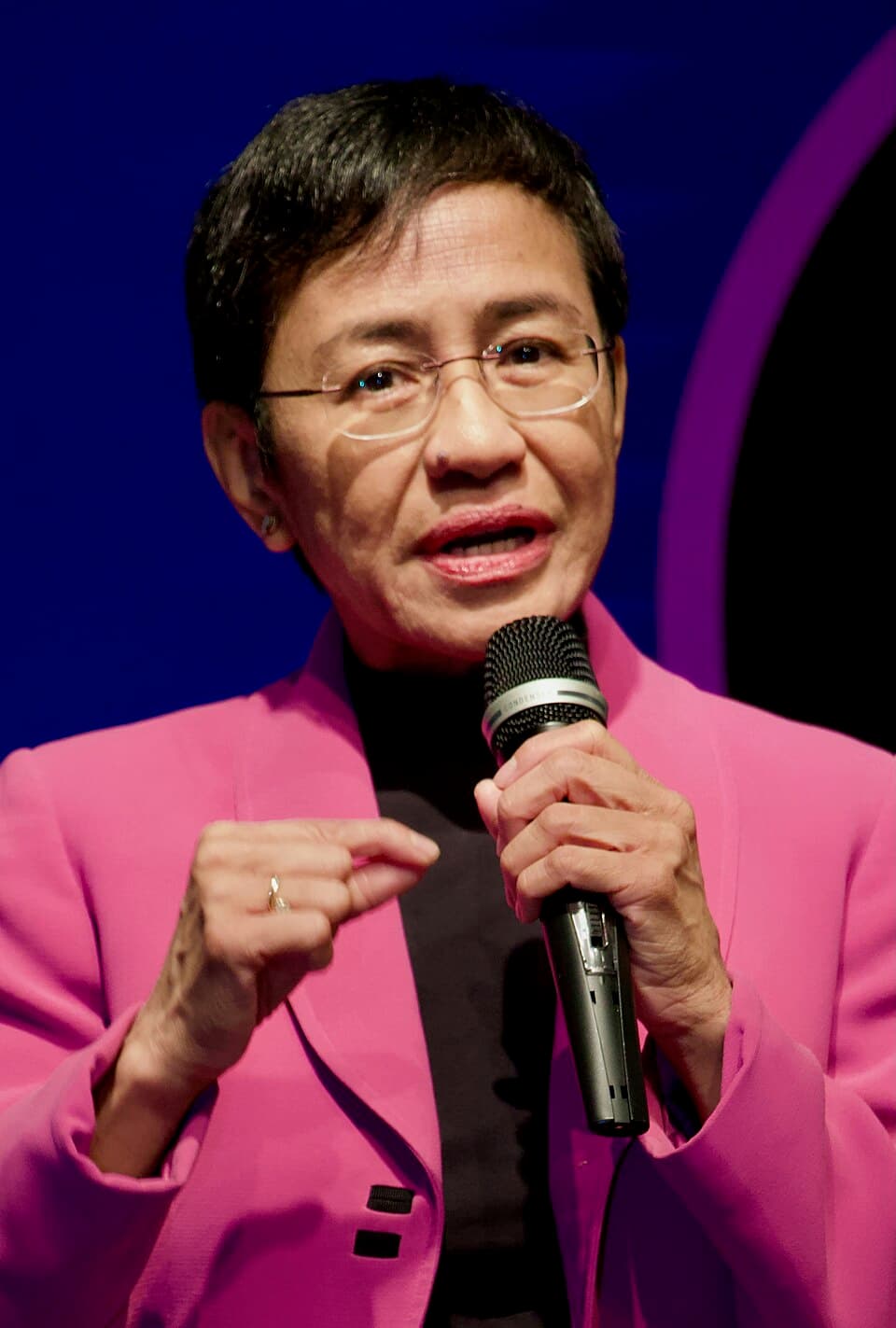
Filipino, American · Activism · Politics
Maria Ressa
October 2, 1963 – present
Early Life and Background
Maria Angelita Ressa (née Maria Angelita Delfin Aycardo) was born on 2 October 1963 in Manila, Philippines.[1][3][7][10][11][12] She spent her early childhood in the Philippines during a period of mounting political tension that culminated in the declaration of martial law by President Ferdinand Marcos in 1972.[6] After martial law was imposed, her family migrated to the United States, and Ressa moved to Toms River, New Jersey, as a young girl, around age nine or ten.[2][4][6][8]
Growing up in New Jersey, Ressa experienced the challenges of immigration and cultural transition. She attended local schools and excelled academically, eventually earning admission to Princeton University.[4][8][11] At Princeton, she studied English, graduating with a bachelor’s degree in 1986, and completed certificates in theater and dance.[8] Her liberal arts education, combined with her bicultural upbringing, laid the foundation for a career that would blend narrative craft, investigative rigor, and a deep interest in politics and society.
After Princeton, Ressa received a Fulbright scholarship to study political theater at the University of the Philippines Diliman, returning to the country of her birth.[8][11] This move back to Manila reconnected her with Philippine society after years in the United States and exposed her directly to the aftermath of authoritarian rule and the struggles for democratic transition in the post-Marcos era. These formative experiences—living under martial law, emigrating, then returning as a scholar—shaped her understanding of power, narrative, and civic responsibility.
Career Beginnings and Development
Ressa began her professional career in journalism in the mid-1980s in the Philippines, initially working as a reporter and producer for television news.[1][3][8] In a period marked by the 1986 People Power Revolution and the fall of the Marcos dictatorship, journalism in the country was undergoing rapid change, and young reporters like Ressa were entering a field newly open to scrutiny of government power.
In 1987, she joined CNN, where she would spend nearly two decades as a lead investigative reporter and bureau chief in Southeast Asia.[1][3][4][8][10][11] Ressa served as head of CNN’s Manila bureau until 1995 and then led the Jakarta bureau from 1995 to 2005.[8] In these roles, she covered major regional events including political transitions, separatist conflicts, and the rise of transnational terrorism. Her reporting emphasized detailed on-the-ground investigation and regional context, contributing to global audiences’ understanding of Southeast Asia.
After leaving CNN, Ressa became head of the news division at ABS-CBN, one of the Philippines’ largest television networks.[3][7][8] As news chief, she oversaw coverage and editorial strategy in a media environment increasingly shaped by cable and emerging digital platforms. She also wrote for international outlets such as CNN and The Wall Street Journal, maintaining a dual presence in domestic and global journalism.[8]
Ressa’s expertise in reporting on terrorism and security was reflected in her early books. In 2003, she published Seeds of Terror: An Eyewitness Account of Al-Qaeda’s Newest Center, which examined the development of jihadist networks in Southeast Asia.[4][3] In 2013, she followed with From Bin Laden to Facebook: 10 Days of Abduction, 10 Years of Terrorism, combining narrative accounts of kidnapping and insurgency with analysis of how extremist movements and digital communication intersect.[4][3] These works solidified her reputation as a global terrorism expert, particularly regarding Asia.
Founding Rappler and Digital Innovation
In 2012, Ressa co-founded Rappler, a digital-only news site based in Manila that integrates investigative reporting with social media–driven engagement.[1][3][4][6][8] Rappler began as a small online operation and quickly grew into one of the Philippines’ leading independent news organizations. Its name combines "rap," meaning conversation, and "ripple," evoking the broader impact of public discussion.[6]
As CEO and executive editor, Ressa led Rappler in developing innovative approaches to data, crowdsourcing, and social media analytics. The site produced in-depth coverage of politics, governance, and human rights, and built specialized teams to analyze how misinformation and propaganda circulated through digital networks. Rappler became known not only for its reports but also for its explanations of how online ecosystems could be manipulated.
Rappler’s work drew particular attention for its coverage of President Rodrigo Duterte, who took office in 2016 and launched a violent "war on drugs" that led to thousands of deaths. Ressa and her team documented extrajudicial killings and patterns of abuse, and investigated how the government’s supporters used social media campaigns to attack critics and distort public debate.[4][5][6]
Under Ressa’s leadership, Rappler became a symbol of digital-era press freedom in the Global South. The site faced sustained attacks from pro-government trolls, regulatory pressure, and repeated efforts to revoke its license or restrict its operations, turning its newsroom into a frontline in the battle over independent journalism and online disinformation.[2][4][5][6]
Legal Battles and Cyber Libel Case
Beginning in the late 2010s, Ressa and Rappler confronted a series of legal challenges widely described as politically motivated. Philippine authorities pursued multiple charges against her, including tax-related cases and alleged violations of foreign ownership rules in media.[2][4][6] Ressa was arrested several times and forced to post bail repeatedly in order to remain free and continue working.[2]
A landmark case involved a cyber libel complaint over a 2012 Rappler article alleging links between a businessman and illicit activities. Prosecutors argued that an update to the story in 2014 brought it under the scope of the country’s 2012 Cybercrime Prevention Act.[6][11] On 21 June 2018, a Philippine court found Ressa guilty of cyber libel, marking one of the first major applications of the law against a prominent journalist.[6]
Press freedom organizations and human rights advocates condemned the ruling, warning that it threatened online journalism and could be used to stifle investigative reporting.[6][11] Ressa’s legal team challenged the decision, and the case became a focal point for international campaigns highlighting the misuse of cybercrime legislation against critics of government.
Amid these proceedings, Ressa continued to speak publicly about disinformation, platform power, and the importance of protecting journalists. Her legal battles underscored the risks faced by reporters, especially women, who challenge authoritarian tendencies and expose human rights violations.
Major Works and Intellectual Contributions
Across her career, Ressa has combined investigative reporting with analytical writing and public advocacy. Her books Seeds of Terror and From Bin Laden to Facebook provided early, regionally grounded examinations of terrorism and the role of communication technologies in extremist networks.[4][3]
In 2022, she published How to Stand Up to a Dictator: The Fight for Our Future, a memoir and manifesto reflecting on her experiences confronting authoritarianism and disinformation, particularly in the Philippines.[4][3] The book situates her personal story within broader global trends, arguing that information integrity is essential to democratic governance and that technology companies have outsized influence over civic life.
Ressa has also contributed numerous essays, talks, and interviews analyzing "information ecosystems"—the complex interplay of social media platforms, algorithms, state actors, and citizens. She emphasizes how engagement-driven content ranking can amplify harmful narratives and enable coordinated harassment campaigns against journalists and activists.[2][4]
Her intellectual work extends beyond media practice into debates over platform regulation, human rights in the digital age, and the responsibilities of states and corporations toward the public sphere. This has made her a sought-after speaker at universities, international organizations, and technology policy forums.[2][4][5]
Awards, Honors, and Global Recognition
Ressa’s efforts to defend press freedom and expose abuses of power have been recognized with numerous awards. In 2018, Time magazine named her among its "Person of the Year" honorees as part of "The Guardians"—a group of journalists singled out for their role in the "war on truth."[2][3][4][5][11] The following year, she was listed in the TIME 100 as one of the world’s most influential people.[2][3][4]
She received the ICFJ Knight International Journalism Award in 2018, recognizing her as a "crusading editor and digital trailblazer" whose work at Rappler spotlighted the policies of Duterte’s government and its deadly anti-drug campaign.[5][8] She has also been named among Time’s "Most Influential Women of the Century," underlining her broader historical impact.[2]
In 2020 and 2021, Ressa and Rappler received multiple international honors from journalism and press freedom organizations, including recognition by UNESCO through the Guillermo Cano World Press Freedom Prize, among others.[3][4] These awards highlighted her courage in facing legal harassment and her leadership in documenting the weaponization of social media.
On 8 October 2021, the Norwegian Nobel Committee announced that Ressa and Russian journalist Dmitry Muratov were awarded the Nobel Peace Prize "for their efforts to safeguard freedom of expression, which is a precondition for democracy and lasting peace."[1][3][4][5][10][12] Ressa thus became the first Filipino Nobel laureate.[1][3][4][9][12] She formally received the medal and diploma and delivered her Nobel Lecture in Oslo on 10 December 2021.[3][4]
Beyond formal awards, Ressa has been granted honorary degrees and invited to deliver keynote addresses at major universities and institutions worldwide, reflecting international esteem for her work on disinformation, democracy, and media freedom.[3][4]
Academic and Institutional Roles
In addition to her journalism, Ressa has taken on roles within academic institutions. On 13 April 2022, Columbia University’s School of International and Public Affairs (SIPA) announced that she would join its faculty as a Professor of Professional Practice, bringing her experience as a journalist and Nobel laureate into graduate-level teaching and public engagement.[2][4][8]
She has served as a distinguished fellow at Columbia University’s Institute of Global Politics since 2023, contributing to research and dialogue on global governance and information integrity.[3][8] In 2024, she became a professor at SIPA, formalizing her academic presence.[3][4][8]
Ressa also serves on the board of the International Center for Journalists (ICFJ), helping guide initiatives that support reporters worldwide.[5] These roles extend her influence beyond newsroom management into the training of future leaders and the strategic direction of organizations dedicated to media development and press freedom.
Personal Life
Maria Ressa holds dual identity as a Filipino and American, reflecting her birth in the Philippines and upbringing in the United States.[3][11][12] She has often spoken about how this background shapes her perspective on democracy, rights, and civic responsibility in both societies.
Ressa is openly lesbian.[11] Her visibility as an LGBTQ+ journalist and leader of a major news organization adds an important dimension to her role in women’s and queer history, particularly in a country where conservative social norms and institutional discrimination remain significant. While detailed public information about her intimate relationships is limited, her openness about her identity contributes to representation and broader conversations about diversity in media leadership.
Much of Ressa’s public persona centers on her professional and civic commitments rather than on her private life. She has described herself as driven by the mission of journalism and by the imperative to defend democratic spaces, often emphasizing the collective nature of Rappler’s work and the importance of community resilience.
Legacy and Historical Impact
Maria Ressa’s legacy is shaped by her role in redefining journalism in the digital age, particularly in Southeast Asia. As co-founder and CEO of Rappler, she demonstrated how a relatively small, digital-only newsroom could investigate powerful actors, innovate in data and social media analysis, and influence global debates about democracy and technology.[1][3][4][6]
Her work exposed the weaponization of social media, showing how platforms designed for connection could be used to spread disinformation, incite violence, and harass critics.[1][2][4][6] These insights have influenced policymakers, academics, and civil society organizations confronting the challenges of digital authoritarianism and platform governance.
Ressa’s willingness to face arrest, prosecutions, and intense online harassment has made her a symbol of resilience for journalists worldwide. She is frequently invoked as an example of how individuals can stand up to state power and corporate irresponsibility by insisting on truth and accountability, even when the personal costs are high.[2][4][5][6]
In women’s history, Ressa occupies a significant place as a Filipina journalist and LGBTQ+ figure who broke barriers by becoming the first Filipino Nobel laureate and one of the most prominent voices for press freedom in the twenty-first century.[1][3][4][9][12] Her career highlights the contributions of women in investigative reporting, digital innovation, and global security analysis, fields often dominated by men.
Her writings, speeches, and institutional roles continue to shape conversations about how societies can rebuild trust in information systems, regulate technology platforms, and uphold the rights of journalists and citizens. For future generations, Ressa’s story offers a case study in how journalism, activism, and scholarship can intersect to defend democratic values.
Later Life and Ongoing Work
As of the mid-2020s, Maria Ressa remains actively engaged in journalism, advocacy, and teaching. She continues to serve as CEO of Rappler, guiding its coverage of Philippine politics, governance, and social issues while navigating ongoing legal and regulatory challenges.[3][6][8]
Ressa’s academic appointments at Columbia University and her fellowships with international institutions position her at the intersection of practice and theory, allowing her to influence policy debates and train future leaders while staying connected to frontline reporting.[2][3][4][8]
She regularly participates in global forums discussing disinformation, platform accountability, and press freedom, often emphasizing the urgency of reforming information ecosystems to protect democratic processes. Her later work builds on themes developed throughout her career: the importance of truth, the dangers of unchecked power, and the need for collective action to safeguard civic spaces.[2][4]
Maria Ressa is alive and continues to be a central figure in contemporary struggles over journalism and democracy. Her evolving contributions—through Rappler, her books, public lectures, and academic engagement—ensure that her historical impact is ongoing, as new generations confront the challenges of authoritarianism and the digital public sphere.
Dated achievements
6 indexed.
- Oct021963Activism
Birth of Maria Ressa
Maria Angelita Ressa was born in Manila, Philippines.
View details Maria Ressa Biography - Jun212018Politics
Cyber libel conviction against Maria Ressa
Rappler CEO Maria Ressa was found guilty of cyber libel over a 2012 online article.
View details