← All women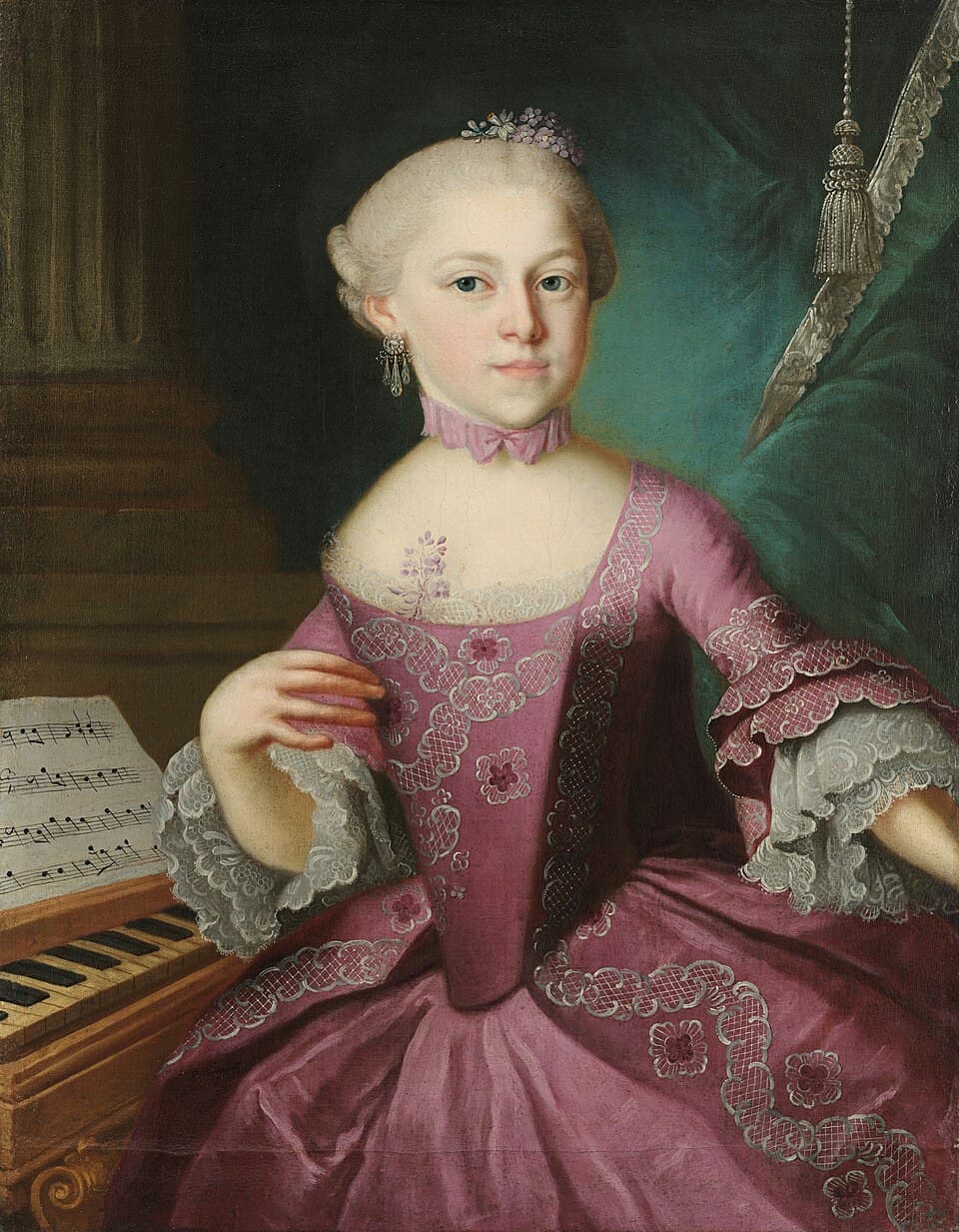
Austrian · Arts · Literature
Maria Anna Mozart
July 30, 1751 – October 29, 1829
Early Life and Family Background
Maria Anna Walburga Ignatia Mozart, universally known by her family nickname Nannerl, was born on 30 July 1751 in Salzburg, then the seat of an independent Prince-Archbishopric within the Holy Roman Empire. She was the fourth of seven children born to Johann Georg Leopold Mozart, a violinist, composer, and influential pedagogue employed in the court orchestra of the Archbishop of Salzburg, and his wife, Anna Maria Mozart (née Pertl). Of the seven children, only Nannerl and her younger brother, Johannes Chrysostomus Wolfgangus Theophilus Mozart—later known as Wolfgang Amadeus Mozart, born in 1756—survived past infancy, a common tragedy in an era of high child mortality.
The Mozart household in Salzburg was steeped in music. Leopold Mozart was the author of a highly regarded treatise on violin technique, Versuch einer gründlichen Violinschule (1756), and was deeply invested in the musical education of his children. Nannerl began keyboard lessons around the age of seven or eight, learning harpsichord and clavier under her father's exacting tutelage. She proved to be an extraordinarily gifted student, mastering difficult repertoire with a speed and precision that astonished her father and, later, audiences across Europe.
A Child Prodigy on the European Stage
By the early 1760s, Leopold Mozart recognized that both of his surviving children possessed prodigious musical gifts, and he made the fateful decision to showcase them publicly, both to secure the family's reputation and to supplement his modest court salary. In January 1762, the family made a preliminary trip to Munich, and in 1763 they embarked on a much more ambitious, multi-year "Grand Tour" of European courts and capitals, including Munich, Augsburg, Frankfurt, Brussels, Paris, London, The Hague, Amsterdam, Geneva, and various German principalities.
During these years, Nannerl—despite being only four and a half years older than Wolfgang—was frequently billed as the more remarkable performer of the two, particularly in the tour's earliest phases. Contemporary newspaper notices and courtly correspondence often referred to "the two wonders of nature" or similar phrasing, describing performances in which Nannerl demonstrated flawless technique on the harpsichord, sight-reading, and improvisation. Some accounts from London and Paris singled out her playing as being of exceptional artistic maturity for a girl not yet in her teens. She and Wolfgang performed four-hand pieces together, astonishing courtly audiences accustomed to adult virtuosos.
The tour, which extended intermittently from 1763 until roughly 1766-1769 with additional shorter trips, exposed the Mozart children to the finest musicians, composers, and instruments of the age, and was crucial to Wolfgang's development as a composer. For Nannerl, it represented the peak of her public musical career—a career that would soon be foreclosed by the social conventions of her era.
The Turning Point: Gender and the End of a Public Career
As Nannerl approached the age of eighteen, around 1769, Leopold Mozart made the decision—entirely typical for the period—that she should cease appearing in public concerts. Unmarried young women of respectable families were not expected to pursue careers as touring performers; such a path was considered unsuitable and potentially damaging to a young woman's prospects for marriage and social standing. From this point forward, while Wolfgang continued touring Italy and beyond to establish his composing career, Nannerl remained largely at home in Salzburg, continuing to play piano privately, teach music lessons to the children of local families, and manage domestic responsibilities within the Mozart household.
This divergence in their paths has become one of the most frequently cited examples in music history of the structural barriers placed before talented women. Nannerl was, by all contemporary accounts, at least the equal of her brother in keyboard performance during their shared childhood years, yet the family's — and society's — expectations meant that only Wolfgang's talents were permitted to flourish into a full professional and compositional career. Some scholars and biographers have suggested that Nannerl also composed music during her youth; letters from Wolfgang to his sister in the 1770s praise compositions she reportedly wrote and sent to him, though none of her compositions are known to survive today, a loss that has fueled considerable historical speculation and regret among musicologists.
Marriage and Domestic Life
In 1784, at the age of 33 — considered a late marriage by the standards of the day — Nannerl married Johann Baptist Franz von Berchtold zu Sonnenburg, a magistrate and twice-widowed nobleman with five children from his previous marriages, and moved to St. Gilgen, a small town near Salzburg where her own mother had been born. The marriage was arranged with her father's strong encouragement, and correspondence from the period suggests Nannerl approached it with a mixture of duty and resignation rather than romantic enthusiasm, though the couple appeared to develop a working, respectful partnership.
Nannerl bore three children of her own during the marriage: Leopold Alois Pantaleon (born 1785), Jeanette (born 1786), and Maria Babette (born 1789). Her father, Leopold, in a further demonstration of the family's complicated dynamics, took custody of her firstborn son and raised him in Salzburg, allowing Nannerl to continue some involvement in music and household affairs in St. Gilgen. Despite her domestic responsibilities, she maintained a regular and warm correspondence with her brother Wolfgang until his early death in 1791, and continued to play the piano, giving lessons to local children and maintaining her connection to music throughout her married years.
Widowhood and Later Life in Salzburg
Following her husband's death in 1801, Nannerl returned to Salzburg, where she would spend the remainder of her life. She lived modestly, supporting herself in part through piano instruction to the children of Salzburg's citizens, and became an important living connection to the legendary Mozart family for visitors, biographers, and musicologists eager to document Wolfgang's life following his death in 1791 and the rise of his posthumous fame.
In her later years, Nannerl was visited and corresponded with by early Mozart biographers, including Georg Nikolaus von Nissen (the second husband of Wolfgang's widow, Constanze Mozart) and Friedrich Schlichtegroll, who sought her firsthand recollections and access to family letters and documents for the earliest biographical accounts of Wolfgang Amadeus Mozart. Nannerl herself kept a diary from her youth—fragments of which survive and have proven to be an invaluable primary source for scholars studying the Mozart family's touring years, daily routines, and Wolfgang's early compositional development.
Nannerl's eyesight failed in her final years, and she became completely blind before her death. She died in Salzburg on 29 October 1829, at the age of 78, having outlived her brother by nearly thirty-eight years.
Legacy and Historical Significance
For much of the two centuries following her death, Maria Anna Mozart was remembered — when remembered at all — primarily as a footnote to her brother's biography: the sister who once performed alongside the young Wolfgang before fading into domestic obscurity. However, since the late 20th century, scholarly and popular reassessment has recast Nannerl as a figure of significant historical interest in her own right, both for the light her life sheds on the experiences of talented women in the 18th century and for her documented but tragically lost creative output.
Her life has inspired numerous modern works of fiction, film, and scholarship exploring the counterfactual question of what might have been had she been permitted — as her brother was — to pursue a full career as a performer and composer. The 2010 French film Nannerl, la sœur de Mozart (Nannerl, Mozart's Sister) dramatized her thwarted ambitions, and biographical studies increasingly treat her as a case study in the systemic exclusion of women from the professional musical canon of the Classical era, despite documented talent equal to some of the era's most celebrated performers.
Today, Nannerl Mozart is remembered as both a genuine prodigy of the 18th-century musical world and as an emblem of the countless women throughout history whose talents were curtailed not by lack of ability, but by the rigid social structures of their time. Her surviving letters, diary fragments, and the testimony of those who documented her recollections remain essential primary sources for Mozart scholarship, ensuring that her contribution — though indirect — endures in the historical and musicological record.
Dated achievements
3 indexed.
- Jul301751Science
Birth of Maria Anna 'Nannerl' Mozart in Salzburg
Maria Anna Walburga Ignatia Mozart was born in Salzburg, Austria, the elder sister of Wolfgang Amadeus Mozart.
View details Maria Anna Mozart - Wikipedia - Jan011763Science
Grand European Concert Tour Begins with the Mozart Family
Nannerl, aged 11, and Wolfgang embarked on a multi-year European tour, performing before royalty and nobility as celebrated child prodigies.