← All women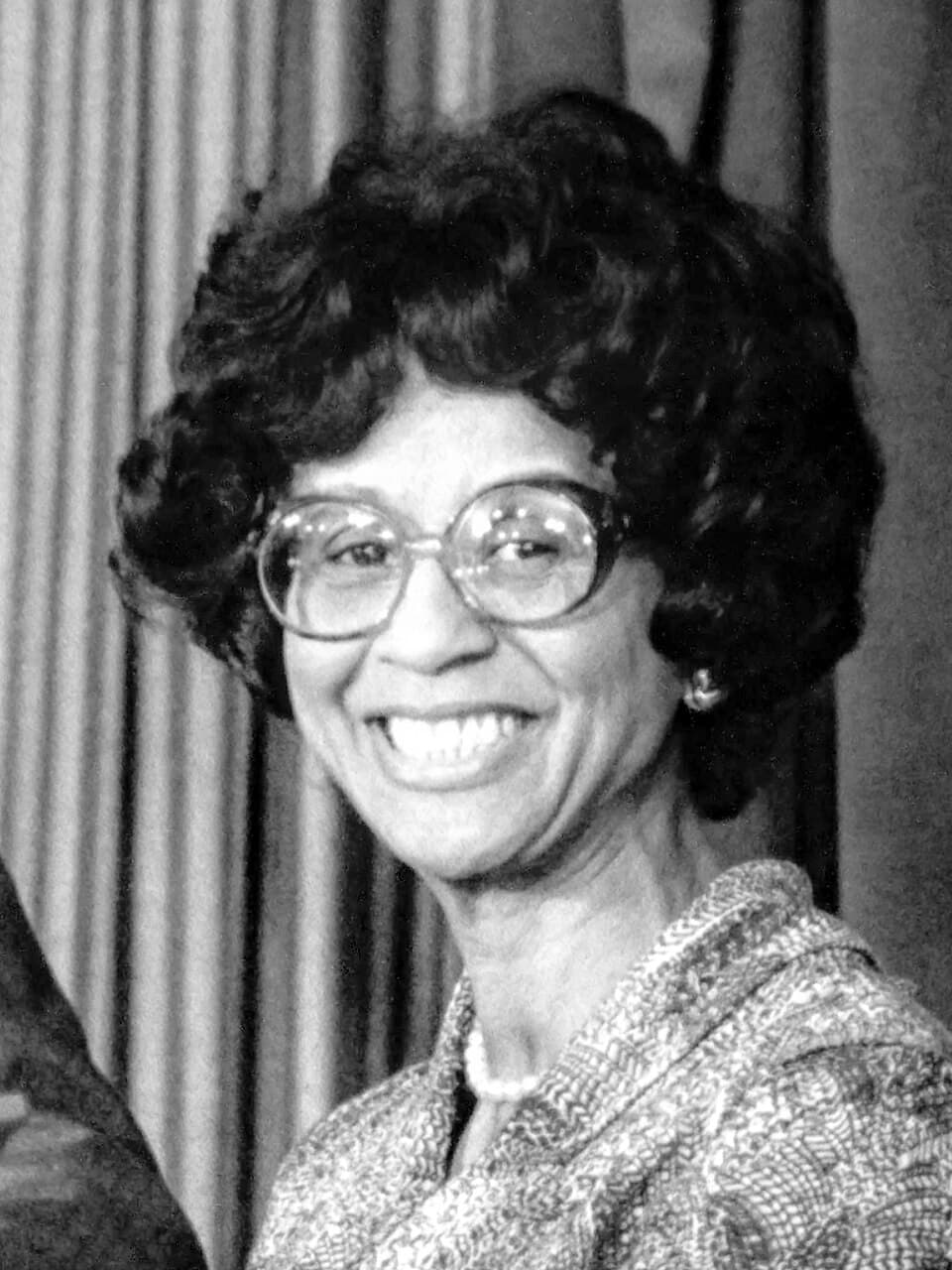
American · Law · Activism · Politics
Margaret Wilson
January 30, 1919 – August 11, 2009
Early life and family background
Margaret Bush Wilson was born on January 30, 1919, in St. Louis, Missouri, the daughter of Jesse H. Bush, a real-estate broker and activist, and Margaret Smith Bush, an educator. She grew up in a city marked by rigid racial segregation, but also by Black civic and professional life that offered models of achievement and resistance. Her parents’ work placed education, public engagement, and self-reliance at the center of her upbringing, and those values later shaped her career as a lawyer and organizer.
Wilson attended local schools in St. Louis and later pursued higher education at Lincoln University, one of the historically Black institutions that provided essential professional training for African Americans excluded from many white universities. She then entered Lincoln University School of Law, where she trained during a period when Black women aspiring to legal careers faced enormous barriers. The legal profession was still overwhelmingly white and male, and opportunities for Black women were especially limited. Wilson’s decision to pursue law placed her among a small but growing group of African-American women determined to use professional credentials as instruments of racial justice.
Entering the legal profession
After graduating from Lincoln University School of Law, Wilson passed the Missouri bar and was admitted to practice on June 4, 1943. She became the second African-American woman lawyer in Missouri, a distinction that reflected both her talent and the narrowness of opportunity in mid-century American law. Her admission to the bar was not simply a personal milestone; it was a public challenge to a legal culture that had long excluded Black women from the profession.
Wilson’s early work as a lawyer unfolded in a segregated society in which Black citizens were denied equal access to housing, employment, and public accommodations. She became part of the legal generation that translated civil-rights grievances into constitutional challenges. In this environment, lawyers like Wilson were crucial because they combined technical legal knowledge with a commitment to broader social change. Her career would soon place her at the center of a landmark Supreme Court case that attacked residential segregation.
Shelley v. Kraemer and civil-rights litigation
Wilson was part of the legal team involved in Shelley v. Kraemer, decided by the U.S. Supreme Court on May 3, 1948. The ruling held that racially restrictive housing covenants could not be enforced by state courts. This decision was a watershed in the fight against housing segregation, particularly in cities such as St. Louis, where restrictive covenants had been widely used to maintain racial boundaries.
Her involvement in the case placed her within one of the most important civil-rights legal victories of the twentieth century. The decision did not end housing discrimination, but it changed the legal landscape by preventing state enforcement of private racial exclusion agreements. For Black families seeking access to neighborhoods, schools, and better economic opportunities, the ruling was a major step forward. For Wilson, it was early evidence of the power of litigation to attack structural racism. It also demonstrated the significance of Black women lawyers in a field that still routinely marginalized them.
Political candidacy and public activism
Later in 1948, Wilson expanded her public role by becoming the first Black woman in Missouri to run for the U.S. Congress, appearing on the ballot as a Progressive Party candidate in the general election held on November 2, 1948. Although the campaign was not successful electorally, its historical importance was substantial. At a time when Black women were rarely visible in statewide or national politics, Wilson’s candidacy asserted their right to seek office and to speak directly on issues of justice, labor, and democracy.
Wilson’s candidacy was consistent with her broader belief that legal advocacy and political action were mutually reinforcing. Her willingness to seek office indicated that civil-rights work required more than courtroom victories; it also demanded public leadership and mass participation. In the late 1940s, that stance was particularly courageous for a Black woman in Missouri, where both racial prejudice and gender stereotypes shaped public life. Her campaign helped expand the boundaries of what Black women in politics could imagine and attempt.
Leadership in the NAACP
By 1958, Wilson had become a leading figure in the St. Louis branch of the NAACP, and that year she became the organization’s first female president. She led a branch of approximately 6,000 members, giving her a major platform from which to push for equal opportunity in the region. Her leadership came during a critical moment in the civil-rights movement, after Brown v. Board of Education had declared school segregation unconstitutional but before many of the decision’s promises had been fully realized on the ground.
Wilson’s presidency overlapped with the Jefferson Bank demonstrations of the early 1960s, in which activists pressed for fair hiring and access to middle-class employment for African Americans in St. Louis. Her role in those protests reflected a pragmatic civil-rights strategy focused not only on formal legal equality but also on economic opportunity. Under her leadership, the St. Louis NAACP became an important force in local struggles over jobs, education, and public institutions. The fact that she held that presidency as the first woman to do so underscored the gender barriers she overcame within the movement itself.
In 1975, Wilson reached the highest level of NAACP governance when she was elected chair of the organization’s National Board of Directors. She became the first woman and the first African-American woman to hold the post, and she would serve nine terms. Her tenure gave her influence over the strategic direction of one of the nation’s most important civil-rights organizations during a period of internal dispute and shifting political priorities. She was eventually removed from the post in 1983 after conflict with executive leadership, but her place in NAACP history was already secure. Her rise to national chair demonstrated that women’s leadership was not ancillary to civil-rights history but central to it.
Personal life
Wilson’s public career was closely tied to her family life and her role as a mother. The historical record most often emphasizes her professional and organizational achievements, but it is also notable that she navigated these responsibilities while raising a family during a period when women were still expected to shoulder the bulk of domestic labor. Her experience reflected the broader reality for many Black women activists, whose civic leadership often had to be balanced with work and family obligations. The sources provided for her life focus primarily on her public service rather than on a large body of personal detail, which itself reflects the way women’s private lives are often under-documented in historical records.
Recognition and historical importance
Wilson’s importance lies in the breadth of her barrier-breaking achievements. She was one of the earliest Black women lawyers in Missouri, a participant in a landmark Supreme Court case against segregated housing, the first Black woman in Missouri to run for Congress, the first female president of the St. Louis NAACP, and the first woman to chair the NAACP’s national board. Each of these roles carried significance on its own, but together they reveal a career devoted to opening institutions that had long excluded women and African Americans.
Her work mattered in a period when civil-rights advances were often contested and incomplete. Housing discrimination persisted after Shelley v. Kraemer; school desegregation required sustained activism after Brown v. Board of Education; and political representation for Black women remained sparse. Wilson’s life demonstrates how change happened through repeated acts of leadership across legal, political, and organizational arenas. She helped make the NAACP more inclusive and helped normalize the presence of Black women in positions of authority.
Later life and death
Wilson remained a respected civil-rights figure long after her years of formal leadership. She died on August 11, 2009, in St. Louis at the age of 90. Obituaries remembered her as a giant of the civil-rights movement and as a pioneer whose career had repeatedly pushed against the limits imposed by race and gender. Her death prompted renewed recognition of her role in Missouri and national civil-rights history.
In historical perspective, Margaret Bush Wilson’s life bridges multiple eras: the segregationist order into which she was born, the legal battles that weakened that order, and the institutional leadership that helped sustain the movement’s gains. Her career is especially significant because it shows how Black women shaped civil-rights history not only as supporters but as lawyers, candidates, branch leaders, and national officers. For women’s history, her legacy is a reminder that representation inside movements is itself a measure of democratic change.
Dated achievements
8 indexed.
- Jan301919Law
Birth of Margaret Bush Wilson
Margaret Bush Wilson was born in St. Louis, Missouri.
View details Margaret Bush Wilson Biography - Jun041943Law
Admitted to the Missouri Bar
Margaret Bush Wilson became the second African-American woman admitted to the Missouri Bar.
View details