← All women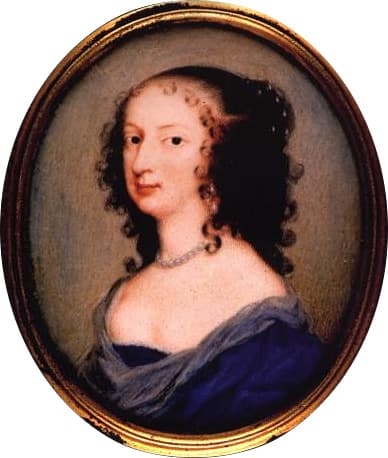
English · Literature · Science
Margaret Lucas Cavendish
1623 – December 15, 1673
Early Life and Background
Margaret Lucas Cavendish was born around 1623 at St John’s Abbey near Colchester, Essex, the youngest child of Thomas Lucas and Elizabeth Leighton Lucas.[2][3][6][10][16] Her family belonged to the prosperous Essex gentry, with strong royalist loyalties, and maintained a large household that afforded its daughters leisure and private instruction, though not formal schooling at the level available to sons.[2][6][12][14]
Her father died when Margaret was very young, leaving her mother to manage the estate and raise eight children.[12] Later autobiographical remarks suggest that Margaret received some tutoring in reading and writing but little systematic education in languages or mathematics, and she long felt intellectually insecure compared with university‑trained men.[14][16] Nonetheless, books and conversation within the household exposed her to courtly culture and to religious and political debates that would shape her later writing.
The outbreak of the English Civil Wars disrupted the Lucas family’s life. Their properties, associated with royalist sympathies, came under pressure, and records of Margaret’s exact birth date were lost in the turmoil.[16] This loss of documentation is why major reference works give her birth only as "about 1623" rather than a specific day.[1][3][4][16]
Entry into Court Circles and Exile
By the early 1640s, Margaret had moved more directly into royalist networks. In 1642, she was sent to live with one of her sisters in Oxford, where Queen Henrietta Maria and the royal court had relocated as the war intensified.[2] There Margaret became a maid of honour to the queen, joining a household that was a key node of royalist political and cultural life.[2][4][6]
In 1644, she accompanied Henrietta Maria into exile in France, after the queen fled England to seek support for the royal cause.[2][4][6] The move to Paris proved pivotal. There, Margaret came into contact with exiled royalists and continental intellectual currents, including the philosophical scene shaped by thinkers such as Descartes and Gassendi.[1][3] At the French court and in associated salons, she gained experience of aristocratic sociability and performance that later informed her plays and prose portraits.
It was in this expatriate community that she met William Cavendish, Marquess of Newcastle‑upon‑Tyne, a wealthy nobleman and former royalist commander who had left England after the defeat at Marston Moor.[2][4][6] Significantly older than Margaret, William Cavendish was a patron of the arts and letters, surrounding himself with poets, philosophers, and fencing masters. His interest in culture and learning created an environment in which Margaret’s aspirations as a writer and thinker could develop.
Marriage and Life in Exile
Margaret and William Cavendish married in exile by late 1645, making her Marchioness of Newcastle.[2][4][6] The couple’s early married life was spent in continental cities such as Rotterdam and Antwerp, where they maintained a courtly household despite strained finances following the confiscation of Cavendish estates in England.[2]
During these years, Margaret began to write extensively. The intellectual company around William, which included scholars and tutors such as the philosopher Thomas Hobbes at various points, exposed her to debates about natural philosophy, politics, and education.[1][3][7] Though she lacked formal schooling, she listened, read, and reflected on these discussions, later crediting her husband and his circle with encouraging her to publish.
Margaret’s self‑consciousness about her limited Latin and formal training did not prevent her from developing philosophical views; instead, it shaped her distinctive authorial persona. In prefaces and autobiographical passages she repeatedly acknowledges her perceived deficiencies while insisting that women have rational capacities equal to men’s and should be allowed to exercise them.[1][3][13]
Return to England and Ducal Status
The Restoration of Charles II in 1660 transformed the Cavendishes’ fortunes. William Cavendish returned to England and was created Duke of Newcastle‑upon‑Tyne in recognition of his loyalty to the crown, elevating Margaret to Duchess of Newcastle‑upon‑Tyne.[1][2][4][5] The couple set about recovering and restoring their confiscated estates, including properties at Welbeck and Bolsover.
As duchess, Margaret occupied a prominent position in the restored royalist hierarchy. She became known for her striking clothing, elaborate coach, and unconventional manners. Contemporary observers often described her as eccentric—extravagant, flirtatious, and prone to what they saw as unfeminine speech—but such accounts also testify to the visibility she achieved as a woman who refused to conform quietly to gender norms.[2][6][7]
Her status as duchess gave her resources and a social platform, but it also intensified scrutiny of her writings. When she published books under her own name, readers did not encounter an anonymous "lady" author but a titled woman whose identity and behaviour were matters of public comment. This visibility both amplified the impact of her work and made her an easy target for ridicule.
Early Publications and Literary Career
Margaret Cavendish’s published career began in the early 1650s, while she was still living abroad. In 1653 she brought out Poems, and Fancies and Philosophicall Fancies, volumes that mixed verse with speculative reflections on nature, atoms, and the structure of the cosmos.[4][13][16] These books are notable because they appeared under her own name at a time when most women published anonymously or circulated manuscripts privately.[4][7][14][16]
Poems, and Fancies includes imaginative treatments of atomism and natural order, while Philosophicall Fancies develops related ideas in prose.[13] Through these works, Cavendish introduced herself both as poet and as natural philosopher. She experimented with blending literary and philosophical modes, using verse not merely for ornament but to explore scientific concepts for a broad readership.[13][14]
In 1655, she published The Worlds Olio, a miscellany of essays, letters, and reflections on topics ranging from gender and courtly behaviour to education and the arts.[13] This book further established her as a "writer of everything," willing to address whatever subject interested her rather than restricting herself to conventionally feminine themes. Her output over the next decade would include plays, orations, and autobiographical writings, as well as natural philosophy.
Natural Philosophy and Metaphysics
Cavendish’s most sustained philosophical work focused on metaphysics and natural philosophy. Modern scholars emphasize that she was not simply a literary dabbler in science but a thinker who developed a coherent, if idiosyncratic, system.[1][3][7][15]
In Philosophical and Physical Opinions (1663), she articulated a form of materialism in which all of nature is composed of matter that is self‑moving, perceptive, and rational.[1][3][15] Rejecting both Cartesian dualism and the purely mechanical philosophy of some Royal Society members, she argued that there is no immaterial soul separate from the body and no incorporeal substances. Instead, nature is a continuous, living whole, and all change arises from the motions of matter itself.[1][15]
Her early writings show an interest in atomism, and historians credit her with being among the first in Britain to develop an original atomist theory rather than simply echoing Epicurean or Gassendist models.[1][3][15] Over time, she modified her views, moving away from strict atomism toward a more organic conception of matter, but she remained committed to the idea that the universe is thoroughly material.
In Philosophical Letters (1664), Cavendish uses the letter form to examine the systems of Descartes, Hobbes, van Helmont, and others.[1][3] She questions their assumptions, critiques their accounts of perception and cognition, and defends her own view that sense and rational knowledge arise from the motions of material parts. This work also contains reflections on method: she argues that experiment alone cannot reveal the inner nature of things, because instruments and observations are limited and must be complemented by rational speculation.[1][3]
Critique of Experimental Philosophy and "The Blazing World"
Cavendish’s engagement with the emerging experimental philosophy of the mid‑seventeenth century culminated in Observations upon Experimental Philosophy and the paired fiction The Description of a New World, Called The Blazing World, published together in 1666.[1][5][9][14]
In Observations, she scrutinizes the practices of the Royal Society and similar groups. She expresses skepticism about the reliability of microscopes and telescopes, arguing that these instruments distort as much as they reveal and that their findings must be interpreted cautiously.[1][5][14] She insists that the inner essences of things cannot be directly seen and that speculative reason is necessary to understand nature’s order.
The Blazing World, often regarded as one of the earliest examples of science fiction, presents a utopian realm reached via a passage at the North Pole.[1][5][9] Its protagonist, a young woman from our world, becomes empress of a fantastical domain populated by hybrid animal‑people who serve as scholars, soldiers, and craftsmen. The narrative features imaginative technologies, alternative political arrangements, and metaphysical discussions that mirror Cavendish’s philosophical concerns.
By publishing Observations and The Blazing World together, Cavendish deliberately paired formal philosophical critique with an imaginative experiment in alternative worlds. This strategy allowed her to explore scientific ideas while also staging a scenario in which a woman wields supreme authority in a learned society, thereby challenging contemporary gender hierarchies.[1][5][9][14]
Visit to the Royal Society
Cavendish’s relationship with the Royal Society reached a symbolic peak on 30 May 1667, when she visited the Society’s meeting rooms in London to witness experiments.[14][15] Contemporary accounts, notably the diary of Samuel Pepys, record that she arrived in a fine coach and that members conducted demonstrations with air pumps and microscopes for her inspection.[14]
Institutional and scholarly sources identify this visit as the moment when Cavendish became the first woman to attend a meeting of the Royal Society.[14][15] She was not admitted as a fellow and did not participate in formal decision‑making, but her presence in the Society’s official gathering breached norms that had kept women out of such spaces.
Pepys described the excitement around her appearance, noting that so many people came to see her "as if it were the Queen of Sweden," highlighting both her fame and the curiosity provoked by a female natural philosopher entering a male‑dominated institution.[14] Modern historians often use this episode to illustrate both the limits and possibilities of women’s participation in seventeenth‑century science—she could visit and be observed, but not join.
Other Major Works
In addition to her philosophical treatises, Cavendish wrote widely in other genres. She produced several volumes of plays, often blending allegory and social satire, and collections of orations and letters that comment on politics, gender, and morality.[7][13]
A particularly important work is The Life of the Thrice Noble, High and Puissant Prince William Cavendishe, Duke, Marquess, and Earl of Newcastle, published in 1667
Cavendish also wrote autobiographical texts, including a "True Relation" of her life, in which she reflects on her childhood, marriage, and writing. These pieces offer rare insight into a seventeenth‑century woman’s self‑presentation and into the constraints and opportunities she perceived in her society.[1][3][7] Throughout her works, Cavendish addresses gender and the position of women. She laments that women’s education is typically superficial, focused on fashion and needlework rather than substantive learning, and criticizes customs that confine women to domestic roles.[1][3][4] While she does not advocate wholesale political revolution, she repeatedly asserts that women possess rational souls equal to men’s and that they ought to be recognized as capable thinkers and writers.[1][3] In some essays and fictional episodes, she imagines alternative communities in which women can engage in philosophical discussion or exercise greater authority, anticipating later feminist utopian writing.[1][5][9] Cavendish’s marriage to William is presented in her writings as affectionate and intellectually supportive. She describes him as encouraging her to write and publish, even when she feared ridicule. At the same time, she accepts many hierarchical aspects of marital and social order, reflecting the complex mixture of conservative and radical impulses in her thought.[1][3][13] Cavendish’s contemporaries were fascinated by her. Some university scholars and philosophers praised aspects of her work, acknowledging her boldness and originality.[13] Others, particularly members of the literary establishment, mocked her style and ideas, treating her as a curiosity rather than a serious thinker.[6][7] Her elaborate dress, distinctive speech, and willingness to appear in public contributed to a reputation for eccentricity. She was said to wear fashions that drew attention and to converse in ways that seemed unconventional for a duchess. These features, which today can be read as strategies of self‑fashioning, were then often pathologized.[2][6][7] Nevertheless, she achieved a level of recognition unusual for women writers of her time. She published at least thirteen separate volumes between 1653 and 1668, many in multiple editions.[13] Modern encyclopedias describe her as one of the first prolific female science writers and highlight that she was one of the very few seventeenth‑century women to publish extensive works of natural philosophy under her own name.[7][14][15] In her final years, Cavendish continued to write, revise, and republish her works while living primarily at the Cavendish estates in the Midlands. She remained engaged with philosophical issues and with the management of her household, though less visibly active in London society than at the time of her Royal Society visit.[2][6] Margaret Cavendish died at Welbeck, Nottinghamshire, on 15 December 1673.[5][9][13] After her death she was buried in Westminster Abbey, an honour that reflected both her ducal status and the family’s prominence.[5][6][13] Her husband William outlived her, and their relationship, as portrayed in her biography of him, continued to influence perceptions of both figures. For centuries after her death, Cavendish’s reputation oscillated between curiosity and neglect. Nineteenth‑ and early twentieth‑century commentators often fixated on her eccentricities and treated her philosophical writings as quaint or confused. However, from the late twentieth century onward, scholars in philosophy, literature, and history of science have substantially revised this view.[1][3][7][13][14] Today, she is recognized as a significant early modern philosopher whose materialist metaphysics offers an important alternative to more familiar systems.[1][3][15] Her insistence that matter is self‑moving and perceptive has been reinterpreted as a sophisticated response to questions about mind, body, and causation. Philosophers now discuss her contributions to debates over determinism, free will, and the nature of rationality. In literary studies, Cavendish is celebrated as a pioneering woman writer who traversed genres—poetry, drama, autobiography, biography, essays, and speculative fiction—while publishing under her own name.[4][13][16] The Blazing World has attracted particular attention as an early example of science fiction and feminist utopian narrative, and it is frequently anthologized and taught in courses on gender and speculative literature.[1][5][9] Historians of science highlight her as one of the most visible "scientific ladies" of the seventeenth century and as a critic of the experimental program of the Royal Society.[7][14][15] Her 1667 visit to the Society and her arguments about the limitations of instruments provide a valuable perspective on the social and methodological debates surrounding the scientific revolution. Institutions such as English Heritage, the Science History Institute, and the Royal Society now feature Cavendish in exhibitions and essays on women in history and women in science.[4][14][15] Philosophical reference works—including the Stanford Encyclopedia of Philosophy and major encyclopedias—offer detailed entries on her thought, further cementing her place in the canon.[1][3][12] More broadly, Cavendish’s life and work challenge assumptions about the historical absence of women from philosophy and science. Though excluded from universities and formal membership in learned societies, she used the resources of rank, print, and imagination to participate in intellectual culture on her own terms. Her example continues to inspire efforts to recover and reassess the contributions of women in early modern Europe and to expand the narratives of the scientific and philosophical past.Views on Gender, Education, and Society
Reception, Eccentricity, and Recognition
Later Life and Death
Legacy and Historical Impact
Dated achievements
6 indexed.
- Jan011653Literature
Publication of *Poems, and Fancies*
Publication of her first book, *Poems, and Fancies*, marking her debut as a printed author.
View details English Heritage Biography - Jan011663Science
Publication of *Philosophical and Physical Opinions*
Publication of *Philosophical and Physical Opinions*, introducing Cavendish's original natural philosophy.