← All women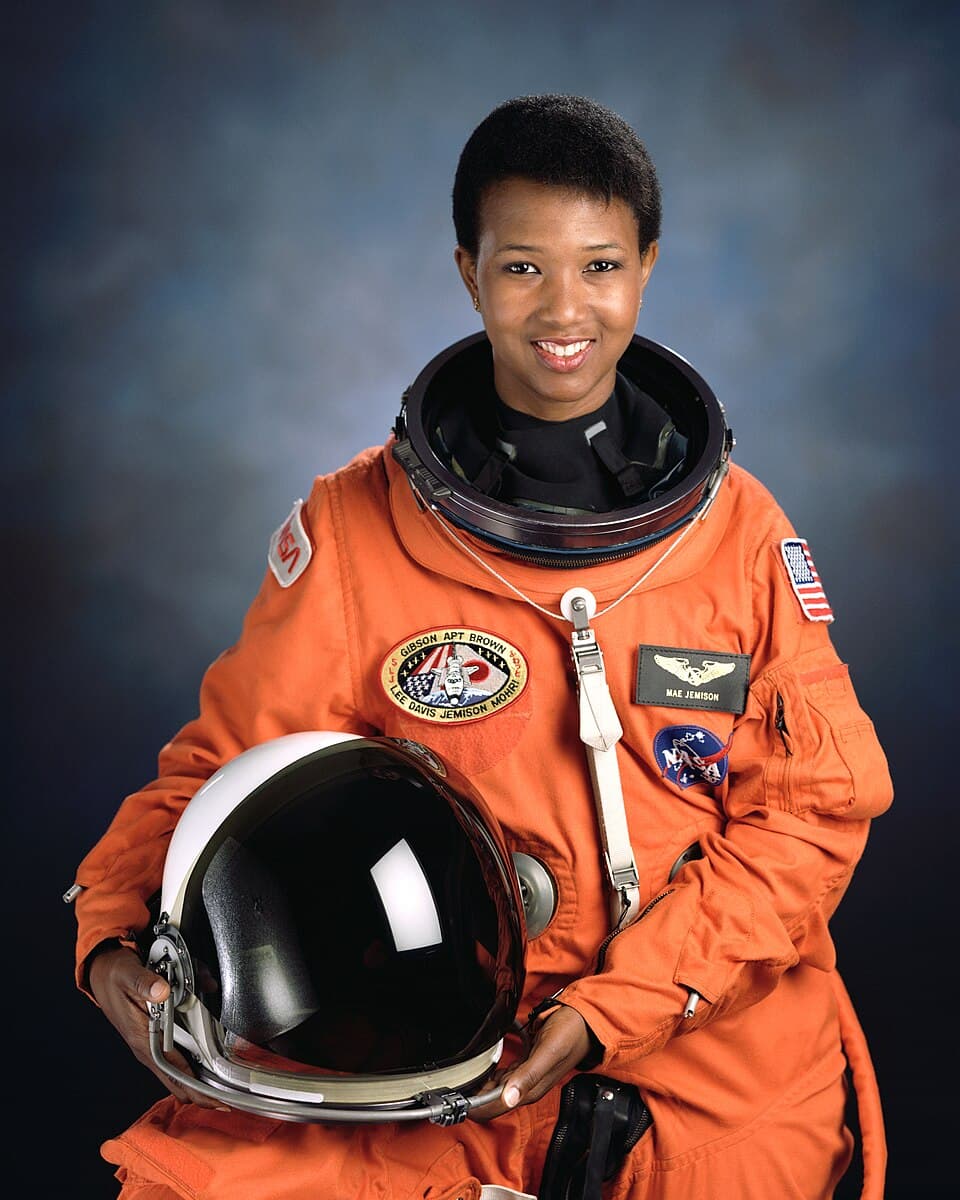
American · Science · Exploration · Medicine
Mae Jemison
October 17, 1956 – present
Early Life and Background
Mae Carol Jemison was born on October 17, 1956, in Decatur, Alabama, United States.[2][3][5] She was the youngest of three children born to Charlie Jemison, a maintenance supervisor, and Dorothy Green Jemison, an elementary school teacher.[1][5][10] When she was about three years old, the family moved to Chicago, Illinois, seeking better educational opportunities and escaping the harshest effects of Jim Crow segregation in the Deep South.[1][3][5][10] Jemison has repeatedly described Chicago as her true hometown.[5][10]
Growing up on the South Side of Chicago in the 1960s and early 1970s, Jemison was encouraged by her parents to pursue her wide-ranging interests. She was fascinated by science, space, and human biology, but also loved dance and the arts.[1][5][7] She read science fiction voraciously, including works by authors such as Arthur C. Clarke and Robert Heinlein, and watched television shows like Star Trek, where seeing the character Lieutenant Uhura, played by Nichelle Nichols, made her feel that Black people had a place in the future.[1][3][7] Jemison has noted that she was often frustrated by the absence of women and people of color in depictions of scientists or astronauts, which motivated her to imagine herself in those roles.
Jemison attended public schools in Chicago and excelled academically, especially in math and science.[1][5] She also trained in various dance forms—including African dance, jazz, modern, and ballet—and considered becoming a professional dancer.[1][5][7] Even as a teenager, she resisted stereotypes that tried to limit her interests; she later recalled that teachers sometimes assumed she would struggle in science courses, and she countered those low expectations by performing at the top of her class.
Higher Education and Medical Training
In 1973, at the age of 16, Jemison enrolled at Stanford University.[2][5][7] As a young Black woman on a predominantly white campus, she faced both racial and gender biases, but she remained active in student organizations and continued to dance, choreographing productions and participating in theater.[1][7] She pursued a demanding interdisciplinary course of study, majoring in chemical engineering while also completing a Bachelor of Arts in African and Afro-American studies.[1][2][4][5] She graduated from Stanford in 1977.[1][2][5]
Determined to combine science with direct service, Jemison then attended Cornell University Medical College (now Weill Cornell Medicine).[1][2][4][5] She earned her M.D. degree in 1981.[1][2][5] During medical school, she studied in Cuba, worked at a Cambodian refugee camp in Thailand, and undertook clinical work in Kenya.[1] These experiences deepened her interest in global health, public health systems, and the intersections of technology, medicine, and social justice.
After completing her medical degree, Jemison interned at the University of Southern California Medical Center, then worked as a general practitioner in Los Angeles.[1][2][5] She repeatedly emphasized community medicine and the importance of culturally competent care.
Peace Corps Service and Early Career
In 1983, Jemison became a medical officer with the Peace Corps, serving in Sierra Leone and Liberia.[1][2][4][5] Stationed in West Africa, she provided medical care for Peace Corps volunteers and U.S. embassy personnel, developed and implemented health-care programs, and supervised the clinic staff.[1][2] She also worked with the National Institutes of Health (NIH) and the Centers for Disease Control (CDC) on research and public health projects, including contributing to efforts related to a hepatitis B vaccine.[2]
Her Peace Corps work exposed her to challenging medical conditions, such as infectious diseases and limited-resource settings, and required substantial logistical and organizational skills. She coordinated responses to epidemics, trained local staff, and oversaw vaccination programs.[1][2] Jemison has said that this period strengthened both her clinical judgment and her ability to function under pressure—skills that later proved crucial in astronaut training and spaceflight.
Returning to the United States in the mid-1980s, she resumed medical practice and considered ways to merge her interests in engineering, medicine, and international development.[1] Around this time, she also took graduate-level engineering courses and continued dance, maintaining her belief that arts and sciences enrich one another rather than exist in opposition.
Path to NASA and Astronaut Selection
Jemison had long aspired to space travel, but it was Sally Ride’s historic 1983 flight as the first American woman in space that catalyzed her decision to apply to NASA.[1][3] She initially submitted an application in the early 1980s but was not selected. Undeterred, she applied again later in the decade.
NASA temporarily halted astronaut selection after the Space Shuttle Challenger disaster in January 1986, which killed seven crew members and led to a major re-evaluation of the shuttle program. Jemison’s candidacy was among those delayed by this pause.[10] When NASA resumed selections, she was accepted.
On June 4, 1987, Jemison was admitted to NASA’s astronaut training program, becoming the first African American woman selected for NASA’s astronaut corps.[10] Multiple sources, including NASA and historical summaries, note that she joined the astronaut corps in 1987 as part of Astronaut Group 12.[2][3][6] Her selection was a landmark event in the diversification of NASA’s human spaceflight program.
As a trainee, she underwent intensive instruction in shuttle systems, robotics, navigation, survival training, and the operation of Spacelab experiments.[5][7] She also worked in the Shuttle Avionics Integration Laboratory and performed duties related to the development of spaceflight procedures. Her medical and engineering background made her well suited to roles emphasizing life sciences and on-orbit research.
Becoming the First African American Female Astronaut
After roughly a year of training, Jemison completed the astronaut candidate program in 1988 and became a fully qualified NASA astronaut.[1][5] She is widely recognized as the first African American female astronaut, meaning the first Black woman to achieve full astronaut status and eligibility for shuttle missions.[1][5] This status represented more than symbolic inclusion; it meant she could be assigned to crews and carry out mission-critical tasks.
Jemison worked on projects supporting Space Shuttle missions and served as a science mission specialist, a role designed to emphasize scientific expertise alongside piloting and engineering skills.[5][7] According to accounts from the American Chemical Society and NASA, she was among the early astronauts to hold the title of science mission specialist, helping to institutionalize the idea that scientists and physicians should be integral members of spaceflight crews, not only engineers or test pilots.[7]
STS-47: First African American Woman in Space
In the early 1990s, Jemison was selected for STS-47, a joint U.S.–Japan mission aboard the Space Shuttle Endeavour dedicated to Spacelab science.[1][3][5] On September 12, 1992, Endeavour launched from Kennedy Space Center, carrying Jemison and six other crew members into orbit.[1][3][5]
With this launch, Jemison became the first African American woman in space and, as NASA emphasizes, the first woman of color in the world to travel into space.[1][4][9] The mission lasted nearly eight days, from September 12 to September 20, 1992, and conducted an extensive range of experiments—43 in total—across physical and life sciences.[5]
Jemison served as a mission specialist and co-investigator on several biomedical experiments, including studies of bone cell research designed to evaluate how microgravity affects bone cell growth and function.[5] She also participated in investigations of motion sickness, weightlessness, and other physiological responses to spaceflight, using her own body and those of fellow astronauts as experimental subjects.[1][5]
During STS-47, Endeavour orbited Earth 126 times, and Jemison logged 190 hours, 30 minutes, 23 seconds in space.[3][5] The shuttle landed safely on September 20, 1992, at Kennedy Space Center.[3][5] Her successful participation demonstrated that women of color could not only join astronaut ranks but lead complex multidisciplinary experiments in the demanding environment of orbit.
The mission had additional symbolic resonance. Jemison carried a photo of African American aviator Bessie Coleman to honor Coleman’s legacy, as well as a small West African mask and other items reflecting her commitment to global and African diasporic heritage.[1] These personal artifacts underscored her belief that space exploration is a shared human endeavor, enriched by diverse cultural perspectives.
Post-NASA Career: Education, Entrepreneurship, and Public Engagement
Jemison left NASA in 1993 to pursue broader work in education, entrepreneurship, and science communication.[1][2][5] Shortly afterward, she accepted a teaching appointment at Dartmouth College, where she served as a professor of environmental studies and advocated for interdisciplinary approaches that linked advanced technology, social justice, and sustainable development.[1][5]
She founded a consulting firm, Jemison Group, Inc., based in Houston, to explore applications of space technology and other advanced technologies to everyday life on Earth.[1][2][5][10] The company has worked on projects ranging from telemedicine and health-sensing technologies to educational programs designed to increase science literacy among underrepresented communities.
Later, Jemison became involved with BioSentient Corp, a medical technology company focused on wearable devices and physiological monitoring.[9] She has served in leadership and advisory roles across various organizations that emphasize innovation, STEM education, and the ethical integration of science into society.
From 1999 to 2002, Jemison was an Andrew D. White Professor-at-Large at Cornell University, a visiting role that allowed her to give lectures, consult with students and faculty, and foster interdisciplinary dialogue.[7] She has also served on corporate boards and advisory committees related to engineering, energy, and space.
The 100 Year Starship and Long-Term Vision
One of Jemison’s most prominent later initiatives is 100 Year Starship, a project originally seeded by a partnership between DARPA and NASA. In 2011, Jemison’s proposal team was selected to lead the program, which aims to catalyze the research, organization, and cultural transformation needed for humanity to achieve interstellar travel within the next century.[3][4]
Under Jemison’s leadership, the 100 Year Starship initiative has hosted symposia, published analyses, and convened a wide range of experts from astrophysics, engineering, ethics, social sciences, and the arts. The project is notable for emphasizing that the challenges of long-term space exploration are not only technical but also social and cultural—requiring inclusive participation and new modes of thinking about human futures.
Awards, Honors, and Recognition
Jemison has received numerous awards and honors recognizing her trailblazing role and contributions to science and medicine. These include induction into the National Women’s Hall of Fame, various honorary doctorates, and awards from universities, scientific societies, and civic organizations.[1][2][7] She has been featured in major media outlets and educational campaigns, including biographies produced by the National Women’s History Museum, Britannica, NASA, and other institutions.[1][2][4]
Her story is frequently used in educational materials aimed at encouraging girls and students of color to pursue STEM fields. The U.S. Department of Energy, Scholastic, museum programs, and science centers highlight her as an exemplar of interdisciplinary excellence and perseverance.[8][9][10]
Popular Culture and Public Presence
Jemison is also known for her engagement with popular culture. In 1993, she appeared in an episode of Star Trek: The Next Generation, "Second Chances," playing Lieutenant Palmer.[3] Her cameo made her the first real-life astronaut to appear on Star Trek, a fitting tribute to the television series that had inspired her as a child.[3][18] She has since participated in documentaries, interviews, and educational programming highlighting both her spaceflight experience and broader views on science and society.
She is a sought-after public speaker, delivering keynote addresses on topics such as innovation, diversity in STEM, and the importance of integrating arts and humanities with scientific education.[1][7] Through books, essays, and speeches, Jemison emphasizes that technological progress must be coupled with ethical reflection and inclusive participation if it is to benefit humanity.
Personal Life
Public sources describe Jemison as maintaining a rich personal life that includes continued involvement in dance and languages. She speaks or has studied multiple languages, including Russian, Swahili, and Japanese, reflecting her international orientation and Peace Corps experience.[7] She has said that dance remains important to her and that she has choreographed and performed in various contexts.
Jemison tends to keep details of her intimate relationships and family life private, and major biographies focus primarily on her professional and public roles. As of the mid-2020s, she is widely described as living in Houston and remaining active in professional and public engagements.[7][10]
Legacy and Historical Impact
Mae Jemison’s legacy rests on several intertwined achievements. She was the first African American woman selected for NASA’s astronaut program and the first woman of color in the world to travel into space, milestones that have enduring symbolic and practical significance.[1][2][4][5][9] Her success in a field long closed to women and people of color demonstrates the impact of civil rights and feminist movements on elite scientific institutions.
Beyond these "firsts," Jemison has consistently advocated for a broad vision of science—one that values cultural diversity, ethical responsibility, and the union of arts and sciences. Through her work in global health, technology entrepreneurship, and initiatives like 100 Year Starship, she has argued that who participates in science affects which questions are asked and which solutions are pursued.
Her life story has inspired countless students to see themselves as potential scientists, engineers, physicians, and astronauts. Educational resources from the National Women’s History Museum, museums, and school programs often feature her as a case study in overcoming barriers and integrating multiple interests to build a meaningful career.[1][10]
In women’s history, Jemison stands as a central figure in the late-20th-century expansion of women’s roles in STEM. In African American history, she embodies the movement from desegregation to genuine inclusion in high-technology fields. In the history of space exploration, she represents a shift toward crews that reflect the global human community, and toward missions that foreground scientific research and human health.
Later Life and Ongoing Work
As of the 2020s, Mae Jemison remains alive and active in public and professional life.[2][3][4] She continues to lead and advise initiatives related to advanced technology, health, and space exploration, and she frequently appears at conferences, universities, and policy forums.
Her ongoing work underscores a central theme of her career: that space exploration is not isolated from everyday concerns, but deeply connected to issues of education, health, equity, and the environment. By linking her experience as an astronaut with her commitments as a physician, engineer, and educator, Jemison has helped broaden public understanding of what it means to be a scientist and how science can serve society.
In editorial almanacs of women’s history, Mae Jemison’s biography occupies a pivotal place—as a narrative of perseverance, interdisciplinary excellence, and barrier-breaking achievement that continues to shape how future generations imagine both science and space.
Dated achievements
5 indexed.
- Oct171956Science
Birth of Mae Jemison
Mae Carol Jemison was born in Decatur, Alabama, on October 17, 1956.
View details Mae Jemison - Britannica - Jun011987Exploration
First African American Woman Selected for NASA Astronaut Program
In June 1987, Mae Jemison became the first African American woman selected into NASA's astronaut training program.