← All women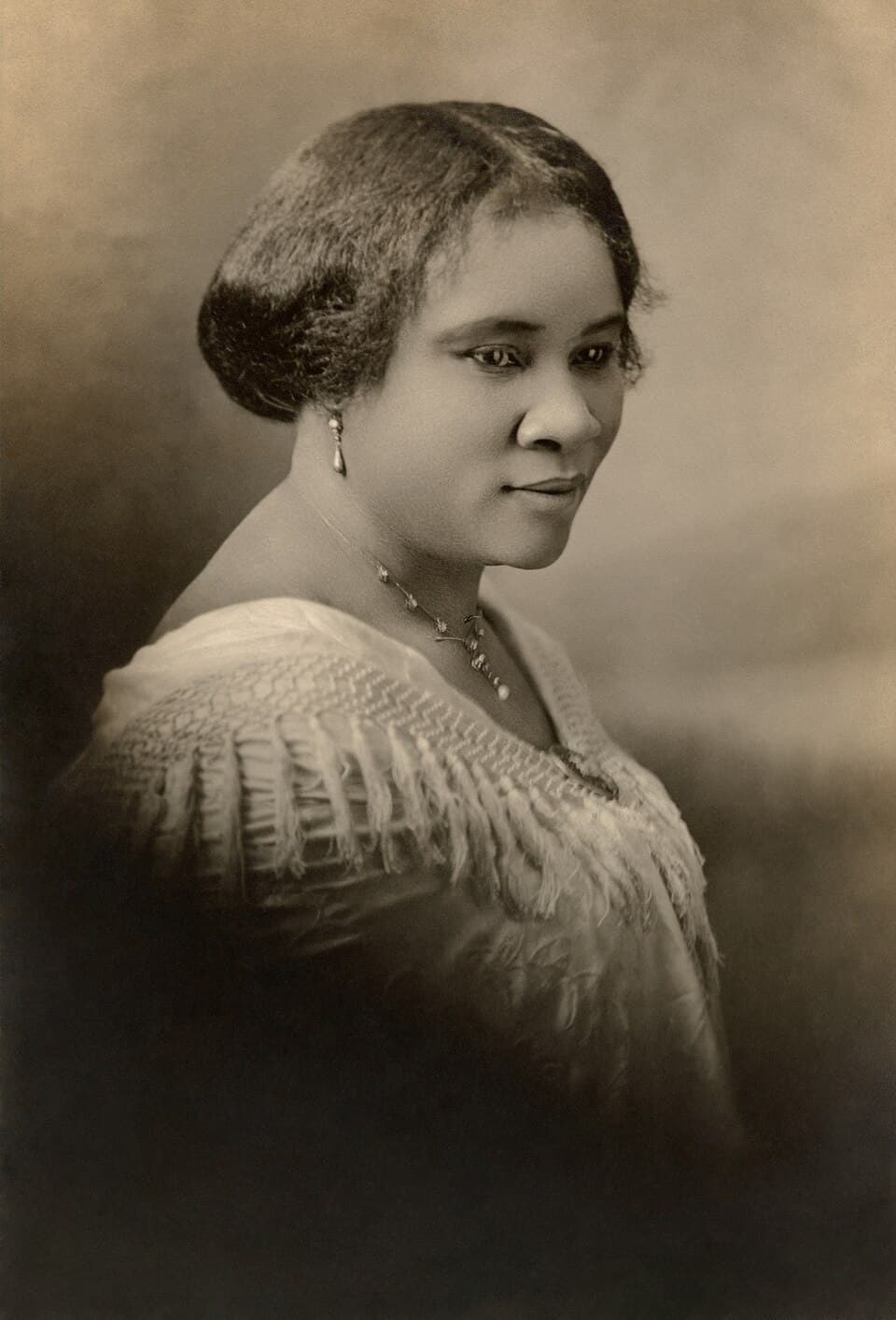
American · Activism
Madam CJ Walker
December 23, 1867 – May 25, 1919
Early Life and Background
Madam C. J. Walker, born Sarah Breedlove on December 23, 1867, entered the world on a plantation near Delta, Madison Parish, Louisiana, as the first child in her family born free after the end of American slavery.[1][2][6][11] Her parents, Owen and Minerva Anderson Breedlove, had been enslaved and became sharecroppers after the Civil War, reflecting the limited economic options available to formerly enslaved people in the rural South.[1][2][6]
Sarah was the youngest of several children—sources commonly list six—and grew up in conditions of profound poverty and racial oppression.[1][2] Around 1874, when she was still a young girl, she was orphaned by the deaths of both parents and went to live with her sister Louvenia and brother-in-law in Vicksburg, Mississippi.[2][12] In their household she worked as a domestic servant, an experience typical for Black girls and women in the post‑Reconstruction South and formative in shaping her understanding of labor, exploitation, and the need for economic independence.[1][12]
Formal schooling opportunities were scarce for African Americans in rural Louisiana and Mississippi, and Sarah received very little structured education; she later described herself as having been largely illiterate in her youth.[1][2] Nevertheless, she absorbed lessons about resilience and community from Black churches and mutual aid networks that were crucial supports for freedpeople. These early hardships—including child labor, orphanhood, and the constant threat of racial violence—would inform her later commitment to philanthropy, education, and activism for African American civil rights.[1][12]
Marriage, Motherhood, and Early Work
In 1882, at about age 14 or 15, Sarah married Moses McWilliams, likely seeking protection and stability amid the harsh environment facing young Black women in Mississippi.[2][12] The couple had a daughter, Lelia McWilliams, later known as A'Lelia Walker, who would become important in her mother’s business and in Harlem cultural life.[2][1] Around two years after their marriage, Moses died, leaving Sarah a widow in her late teens and a single mother responsible for her young child.[2][12]
After Moses’s death, Sarah moved to St. Louis, Missouri, where three of her brothers worked as barbers.[2][1] To support herself and her daughter, she worked as a laundress, earning wages often reported at about a dollar a day—barely enough to survive.[1][12] Laundry work was physically demanding and socially stigmatized, but it gave her insight into the economic realities facing Black working-class women and spurred her desire for a better life. In St. Louis, she became involved in Black church communities and women’s club networks, especially through the African Methodist Episcopal (AME) Church, which provided spiritual support, social mobility, and informal education.[1][2]
In 1894, she married John Davis in St. Louis.[2] The marriage was troubled, and she eventually left Davis; sources describe the relationship as unstable and note that her growing engagement with church and club circles coincided with her decision to end it.[2][12] During these years, Sarah began to imagine possibilities beyond domestic labor, influenced by the example of Black middle-class women who used organizational life to pursue education, entrepreneurship, and reform.[1][2]
Health Crisis and Entry into the Hair-Care Business
Like many African American women of her time, Sarah had long used harsh lye-based soaps and other damaging products on her hair.[1][3] In her early thirties, she suffered a serious scalp ailment that caused significant hair loss, an experience that deeply affected her self-image and sense of dignity.[1][3] She experimented with home remedies and commercial products, including preparations by the hair-care entrepreneur Annie Turnbo Malone, for whom she briefly worked as a sales agent.[1][2][9]
During this period, she began developing her own formula for treating scalp conditions and promoting hair growth. By the mid‑1900s, she had created a product that came to be known as Madam Walker’s Wonderful Hair Grower, along with a broader regimen of shampooing, scalp treatments, and careful grooming.[1][2][11] This regimen would later be systematized as the “Walker System” of hair care, designed specifically to address the needs of Black women’s hair and scalp health.[1][11][12]
Move to Denver and Founding of Her Business
In 1905, seeking a fresh start and new opportunities, Sarah moved to Denver, Colorado, where she began selling hair-care products and refining her own formula.[2][12] She initially worked as a cook for a pharmacist, an experience that may have helped her understand ingredients and manufacturing processes.[12] In Denver she intensified her door‑to‑door sales efforts, offering demonstrations of her treatments and cultivating a personal clientele among African American women.[1][12]
In 1906, Sarah married Charles Joseph “C. J.” Walker, a St. Louis newspaperman, and adopted the professional name “Madam C. J. Walker”.[2][1] The new name conferred an air of expertise and European-style elegance that appealed to customers and reflected conventions in the beauty culture industry. As Madam Walker, she began advertising her products widely in African American newspapers and traveling across the country to conduct lecture-demonstrations on hair care, hygiene, and self-presentation.[1][2][11]
Her business model combined direct sales, personal testimony, and a strong message of racial uplift. Walker emphasized that healthy grooming, neat appearance, and economic independence were intertwined, urging Black women to see beauty culture as a path to self-respect and social mobility in a society structured by racism and sexism.[1][12]
Expansion to Pittsburgh and Indianapolis
By 1908, Madam Walker had established a factory and hair school in Pittsburgh, Pennsylvania, often cited as an early base for training "Walker Agents" and systematizing her hair-care methods.[2][15] The Pittsburgh operation allowed her to begin manufacturing on a larger scale and to formalize instruction for women who wished to become professional hair culturists, beauticians, and product representatives.[1][11] Through this training, she framed beauty work as a respectable occupation that offered income, leadership, and community influence.
In 1910, Walker relocated her major operations to Indianapolis, Indiana, where she incorporated the Madam C. J. Walker Manufacturing Company.[2][11][17] Indianapolis offered railroad access, an established Black community, and a favorable business climate. The company’s facilities eventually included a factory, offices, laboratories, and a beauty school, making it one of the most prominent Black-owned enterprises of its era.[1][5][11] From Indianapolis, Walker’s products—shampoos, pomades, pressing oils, and toiletries—were shipped throughout the United States and to international markets.
Her enterprise relied on a network of thousands of Walker Agents, predominantly Black women, who sold products door to door and in salons, organized local clubs, and spread the Walker System. Walker’s training emphasized discipline, hygiene, customer care, and financial literacy, positioning agents as community role models and business professionals.[1][11][12]
International Reach and Business Strategies
By 1913, Madam Walker had begun international travels to promote her products in the Caribbean and Latin America, including visits to Cuba, Panama, and other locations where Black communities were receptive to her brand.[2][12] These journeys extended the reach of her company beyond the United States and underscored the transnational dimension of Black beauty culture in the early twentieth century.[1][12]
Walker was an innovative marketer. She invested in newspaper advertising, used testimonials and before‑and‑after photographs, and linked product use to modernity and racial pride.[1][11] She portrayed well‑groomed hair as a symbol of self-care and professionalism rather than assimilation, arguing that Black women deserved high-quality products tailored to their specific needs. Her company also offered mail‑order services, printed catalogs, and promotional materials that reinforced a consistent brand identity.[1][11][17]
Despite popular myths, historians and primary records show that Walker did not hold the original patents for the straightening comb, hot comb, or permanent wave machine. In 1913, she filed a patent application for a "hair drying and straightening comb," but did not complete the process, and no granted patent appears in her name.[2][6] The first U.S. patent for a comb specifically designed to straighten curly or kinky hair was granted in 1920 to Walter H. Sammons.[2][7] In 1928, her employee Marjorie Stewart Joyner patented a permanent wave machine, with rights assigned to the Madam C. J. Walker Company, but the patents credit Joyner as inventor, not Walker.[3][5][11] These clarifications are important for accurately understanding her contributions as an entrepreneur rather than as a technical inventor.
Philanthropy, Activism, and Civic Leadership
As her wealth grew, Madam Walker became a prominent philanthropist and activist. She donated generously to African American institutions, including Black schools, orphanages, and churches, and became a patron of the arts.[1][11][13] She is frequently noted for her substantial support of the YMCA in Indianapolis; one widely cited example is her large contribution to the construction of a new Black YMCA in the 1910s.[1][5][16] She also contributed to organizations such as the NAACP, funding anti‑lynching campaigns and supporting legal challenges to racial violence.[1][11]
Walker used her platform to advocate for racial justice and women’s economic independence. She encouraged her agents and customers to become politically engaged, telling them that their success should translate into community uplift and civic responsibility.[1][11] She spoke at gatherings of Black leaders and at women’s club meetings, arguing that Black women must organize for better wages, educational opportunities, and civil rights.
In 1917, she hosted and presided over a convention of the Madam C. J. Walker Hair Culturists Union of America in Philadelphia, which is often described as one of the first national meetings of female entrepreneurs and beauty culturists.[2][12][16] Delegates discussed business strategies, social issues, and philanthropic initiatives, underscoring Walker’s insistence that commercial success should be linked to collective advancement.
Villa Lewaro and Cultural Influence
In the late 1910s, Madam Walker commissioned the construction of a grand mansion in Irvington-on-Hudson, New York, known as Villa Lewaro, designed by Black architect Vertner Tandy, a co‑founder of Alpha Phi Alpha fraternity.[1][2][11] Completed around 1918, Villa Lewaro became both a private residence and an important social and political gathering place.[2][11][16]
At Villa Lewaro, Walker hosted Black intellectuals, artists, and civil rights leaders. The estate symbolized the possibilities of Black wealth and achievement during the Jim Crow era and challenged prevailing stereotypes about African American capabilities and social status.[1][11] It also demonstrated her commitment to spending her fortune in ways that had symbolic and practical meaning for the broader community.
Walker’s only child, A’Lelia Walker, played a key role in sustaining the home’s status as a cultural hub. After Madam Walker’s death, A’Lelia became a notable figure in Harlem, associated with the Harlem Renaissance and remembered for hosting salons that brought together writers, musicians, and artists.[1][2] The connection between the Walker enterprise and Harlem’s cultural flowering further enhanced Madam Walker’s legacy.
Awards, Honors, and Contemporary Recognition
During her lifetime, Madam C. J. Walker received recognition within African American communities, including commendations from churches, fraternal orders, and civic organizations that benefited from her donations and leadership.[1][11] She was celebrated in Black newspapers as a model of race pride, business acumen, and feminine respectability.
After her death, her reputation grew. The Guinness Book of World Records has recorded her as the first woman to become a self‑made millionaire in America, though historians caution that precise wealth comparisons and dates of achieving millionaire status are difficult to verify and that she should be understood as among the earliest and most prominent female self‑made millionaires.[2][13] Institutions such as the National Women’s History Museum, the Library of Congress, and the National Park Service now feature her as a central figure in exhibits and educational materials on women’s history, entrepreneurship, and civil rights.[1][5][11]
Her life has been the subject of extensive scholarly research, most notably in the biography On Her Own Ground by her great‑great-granddaughter A’Lelia Bundles, which provides detailed documentation of her business strategies, activism, and family life.[7][6] Popular media have also embraced her story, including television dramatizations and documentaries that situate her in broader narratives about Black women’s leadership and the history of the beauty industry.
Personal Life
Madam Walker’s personal life was shaped by the demands of business and the constraints of her era. Her first marriage to Moses McWilliams brought her daughter A’Lelia and ended with his early death.[2][12] Her second marriage to John Davis in 1894 was marked by instability, and she left Davis as her aspirations and involvement in community networks grew.[2][12] Her third marriage, to Charles J. Walker in 1906, was closely tied to her business persona: she adopted his surname and the "Madam" title as part of her brand, and he assisted with advertising and promotion.[2][1]
Over time, the marital relationship with Charles Walker also became strained, and they eventually separated, though she continued to use the name Madam C. J. Walker professionally.[2] She devoted much of her energy to her company, her agents, and her philanthropic work. Her bond with her daughter A’Lelia remained central; A’Lelia served in executive roles in the company and inherited significant responsibilities for the business and estate after Madam Walker’s death.[1][2]
Later Life, Illness, and Death
In her later years, Madam Walker balanced her expanding business, public speaking, and philanthropy with increasing health challenges. She suffered from hypertension, a condition not yet well understood or effectively treated, and eventually experienced kidney failure.[3][13] Despite her illness, she continued to travel, oversee company matters, and engage in civic work.
On May 25, 1919, she died at Villa Lewaro in Irvington-on-Hudson, New York.[2][3][12] Sources describe her cause of death as complications from hypertension and kidney failure. At the time, she was widely considered the wealthiest African American businesswoman and the wealthiest self‑made Black woman in America.[2][11] Her estate included the manufacturing company, real property, and substantial resources that were directed, in part, toward educational and charitable purposes.
Legacy and Historical Impact
Madam C. J. Walker’s legacy encompasses entrepreneurship, gender and race politics, philanthropy, and cultural influence. She demonstrated that a Black woman, born into poverty to formerly enslaved parents, could build a large-scale enterprise, employ and train thousands of workers, and use her wealth to challenge racial inequality.[1][11][12] Her emphasis on beauty culture as a site of empowerment reshaped the economics and social meaning of Black women’s grooming practices.
Through the Walker System and the network of Walker Agents, she offered one of the earliest mass opportunities for Black women’s business participation, providing them with education, income, and managerial experience at a time when mainstream labor markets routinely excluded them from skilled and professional work.[1][11] Her speeches and organizational activities linked economic independence to political activism, influencing subsequent generations of Black women entrepreneurs and community leaders.
Historically, she occupies a complex place in discussions of respectability politics and beauty standards. Some critics have questioned whether straightening and styling hair reinforced Eurocentric norms, while others emphasize that Walker framed her products around health, cleanliness, and self-determination rather than assimilation.[1][9] The ongoing debates about her work reflect broader tensions in the history of Black aesthetics and commerce.
Institutionally, her name endures in the Madam C. J. Walker Manufacturing Company, in preserved sites such as the Walker Building in Indianapolis, and in educational programs that use her story to teach students about entrepreneurship, resilience, and social responsibility.[5][17][8] Scholars and public historians continue to refine and correct popular narratives about her life, addressing misconceptions about patents and "firsts" while affirming her documented accomplishments.
In the broader landscape of women’s history, Madam C. J. Walker stands as a pivotal figure in the emergence of a Black female business class in the United States. Her life illustrates how beauty culture, consumer markets, and civic activism intersected in the early twentieth century, and how one woman used those intersections to carve out unprecedented space for herself and for countless other African American women striving for economic and social power.
Dated achievements
2 indexed.
- Dec231867Activism
Birth of Sarah Breedlove (Madam C. J. Walker)
Sarah Breedlove, later known as Madam C. J. Walker, was born near Delta, Madison Parish, Louisiana, the first free-born child in her family.
View details Madam C. J. Walker - Wikipedia - May251919Activism
Death of Madam C. J. Walker at Villa Lewaro
Madam C. J. Walker died at age 51 at her Villa Lewaro estate in Irvington-on-Hudson, New York, from complications of hypertension and kidney failure.