← All women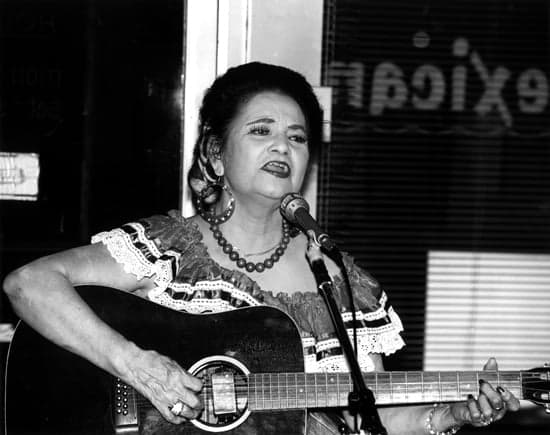
American · Arts
Lydia Mendoza
1916 – December 20, 2007
Early Life and Background
Lydia Mendoza was born in Houston, Texas, in May 1916, in the Houston Heights neighborhood, to Mexican immigrant parents Francisco and Leonora Mendoza.[7][11][14] Her family had fled the upheavals of the Mexican Revolution and settled in Texas, joining growing communities of Mexican‑origin laborers and artisans in the U.S. Southwest.[6][11] Reliable sources disagree on her exact birth date: some give May 13, others May 21, and others May 31, and the Texas State Historical Association lists only the month of May without a specific day.[1][3][4][5][7][11] In light of these contradictions, historians generally accept May 1916 as her birth month and year, but not a precise day.
Mendoza grew up in a profoundly musical family. Her parents and relatives played and sang traditional Mexican songs, corridos, and waltzes, passing on repertoire from northern Mexico and the borderlands.[7][14] According to Women in Texas History, by the age of four she was already fashioning her own makeshift guitar from wood, nails, and rubber bands, an early sign of her determination to make music despite poverty and limited resources.[14] The family’s economic situation remained precarious; they often supplemented meager earnings with street performances in Houston and other Texas towns.
Her parents formed a family group that would become known as El Cuarteto Carta Blanca (sometimes called La Cuarteto Carta Blanca), with Mendoza taking on instrumental and later vocal roles as a child.[12][14] Instead of formal schooling in conservatories, she learned music informally in kitchens, markets, and plazas, absorbing vocal techniques, guitar accompaniment, and a vast songbook of romantic ballads and narrative corridos. This grassroots apprenticeship grounded her style firmly in working‑class Mexican‑American culture and later shaped her identity as "La Cancionera de los Pobres"—the Songstress of the Poor.[2][7]
Career Beginnings: Street Performances and First Recordings
During the 1920s, the Mendoza family traveled widely as migrant workers, following seasonal labor across Texas and the Midwest.[14] They performed on street corners, in open‑air markets, and at informal gatherings, combining music with agricultural and industrial work to survive. These itinerant years immersed Lydia in the daily realities of Mexican‑American laborers and exposed her to diverse regional styles.
A turning point came in 1928, when El Cuarteto Carta Blanca auditioned for the Okeh record label in San Antonio and won a contract.[12][14] In a makeshift studio set up in a hotel room, the family recorded twenty songs for $140—a substantial sum for migrant musicians.[14] Lydia, about twelve years old, played violin and possibly contributed vocals. This session, documented by ethnomusicologists and by Smithsonian Folkways, is recognized as Mendoza’s entry into the commercial recording world and the beginning of a career that would span nearly sixty years.[12]
After the Okeh recordings, the family continued to travel, including to Michigan as migrant laborers, before returning to San Antonio in the early 1930s.[14] In San Antonio, they resumed public performances, particularly in Plaza del Zacate, an informal market space where Mexican‑American vendors and musicians gathered. There, Lydia refined her presence as both singer and guitarist, performing for coins from audiences that included newly arrived immigrants, railroad workers, and domestic laborers.[14]
At this stage, her music remained a family enterprise supervised by her father, who handled contracts and finances. Later accounts stress that his vigilance protected her from exploitation by record companies, a serious concern for Spanish‑language artists in an era of minimal regulation and widespread discrimination.[15]
Breakthrough: "Mal Hombre" and Regional Stardom
Mendoza’s transition from ensemble member to solo star came in the mid‑1930s. In San Antonio she auditioned for the Spanish‑language radio program La Voz Latina and began appearing regularly, showcasing her voice and self‑accompanied guitar work.[9][12] Through these radio appearances she built a following and attracted the attention of talent scouts for Bluebird Records, a subsidiary of RCA Victor that sought to tap the growing Mexican‑American market.
In 1934, she recorded "Mal Hombre" for Bluebird in San Antonio.[3][7][9][12][14] Accompanying herself on her trademark twelve‑string guitar, she delivered a tango‑influenced ballad whose lyrics portray a cruel man and the suffering he inflicts. The song’s stark emotionalism, coupled with Mendoza’s clear, plaintive vocal delivery, resonated powerfully with audiences along the Texas‑Mexico border and beyond. Within a short time, "Mal Hombre" was widely recognized as her signature song and first major hit.[3][7][9]
The success of "Mal Hombre" elevated Lydia Mendoza from local performer to regional celebrity. She began touring more extensively across Texas and the U.S. Southwest, appearing in theaters, dance halls, and festivals. Her records circulated on 78 rpm discs and over radio, making her voice familiar to listeners in both urban barrios and rural communities.[9][11] Scholars and journalists describe her as the first star of recorded Tejano and norteño music in the United States, and the first woman in the Hispanic Southwest to achieve such widespread fame as a singer.[4][9][11]
At a time when Spanish‑language performers were largely marginalized, her stardom was remarkable. She sang exclusively in Spanish, yet became a major figure in U.S. popular music in the borderlands.[2][9] Her success also challenged gender norms: she appeared publicly as a professional musician, traveled widely, and headlined shows in an industry dominated by male artists. This breakthrough earned her enduring sobriquets such as "La Alondra de la Frontera" (The Lark of the Border), "La Cancionera de los Pobres" (The Songstress of the Poor), and later "La Gloria de Texas" (The Glory of Texas).[2][7][11]
Consolidation of a Career: 1930s–1950s
Through the late 1930s and 1940s, Mendoza’s popularity grew throughout Texas, the broader Southwest, and northern Mexico. She recorded numerous sides for labels such as Bluebird and performed on border radio stations that broadcast widely on both sides of the Rio Grande.[2][9] Her repertoire included romantic canciones, corridos, polkas, and tangos, often focusing on themes of love, betrayal, poverty, and migration—topics that reflected her audience’s lived experiences.
Her performance style combined a powerful yet intimate voice with the distinctive sound of the twelve‑string guitar, which provided rich harmonic and rhythmic support. Unlike some contemporaries who relied on full orchestras or conjuntos, Mendoza often appeared as a soloist, exploring the expressive possibilities of voice and guitar alone.[2][12] This minimalist format intensified the emotional impact of her songs and helped define the aesthetic of early Tejano music.
On August 17, 1950, Mendoza held her first recording session for Falcon Records, a Texas label that specialized in Spanish‑language music.[12] Her move to Falcon signaled a shift toward labels rooted in Mexican‑American communities and strengthened her role in the evolving Tejano and conjunto industries. Falcon’s distribution network helped spread her music further across the borderlands, while allowing her to continue singing in Spanish for primarily Latino audiences.
Across these decades she recorded hundreds of songs, including classics such as "Delgadina" and "Amor de Madre," and made thousands of personal appearances.[2][12][16] She was particularly beloved in working‑class neighborhoods, where listeners identified with her narratives and appreciated the dignity she accorded to ordinary lives. Nicknames such as "Songstress of the Poor" reflected this connection and set her apart from more commercialized pop singers.[2][11]
Major Works, Highlights, and Public Recognition
Mendoza’s discography, spanning from her 1928 family recordings to her final documented performance in 1986, includes a wide array of genres and themes. "Mal Hombre" remained her calling card, but songs like "Pero Qué Triste" and "Angel de Mis Anhelos" also became favorites.[3][15] She often reinterpreted traditional Mexican songs, lending them new emotional depth through her phrasing and guitar work.
Her influence extended beyond recordings. She performed at major public events, including the inauguration of President Jimmy Carter in 1977, where her presence symbolized the growing recognition of Latino cultures in national life.[5][14] By this time she was already regarded as an elder stateswoman of Tejano music, a living bridge between early borderlands recording culture and contemporary Chicano and Tejano scenes.
In 1982, Mendoza received the National Heritage Fellowship from the National Endowment for the Arts, one of the United States’ highest honors for folk and traditional artists.[1][12] The award recognized her "long, groundbreaking career" and her role in uniting intimate, family song styles from northern Mexico with commercial performance practices.[12] Though the exact presentation date is not firmly documented in accessible sources, the fellowship placed her among a select group of master traditional artists whose work is deemed vital to the American cultural heritage.
She was inducted into the Texas Women’s Hall of Fame in 1985 and became the first Tejana admitted into the Conjunto Hall of Fame in 1991.[12] In 1999 she received the National Medal of Arts, further cementing her status as a national cultural figure and acknowledging the centrality of Mexican‑American and Tejano traditions in the U.S. arts landscape.[5][14]
Mendoza’s last documented recording is a live performance in Santa Barbara, California, on April 27, 1986, preserved on compact disc and analyzed by scholars as the concluding entry in her official discography.[6][12] This concert captures her mature artistry and demonstrates the continued appeal of her music to Mexican‑American communities far beyond Texas.
Awards, Honors, and Titles
Over the course of her career, Lydia Mendoza accumulated a remarkable list of awards and symbolic titles:
- National Heritage Fellowship (NEA), 1982, recognizing her as a master of traditional arts.[1][12]
- Texas Women’s Hall of Fame induction, 1985, honoring her contributions to Texas history and culture.[12]
- Conjunto Hall of Fame induction as the first Tejana member, 1991, underscoring her pioneering role as a woman in the genre.[12]
- National Medal of Arts, 1999, one of the highest U.S. artistic honors, for her impact on American music.[5][14]
Beyond formal awards, she was widely referred to as the "First Lady" or "First Queen" of Tejano music, "La Alondra de la Frontera," "La Cancionera de los Pobres," and "La Gloria de Texas."[2][6][7][11][16] These honorifics reflected both popular affection and scholarly recognition of her role as the earliest major female star in the Tejano tradition.
Personal Life
Details of Mendoza’s personal life are less extensively documented than her musical career, but available sources note that she married and had children, balancing family responsibilities with extensive touring and recording.[5][15] Ebsco’s research starter mentions the loss of her first husband, a personal tragedy she endured while continuing to perform and provide for her family.[5]
She spent much of her later life in modest circumstances, living in a small bungalow in Houston Heights according to a biographical note on IMDb.[15] Her home life, like her music, remained closely tied to working‑class Mexican‑American neighborhoods. Even as she received national accolades, she maintained an unpretentious lifestyle that resonated with the audiences she had sung for across decades.
In her final years she suffered a stroke that eventually cost her both her singing voice and her ability to play guitar.[14][15] This forced retirement from active performance was a poignant end to a life so thoroughly defined by music. Nevertheless, she continued to be honored by communities, festivals, and institutions that recognized her enduring influence.
Later Life and Death
By the late twentieth century, Mendoza was a revered elder of Tejano and Mexican‑American music. She appeared at heritage festivals, received tributes in documentaries and radio programs, and was the subject of scholarly studies that placed her within broader narratives of borderlands culture and women’s history.[6][9][11]
Her final documented public recording, the 1986 Santa Barbara concert, effectively closed her recording career, though she continued to appear publicly for some years thereafter.[6][12] After suffering a stroke in the late 1980s, she gradually withdrew from performance.[14][15] Yet her recordings remained in circulation through reissues, and younger artists discovered her work via archival releases and radio retrospectives.
On December 20, 2007, Lydia Mendoza died in San Antonio, Texas, at the age of ninety‑one.[3][7][13] Obituaries noted her as one of the most important figures in Tejano and Mexican‑American music, emphasizing her role as a voice for the poor and marginalized. The Texas State Historical Association and other sources record San Antonio—the city where her early fame blossomed—as the place of her death.[7][13]
Legacy and Historical Impact
Lydia Mendoza’s legacy is multifaceted, encompassing musical innovation, cultural representation, and gender history. Musically, she helped define the sound of early Tejano and norteño music in the United States, combining Mexican song forms with the twelve‑string guitar and a highly expressive vocal style.[2][6][12] Her approach influenced countless singers and guitarists, many of whom cite her as a foundational inspiration.
Culturally, Mendoza gave voice to Mexican‑American working‑class experiences at a time when they were largely absent from mainstream U.S. media. Her songs articulated themes of migration, hardship, and emotional resilience, allowing listeners to hear their lives reflected in art.[2][6][9] As a woman performing publicly in Spanish and achieving broad fame, she broke significant barriers in both the music industry and Latino communities, challenging assumptions about women’s roles and capacities.
Historians and critics have described her as "The Mother of Tejano Music" and the first female icon of the genre.[3][6][11] Her career helps scholars trace the evolution of Mexican‑American music from street corners and hotel‑room studios to major labels, national awards, and academic recognition. The fact that she received the National Heritage Fellowship and National Medal of Arts underscores how far these traditions have come—from marginal status to national cultural treasure.
Her story is central to women’s history in the United States. She demonstrated that a Latina from a poor immigrant family could shape a major musical tradition and earn enduring fame without abandoning her language or community. Later stars such as Selena Quintanilla‑Pérez emerged in a landscape that Mendoza helped create, where female Tejano singers could be understood as icons rather than exceptions.[6][11]
Today, her recordings are preserved in collections such as the Strachwitz Frontera Collection at UCLA and in the catalogs of Smithsonian Folkways and other archival labels.[2][12] Scholarly articles, biographies, and radio programs continue to explore her life and work, ensuring that her contributions remain visible to new generations of listeners and researchers.
Assessment in Women’s History
In the context of women’s history, Lydia Mendoza stands as a pioneering figure who intersected multiple axes of identity: gender, ethnicity, class, and language. She was not merely a successful singer; she was a trailblazer who demonstrated that women of color, singing in a minority language, could achieve lasting celebrity and artistic authority.
Her career illuminates the roles of women in family‑based musical enterprises, the ways in which they navigated patriarchal controls (such as her father’s management of contracts) while asserting their own artistic agency, and the significance of domestic and community spaces as incubators of artistic talent.[7][14][15] It also highlights how public performance could both challenge and reinforce traditional gender norms in Mexican‑American communities.
For historians of the United States and the borderlands, Mendoza offers a case study in how cultural production can serve as a form of resilience and resistance. Through her songs, she carved out expressive space for the poor, the migrant, and the marginalized, using music to assert presence in a society that often rendered Mexican‑Americans invisible. Her induction into multiple halls of fame and her receipt of national arts awards reflect a belated but meaningful institutional recognition of that role.
As research continues to uncover more details about her life, Lydia Mendoza remains a central figure in any editorial almanac of women’s history—a woman whose voice carried across borders, decades, and social divides, and whose legacy continues to shape the soundscape of the American Southwest.
Dated achievements
7 indexed.
- May011916Arts
Born in Houston, Texas
Lydia Mendoza was born in Houston, Texas, marking the start of her journey towards becoming a Tejano music icon.
View details Handbook of Texas Online - Jan011928Arts
Recording career begins with El Cuarteto Carta Blanca
At about 12, Lydia Mendoza began her recording career with her family's ensemble in San Antonio, Texas.