← All women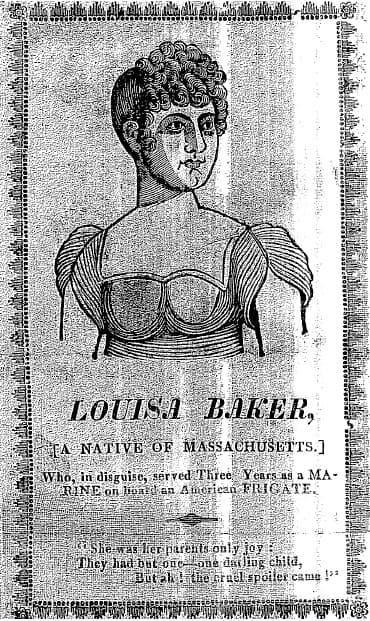
American (fictional persona) · Literature · Activism
Lucy Brewer
Unknown – present
Overview
Lucy Brewer is a historically significant but fictional figure associated with early nineteenth‑century American pamphlet literature and later U.S. Marine Corps folklore.[1][3][7] Presented in popular tracts as a young woman who disguised herself as a man and served for three years as a Marine sharpshooter aboard the frigate USS Constitution during the War of 1812, Brewer was long celebrated in legend as the first woman Marine.[1][2][6][12] Modern scholarship and official Marine Corps historiography, however, have demonstrated that "Lucy Brewer" is best understood as a pen name or persona attached to a series of sensational pamphlets, likely written by Nathaniel Hill Wright and published by Nathaniel Coverly Jr. in Boston around 1815–1816.[3][7][8][11]
No archival evidence supports the existence of a real woman matching the biography given in the pamphlets, and researchers have confirmed that no woman fought aboard Constitution in the War of 1812.[3][8][11] Nonetheless, the figure of Lucy Brewer has had lasting impact on U.S. cultural and military history. Her story shaped nineteenth‑century understandings of gender, sexuality, and patriotism; it later informed Marine Corps recruiting rhetoric; and, even after being officially classified as fiction in the 1960s, it continues to be invoked as a symbol of women’s fighting spirit and desire to serve.[2][4][6][9][11]
Early Life and Background (within the fictional narrative)
In the pamphlets marketed as The Female Marine; or the Adventures of Miss Lucy Brewer, the heroine is introduced as a farm girl from Plymouth, Massachusetts, born in the late eighteenth century.[1][6][12] According to the narrative, she grows up in a modest rural household, receiving limited formal education but acquiring strong moral instruction and a sense of duty. As a teenager, Brewer allegedly falls in love with a local young man who seduces her, gets her pregnant, and abandons her rather than marrying her.[6][12] Facing social disgrace and unable to remain with her family, she is said to flee to Boston.
In Boston, the story claims, Brewer is lured into prostitution in one of the city’s brothels, where she experiences exploitation and comes to view sex work as degrading and dangerous.[6][7][12] After a period of disillusionment, she resolves to escape this life. Seeking both refuge and a chance to redeem herself, she purportedly cuts her hair, adopts male clothing, and assumes the alias George Baker.[3][6][11][12] The narrative presents this gender disguise as a daring act of autonomy, allowing the heroine to enter spaces otherwise closed to women.
It is crucial to emphasize that all of these details stem from the literary plot. Modern historians have found no corroborating records for a Lucy Brewer, Eliza Bowen, Louisa Baker, or George Baker matching the pamphlets’ claims, nor for the supposed husband "Mr. West" mentioned in some editions.[3][6][11][12] These biographical elements are therefore analyzed today as part of a constructed moral and adventure tale, not as verifiable history.
Career Beginnings and Development: From Pamphlet Heroine to "Female Marine"
Within the fictional narrative, Brewer’s "career" begins when she enlists in the U.S. Marine Corps under the male alias George Baker and is assigned as a shipboard Marine aboard USS Constitution during the War of 1812.[1][2][3][6][12] The pamphlets describe her training as a sharpshooter and her participation in key naval engagements, including Constitution’s famous battles with HMS Guerriere and HMS Java.[2][7][11][12]
As a Marine aboard "Old Ironsides," she is portrayed as brave, disciplined, and exceptionally accurate with her musket, earning the respect of her fellow Marines who remain unaware of her true sex. The story emphasizes the physical hardship and close quarters of life on a wooden warship, using these descriptions both to heighten dramatic tension and to underscore the supposed difficulty of maintaining a gender disguise in such conditions.[2][6][11][12]
After three years of service in disguise, the narrative claims, she receives an honorable discharge and returns to civilian life.[6][12] In some versions, she fights a duel at Newport with a young midshipman, further displaying her martial prowess.[12] Ultimately, she confesses her true identity, repents of her earlier prostitution, and marries a respectable man (often named Mr. West), settling into domestic life as a redeemed woman.[6][7][12]
This arc—from fallen woman to disguised soldier to morally reformed wife—follows common patterns in early nineteenth‑century "awful beacon" literature, which used sensational plots to warn readers against vice while still providing entertainment.[7][11][12] Brewer’s supposed Marine "career," therefore, functions as a narrative device rather than a record of genuine service.
Authorship, Major Works, and Publication History
The central text associated with Lucy Brewer is The Female Marine; or the Adventures of Miss Lucy Brewer, first published as a series of pamphlets by Boston printer and publisher Nathaniel Coverly Jr. around 1815.[7][11][12] Advertisements presented the work as Brewer’s own autobiography, and early readers appear to have accepted at least some of its claims as fact. The pamphlets were marketed to a broad audience in Boston and throughout New England, sold cheaply and sometimes bundled with other moral tracts.
Supplementary and sequel pamphlets soon followed. Between 1815 and roughly 1816, Coverly issued additional narratives featuring the heroine under related names, including An Affecting Narrative of Louisa Baker (also referred to as Lucy Brewer), and further pamphlets elaborating on her adventures, repentance, and marriage.[7][8][11] These texts were reprinted many times; the USS Constitution Museum notes at least twenty‑one editions within three years of the initial release, attesting to their popularity in the period.[11]
Modern scholars have examined stylistic and publishing evidence to identify the probable author. The consensus is that the Brewer/Baker narratives were likely written by Nathaniel Hill Wright (1787–1824), a clergyman and writer, working in collaboration with Coverly.[3][10][11] Wright’s involvement explains the texts’ blend of moral admonition and sensational content: they warn about seduction, prostitution, and gambling while also providing vivid descriptions of battles and duels.
These pamphlets belong to a broader genre of early American popular literature that includes "confessions," "awful beacons," and pseudo‑autobiographical accounts of fallen and redeemed women. Brewer’s story stands out within this corpus because it explicitly connects female virtue and vice to military service and national honor, situating her redemption within a patriotic narrative of the War of 1812.[7][11][12]
Reception, Legend Formation, and Official Debate
In the nineteenth century, the Brewer pamphlets circulated widely, but their status hovered between entertainment and potential fact. Some readers treated them as cautionary tales, focusing on the moral lessons about seduction and prostitution. Others embraced the vision of a woman fighting for her country, seeing Brewer as an exemplar of female courage and independence.[2][6][11]
Over time, the figure of Lucy Brewer migrated from literature into oral tradition and military lore. By the twentieth century, she was sometimes cited—without rigorous source checking—as the "first woman Marine." A side street at Marine Corps Base Camp Lejeune in North Carolina was named Lucy Brewer Avenue, and various informal histories and websites celebrated her alleged service aboard USS Constitution.[2][5][9]
However, professional historians working with ship logs, muster rolls, and Marine Corps records increasingly questioned these claims. Investigations undertaken by naval historians and the Marine Corps’ historical branch showed that crew lists did not include George Baker matching the pamphlets’ description, that physical examinations and shipboard conditions made prolonged gender disguise implausible, and that no contemporary accounts mentioned a woman Marine on Constitution.[3][4][8][11]
By the 1960s, the United States Marine Corps formally classified the Lucy Brewer story as fiction.[4] The Corps’ museum and historical publications acknowledge Brewer as a pen name and literary creation rather than an actual Marine, and official histories recognize Opha May Johnson, who enlisted on 13 August 1918, as the first woman Marine.[3][4][6]
In the late twentieth century, scholars of naval history and early American literature further solidified this conclusion. Research published by institutions such as the USS Constitution Museum demonstrates that no woman served as a combatant aboard Constitution in the War of 1812 and that the Brewer/Baker stories were almost certainly authored by Wright for Coverly.[8][11] Brewer herself is therefore treated as a fictional character whose story nonetheless had real-world cultural effects.
Awards, Honors, and Recognition (Symbolic Rather Than Historical)
Because Lucy Brewer is not a verifiable historical individual, she did not receive formal military decorations or civilian awards. However, her legend has been informally honored and referenced within the Marine Corps community and broader popular culture.
At Camp Lejeune, the naming of Lucy Brewer Avenue symbolically canonizes her as part of the Corps’ heritage, recognizing her as an embodiment of Marine courage and independence rather than as a documented veteran.[2][9] Web‑based histories of women in the Corps, such as those on Defense Media Network and military news sites, often mention Brewer while carefully qualifying the uncertainty of her existence.[2][6][9]
In 2001, a Marine Corps message honoring women Marines noted that their "unique lineage" could "trace its roots back to Lucy Brewer, the legendary woman who served aboard the USS Constitution during the War of 1812."[3] The wording—"legendary" rather than "historical"—captures the dual status of the figure: discredited as fact but valued as narrative inspiration.
In more recent years, both Encyclopaedia Britannica and the National Museum of the Marine Corps have produced concise entries framing Brewer as a purported or legendary first woman Marine whose claim is "colorful but generally agreed to be unfounded."[1][4] These institutional recognitions underscore the importance of separating myth from documented service while still acknowledging the role of storytelling in shaping women's‑history discourse.
Personal Life Within the Narrative and Lack of Historical Corroboration
Inside the fictional corpus, Brewer’s personal life is central to the moral message. The pamphlets recount an early seduction and pregnancy, abandonment by the father of her child, descent into prostitution in Boston, and eventual escape via military service in male disguise.[6][7][12] After her discharge and duel, she is depicted as marrying a respectable man, sometimes named Mr. West, and living as a virtuous wife who warns other young women against moral lapses.[6][7][12]
This trajectory mirrors common tropes of the era’s "fallen woman" literature, where sexual transgression leads to social ruin but repentance and conformity to domestic norms offer redemption. The narrative allows Brewer to be both transgressive—entering the masculine arena of war—and ultimately conservative, reinforcing ideals of heterosexual marriage and female chastity.[7][11][12]
Historians studying women’s history and gender in early America treat these personal‑life details as literary constructs rather than biographical facts. There is no documentary evidence of Brewer’s birth, family, pregnancy, or marriage, nor of any Eliza Bowen or Louisa Baker whose life matches the story.[3][6][11][12] As a result, in modern biographical work, Brewer is discussed not as a subject whose private life can be reconstructed, but as a fictional persona through which early nineteenth‑century anxieties about sexuality, gender roles, and social mobility were explored.
Legacy and Historical Impact
Despite her fictional status, Lucy Brewer has exerted significant influence on both popular imaginations and the historiography of women in the armed forces. Her story introduced to early nineteenth‑century audiences the notion of a woman who could fight, shoot, and endure naval warfare as effectively as men, decades before women were allowed to enlist.[2][6][7][11]
In the century that followed, Brewer’s legend persisted in military lore and popular histories, helping normalize the idea that women might one day serve as Marines. During World War II and later, references to Brewer appeared in recruiting materials for the Marine Corps Women’s Reserve, where she was used as an inspirational figure rather than as a rigorously documented predecessor.[11]
The modern reassessment of Brewer’s story is itself an important chapter in women’s history. It highlights the need to critically evaluate sources, particularly sensational or autobiographical accounts that may mix fact and fiction. Scholars who debunked Brewer’s historicity also brought attention to the real obstacles women faced in entering military service and to the importance of recognizing documented pioneers like Opha May Johnson and later generations of women Marines.[3][4][6][8][9]
In gender and literary studies, Brewer’s tale is used as a case study in how narratives of cross‑dressing, military service, and repentance served to negotiate changing ideas about femininity, masculinity, and citizenship in the early American republic.[7][11] Her continuing presence in articles, museum exhibits, and online discussions about "the first woman Marine" underscores how myth can be remarkably resilient, even in the face of contrary evidence.
Later Life and Death (Narrative vs. Historical Reality)
Within the fictional texts, Brewer’s "later life" is described briefly: after leaving the Marines, fighting a duel, and revealing her sex, she marries and retires into respectable domesticity, warning others not to repeat her youthful mistakes.[6][7][12] The pamphlets imply that she lives into the early nineteenth century as a reformed woman, though they do not provide specific dates or detailed accounts of her later experiences.
Historically, however, there is no evidence that such a woman existed, and no birth or death records have been found that can be confidently linked to the persona of Lucy Brewer or her aliases.[3][6][7][11] Encyclopaedia Britannica, summarizing the legend, notes Brewer as "born late 1700s, Massachusetts, U.S.—died early 1800s," but this phrasing reflects the narrative framework rather than documented vital statistics.[1] Researchers emphasize that without corroborating archival records, these dates must be treated as part of the literary construct.
Consequently, in scholarly and editorial almanac contexts, Brewer is catalogued as a fictional or legendary figure with no verifiable birth or death information. Her "life" exists in the texts themselves and in subsequent reinterpretations, not in archival documentation. This distinction is vital for women’s‑history research: while Brewer’s story is worth studying for its cultural impact, it should not be mistaken for evidence of actual female combat service aboard USS Constitution during the War of 1812.[3][4][8][11]
Significance for Women’s‑History Research
For meticulous women’s‑history researchers, Lucy Brewer represents both a caution and an opportunity. She warns against uncritical adoption of heroic narratives that lack archival backing, especially when such stories promise striking "firsts" that may overshadow less dramatic but well-documented contributions of real women.[3][4][6][8]
At the same time, Brewer’s legend offers insight into how early Americans imagined women’s potential roles in war and nation‑building, and how these imaginings could later influence policy, recruitment, and the self‑understanding of institutions like the Marine Corps.[2][7][11] Studying Brewer thus requires a two‑track approach: separating historical fact from literary invention while also acknowledging that invention itself can shape historical trajectories.
Today, Brewer is typically described as a legendary or purported first woman Marine, with clear caveats about the lack of corroborating evidence.[1][3][4][6] Her story remains a reference point in discussions of women’s integration into armed forces, the role of cross‑dressing narratives in literature, and the complex interplay between myth and history in the construction of national and gender identities.
Dated achievements
2 indexed.
- Jan011815Science
Publication of "The Female Marine" pamphlet series
Boston publisher Nathaniel Coverly issued "The Female Marine; or the Adventures of Lucy Brewer," a fictional autobiographical pamphlet claiming service disguised as a man aboard USS Constitution.
View details Lucy Brewer and the Making of a Female Marine - Past is Present - Jan011960