← All women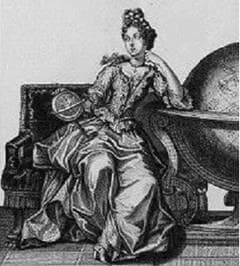
French · Science
Louise du Pierry
July 30, 1746 – February 27, 1807
Early Life and Background
Louise du Pierry, born Elisabeth Louise Félicité Pourra de la Madeleine, came into the world on 30 July 1746 in La Ferté‑Bernard, a small town in the former province of Maine in north‑western France.[1][10][11] Her later biographers note some uncertainty in the exact birth date—parish and secondary records sometimes give 1 August—but modern reference works and structured data increasingly converge on 30 July 1746 as the most likely date.[1][10]
Little is known with certainty about her parents and childhood. Available sources identify her as coming from a milieu that was educated enough to allow access to letters and the sciences but outside the high aristocracy; she did not belong to the circle of princesses or grandes dames who dominated court life. Her birth name appears in slightly different forms across languages—Elisabeth Louise Félicité Pourra de la Madeleine, sometimes with "Pourrat" or "Pourri"—reflecting the fluid orthography of the eighteenth century and the transmission of French names into foreign bibliographies.[1][2][3][5][6][8]
As a girl in mid‑eighteenth‑century France, du Pierry would not have had access to formal university education. Girls were often educated at home or in convent schools, with emphasis on religion, moral instruction, and accomplishments like drawing or music. Her later mastery of mathematics, astronomical computation, and natural history suggests that she received either unusually strong private instruction or was largely self‑taught, guided by books and informal mentors. The Paris Observatory’s retrospective on women astronomers describes her as a "recognized mathematician and astronomer" who divided her time between astronomical calculations, studies of insects and plants, chemical tables, and scientific drawings.[7] This breadth indicates an intellectual formation grounded in Enlightenment curiosity and a willingness to cross disciplinary boundaries.
Career Beginnings and Development
Du Pierry’s documented scientific career began when she encountered Joseph Jérôme Lefrançois de Lalande, one of France’s leading astronomers and director of the Paris Observatory. In 1779, she met Lalande and started studying astronomy with him, quickly becoming his scientific assistant.[7][1][8] Under his guidance she mastered the demanding mathematical techniques necessary for ephemeris calculations—precise tables that predict the positions of celestial bodies at given times.
The Paris Observatory account emphasizes that she worked "alongside her male colleagues," helping compute ephemerides, supervising the team in Lalande’s absence, and rereading some of his manuscripts before publication.[7] Such responsibilities go beyond the role of a mere student or copyist. They placed her within the core computational labor of eighteenth‑century astronomy, a field in which accurate tables were essential to navigation, timekeeping, and scientific theory.
Du Pierry’s collaboration with Lalande took shape within a context where scientific work often relied on networks of assistants who were not fully credited as authors. Women in particular frequently contributed observations and calculations that were then incorporated into works published under male names. Contemporary descriptions of du Pierry’s activities—collecting information about eclipses, computing tables, and preparing data on day and night—underline her technical skill and reliability.[12][1][8]
Major Works, Discoveries, and Accomplishments
Work on Eclipses and Ephemerides
One of du Pierry’s central contributions was her work on eclipse data. Encyclopedia accounts state that she "collected information about eclipses," which Lalande used in his studies of lunar motion.[12] Drawing together scattered observational records from different locations and years required careful evaluation of the quality and timing of each observation. This work contributed to the refinement of the Moon’s orbital parameters, which underpinned both celestial mechanics and practical calculations such as lunar distance methods for navigation.
Russian and Arabic biographies add that du Pierry herself predicted eclipses and computed tables related to the duration of day and night and to refraction.[8][4] These sources, while more summary in nature, are consistent with the Paris Observatory and encyclopedia descriptions that highlight her excellence in positional astronomy and tabular calculation.[7][12] Her ability to perform such work indicates a high level of mathematical competence unusual for women of her era.
Tables of the Duration of Day and Night (1782, 1783)
Du Pierry’s most clearly documented independent publication concerned the duration of day and night1782, she produced an explanation of tables of the duration of day and night, likely describing the astronomical and mathematical basis for such tables and their use.[7] According to the Paris Observatory’s retrospective, this work was incorporated the following year into volume 8 of Lalande’s Ephémérides des mouvements célestes, published in 1783.[7]
Ephémérides were annual or periodic volumes providing computed positions of the Sun, Moon, planets, and stars. Inclusion of du Pierry’s work in this series meant that her calculations reached navigators, astronomers, and educated readers who depended on ephemerides for practical and scientific purposes. The tables of day and night duration, computed for the latitude of Paris and possibly other locations, aided in understanding seasonal changes in daylight and planning observations. They also intersected with broader Enlightenment interests in classifying and quantifying natural phenomena.
This contribution is an early example of a woman’s work in astronomy entering a standard reference publication under her own name, even if framed within a volume edited by a male authority. It reinforced the recognition of du Pierry as more than an assistant and helped establish her reputation in positional astronomy.
Academy of Sciences of Béziers (1788)
In 1788, du Pierry advanced from collaborator to formally recognized member of a learned society. She succeeded Nicole‑Reine Lepaute at the Academy of Sciences of Béziers (Académie des Sciences de Béziers).[7][8] Lepaute herself had been a prominent French woman astronomer, known for her calculations of cometary orbits and contributions to major ephemeris projects.
Du Pierry’s succession to Lepaute’s place at Béziers signifies continuity in women’s participation in French provincial scientific academies, albeit on an exceptional basis. Membership in such an academy conferred status and formal acknowledgment of scientific merit. Though detailed minutes of her activities there are not widely available in modern sources, her election attests to the esteem in which her mathematical and observational skills were held.
First Woman Professor at the Sorbonne (1789)
Du Pierry’s most widely recognized accomplishment came in 1789, when she became the first woman professor at the Sorbonne, the historic faculty of the University of Paris.[1][2][6][7][8][12] Multiple sources emphasize that she was appointed to lead a public astronomy course explicitly designed for women, titled Cours d’astronomie ouvert pour les dames et mis à leur portée—"astronomy course open to ladies and adapted to their level."[1][2][6][8]
This appointment was a barrier‑breaking moment. The universities of Europe had long excluded women from formal teaching positions. By entrusting du Pierry with a professorship and a course, the Sorbonne acknowledged both her technical competence and her ability to communicate complex ideas to a non‑specialist, female audience. The year 1789 also coincided with the outbreak of the French Revolution, when debates about citizenship, rights, and education intensified. Du Pierry’s course fitted within Enlightenment ideals of spreading scientific knowledge beyond elite male circles.
Accounts of her teaching emphasize that she made astronomy accessible while maintaining scientific rigor. Lalande would later collect and adapt these lessons in his 1790 book Astronomie des dames, which he dedicated to du Pierry and presented her as a model for women’s intellectual achievement.[12][5] The course at the Sorbonne stands as a landmark in the history of women’s access to higher education, predating the broader admission of women to European universities by decades.
Astronomie des dames and Dedication (1790)
In 1790, Lalande published Astronomie des dames, a work that compiled the content of the astronomy courses du Pierry had delivered in 1789.[5][12] In his dedication, Lalande portrayed her as an exemplar of female intellectual capacity and explicitly honored her contributions. The Paris Observatory and encyclopedia entries note that he "dedicated his book Astronomie des dames (1790) to Pierry, declaring her a female role model because of her intellectual qualities."[12][7][5]
A male academic publicly celebrating a woman as a scientific role model was unusual in the late eighteenth century. The dedication reinforced the legitimacy of women’s scientific pursuits and offered potential inspiration to female readers. At the same time, the framing of astronomy "for ladies" reflected contemporary gender expectations: knowledge was to be presented in a manner deemed appropriate to women’s social roles. Du Pierry’s collaboration with Lalande in shaping this didactic genre helped define an early model of science education directed toward women.
Chemical Tables with Fourcroy (1800–1801; published 1801)
Du Pierry’s scientific interests extended beyond astronomy to chemistry. The Paris Observatory account reports that between 1800 and 1801 she co‑edited with the eminent chemist Antoine‑François Fourcroy a work titled Table alphabétique et analytique du système de connaissances chimiques—the Alphabetical and Analytical Table of the System of Chemical Knowledge.[7] This reference work was published in 1801.[7]
Fourcroy was a major figure in the chemical reforms associated with Lavoisier and the development of modern nomenclature. Du Pierry’s collaboration on a comprehensive analytical table indicates that she was competent in organizing complex scientific information, not only computing astronomical data. The work would have functioned as an index and conceptual map of chemical topics, aiding students and practitioners in navigating the new system of substances and reactions.
That a woman co‑edited such a reference with a leading chemist further illustrates du Pierry’s integration into the scientific community. It also shows the porous boundaries between disciplines in her career: she moved from astronomical ephemerides to insect and plant studies to chemical classification, embodying an Enlightenment polymathic spirit.
Awards, Honors, and Recognition
Formal awards akin to modern prizes are not recorded in surviving sources about du Pierry. However, several markers of recognition stand out:
- Membership in the Academy of Sciences of Béziers in 1788, succeeding Nicole‑Reine Lepaute, signaled peer acknowledgment of her scientific merit.[7][8]
- Appointment as professor at the Sorbonne in 1789, the first such appointment for a woman at that institution, represented institutional recognition of her expertise and teaching ability.[1][2][6][7][12]
- Lalande’s dedication of Astronomie des dames in 1790 explicitly praised her intellectual qualities and presented her as a role model for women in science.[5][7][12]
Modern remembrance has added further symbolic recognition. A local article from La Ferté‑Bernard notes that she is counted among "72 women scientists whose names are inscribed on the Eiffel Tower," a reference to the names of scientists engraved on the monument, though independent verification of that exact figure in primary sources is limited.[11] Contemporary biographical projects such as Pantheon and the Paris Observatory’s "Three centuries of women astronomers" place du Pierry within curated lists of historically significant women scientists.[7][9]
Personal Life
Details of du Pierry’s personal life are sparse. Modern accounts consistently refer to her as Madame du Pierry, implying marriage, but do not provide clear information about her husband’s identity, profession, or any children.[1][2][5][6][8] No surviving evidence in the consulted sources elaborates on her domestic arrangements or whether she balanced household responsibilities with her scientific work.
Some biographical sketches in non‑French languages list occupations such as "painter" and "designer" alongside "astronomer," suggesting that she may have engaged in artistic pursuits, perhaps related to scientific illustration of plants and insects.[5][6] The Paris Observatory note that she devoted time to "drawings of plants and insects" aligns with this description.[7] However, these activities are documented only broadly and not tied to named works or patrons.
In keeping with the norms of the period, du Pierry’s scientific contributions were often described in relation to male colleagues—Lalande in astronomy and Fourcroy in chemistry—and she worked within social structures that constrained women’s visibility as independent intellectuals. The scarcity of personal documentation today reflects both the limited survival of records concerning women and the tendency of contemporaries to record women’s domestic lives less systematically than men’s professional careers.
Legacy and Historical Impact
Louise du Pierry’s legacy can be traced along two intertwined axes: her substantive contributions to astronomical computation and her role as a pioneer of women’s participation in university teaching and scientific institutions.
On the scientific side, her work on eclipse data, ephemerides, and tables of the duration of day and night contributed to the consolidation of eighteenth‑century positional astronomy. By collecting and computing observational data, she supported efforts to refine predictions of celestial events and understand the motions of the Moon and Sun.[7][8][12] Her inclusion in standard ephemeris volumes and reference works meant that her calculations entered the everyday toolkit of astronomers and navigators.
Equally important is her symbolic and institutional impact. As the first woman professor at the Sorbonne, she demonstrated that a woman could occupy a teaching position in one of Europe’s most venerable universities.[1][2][6][7][8][12] Her course for women, and Lalande’s subsequent Astronomie des dames, opened space—however limited—for women to be seen as legitimate audiences and potential practitioners of scientific knowledge.
Du Pierry’s succession to Nicole‑Reine Lepaute at the Academy of Sciences of Béziers illustrates a small but significant tradition of women participating in French scientific academies in the late Enlightenment.[7][8] Their presence challenged prevailing assumptions about women’s intellectual capacities and laid a foundation for future generations of women seeking entry into scientific societies and universities.
Modern historians of science increasingly highlight du Pierry as part of a network of eighteenth‑century women astronomers, including Lepaute and others, whose work was essential to the production of ephemerides and observational data but often marginalized in canonical narratives. Projects like the Paris Observatory’s "Three centuries of women astronomers" and multilingual Wikipedia entries help restore her to visibility and situate her within a broader historiography of women in science.[1][2][5][7][8]
Later Life and Death
After the publication of the chemical knowledge table in 1801, sources provide only limited information about du Pierry’s final years. She apparently continued to live in the Paris region and maintained ties to scientific circles. Some later summaries loosely suggest that she died "around 1807"; multilingual reference entries record conflicting death years, with a few listing 1830.[4][6][10][11]
Closer examination of structured data and multiple biographical narratives, however, support 27 February 1807 as her date of death in Luzarches, in the Val‑d’Oise department north of Paris.[1][5][10] This date is given explicitly in English and Basque Wikipedia entries and in Wikidata, and corresponds to an age in her early sixties, consistent with the known birth year.[1][3][5][10] Some local news writing from La Ferté‑Bernard repeats the 27 February date but pairs it with 1830, likely an error introduced during compilation.[11]
Du Pierry’s death came in the Napoleonic era, when institutional reforms affected universities, academies, and the organization of science. The limited documentation of her later life reflects both the disruptions of the Revolutionary and Napoleonic decades and the general scarcity of records relating to women scientists. Yet her earlier decades of active work—spanning astronomy, natural history, and chemistry—had already secured her a place in the intellectual history of the Enlightenment.
Today, Louise du Pierry is remembered primarily as a French astronomer and chemist and as the first woman professor at the Sorbonne. Her trajectory from provincial birth in 1746 to university teaching in 1789 illustrates the possibilities and constraints faced by women in eighteenth‑century science and underscores the importance of acknowledging the diverse contributors whose calculations, tables, and teaching helped build modern scientific knowledge.[1][2][5][7][8][12]
Dated achievements
3 indexed.
- Jul301746Science
Birth of Louise du Pierry
Louise du Pierry was born on July 30, 1746, in La Ferté-Bernard, France.
View details Three Centuries of Women at the Paris Observatory - Jan011789Science
First Woman Professor at the Sorbonne
In 1789, Louise du Pierry was appointed the first female professor at the Sorbonne, where she taught astronomy.